
MOT, servicing and condition
The most common MOT failures, and why cars fail their MOT
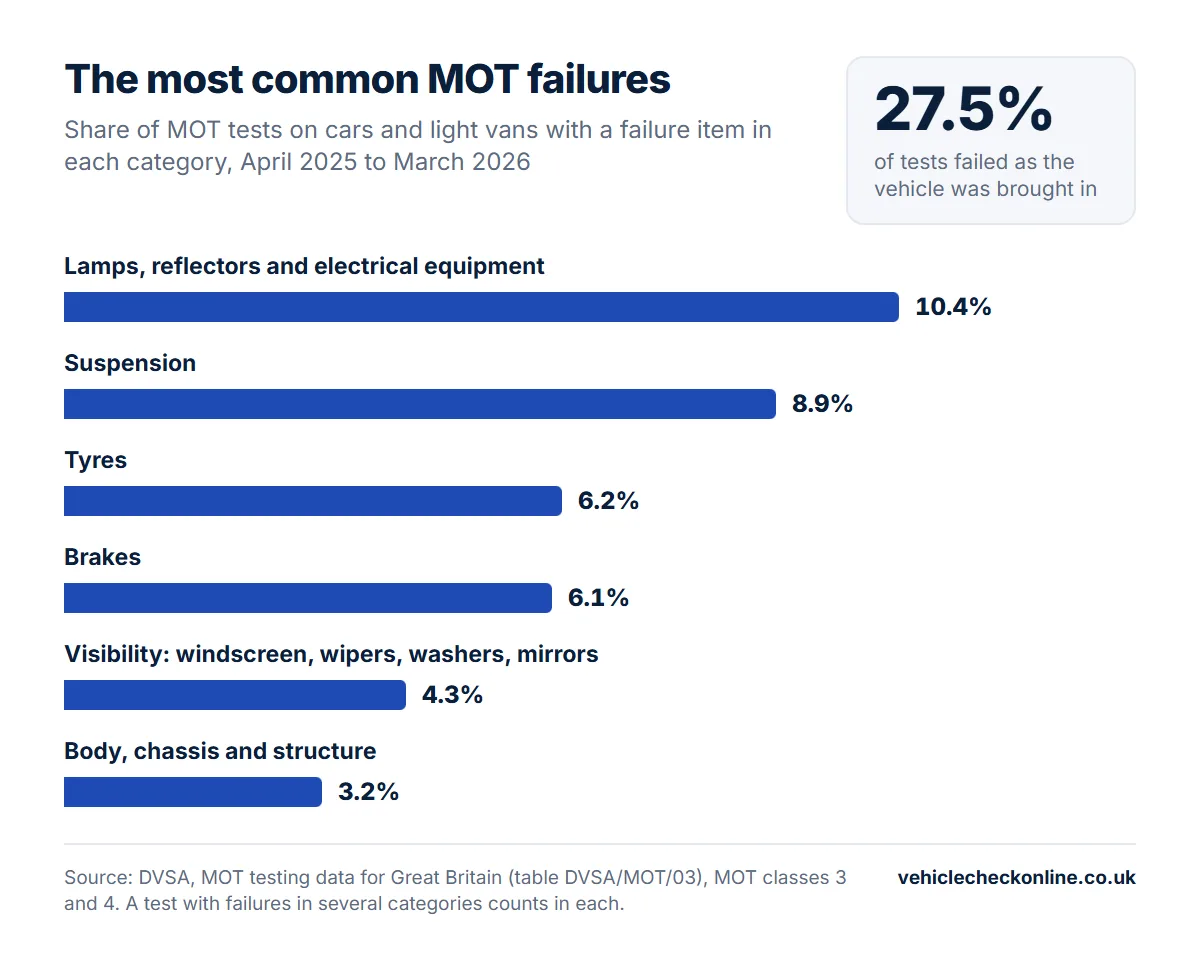
The most common MOT failures are faults with the lamps, reflectors and electrics, followed by suspension, tyres, brakes and visibility, such as wipers, washers and windscreen damage. In DVSA's data for April 2025 to March 2026, 27.5% of MOTs on cars and light vans failed as the vehicle was brought in, and 10.4% of tests found a failure item in the lamps and electrics.
This guide sets out DVSA's latest figures and what each common failure covers, why cars fail and why older ones fail more often, what is known about the MOT fail rate by car model, and simple ways to avoid the usual fails. The figures cover Great Britain.
What are the most common MOT failures in the latest figures?
DVSA publishes MOT testing data for Great Britain every three months. It sorts failure items, meaning dangerous or major defects, into categories by the part of the car they concern, and counts a test under every category in which it had one. The latest full year is the 2025 to 2026 financial year, from 1 April 2025 to 31 March 2026, when cars, light vans and passenger vehicles with up to 12 seats (MOT classes 3 and 4) had 33.3 million tests.
| Defect category | Tests with a failure item in it | Share of all failure items |
|---|---|---|
| Lamps, reflectors and electrical equipment | 10.4% | 24.9% |
| Suspension | 8.9% | 20.5% |
| Tyres | 6.2% | 12.9% |
| Brakes | 6.1% | 15.2% |
| Visibility: windscreen, wipers, washers, mirrors | 4.3% | 7.7% |
| Body, chassis and structure | 3.2% | 6.3% |
| Noise, emissions and leaks | 3.1% | 5.9% |
| Steering | 1.9% | 3.6% |
A failed test usually has more than one failure item, 2.39 on average that year, so the percentages add up to more than the fail rate. The middle column shows how many tests a problem affects; the last shows how big a share of all the failure items it makes up.
How many cars fail their MOT?
More than 1 in 4. In 2025 to 2026, 27.51% of tests on cars and light vans were initial fails, meaning the vehicle failed as it was brought in. That is slightly down from 28.08% the year before, and the first three months of the next year, April to June 2026, came in at 26.75%.
Some of those vehicles had their faults put right at the test centre during the test and then passed. Leaving them out gives DVSA's final fail rate for the year, 22.30%: the share of tests that ended as a fail.
Dangerous defects are less common, but not rare: 7.22% of tests found at least one, about 1 in 14. Most were on tyres, which made up 60.6% of all dangerous defects, and brakes, with 28.8%.
Why do cars fail their MOT?
The five biggest categories are all made of parts that wear, blow or corrode in normal use. This is what each one covers in the MOT inspection manual, and the kind of fault that fails it:
- Lamps, reflectors and electrical equipment. Every lamp, from the headlamps and their aim to the brake lights, indicators, hazard lights and number plate lamp, plus the reflectors, the wiring and the battery. A headlamp or indicator that does not light is a major defect, so one blown bulb can fail the car.
- Suspension. Springs, shock absorbers, suspension arms, sub-frames and anti-roll bars, and the joints, pins and bushes that link them. They wear and corrode out of sight, which is why suspension advisories at the last test are worth acting on.
- Tyres. Tread below the legal minimum, cuts deep enough to reach the cords, lumps and bulges from damage to the tyre's structure, and tyres of different sizes on the same axle.
- Brakes. Pads or linings worn down to the wear indicator, or below 1.5mm, worn or damaged discs, corroded pipes, damaged hoses, and brakes that fall short in the efficiency test.
- Visibility. Windscreen damage in the driver's view, wipers and washers that do not clear the screen, missing or damaged mirrors, and anything that blocks the view of the road.
Do older cars fail their MOT more often?
Yes, up to a point. In its 2023 consultation on the date of the first MOT, the Department for Transport looked at DVSA data and found that failure rates rise significantly as vehicles get older, up to about 14 years of age, and then level off. Vehicles over 20 years old, a small group, failed somewhat less often.
Even young cars fail. For class 4 vehicles in 2019, the initial failure rate was 14% at three years old, the age of the first MOT, and 16% at four.
As the consultation put it, vehicles are more likely to fail as they get older and develop significant problems. On an older car, the advisories in its MOT history are the best guide to which of those problems are on the way.
What is the MOT fail rate by car make and model?
DVSA does not publish an official MOT fail rate for each make and model. What it does publish is anonymised data on every MOT test and its outcome, going back to 2005, including the make and model of the vehicle, the mileage and the reasons for failure, free to reuse under the Open Government Licence.
We used that data to work out the rates below for the 14 car models tested most often in October 2025. We took every first test of a car or light van in MOT class 4 that month (3,205,764 tests, retests left out) and counted a test as failed first time if the vehicle failed or only passed after repairs at the test centre. Trims recorded under their own name, such as a Fiesta Titanium, count with their model; other models with a similar name, such as the Yaris Cross, do not.
| Model | Tests, October 2025 | Failed first time | At 9 to 11 years | At 12 to 14 years |
|---|---|---|---|---|
| Ford Fiesta | 133,156 | 36.1% | 33.7% | 41.1% |
| Ford Focus | 85,177 | 33.9% | 26.9% | 38.5% |
| Volkswagen Golf | 83,554 | 26.6% | 17.7% | 28.3% |
| Vauxhall Corsa | 80,279 | 38.0% | 36.9% | 42.5% |
| Volkswagen Polo | 60,781 | 33.8% | 27.4% | 38.2% |
| Nissan Qashqai | 58,477 | 32.7% | 30.7% | 46.1% |
| Vauxhall Astra | 56,773 | 35.6% | 29.8% | 35.7% |
| BMW 3 Series | 44,148 | 24.8% | 18.1% | 28.0% |
| Toyota Yaris | 44,013 | 29.1% | 20.6% | 31.7% |
| Audi A3 | 40,251 | 25.2% | 18.2% | 28.9% |
| Fiat 500 | 33,289 | 34.0% | 32.8% | 37.8% |
| Mercedes-Benz C-Class | 32,930 | 26.4% | 20.4% | 30.1% |
| Honda Jazz | 31,950 | 27.5% | 16.4% | 22.6% |
| Renault Clio | 29,118 | 45.6% | 43.6% | 49.5% |
| All cars and light vans | 3,205,764 | 28.6% | 26.6% | 34.9% |
Age explains much of the gap between models: one whose cars on the road are mostly old fails more often than one whose cars are mostly young. The last two columns compare cars of the same age, which is fairer. These figures cover a single month, so read small differences with care.
For a car you are thinking of buying, its own record matters more than its model's average. A well-kept example of a model with a high fail rate can have a clean history, and the reverse is just as possible.
How can you see a car's MOT failures and advisories for free?
Enter the registration in our free MOT check to see every test the car has had, with its result, the failure items, the advisories and the mileage. The same page shows whether the DVSA reports an outstanding safety recall.
Read the fails as part of the whole record:
- a fail followed by a pass soon after usually means the faults were repaired and the car retested;
- fails in the same category year after year, such as suspension or brakes, point to a part that keeps wearing out or was not properly fixed;
- a dangerous defect is the one to ask about: who repaired it, and is there an invoice;
- advisories at the latest test show what may fail next.
Our guide on what to look for in MOT history covers the rest of the record, from the mileage readings to gaps between tests.
How can you avoid the most common MOT failures?
The biggest categories are also among the easiest to check before the test:
- Lights: with someone to help, check every lamp, including the brake lights and the number plate lamp, and replace any dead bulb.
- Tyres: check the tread on all four tyres, across the width and all the way round, and look for cuts and bulges.
- Brakes: watch for warning lights, noises or the car pulling to one side, and have the pads checked if they were advised as wearing thin.
- Suspension: listen for knocks over bumps, look for uneven tyre wear, and ask a garage to look at any suspension advisory before the test.
- Visibility: run the wipers and washers, top up the washer fluid, and have chips in the driver's line of sight repaired.
Our MOT checklist has the full list of pre-MOT checks, and the things that can stop a test going ahead.
If the test finds a dangerous defect, the car must not be driven until it is repaired, even if its old MOT still has time to run.
Questions and answers
What is the MOT pass rate?
In 2025 to 2026, 72.5% of MOT tests on cars and light vans in Great Britain passed as the vehicle was brought in. Counting those that passed once faults were put right during the test, 77.7% passed.
What counts as an automatic MOT fail?
Any dangerous or major defect fails the test, however good the rest of the car is. Tread below the legal limit, brake pads worn below 1.5mm and brake lights that do not work at all are all graded dangerous.
Can a blown bulb fail an MOT?
Yes. A headlamp or indicator that does not light is a major defect, which is a fail. If only part of a lamp with several light sources is out, up to half of it, the defect is minor and the car can still pass.
Does a minor defect fail the MOT?
No. Minor defects and advisories are listed on a pass for you to monitor or fix, and DVSA's failure figures count only dangerous and major defects.
Where do these MOT figures come from?
From DVSA's MOT testing data for Great Britain, which is updated every three months. DVSA notes that this data is not classed as an official statistic.
Do MOT fails stay on a car's record?
Yes. Each fail is kept in the MOT history with its failure items, next to the retest that followed, so a buyer can read them with just the registration.
Sources
- GOV.UK (DVSA): MOT testing data for Great Britain
- GOV.UK (DfT): Changes to the date of the first MOT test, consultation (failure rates by age)
- DVSA open data: anonymised MOT tests and results
- GOV.UK (DVSA): MOT inspection manual for cars and passenger vehicles
- GOV.UK: Getting an MOT (results, and driving after a fail)
Related guides
- MOT checklist: what is checked in an MOT and how to prepareThe MOT checklist for cars: what is checked in an MOT and what is not, the maximum fee, and pre-MOT checks for bulbs, tyres, wipers and warning lights.
- MOT advisories explained: what an advisory means and what to doWhat an MOT advisory means, how it differs from minor, major and dangerous defects, whether you can drive with advisories, and the advisory wording decoded.
- What to look for in a car's MOT historyWhat to look for in MOT history before you buy: repeated advisories, corrosion, gaps, mileage drops and fails, and which entries are red flags or harmless.
- How old are your tyres, and is the tread legal?How to check tyre age from the sidewall date code, the legal tyre tread depth in the UK and the penalty, and what to look for on a used car's tyres.
- Buying a car with no MOT: what is legal and how to get it homeBuying a car with no MOT is legal, but you can't tax it, and it may only be driven to a booked MOT or for repairs. How to get it home, insurance, and the price.
This guide is general information for people buying, owning or selling a car in the UK, not legal or financial advice. Vehicle Check Online is an independent service, not affiliated with the DVLA, the DVSA or GOV.UK.