
MOT, servicing and condition
How old are your tyres, and is the tread legal?
To check a tyre's age, find the four-digit date code on its sidewall, usually at the end of a code that starts with "DOT": the first two digits are the week it was made and the last two the year, so 3622 means week 36 of 2022. A car's tyres must have at least 1.6 mm of tread across the central three-quarters, all the way round. UK law sets no age limit for car tyres.
This guide explains how to read the date code, what the rules say about old tyres, how tread depth is measured and what the penalties are, how to check the tread yourself, and what to look at on the tyres of a used car before you buy it.
How do you read the tyre date code?
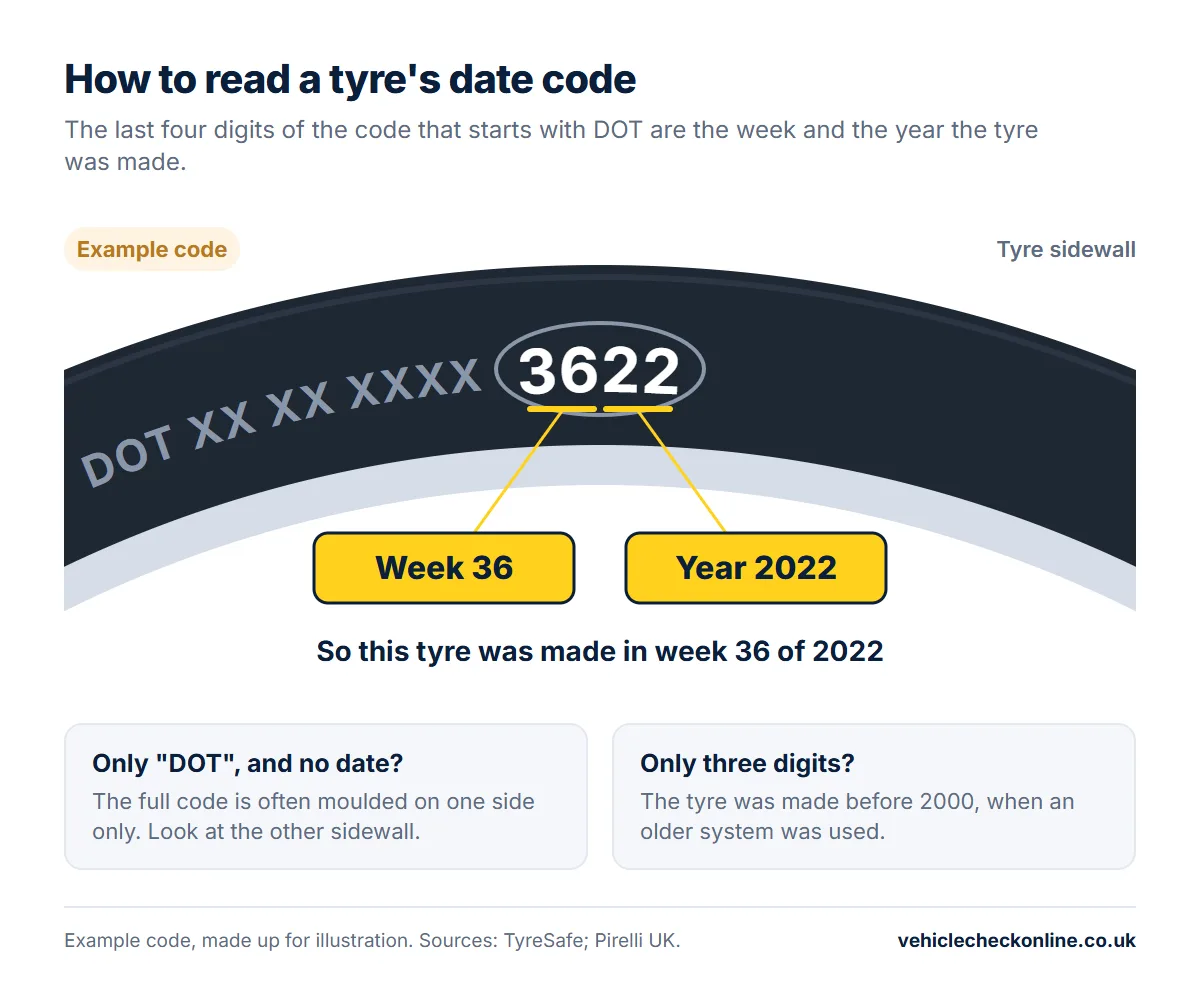
Most tyres have a code moulded into the sidewall that begins with the letters DOT. The last four digits of that code are the date of manufacture, often set inside a small raised oval. The first two digits give the week of the year the tyre was made, and the last two give the year: a tyre marked 0517 was made in the fifth week of 2017.
Makers only have to mould the complete code on one sidewall. If you find "DOT" with nothing after it, look at the other side of the tyre, which may mean looking at the inner face of the wheel. A code with only three digits at the end means the tyre was made before 2000, when a different system was used.
The date shows when the tyre was made, which may be some time before it was fitted to the car.
Is there a legal age limit for car tyres?
No. UK law sets no maximum age for the tyres on a car or on a van up to 3,500 kg. The age limit that does exist has applied in Great Britain since 1 February 2021, and Northern Ireland has adopted the same rule. It covers only some heavier vehicles:
| Vehicle | Tyres covered | Tyres over 10 years old |
|---|---|---|
| Lorries and other goods vehicles over 3,500 kg | Front axles | Not allowed |
| Buses and coaches | Front axles | Not allowed |
| Minibuses (9 to 16 passenger seats) | Any single wheel, front or rear | Not allowed |
| Cars, and vans up to 3,500 kg | None | No legal limit |
Those vehicles must also keep their date codes legible. The MOT reflects the same split: the DVSA's inspection manual says the tyre age check applies to vehicles with more than 8 passenger seats, so a car is not tested on the age of its tyres.
Age still matters. Pirelli says tyres have no single expiry date, but that "the weakening effect of the years is inevitable for all tyres". Michelin recommends a yearly inspection by a tyre professional once tyres have been in use for five years, and replacing them ten years after they were made, whatever their tread, spares included. On an older or little-used car, read the date codes as carefully as the tread.
What is the legal tyre tread depth in the UK?
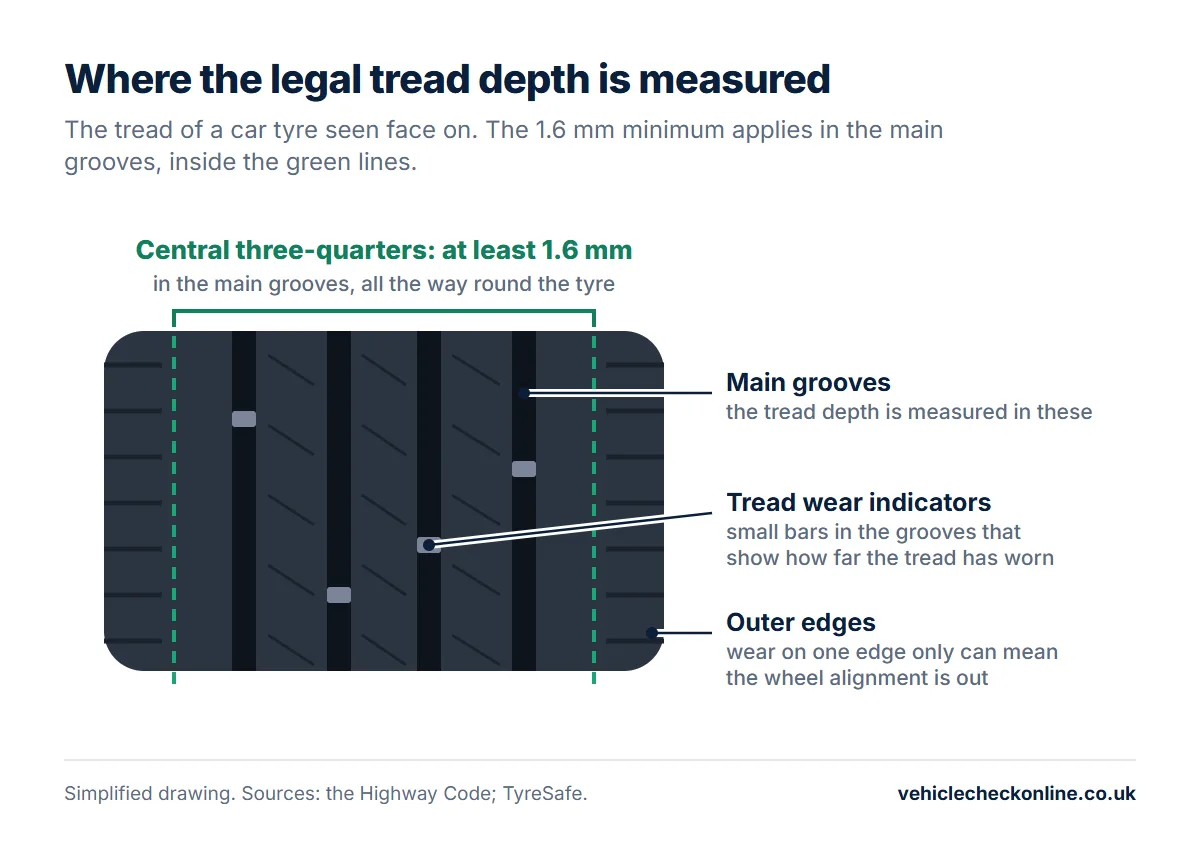
For a car, a van up to 3,500 kg or a light trailer, the legal minimum is 1.6 mm. It must be met in a continuous band across the central three-quarters of the tread's width, and all the way round the tyre. Northern Ireland's own regulations set the same minimum.
Tread is measured in the main grooves: the ones that hold the tread wear indicators, small bars moulded into the bottom of the grooves to show how far the tread has worn. The thin slits cut into the tread blocks, called sipes, do not count.
The tread is not the only rule. A tyre must not be used on a road if it has:
- a cut longer than 25 mm or 10% of the tyre's section width, whichever is greater, that is deep enough to reach the ply or cord
- any lump, bulge or tear caused by its structure separating or failing
- any of its ply or cord exposed
- too little or too much air: the Highway Code says tyres must be inflated to the vehicle maker's figure for the load being carried
What is the penalty for illegal tyres?
In Great Britain, using a vehicle with a tyre that breaks these rules is an offence under section 41A of the Road Traffic Act 1988. For a car, the Road Traffic Offenders Act 1988 and GOV.UK set out the penalties:
| Penalty | For a car in Great Britain |
|---|---|
| Fine | Up to £2,500 (level 4 on the standard scale) |
| Penalty points | 3, recorded as endorsement code CU30 |
| Driving ban | Possible, at the court's discretion |
| Time on your driving record | 4 years from the date of the offence |
TyreSafe, the UK tyre safety charity, points out that the fine and the points can apply to each illegal tyre, and warns that an insurance claim may be invalidated if an accident happens on illegal tyres.
At the MOT, tread below the legal limit is a dangerous defect, so the car fails. Our guide to MOT advisories explains the warnings a tester gives when a tyre is getting close.
How do you check your tread depth?
- Pick out any stones lodged in the tread.
- Push a 20p coin into one of the main grooves.
- Look at the coin's outer band. If it is hidden, the tread is above the legal limit at that point. If you can see it, the tyre may be illegal and unsafe: have it checked by a tyre professional straight away.
- Repeat in at least three places around each tyre, and in more than one groove.
The coin test is a quick guide, not a measurement. A tread depth gauge reads each groove in millimetres, and the tread wear indicators help too: tread worn down level with them needs checking at once.
Do not wait for 1.6 mm. TyreSafe advises replacing tyres well before the legal limit, and quotes tests by MIRA in which cars on 1.6 mm of tread took up to 44% longer to stop in the wet than cars on 3 mm. It suggests checking your tyres at least once a month and before a long journey.
How do you check the tyres on a used car?
The tyres tell you about more than themselves: the way they have worn says something about the car's steering, suspension and care. At a viewing, go round all four, then the spare:
- The tread on every tyre, in several places, with the coin or a gauge.
- The date codes. Note the year on each tyre. Very old tyres, or a mix of ages, are worth asking about and worth pricing in.
- Cuts, lumps and bulges on each sidewall, and anything stuck in the tread. TyreSafe says a lump or bulge could mean internal damage and needs a specialist to look at it.
- Uneven wear. Wear on one edge only, or patchy wear such as feathering or cupping, can mean the wheel alignment is out or the steering or suspension is worn, often after a knock against a kerb or a pothole. Wear on both outer edges can mean the tyre was run with too little air, and wear down the centre that it had too much.
- The spare, or the compressor and sealant if the car has no spare. An MOT tester only inspects the tyres on the road wheels, so nobody may have looked at it for years.
On the test drive, a car that pulls to one side, or a steering wheel that sits off-centre when you drive straight, points to the same alignment problems. Tyres that need replacing, or an alignment check, are a fair reason to negotiate. Our used car checklist covers the rest of the car.
What does the MOT history show about a car's tyres?
Every MOT records tyre failures and advisories, such as tread worn close to the legal limit or worn on one edge. Our free MOT check shows them for any car, test by test, with the mileage at each one.
Read them as a pattern. A tyre advisory followed by a clean test usually means new tyres went on. The same edge-wear advisory on the same axle, test after test, suggests an alignment or suspension fault that was never put right. The MOT history will not show the age of the tyres or the state of the spare, so check those yourself.
Questions and answers
Will old tyres fail an MOT?
Not for their age alone. The MOT only checks tyre age on vehicles with more than 8 passenger seats, but a tyre of any age fails if its tread is below the limit or it has a serious cut, a bulge or exposed cord.
Is a space saver spare tyre legal?
Yes, as a temporary spare on a car, but the rules only allow it while the car is driven at no more than 50 mph. Have a full-size tyre fitted as soon as you can.
How often should I check my tyres?
TyreSafe suggests at least once a month and before a long journey. Check the pressure, the condition and the tread depth, and the spare or the repair kit too.
What does a three-digit tyre date code mean?
The tyre was made before 2000, when a different system was used. Such a tyre is more than 25 years old, far beyond the ten years after which Michelin, for one, recommends replacing a tyre.
Is 2 mm of tread legal?
Yes. It is above the 1.6 mm minimum for a car. But grip in the wet falls as the tread wears down, and TyreSafe advises replacing tyres well before they reach the legal limit.
How long do car tyres last?
There is no fixed lifespan. Pirelli says it depends on how often and in what conditions the tyres are used, the wheel alignment and how they are stored, so judge them on their tread, condition and date code.
Sources
- GOV.UK: The Highway Code, Annex 6 (tyres)
- legislation.gov.uk: Road Vehicles (Construction and Use) Regulations 1986, regulation 27
- legislation.gov.uk: Road Traffic Offenders Act 1988, Schedule 2 (penalties)
- GOV.UK: MOT inspection manual, axles, wheels, tyres and suspension
- TyreSafe: Tread depth
Related guides
- MOT checklist: what is checked in an MOT and how to prepareThe MOT checklist for cars: what is checked in an MOT and what is not, the maximum fee, and pre-MOT checks for bulbs, tyres, wipers and warning lights.
- Used car checklist: what to check before you buyWhat to check when buying a used car, in order: the records, V5C and VIN, bodywork, tyres, engine, interior, test drive and seller, and what each sign means.
- The most common MOT failures, and why cars fail their MOTThe most common MOT failures in DVSA's latest data: lights, suspension, tyres, brakes and visibility, plus fail rates by car and age and how to avoid a fail.
This guide is general information for people buying, owning or selling a car in the UK, not legal or financial advice. Vehicle Check Online is an independent service, not affiliated with the DVLA, the DVSA or GOV.UK.