
Write-offs and accident damage
What does Cat S mean on a car?
Cat S means an insurer wrote the car off after structural damage: damage to its frame or chassis, the parts that hold the car together and protect the people inside in a crash. A Cat S car can legally go back on the road once it has been repaired to a roadworthy condition.
Category S has been used since 1 October 2017. It is not a ban, but it is a warning: how safe the car is now depends entirely on how well it was repaired, and nobody official checks that repair. This guide explains what the category means, how a Cat S car gets back on the road and how to tell if a car is Cat S.
What does the S in Cat S stand for?
When a car is badly damaged, the insurer decides whether repairing it makes sense. If it does not, the car is declared a total loss: it is "written off", the owner is paid out, and the car is given a category that is recorded against it.
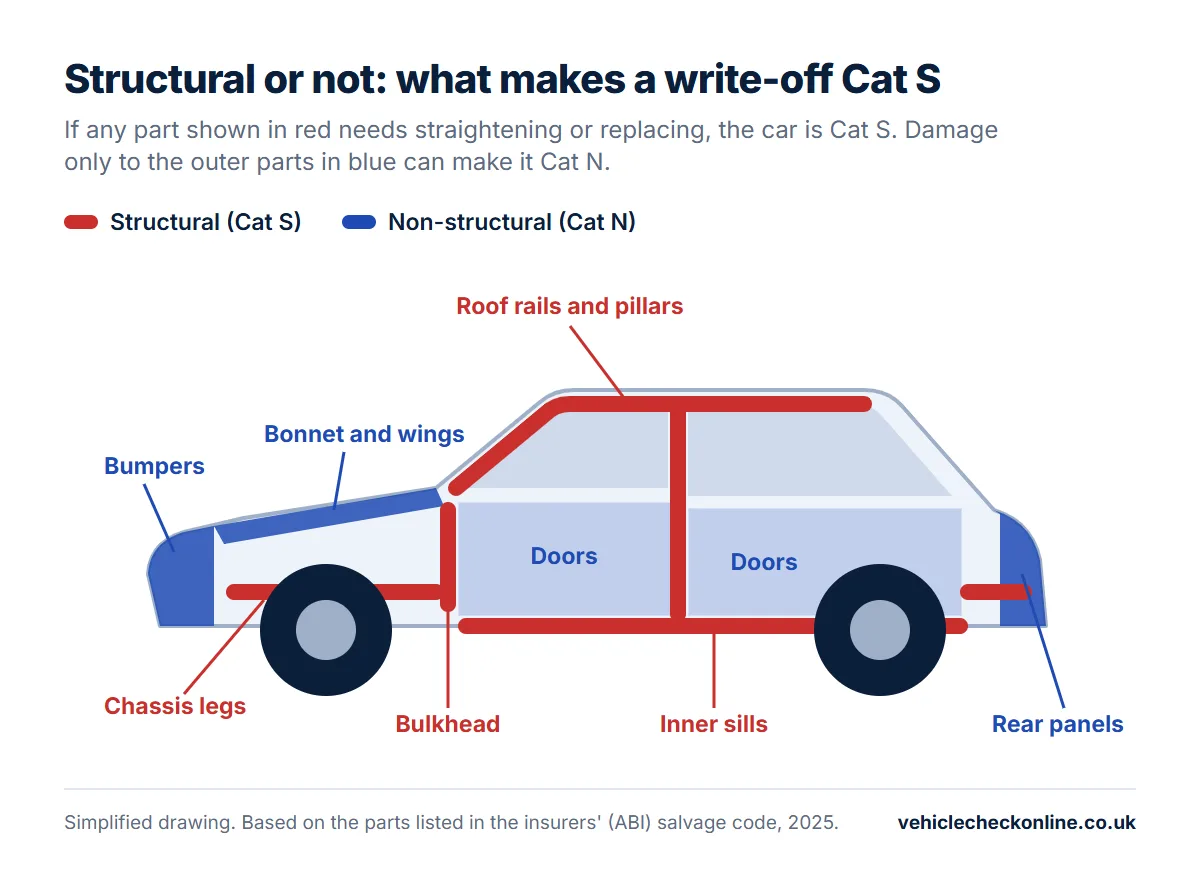
S stands for structurally damaged, repairable. The damage reached the car's structure, such as the chassis, the frame or the crumple zones, rather than only bolt-on parts like bumpers, wings or lights. A repairer can still fix it, and once fixed the car may be driven, taxed, insured and sold again.
A car is usually written off because repairing it would cost more than it is worth, not because it cannot be repaired. That is why many Cat S cars are fairly ordinary cars with a serious, but fixable, accident in their past.
What are the four write-off categories?
Insurers in the UK use four categories, set by the Association of British Insurers' code of practice for vehicle salvage. Only two of them can ever go back on the road.
| Category | What it means | Back on the road? |
|---|---|---|
| A (scrap) | The whole car must be crushed. No part of it can be reused. | Never |
| B (break) | The body shell must be crushed, but some parts can be salvaged and reused. | Never |
| S (structural) | Structural damage to the frame or chassis that can be repaired. | Yes, once repaired to a roadworthy condition |
| N (non-structural) | Damage to non-structural parts, such as panels, electrics or trim, that can be repaired. | Yes, once repaired to a roadworthy condition |
A Cat A or Cat B car offered for sale to drive is a serious red flag: neither may legally return to the road.
How does Cat S compare with the old Cat C and Cat D?
Before October 2017, repairable write-offs were marked Cat C or Cat D. Those categories were about money: Cat C meant the repair would cost more than the car was worth, Cat D meant it would cost less but the insurer chose not to repair it.
The insurers' code changed on 1 October 2017 to describe the damage itself instead. Cat S covers structural damage and Cat N covers everything else. There is no exact match between the old and new categories, so a Cat D car is not simply an "old Cat N".
Cars written off before the change keep their old category, so you will still see Cat C and Cat D cars for sale. Treat them with the same care as Cat S and Cat N.
How does a Cat S car get back on the road?
- The insurer pays the owner and takes the car, or sells it back to the owner for its salvage value.
- The car is repaired, by the owner, a garage or a trader who buys salvage.
- For a Cat S car, the old logbook (V5C) goes to the insurer and the keeper applies to the DVLA for a new one on form V62. The DVLA records the category on the vehicle's logbook.
- The car needs a valid MOT (if it is over three years old), tax and insurance before it is driven again.
Nobody inspects the repair itself. The Vehicle Identity Check that some written-off cars once had to pass ended in October 2015, and an MOT only tests the car's condition on the day, not the quality of the structural repair. A badly repaired Cat S car can pass an MOT.
Is a repaired Cat S car safe?
It can be, if the repair was done properly: a car straightened on a jig by a body shop that follows the manufacturer's repair methods can be as strong as it was before, while a car patched up cheaply to sell on may not protect you in another crash. Because you cannot see inside the structure, judge the repair rather than the letter: our guide should I buy a Cat S car lists the proof to ask for, the inspection to arrange and the signs that should end the sale.
How can you tell if a car is Cat S?
A seller should tell you, but you should not rely on that. There are three ways to find out:
- Run a write-off check. It searches the insurers' records of written-off vehicles by registration, so it shows the category even if the seller does not mention it. Our write-off check is part of the Premium report, £7.99.
- Look at the V5C logbook. A Cat S car that went back on the road should have a logbook that records the category. Check that the VIN on the logbook matches the car.
- Ask the seller directly, and get the answer in writing in the advert, a message or the receipt.
The logbook is not enough on its own. A Cat N car keeps its existing logbook, and a car written off before 2017 may show an old category or none at all on paperwork the seller hands you. The insurers' record is the one that counts.
What does Cat S change for insurance and price?
You must tell an insurer the car is a repaired write-off, and not every insurer will cover one: can you insure a Cat S car explains what to declare and why. A Cat S car also sells for less than the same car with a clean history, and our guide to how much does Cat S reduce car value shows how to work out the gap.
What can you do if the seller did not tell you it was Cat S?
If you bought from a dealer, the car must match how it was described and be of satisfactory quality under the Consumer Rights Act 2015. A repaired write-off sold without being described as one may fall short of that, and you may be able to reject it or ask for a repair or refund. Contact the dealer in writing first.
If you bought privately, the seller must not mislead you about the car. If they told you it had never been written off and that was untrue, you may have a claim. Citizens Advice can explain your options. This guide is general information, not legal advice.
Questions and answers
Does Cat S mean the car was in a big accident?
It means the damage reached the car's structure, such as the chassis or frame. That is usually a serious impact, but the car was judged repairable, and many Cat S cars are written off because the repair cost more than the car was worth.
Can a Cat S car pass an MOT?
Yes. Once repaired to a roadworthy condition, a Cat S car can pass an MOT like any other car. The MOT does not check the quality of the structural repair, so a pass does not prove the repair was done well.
Does Cat S show on the V5C logbook?
For a Cat S car that went back on the road, the keeper applies for a new logbook and the DVLA records the category on it. A write-off check is still worth doing, because older categories and Cat N cars may not be obvious from the paperwork.
Is Cat S worse than Cat N?
Cat S means structural damage, Cat N means damage to other parts, so Cat S is generally the more serious of the two. In both cases, how well the car was repaired matters more than the letter.
Can a Cat S marker be removed?
Not because the car has been repaired or sold. The insurers' code allows a category to be changed only to correct an error or in exceptional cases, and the logbook of a Cat S car carries the marker.
Sources
- GOV.UK: Insurance write-offs (scrapping your vehicle and insurance write-offs)
- GOV.UK: Buying repaired written-off vehicles, a consumer guide
- ABI: Salvage code updated (categories S and N from October 2017)
Related guides
- What does Cat N mean on a car?Cat N means an insurer wrote the car off after damage that did not reach its structure. What it covers, what it hides and how to confirm it.
- Should I buy a Cat S car?Should I buy a Cat S car? When a repaired Cat S is worth it, the repair proof to ask for, whether it needs an inspection or a new MOT, and when to walk away.
- What do Cat C and Cat D mean on a car?Cat D car meaning: a write-off that could be repaired for no more than the car's value. How Cat C and D differ from Cat S and N, and what to check.
This guide is general information for people buying, owning or selling a car in the UK, not legal or financial advice. Vehicle Check Online is an independent service, not affiliated with the DVLA, the DVSA or GOV.UK.