
Write-offs and accident damage
Car category check: how to find out if a car is Cat S, N, C or D
A car category check tells you whether an insurer has written the car off and in which category: A, B, S or N, or C or D for a car written off before October 2017. Only the insurers' register holds every category, and it is not open to the public, so a complete check means a paid check by registration. Free records only give clues: the logbook shows Cat S, but not Cat N.
This guide sums up the categories, then explains where a category is recorded and for how long, how to check for each category, what you can check for free, how to find your own car's category, what the seller should tell you, how a paid check works and what to do if the car you want has a category.
What are the write-off categories?
When an insurer decides a car should be written off, it pays the owner the car's current value instead of the cost of repairing it, and the car is given a category. GOV.UK lists the four in use today. Cars written off before the insurers' salvage code changed in October 2017 were given C or D instead of S or N. Most letters below link to a full guide.
| Category | In use | What it means | Back on the road? |
|---|---|---|---|
| A (scrap) | Before and after October 2017 | Cannot be repaired: the entire vehicle has to be crushed | Never |
| B (break) | Before and after October 2017 | Cannot be repaired: the body shell has to be crushed, but other parts can be salvaged | Never |
| C | Before October 2017 | Repairable, but the repair would cost more than the car's value before the accident | Yes, once repaired |
| D | Before October 2017 | Repairable for no more than the car's value before the accident | Yes, once repaired |
| S (structural) | Since October 2017 | Can be repaired following structural damage | Yes, once repaired to a roadworthy condition |
| N (non-structural) | Since October 2017 | Can be repaired following non-structural damage | Yes, once repaired to a roadworthy condition |
Where is a write-off category recorded?
The category is set when the car is written off. From then on it sits in two records:
- The insurers' register. Insurers record the category on a central register of written-off and stolen vehicles, which Thatcham Research called MIAFTR, the Motor Insurance Anti-Fraud and Theft Register, when the categories changed in 2017. Today the Motor Insurers' Bureau (MIB) holds this central record, now called Vehicle Salvage and Theft Data, with each vehicle's damage category, and says it is only available to authorised professionals. The organisations that receive it include the DVLA and vehicle history companies.
- The DVLA. Under the vehicle registration regulations, the insurer must tell the DVLA whether a written-off car is suitable for repair and, if it is, whether it had structural damage (a duty added in February 2018). It must tell the keeper the same. The DVLA records the category in a Cat S car's logbook, as the next section explains.
Neither record is open for you to search. What you can see is what reaches the logbook, and the result of a check run by a company that has access to the insurers' data.
The insurers' record does not last for ever. MIB says information is held on this database for seven years, so a write-off from longer ago may no longer show in a check.
Does the V5C logbook show the category?
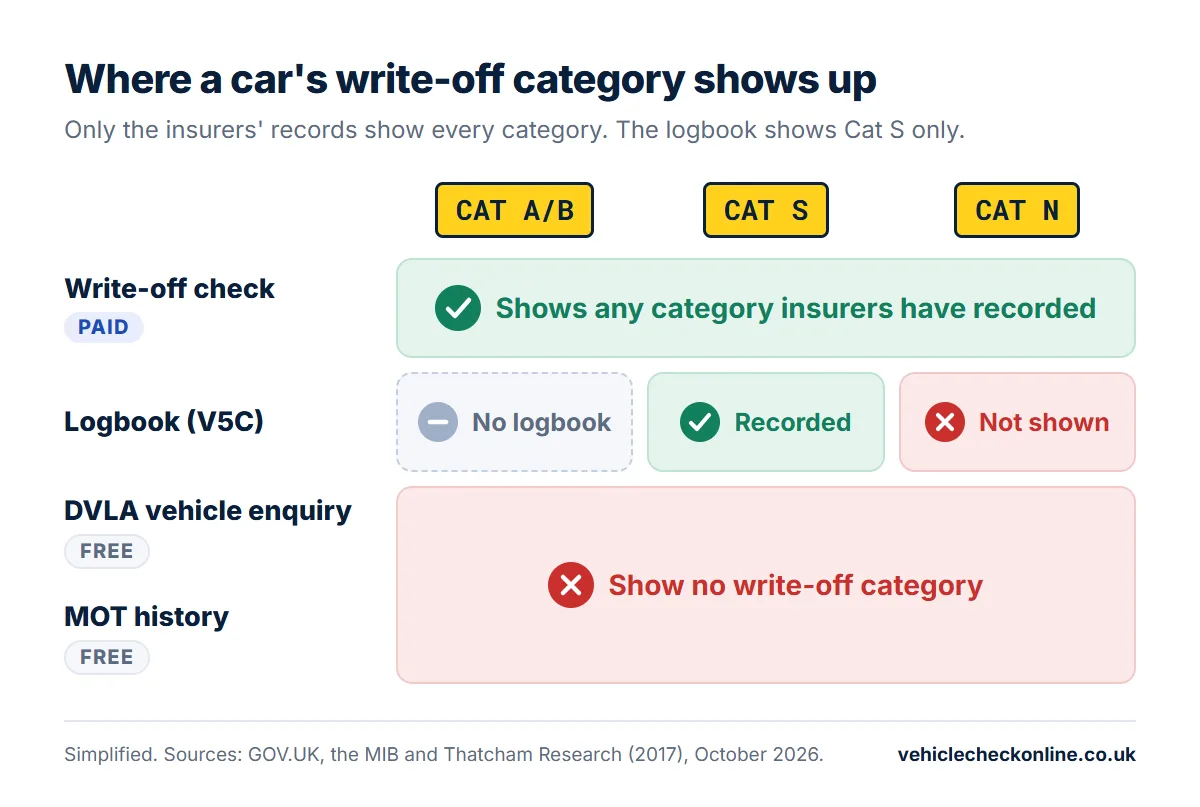
Only for some categories, so it can confirm a write-off but never rule one out:
- Cat S: yes. To keep a Cat S car, the keeper sends the complete logbook to the insurer and applies for a free duplicate on form V62, and the DVLA records the category in the new one. When Cat S began in 2017, Thatcham Research reported the wording added to the logbook as: "This vehicle has been salvaged due to structural damage but following a technical evaluation declared suitable for repair."
- Cat N: no. The keeper can keep the existing logbook, so it may say nothing about the write-off.
- Cat A and Cat B: there should be no logbook. The DVLA has not issued one for these categories since 26 October 2015, and it does not re-register them.
- Cat C and Cat D: not reliably. From 2003 until 26 October 2015, a Cat C car could only get a new logbook after passing a Vehicle Identity Check, and that logbook showed it had been a write-off. Cat D cars never needed the check.
A logbook that says nothing about a write-off proves nothing. A Cat N car keeps its old logbook, and an older write-off may not show on it at all.
Can you check a car's category for free in the UK?
Only partly. There is no free public register of write-offs, and no free DVLA car category check: the MIB lets only authorised organisations use the insurers' data, and its service for members of the public covers only a car you own, with no markers from before your ownership. GOV.UK's guide for buyers of repaired write-offs points you to a private history check to find out whether a car has been written off.
The free government services do not show a write-off category. The DVLA's vehicle enquiry lists tax, SORN, MOT expiry, first registration, the date of the last logbook, year of manufacture, type approval category (M1 for an ordinary car, which describes the kind of vehicle, not its history), weight, engine size, fuel, emissions and export status. The MOT history shows each test's result and mileage, and any faults found, again with no category. Our free pages show the DVSA's MOT data, so they cannot show it either.
Free checks still narrow things down:
- Read the logbook for a Cat S record, and compare it with the DVLA's vehicle enquiry, which shows when the last logbook was issued. Our guide on whether a V5C is genuine explains how.
- Ask the seller in writing whether the car has ever been written off, in which category and when, and keep the reply.
- Read the free MOT history. A long gap between tests can mark time off the road, and advisories that appear after it can hint at what was repaired.
- Look at the car for signs of repair, such as uneven panel gaps or paint that does not match. How to tell if a car has been in an accident goes through them.
Free checks can confirm a Cat S or raise a doubt. To see a Cat N, or to know that no write-off is recorded at all, you need a check of the insurers' records.
How do you check if a car is Cat S, Cat N, C or D?
Each category leaves different traces, so the free clue you can look for depends on the letter. For every one of them, the record that settles the question is the insurers' own.
| Category | Free clue | What confirms it |
|---|---|---|
| Cat S | The logbook of a repaired car should record it | A write-off check, matched to the logbook and the VIN |
| Cat N | Nothing on the logbook: only the seller's answer, the MOT history or signs of repair | A write-off check |
| Cat C or D (before October 2017) | A Cat C logbook issued after a Vehicle Identity Check (2003 to 2015); nothing for Cat D | A write-off check, if the record is still held |
| Cat A or B | No logbook issued since 26 October 2015 | A write-off check: walk away if the car is offered to drive |
The older the write-off, the more the free clues matter. Every Cat C or Cat D write-off dates from before October 2017, more than seven years ago, and MIB says it holds information on the write-off database for seven years. A check may therefore not find an old Cat C or D, so look closely at the logbook, read the MOT history for a long gap or a sudden run of new advisories, and ask the seller what happened.
How do I find out what category my car is?
If your own insurer wrote the car off, you should already know: the registration regulations require it to tell you whether the car is suitable for repair and, if so, whether it had structural damage. If the car was written off before you bought it, there are three places to look:
- The logbook. A repaired Cat S car's logbook should record the category. A Cat N car's may say nothing.
- The MIB. It can search its write-off and theft data for a vehicle you own, but it cannot share markers from before your ownership, so it only shows what happened while the car was yours. You need proof of identity, and MIB says the information is free in most cases.
- A write-off check. It shows the write-offs insurers have recorded against the car, including any from before you owned it, as long as the record is still held.
If you find a category you did not know about, tell your insurer: GOV.UK's guide warns that an insurer can reject a claim for non-disclosure if a previous write-off is not declared. If a seller hid it from you, Citizens Advice can explain your options.
What should the seller tell you about a write-off?
A dealer should tell you. Business Companion, the Trading Standards guidance for businesses in Great Britain, gives "failing to inform a consumer that a car has previously been an insurance write-off" as an example of a misleading omission, one of the unfair practices banned by Part 4 of the Digital Markets, Competition and Consumers Act 2024 since 6 April 2025.
A private seller has lighter duties, but under section 13 of the Sale of Goods Act 1979 a car sold by description must match that description, and a car advertised as "never written off" that was written off does not. Our guide to private sellers and dealers explains how your rights differ.
Either way, ask the question in writing and keep the answer. This is general information, not legal advice: Citizens Advice can help with your own case.
How does a paid category check work?
- Enter the registration. Our Cat S and Cat N check searches the write-off records insurers have registered and shows any category recorded against the car, with the date of the loss and, when the record includes them, the areas of damage and the insurer.
- Check that the car in the result is the one you are viewing: the same make, model and colour.
- Match the VIN. GOV.UK's guide for buyers advises checking that the VIN on the car matches the one in the logbook. The Premium report shows the full VIN, so you can compare all three.
- Compare the result with the logbook and with what the seller said. A Cat S record with a logbook that does not mention it, or a seller who said the car was never written off, needs an explanation before you go any further.
The write-off check is part of the Premium report (£7.99), alongside the outstanding finance and stolen checks. The basic report (£3.99) does not include it. Our car history check page lists what each report covers.
What does a clean result not prove?
A check shows the write-offs insurers have recorded. It cannot show damage that was repaired without a write-off, such as a claim the insurer paid to repair, or a repair the owner paid for privately. And because MIB keeps write-off information for seven years, an older write-off may have dropped off the record. No record is not proof that the car was never damaged.
So judge the car as well as the record, and have it inspected if anything looks wrong. Our guide to checking a car's accident history explains which records of accidents and damage exist, and which of them a buyer can see.
What should you do if the car has a category?
A Cat A or Cat B record on a car offered to drive means walk away: neither should ever be back on the road. For Cat S, Cat N or an older Cat C or D, work through these before you agree a price:
- Have it inspected. GOV.UK's guide recommends an engineer who will identify any structural damage. Should you buy a Cat S car? lists what the inspection should cover.
- Get an insurance quote first, and tell the insurer about the write-off: GOV.UK warns that an insurer can reject a claim for non-disclosure if you do not. See insurance and finance on Cat S and Cat N cars.
- Ask any lender whether it will lend on a written-off car before you commit, and tell it the category.
- Check the price. GOV.UK notes that Cat S cars are often slightly cheaper than similar cars of the same age and mileage. How much Cat N reduces value shows how to judge a fair figure.
- Plan for selling it. Describe the category honestly when you sell: declaring Cat N when selling sets out what the law asks.
Questions and answers
Does the DVLA show a car's write-off category for free?
No. The DVLA's free vehicle enquiry and the MOT history do not list write-off categories. A repaired Cat S car's logbook should record the category, but to search the insurers' records for Cat S or Cat N you need a paid write-off check.
Where does it say Cat N on the logbook?
Usually nowhere. An owner who keeps a Cat N car can keep the logbook issued before the write-off, so it need not mention the category. Only a check of the insurers' records shows a Cat N.
How long does a write-off category stay on a car's record?
The MIB, which holds the insurers' central record of written-off vehicles, says information is held on that database for seven years. After that a check may not show the write-off, so the logbook, the MOT history and the seller's answers matter more for an older write-off.
Is a car's write-off category the same as its insurance group?
No. A write-off category records that an insurer wrote that particular car off. An insurance group is a score from 1 to 50 that insurers use to help judge a vehicle's risk, based on its attributes. The two are separate.
What does M1 mean on a DVLA vehicle check?
It is the type approval category, which describes the kind of vehicle, not its history. The DVSA's MOT inspection manual defines M1 as a vehicle with four or more wheels for carrying passengers, with no more than 8 passenger seats besides the driver's.
Does an MOT certificate show if a car is Cat S or Cat N?
No. Neither the certificate nor the MOT history shows write-off categories: the history lists each test's result, the mileage and any faults found. The test is also carried out without dismantling the car, so a pass does not prove that a hidden repair was done well.
What should I do if a check shows a category the seller did not mention?
Do not pay until you have an explanation. Ask the seller in writing, look at the logbook, and walk away if the answers do not add up. If you have already bought the car, Citizens Advice can explain your options.
Do I need the logbook to run a category check?
No. A check of the insurers' records works from the registration number alone. You still need the logbook and the car to confirm that the VIN matches, so you know the record belongs to the car you are buying.
Sources
- GOV.UK: Insurance write-offs (scrapping your vehicle and insurance write-offs)
- GOV.UK: Buying repaired written-off vehicles, a consumer guide
- Motor Insurers' Bureau: Resources for data recipients (Vehicle Salvage and Theft Data)
- Motor Insurers' Bureau: Your data and privacy (a search for a vehicle you own; data held for seven years)
- legislation.gov.uk: Road Vehicles (Registration and Licensing) Regulations 2002, Schedule 3A
- Thatcham Research: Revised salvage code of practice comes into play on 1 October (2017)
Related guides
- What does Cat S mean on a car?Cat S means a car was written off after structural damage and can go back on the road once repaired: what the S stands for and how to tell if a car is Cat S.
- What does Cat N mean on a car?Cat N means an insurer wrote the car off after damage that did not reach its structure. What it covers, what it hides and how to confirm it.
- What do Cat C and Cat D mean on a car?Cat D car meaning: a write-off that could be repaired for no more than the car's value. How Cat C and D differ from Cat S and N, and what to check.
- Car accident check: how to find out if a car has been in an accidentCar accident check: how to find out if a car has been in an accident, what write-off records and the free MOT history show, and how to get your claims history.
This guide is general information for people buying, owning or selling a car in the UK, not legal or financial advice. Vehicle Check Online is an independent service, not affiliated with the DVLA, the DVSA or GOV.UK.