
Selling your car
Declaring Cat N when you sell a car: what the law says
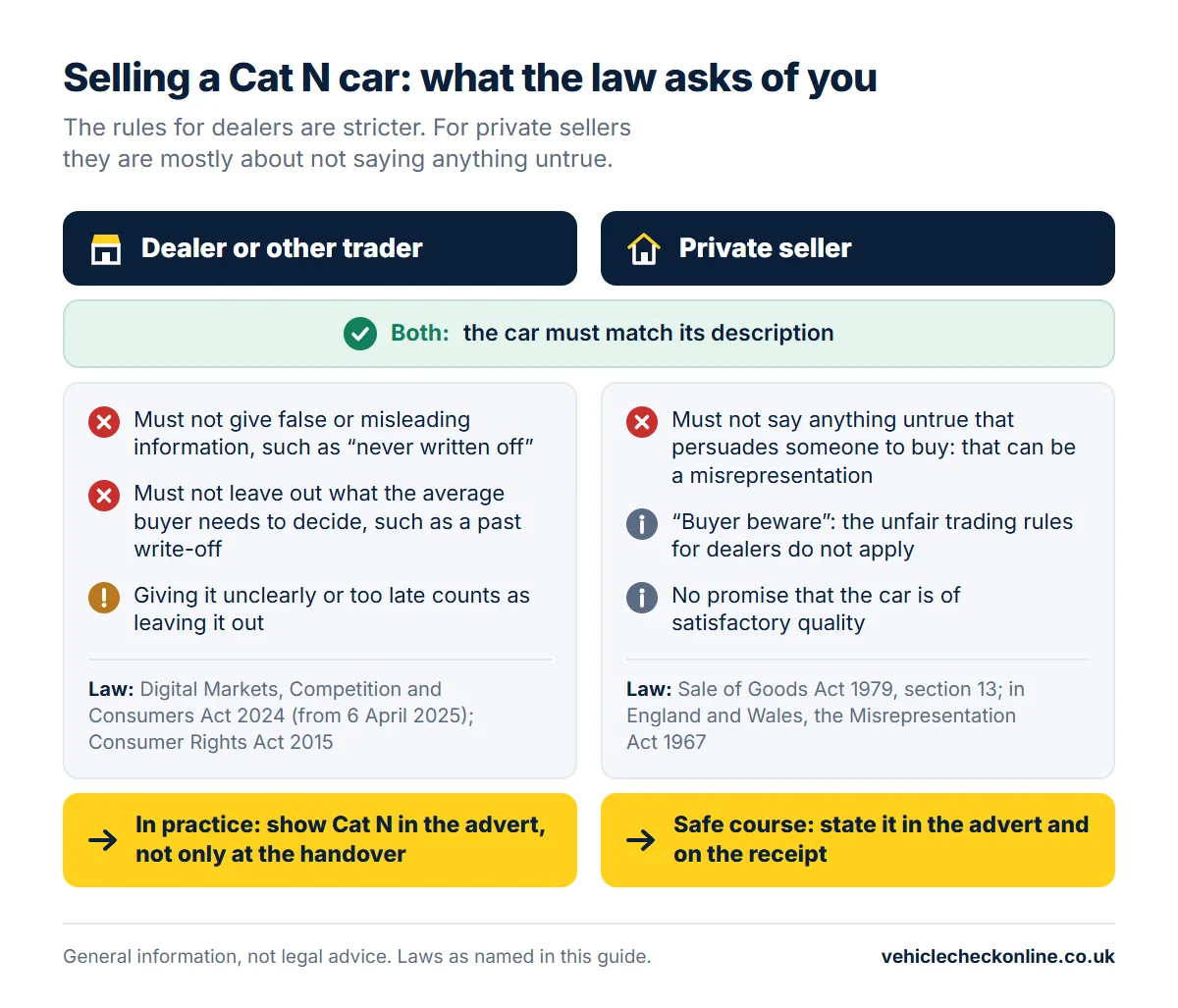
If you sell as a dealer, you are expected to tell buyers a car is Cat N: Trading Standards guidance gives failing to tell a buyer that a car was an insurance write-off as an example of a banned misleading omission. If you sell privately, the car must match its description and you must not mislead the buyer, so the safe course is to state the category in the advert and on the receipt.
This guide sets out what the law says for dealers and for private sellers, how telling DVLA differs from telling a buyer, and how to declare Cat N in a way that protects you. It is general information, not legal advice: for your own situation, contact Citizens Advice.
Who has to declare Cat N when selling a car?
| Who is selling | What the law says | Where it comes from |
|---|---|---|
| A dealer or other trader | Must not give false or misleading information, or leave out information the average buyer needs to make an informed decision. The car must match its description. | Digital Markets, Competition and Consumers Act 2024, Part 4 (from 6 April 2025); Consumer Rights Act 2015 |
| A private seller | The car must match its description. An untrue statement that persuades someone to buy can be a misrepresentation. | Sale of Goods Act 1979, section 13; in England and Wales, the Misrepresentation Act 1967 |
| Any owner, to DVLA | Tell DVLA when the car is written off. Selling it later has no separate write-off step. | GOV.UK guidance on insurance write-offs |
The rules for dealers are stricter because consumer protection law is aimed at traders. The rules for private sellers are mostly about not saying anything untrue.
Do car dealers have to declare Cat N?
Yes, in practice. Since 6 April 2025, unfair commercial practices by traders have been banned by Part 4 of the Digital Markets, Competition and Consumers Act 2024, which replaced most of the Consumer Protection from Unfair Trading Regulations 2008 and applies across the UK. Two parts of it matter here:
- Misleading actions (section 226): giving false or misleading information about the car, or an overall presentation likely to deceive, for example describing a Cat N car as never written off.
- Misleading omissions (section 227): leaving out material information, which the Act defines as information the average consumer needs to take an informed decision. Giving it in a way that is unclear or too late counts as leaving it out.
Business Companion, the Trading Standards guidance for businesses in Great Britain, lists "failing to inform a consumer that a car has previously been an insurance write-off" among its examples of misleading omissions in used car sales. The same guidance says traders must not use phrases such as "sold as seen" or "trade sale" to restrict a buyer's rights.
The Consumer Rights Act 2015 adds that goods must match their description, and that what a trader says about a car's main characteristics forms part of the contract. For a dealer, the safe practice is to show the category in the advert, not only at the handover, because information given too late can count as an omission.
Do private sellers have to declare Cat N?
The duties are lighter. Citizens Advice describes a private sale as "buyer beware", and the unfair trading rules that bind dealers apply to traders, not to someone selling their own car. A private seller also does not promise the car is of satisfactory quality: under the Sale of Goods Act 1979 that duty applies only to sales in the course of a business.
What the law does ask of a private seller is honesty in what they say. Under section 13 of the Sale of Goods Act 1979, a car sold by description must match that description, and a buyer who was told something untrue that led them to buy may have a claim for misrepresentation. In England and Wales that comes under the Misrepresentation Act 1967; Northern Ireland has its own Act, and Scotland has its own rules.
So the risk for a private seller lies in anything said or written that is not true. These are the statements that cause problems with a Cat N car:
- "No accidents", "never written off" or "clean history" in the advert.
- Answering "no" when a buyer asks whether the car has been written off or in an accident.
- A half-answer to a direct question, such as mentioning "a small repair" when the car was written off.
- Saying a history check was clear when it was not, or when you never ran one.
If you buy and sell cars to make money, you may count as a trader in law, whatever the advert says, and the dealer rules apply to you. Our guide on private seller vs dealer explains the difference.
Is telling DVLA the same as telling the buyer?
Your write-off duty to DVLA comes when the car is written off, not when you sell it. GOV.UK tells owners to tell DVLA when their vehicle has been written off, and says you can be fined £1,000 if you do not.
If you kept a Cat N car after the payout, GOV.UK says you can keep the existing logbook (V5C). For a Cat S car, the keeper applies for a duplicate logbook and DVLA records the category on it. That means the logbook of a Cat N car may not show the category at all, which is why a car category check looks at the insurers' records.
When you sell, you tell DVLA about the sale in the usual way, with the buyer's details and the date. GOV.UK's guidance on that step does not mention write-offs, and it does nothing to tell the buyer. Telling the buyer is up to you.
How do you declare Cat N when you sell?
- Put "Cat N" and the year of the write-off in the advert. If the selling site has a box for write-off history, fill it in.
- Say briefly what the damage was and how it was repaired, and offer the repair invoices and photos.
- Give the same answer to every buyer who asks, in writing where you can, and keep the messages.
- Write it on the receipt, for example: "Sold as a repaired Cat N insurance write-off, recorded in [year]." Both of you sign and keep a copy. Our car sale receipt template shows what else to include.
- Keep a copy of the advert as it appeared on the day of the sale.
If you are not sure of your car's history, check it before you advertise, so that what you say is accurate. Our write-off check shows any category and the date of the loss, as part of the Premium report, £7.99.
Why is declaring Cat N in your interest?
A buyer who runs a write-off check can see the category whether you mention it or not. If they find it after travelling to a viewing, they will doubt everything else you have said, and probably walk away.
Declaring it up front means the buyers who come to see the car already accept the history, the price is agreed on that basis, and you have written proof that you told them. That proof is what protects you if a buyer later says they were misled.
A Cat N car usually sells for less than a clean one. Our guide to how much Cat N reduces value shows how to set a fair price.
What if you did not know your car was Cat N?
You may have bought the car without being told. You cannot describe what you do not know, but once you find out, you must not deny it to a buyer.
In England and Wales, a seller who made an untrue statement can be liable for the buyer's loss unless they prove they had reasonable grounds to believe it was true and did believe it, under section 2 of the Misrepresentation Act 1967. The simplest protection is to check the record before you advertise, so that what you say is accurate. If you were sold the car without being told, Citizens Advice can explain what you can do about the person who sold it to you.
If you are buying, should you rely on the seller to declare Cat N?
Whatever the law says, some sellers will not mention a write-off, and some genuinely do not know. Check the registration yourself before you pay.
If you find out after buying that a car was Cat N and you were not told, keep the advert, the messages and the receipt. If you bought from a dealer, contact them in writing first: a car that does not match its description may give you a right to a repair or some or all of your money back. If you bought privately, what matters is whether the car was misdescribed or you were told something untrue. Citizens Advice can advise on your own case.
Questions and answers
Is it illegal to sell a Cat N car?
No. GOV.UK says a Cat N car can be used again once it is repaired to a roadworthy condition, and it can be sold. What matters is describing it honestly and not misleading the buyer.
Do I have to tell DVLA my car is Cat N when I sell it?
The duty to tell DVLA about a write-off comes when the car is written off. When you sell, you tell DVLA about the sale in the usual way, and GOV.UK's guidance on that step has no write-off question.
Does Cat N show on the logbook?
Not necessarily. GOV.UK says the owner of a Cat N car can keep the existing logbook, so it may not mention the category. The insurers' write-off record is what a check shows.
Can I part-exchange a Cat N car?
Yes. Tell the dealer it is Cat N when you ask for a price. Dealers can check the write-off record themselves, and their offer will allow for the category.
Can a buyer return a Cat N car they bought privately?
Only in limited cases, for example if the car did not match its description or the seller said something untrue that led them to buy. Citizens Advice can explain the options in a particular case.
Does Cat N ever come off a car's record?
You cannot have it taken off: the insurers' code allows a category to be changed only to correct an error or in exceptional cases. So assume a buyer's write-off check will show it, and declare it.
Sources
- legislation.gov.uk: Digital Markets, Competition and Consumers Act 2024, section 227 (misleading omissions)
- legislation.gov.uk: Sale of Goods Act 1979, section 13 (sale by description)
- Business Companion (Trading Standards): Selling used vehicles
- Citizens Advice: Letter to complain about misdescribed goods bought from a private seller
- GOV.UK: Insurance write-offs
Related guides
- What does Cat N mean on a car?Cat N means an insurer wrote the car off after damage that did not reach its structure. What it covers, what it hides and how to confirm it.
- How much less is a Cat N or Cat S car worth?How much do Cat N and Cat S reduce a car's value? Why there is no fixed figure, what drives the discount, and how to work out a fair price for a write-off.
- Buying a used car: private seller vs dealerPrivate seller vs dealer: your legal rights, returns, warranties, price and risks when buying a used car in the UK, and the checks you still need either way.
- Private car sale receipt: a free UK templateA free car sale receipt template for UK private sales: the wording to copy, what each line is for, the finance and write-off statements, and what to do next.
This guide is general information for people buying, owning or selling a car in the UK, not legal or financial advice. Vehicle Check Online is an independent service, not affiliated with the DVLA, the DVSA or GOV.UK.