
Buying a used car
Used car checklist: what to check before you buy
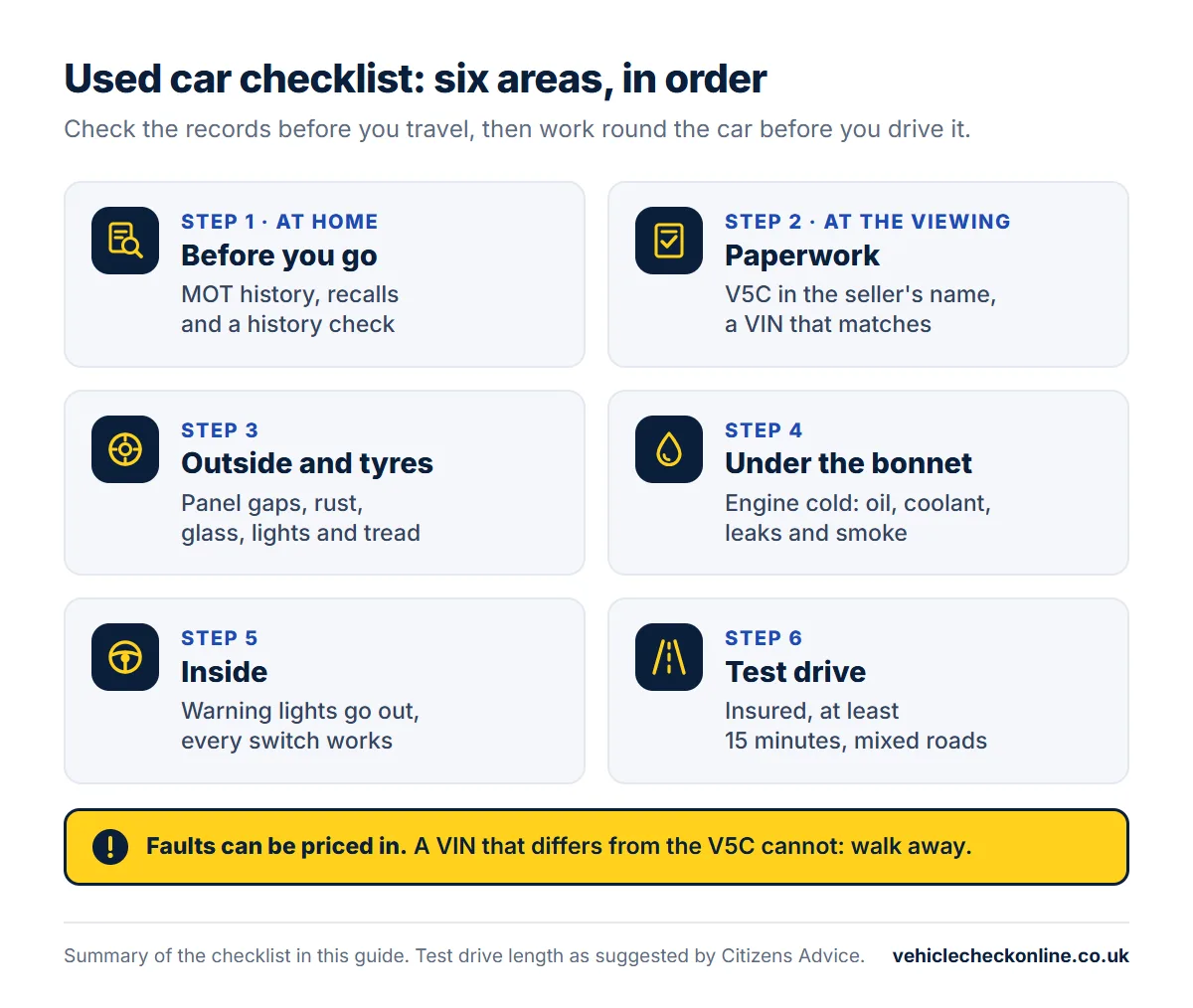
What to check when buying a used car, in order: its records before you travel (the MOT history and a history check), then at the viewing the V5C logbook and VIN, the bodywork and tyres, under the bonnet and the inside, and finally a test drive. See the car in daylight, when it is dry and the engine is cold, and walk away if the car and its paperwork do not match.
This used car checklist follows the order of a viewing, area by area: what to look at, what a warning sign can mean, and at the end a table of the signs that matter most.
What records should you check before you travel?
Start at home, with the registration number: it is all a reg check needs. GOV.UK advises asking the seller for it, with the make, model and MOT test number, and checking that they match the DVLA's record of the car. It also advises checking whether the car has been recalled for a serious safety issue.
Then read the MOT history. The official records cover tests since 2005 in England, Scotland and Wales, and since 2017 in Northern Ireland. Our free MOT history page shows each test with its result, failures, advisories and mileage, and the outstanding safety recall status the DVSA reports. Write down every advisory: each one tells you where to look at the viewing.
Outstanding finance, an insurance write-off or a stolen record never shows on the car itself. A car history check searches those records by registration, along with the previous keepers, plate changes and mileage readings, in the Premium report for £7.99. If it turns up a problem, you have not wasted a trip.
If you want the list on paper, our car buying checklist is a PDF made from the MOT history of the car you are going to see: its advisories and failures turned into things to inspect, with a full inspection and test-drive guide. Take these with you as well:
- A torch, even in daylight, for the engine bay, the wheel arches and underneath.
- A tread depth gauge if you have one, and a cloth for the dipstick.
- Your driving licence, and insurance that covers you to drive the car.
- A friend who knows cars, if you do not. Durham County Council's Trading Standards service suggests one, or an inspection by an independent engineer.
How do you check the V5C, VIN and service history?
- The V5C logbook. Ask for the original, not a photo or a copy. The name and address on it should be the seller's, and the address should be where you are seeing the car. Our guide to checking a V5C is genuine covers the watermark and the serial numbers to avoid.
- The VIN and engine number. Find the vehicle identification number on the car, in more than one place if you can, and compare it with the V5C character by character. GOV.UK advises checking the engine number against the logbook too.
- The description. The make, model, colour and engine size on the V5C should match the car in front of you and its MOT record.
- The service history. A stamped book or a digital record, ideally with invoices, whose dates and mileages fit the MOT readings. Our guide on how to check service history explains how to confirm it with the garages.
- Big jobs. If the seller says the cambelt, the clutch or the brakes have been done, ask for the invoices.
Faults can be priced into your offer; a car that is not the one on its paperwork cannot. If the VIN on the car differs from the V5C, walk away.
What should you check on the bodywork, glass and lights?
Walk slowly round the car, then crouch at each corner and look along the sides. Citizens Advice suggests viewing in daylight and preferably when it is dry, because damage is harder to spot on wet paint.
- Panels and paint. Even gaps between panels, the same colour and finish everywhere, and no paint on the rubber seals. Our guide on how to tell if a car has been in an accident explains the signs of a repair.
- Rust. Look at the wheel arches, the sills under the doors, the bottoms of the doors and the edges of the boot lid. Bubbling paint or flaking metal means the rust has got under the surface.
- Glass. MOT testers look for windscreen damage more than 10mm across in the strip in front of the driver, or more than 40mm elsewhere in the area the wipers clear, so a chip there can mean a repair or a new screen.
- Lights. Cracked or misted lenses, and every bulb working. Ask the seller to work the lights, indicators and brake lights while you watch from outside.
- Doors, bonnet and boot. Each one opens and shuts easily, sits flush when closed and locks with the key.
- Stance. On level ground, the car sits level, not low at one corner.
What can you check on the tyres, wheels and brakes?
Tyres take a minute to check and say a lot about how the car has been looked after.
- Tread. The Highway Code says a car's tyres must have at least 1.6mm of tread across the central three-quarters of their width, all the way round. Check the inner edges as well, where wear is easy to miss.
- Damage. Cuts, cracks or bulges in the sidewalls. A bulge means the inside of the tyre is damaged, and the tyre needs replacing.
- Uneven wear. Wear on one edge only, or more wear on one side of the car than the other, can point to an alignment or suspension problem.
- Matching tyres. The same size and type on each axle.
- The spare. A spare wheel or a repair kit, the jack, and the key for the locking wheel nuts if the car has them.
- Wheels and discs. Cracked or badly kerbed wheels and, through the spokes, brake discs with deep grooves or a raised lip at the outer edge, both signs of wear.
What should you check under the bonnet with the engine cold?
Ask the seller not to run the car before you arrive, and put your hand on the bonnet when you get there. A warm engine can hide a car that is slow to start or that smokes until it has warmed up.
- Oil. Pull out the dipstick, wipe it, put it back and check again: the level should be between the marks. A milky, mayonnaise-like deposit under the oil filler cap can mean coolant is getting into the oil, although short journeys can leave some condensation there too.
- Coolant. The level in the expansion tank should be between its marks. Only open anything on the cooling system when the engine is cold.
- Leaks. Oil or coolant on the engine, on the parts below it or on the ground where the car was parked. A spotless engine bay on an otherwise grubby car can be hiding a leak.
- Battery, belts and hoses. Corrosion around the battery terminals, and drive belts or rubber hoses that are cracked, frayed or perished.
- First start. Stand behind the car as it starts. Blue smoke is usually a sign of the engine burning oil, and black smoke of too much fuel; both are worth a mechanic's opinion before you buy.
An electric car has no engine oil to check and no exhaust, and its battery matters most. Our guide to buying a used electric car covers the battery and charging checks.
What should you check inside the car?
- Warning lights. The Highway Code says the dashboard warning lights come on when you turn the ignition on and go out once the engine starts, except the handbrake light. One that stays on needs explaining, and so does an engine or airbag light that never comes on at all.
- Wear against the mileage. A shiny steering wheel, worn pedal rubbers or a sagging driver's seat on a car showing low miles is a reason to compare the reading with the MOT mileage history.
- Every switch. Windows, mirrors, central locking, wipers and washers, horn, heater, the heated screens and the air conditioning, which should blow cold.
- Seats and belts. Every seat adjusts, and every belt clicks in, releases and winds back.
- Damp. A musty smell, wet carpets or misted windows can mean a water leak. Press the carpet in each footwell and lift the boot floor.
- Keys. Count them, and try each one in the doors and to start the car.
What should you check underneath and on the suspension?
You do not need a ramp to spot the obvious. With a torch, look under the front and the back of the car:
- Fresh drips or wet patches underneath, and stains on the ground where the car has been parked.
- Heavy rust on the sills, the floor and the subframes, especially if the MOT history already mentions corrosion.
- An exhaust that is rusted through, held up with wire or blowing at a joint.
- Push down hard on each corner and let go. If the car keeps bouncing, the Highway Code says its shock absorbers are worn.
What should you check on the test drive?
Drive the car only once you know you are insured to: Citizens Advice says not to test drive a car if you are not insured, and suggests driving for at least 15 minutes on different types of road. Turn the radio off so you can hear the car. Our test drive checklist goes through what to feel and listen for at each stage, from the cold start to the look for leaks afterwards.
How do you check the seller as well as the car?
A good car from the wrong seller is still a risky buy. The seller should be the keeper named on the V5C, at the address on it, and able to say how long they have had the car and why they are selling. A previous owners check shows when the car last changed keeper, so you can test that answer. Durham County Council's Trading Standards service warns about motor traders who pose as private sellers to deny buyers their consumer rights.
Our list of questions to ask when buying a used car covers what to ask and which answers should worry you. Get the important answers in writing.
If you are not confident judging a car's condition, a pre-purchase car inspection by an independent mechanic covers what this list cannot, such as the underside on a ramp and the faults stored in the car's electronics.
Things to check when buying a second hand car: what do the signs mean?
Few used cars are perfect. What matters is knowing what a sign can mean and what to do about it before you agree a price.
| What you find | What it can mean | What to do |
|---|---|---|
| The VIN or details differ from the V5C | The car is not the one on the paperwork | Do not buy it |
| A warning light stays on | A fault the car has detected | Ask for it to be diagnosed before you agree a price |
| The car pulls to one side under braking | A brake fault or wrongly inflated tyres | Check the tyre pressures, then have the brakes checked |
| A corner keeps bouncing after you push it down | Worn shock absorbers | Allow for replacing them in your offer |
| Tyres worn on one edge | An alignment or suspension problem | Ask for an alignment check |
| Blue or black exhaust smoke | Burning oil (blue) or too much fuel (black) | Have a mechanic look before you buy |
| An MOT advisory with no invoice for the repair | Work you may have to pay for | Check the item on the car and allow for it in your offer |
Questions and answers
Should I view a used car in the rain or after dark?
Avoid both if you can. Water on the paint and poor light hide scratches, dents and panels that do not match, which is why Citizens Advice suggests viewing in daylight, preferably when it is dry.
Can I check a used car myself if I know nothing about cars?
You can do most of the checks in this list without tools or experience. If you are unsure what you are looking at, take a friend who knows cars, or pay for an independent inspection before you buy.
What paperwork should come with a used car?
The original V5C logbook, the service book or digital service record, invoices for work done, the handbook and all the keys. Without the V5C, do not buy the car.
Why should the engine be cold when I see the car?
Some faults only show on a cold start: an engine that is slow to start, smoke that clears as it warms up, or a rattle that fades. If the bonnet is already warm when you arrive, ask why.
What is the most important thing to check on a used car?
That it is the car on the paperwork, with a clean record: a VIN that matches the V5C, and no outstanding finance, write-off or stolen record. Condition faults can be priced into an offer; a problem with the car's identity or record usually cannot.
Sources
- GOV.UK: Check a used vehicle you're buying
- Citizens Advice: Buying a used car
- The Highway Code, Annex 6: vehicle maintenance, safety and security
- DVSA: MOT inspection manual for cars, section 3 (visibility)
- Durham County Council Trading Standards: Buying a used car
Related guides
- What to check when test driving a used carA test drive checklist for a used car: what to check before you set off, what to feel and listen for on the road, the checks afterwards and how long to drive.
- What to ask when buying a used car: the questions that matterThe questions to ask when buying a used car, on the phone and at the viewing: what each answer tells you, the red-flag replies, and what to check for yourself.
- Independent car inspection in the UK: what it covers and when to get oneA pre-purchase car inspection checks a car's condition before you buy. What it covers, what a history check adds, what affects the cost and when to get one.
- How to buy a used car privately in the UKBuying a car privately in the UK, from advert to driving home: the checks before you view, the paperwork, paying safely and your rights as a private buyer.
- Is a car history check worth it?Is a car history check worth it? What a check shows, what it cannot tell you, what you can see free and when paying for a full report makes sense.
This guide is general information for people buying, owning or selling a car in the UK, not legal or financial advice. Vehicle Check Online is an independent service, not affiliated with the DVLA, the DVSA or GOV.UK.