
Buying a used car
What to ask when buying a used car: the questions that matter
The most useful questions to ask when buying a used car are the ones whose answers you can check: how long the seller has owned it, why they are selling, whether there is finance on it or it has been written off, and what the service and MOT history show. Ask before you travel, ask again at the viewing, and verify anything important yourself.
This guide gives the questions to ask on the phone and at the viewing, why each one matters, what a worrying answer sounds like, and what to get in writing. Most apply to private sellers and dealers alike; a short section covers the extra questions for a dealer.
What questions should you ask a car seller on the phone?
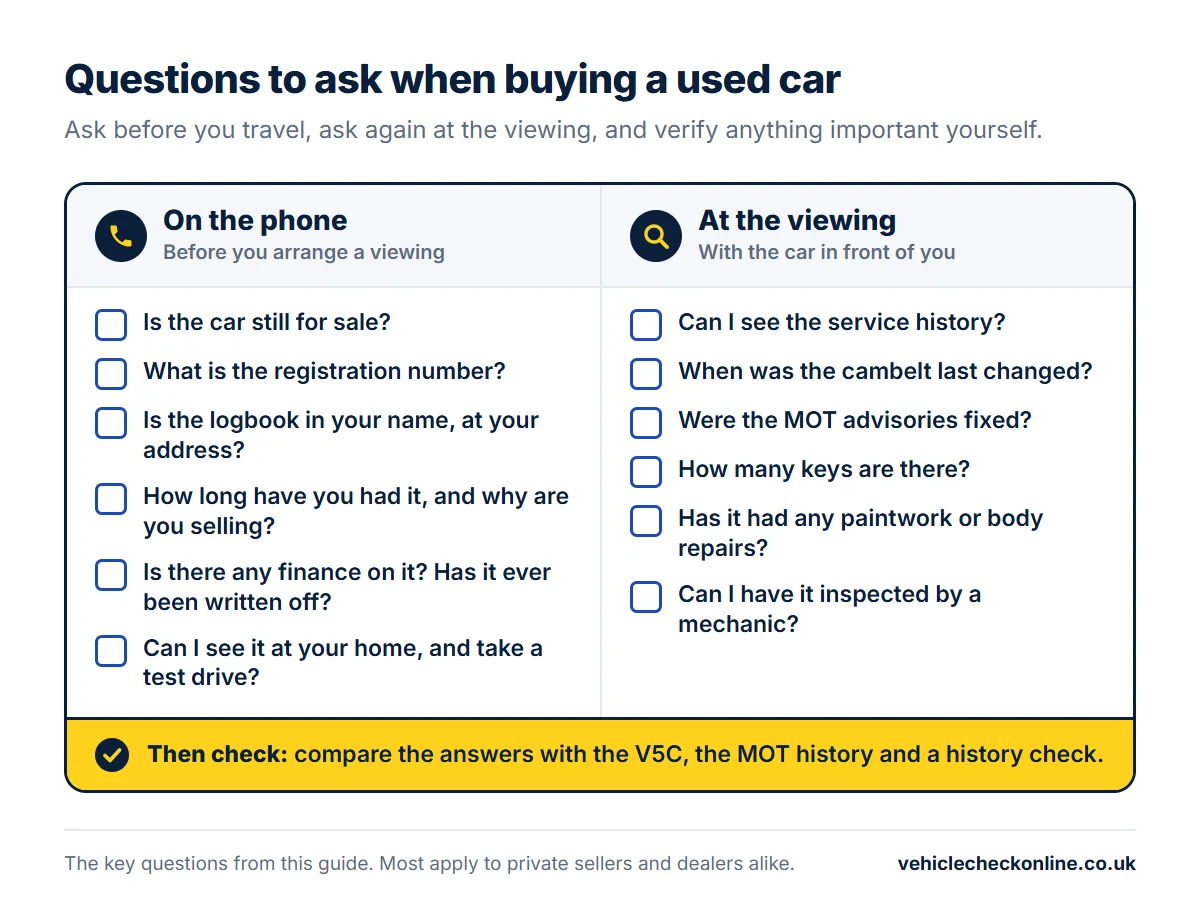
A five-minute call can save you a wasted journey. Ask these before you arrange a viewing:
- "Is the car still for sale?" Do not say which car. A private seller with one car will know; a trader with several may ask "which one?".
- "What is the registration number?" You need it to look up the MOT history and run a history check before you travel: see what a free car history check shows.
- "Is the logbook in your name, at your address?" The answer tells you whether you will be dealing with the registered keeper, and where the viewing should be.
- "How long have you had it, and why are you selling?" A clear, specific answer is a good sign. A vague one, or "a few weeks", needs following up.
- "Is there any finance on it?" Some sellers do not realise that a PCP or hire purchase agreement must be settled before the car is sold. Check the answer with a car finance check.
- "Has it ever been written off or had accident repairs?" Listen to how the seller answers as well as what they say. Then run a car accident check of your own.
- "Are there any warning lights or faults I should know about?" Asking directly makes it harder for a seller to say later that you never asked.
- "Can I see it at your home, and can I take a test drive?" A seller who will only meet elsewhere, or refuses a test drive, is giving you a reason to look for another car.
How do you check the seller's answers before you travel?
GOV.UK advises asking the seller for the registration number, the make and model, and the MOT test number before you see a car, and checking that these match the DVLA's record. With the registration, you can look up the car's MOT history: the result of each test, the mileage recorded and the faults found. GOV.UK holds results for tests since 2005 in England, Scotland and Wales, and since 2017 in Northern Ireland. Our free MOT history check shows a car's MOT records by registration.
Compare the MOT history with what you were told. A seller who says the car "sails through its MOT" when it failed on brakes and suspension last year has told you something useful about how far to trust the rest. A seller who will not give you the registration at all is best avoided.
What should you ask when buying a used car privately at the viewing?
- "Can I see the service history?" Look for stamps and invoices that match the mileage and the dates.
- "When was the cambelt last changed?" Only if the engine has one. It is an expensive job, and a car overdue for it costs you that money soon.
- "Were the MOT advisories fixed?" Advisories are faults that did not fail the test but were noted. Ask for the invoices if the seller says they were dealt with.
- "How many keys are there?" Replacement keys can be expensive, and a missing key is worth asking about.
- "Has it had any paintwork or body repairs?" Compare the answer with what you see: mismatched colours, uneven panel gaps or overspray on rubber seals.
- "Has it been modified?" Modifications can affect your insurance, so you need to know about them.
- "Can I have it inspected by a mechanic?" A seller with nothing to hide rarely objects.
Ask how many owners the car has had and compare the answer with the V5C. Our guide to how many owners is too many explains what the number tells you.
What should you ask about the V5C, service history and MOT?
Ask to see the original V5C logbook, not a copy. Check that the name and address on it are the seller's, that it has a "DVL" watermark, and that the VIN on the car matches it. GOV.UK also lists serial number ranges that may belong to stolen logbooks: if the serial number falls in one of them, do not buy the car.
Ask where the car has been serviced. If the service book shows a garage, you can ring it to confirm the work was done. For the MOT, the online history is more complete than any paper certificate the seller hands you.
Is it enough to ask about finance, write-offs and theft?
Ask about finance, write-offs and theft, but do not rely on the answer. A seller may not know the car's history before they owned it, may have misunderstood a finance agreement, or may simply not tell the truth. None of these things shows on the car itself.
A car history check answers them from the records: outstanding finance, insurance write-offs (Cat S, Cat N, A and B, and any older Cat C or D still held), stolen records, the number of previous keepers and any plate changes. If the result differs from what the seller told you, ask them to explain before you go any further.
Which red-flag answers should you listen for?
| Question | Reassuring answer | Red flag |
|---|---|---|
| How long have you owned it? | A specific time that matches the V5C and a previous owners check | "A few weeks", or "I'm selling it for a friend" |
| Why are you selling? | A clear reason: a new car, a growing family, moving abroad | Vague, changing or no reason |
| Is there any finance on it? | "No", and the history check agrees | "Yes, but you can take over the payments" |
| Can I see it at your home? | Yes, at the address on the V5C | A car park, a lay-by or "I'll bring it to you" |
| Can I have it inspected? | Yes, whenever suits you | No, or "someone else is coming to see it today" |
| How would you like to be paid? | Bank transfer to their own account at the handover | A deposit now, cash only, or payment to someone else |
One awkward answer is not proof of anything. Several together are a reason to walk away. If the seller pushes you to pay quickly, read our guide to car buying scams first.
What should you get in writing?
If something goes wrong later, what the seller said matters, especially in a private sale where your rights depend largely on the car matching its description. So:
- Ask the important questions by text or email, or follow up a phone call with a message summarising the answers.
- Take a screenshot of the advert before you go, in case it is changed or removed.
- Get a receipt with the date, the price, the registration and VIN, the mileage, both names and addresses, and any faults the seller told you about.
What extra questions should you ask a dealer?
- "What checks and preparation has the car had, and can I see the results?"
- "Is there a warranty, who provides it, and what does it exclude?"
- "Are there any admin or preparation fees on top of the advertised price?"
- "Has the car been checked for outstanding finance and write-offs, and can I see the report?"
A dealer's answers do not replace your own checks, but a dealer must sell you a car that is of satisfactory quality, fit for purpose and as described, under the Consumer Rights Act 2015. Our guide to private seller vs dealer explains what that means.
Questions and answers
What should I not say when buying a used car?
Avoid telling the seller the most you can spend, or that you have already decided to buy, before you have seen the car and the checks are done. It weakens your position if you need to negotiate or walk away.
Is it rude to ask for an inspection?
No. Asking for an inspection by a mechanic is a normal part of buying a used car. A genuine seller expects it, and one who refuses has told you something.
What if the seller will not give me the registration number?
Look for another car. The registration is shown on the car itself, and you need it to look up the MOT history and run a history check before you travel.
Can I trust a seller who says the car has never been in an accident?
They may be honest and still be wrong, because they may not know what happened before they owned it. A write-off check shows whether an insurer recorded the car as a write-off, and an inspection can find repairs that were never reported.
Should I ask why the car has a new MOT?
Yes. A fresh MOT is useful, but ask what work was done to pass it, and look at the MOT history to see whether it failed first and what was repaired.
Do I need to ask the same questions at a dealer?
Most of them, yes. Dealers have more legal duties than private sellers, but the history, the paperwork and the condition of the car still need checking.
Sources
- GOV.UK: Check a used vehicle you're buying
- GOV.UK: Check the MOT history of a vehicle
- Citizens Advice: Buying a used car
Related guides
- How to buy a used car privately in the UKBuying a car privately in the UK, from advert to driving home: the checks before you view, the paperwork, paying safely and your rights as a private buyer.
- How many previous owners is too many for a used car?There's no fixed limit: about one keeper per three years of age is normal. Why short ownerships are the real warning sign, and how to check a car's true number.
- What to look for in a car's MOT historyWhat to look for in MOT history before you buy: repeated advisories, corrosion, gaps, mileage drops and fails, and which entries are red flags or harmless.
- Buying a used car: private seller vs dealerPrivate seller vs dealer: your legal rights, returns, warranties, price and risks when buying a used car in the UK, and the checks you still need either way.
- Car insurance groups: what they mean and how to find yoursUK car insurance groups rate cars from 1, cheapest to insure, to 50. How to check your car's group by reg, what sets it, what 11E means and what's changing.
This guide is general information for people buying, owning or selling a car in the UK, not legal or financial advice. Vehicle Check Online is an independent service, not affiliated with the DVLA, the DVSA or GOV.UK.