
Buying a used car
Car insurance groups: what they mean and how to find yours
Car insurance groups rate every car model and version sold in the UK from 1, the cheapest to insure, to 50, the most expensive, on its repair costs, price, performance, and safety and security kit. To find what insurance group your car is in, enter its registration in a free group checker on an insurer's or price comparison website, or ask for a quote. The group rates the car, not you.
Thatcham Research's newer Vehicle Risk Rating has been taking over from the groups since September 2024: newly launched models carry both until early 2027, after which the new rating is due to become the only reference. This guide covers who sets the groups and what decides them, what the numbers and letters mean, how to check a car before you buy, how the new rating differs, and why your own details matter as much as the car's.
What is a car insurance group?
An insurance group is a rating given to each car model, and to each version of it, that tells insurers how risky it is likely to be to insure compared with other vehicles. Cars are rated from 1 to 50. Light vans are rated on the same scheme, from 21 to 50.
The lower the group, the cheaper a car tends to be to insure for the same driver. But the group is only a guide. Thatcham Research, which produces the data behind it, calls the result an advisory score: a starting point for insurers, not a price.
The group belongs to the exact version, not just the model name. A more powerful engine or a better-equipped trim level can put the same model in a higher group than its basic version.
What do the insurance group numbers and letters mean?
Group 1 is the lowest-risk, cheapest end of the car scale and group 50 the highest; vans run from 21 to 50, and a letter after the number is a security suffix. In full:
| What you see | What it means |
|---|---|
| Group 1 | The lowest rating on the car scale: the cheapest end to insure for the same driver |
| Group 50 | The highest rating on the car scale: the most expensive end |
| Group 21 to 50 on a van | Light vans have their own range on the same scheme, starting at 21 |
| A letter after the number, as in 11E | The security suffix: how the car did in a benchmark set of security tests |
| Five scores from 1 to 99 | The newer Vehicle Risk Rating, which is not a group number |
The number is the group itself. A car listed as 13E is in group 13, in the lower third of the scale, and the E is its security suffix. Thatcham's own pages explain what the suffix measures but do not publish a key to the letters, so if a letter on a quote puzzles you, ask the insurer what it means for your price.
There is no official price list by group either. Two cars in the same group can be priced differently, and one car is priced differently for different drivers, so a group tells you roughly where a car sits on the scale, not what you will pay.
Who sets insurance groups?
The groups come from the insurance industry itself, not from the government. Thatcham Research assesses each model on around 125 attributes and passes its data every week to the Group Rating panel of the Association of British Insurers (ABI). The panel turns it into an advisory group, using a standard formula overseen by insurance industry experts.
Each vehicle also gets a unique eight-digit ABI code, which identifies the exact model and version in Thatcham's industry-standard vehicle data. Thatcham supplies that data to motor insurers, comparison sites, software houses and registration lookup services, so a group checker and an insurer start from the same information.
The DVLA plays no part. Its vehicle enquiry on GOV.UK lists details such as a car's tax, MOT expiry, engine size, fuel type and CO2 emissions, but not its insurance group.
What decides a car's insurance group?
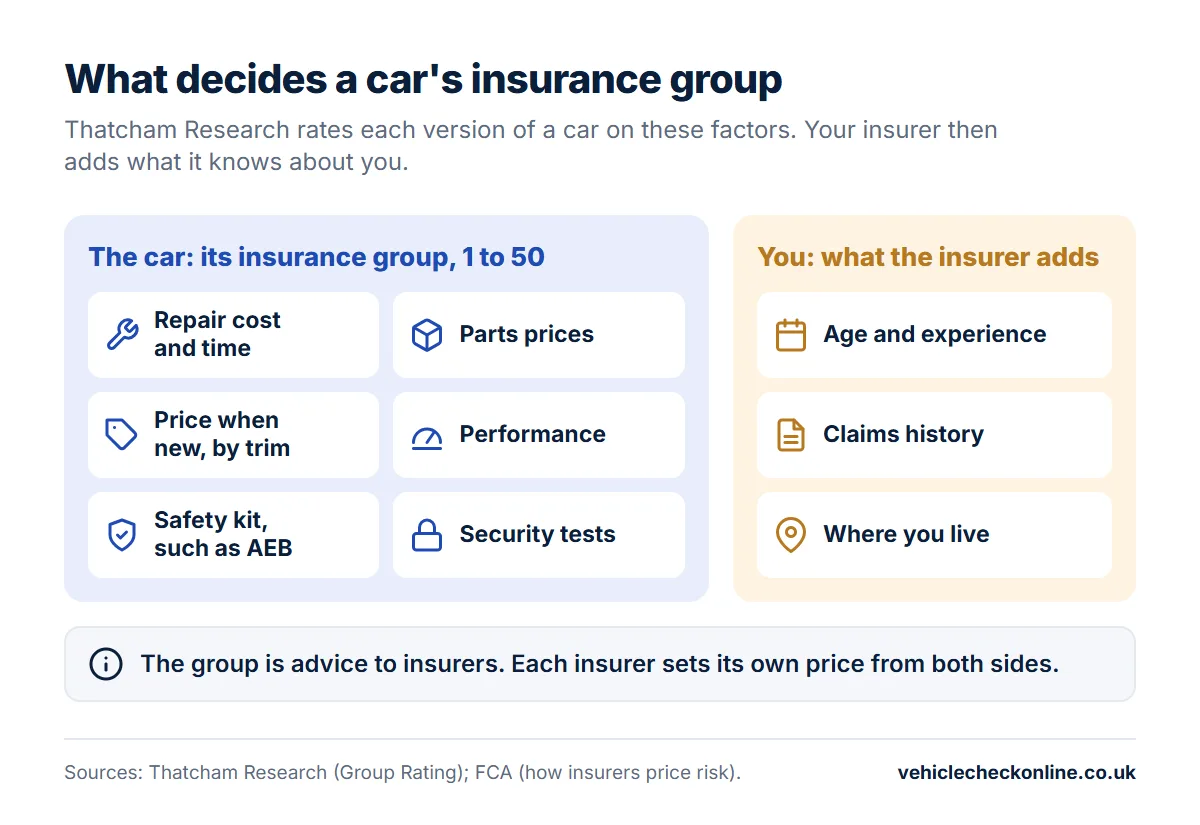
Thatcham lists the things it weighs. Most of them come down to what a claim on the car is likely to cost:
- Repair cost and time: how the car would be repaired after a claim, and what it would cost and how long it would take to put it back as it was.
- Parts prices: priced from a standard list of the panels and parts most often damaged in accidents.
- Price when new: including the differences between trim levels, and what it would cost to settle a claim if the car were written off.
- Performance: the 0-60 time, the weight and the top speed.
- Safety equipment: whether autonomous emergency braking (AEB) is fitted as standard and how well it works, and how complex the standard safety and security systems are.
- Security: a suffix added to the group shows how the car performed in a benchmark set of security tests.
Taken together, these factors mean the lowest groups tend to go to versions that are cheap to buy new, cheap to repair and modest in performance, and the highest to fast or expensive cars that cost a lot to put right.
How do you check a car's insurance group by registration?
- Find out the exact version of the car: the make, model, engine, fuel, trim and year. The advert and the seller should give you most of it.
- Enter the registration in a free car insurance group checker on an insurer's or a price comparison website, or pick the make, model and version from its lists.
- Check that the version the checker finds is the car you are looking at, with the same engine and trim, since versions of one model can be in different groups.
- Get an insurance quote for that exact car before you agree to buy it.
The quote is the figure that counts. Which? advises checking what a car you are considering costs to insure before you go ahead with the purchase. That matters because two cars in the same group can still be priced differently for you.
Our free car page and our reports do not show the insurance group. The free page does show the make, model, fuel, engine size, year of manufacture and date of first registration of any car, which helps you pick the right version in a group checker: enter the registration on our free car tax check page to open it.
Why is the insurance group only part of the price?
An insurance price is set for you as well as for the car. The FCA, which regulates insurers, explains that insurers set prices on risk, looking at data such as the driver's age, experience and claims history, and at where you live, where things like heavy traffic, theft and vandalism matter.
So the same car can be quoted very differently for two drivers, and a car in a low group is not cheap to insure for everyone. Each insurer also weighs the risks in its own way, which is why quotes for the same driver and car vary between insurers.
Are insurance groups being replaced by the new Vehicle Risk Rating?
Yes, gradually. Thatcham Research launched its Vehicle Risk Rating on 24 September 2024. Instead of one number, it gives five assessments, for performance, damageability, repairability, safety and security, each scored from 1 to 99. When we checked on 16 November 2026, Thatcham's Group Rating page still described the 1 to 50 system as being replaced.
At the launch Thatcham planned 18 months in which both systems would apply. In July 2025 it said the dual-rating period would run until early 2027, with newly launched vehicles getting both a group and a Vehicle Risk Rating in the meantime, and that the new rating would then become the sole reference for insurability in the UK.
The new rating behaves differently. Thatcham describes the old group as a static rating and the new one as dynamic, giving an ongoing view as a vehicle's risk changes. Because it is five separate scores on a different scale, there is no way to convert a group number into a Vehicle Risk Rating or back again.
If you are looking at a recent model, a checker or an insurer may show a Vehicle Risk Rating as well as, or instead of, a group. Either way, the quote for the exact car is what matters.
Are insurance groups the same as insurance categories?
No. A car described as "insurance category S" or "Cat D" has a write-off category, not a group. An insurer gives a damaged car a category when it writes it off: GOV.UK lists A and B for cars that cannot be repaired, and S and N for cars that can, after structural or non-structural damage. S and N replaced the old categories C and D on 1 October 2017. A write-off check by registration shows whether a car has been given one.
A write-off category belongs to one car's history, while a group applies to every car of that version. Our guide to the car category check explains what you can find out free and what needs a paid check.
The level of cover you choose is a third thing again. GOV.UK says third party insurance is the legal minimum, and a policy can cover more than that, whatever the car's group.
How do write-offs and modifications affect your quote?
The group describes the model, but your insurer also asks about the individual car. A repaired write-off is the same model with a very different history: GOV.UK notes that not all insurers will automatically cover one, and tells buyers to inform their insurer that the car was declared a total loss. Our guide to insuring a Cat S or Cat N car explains what to tell them and why.
Modifications matter in the same way. The Financial Ombudsman Service advises telling your insurer about any change as soon as possible, from alloy wheels or tinted windows to engine tuning, and warns that making a claim without having declared a significant change may leave the policy invalid. If you suspect a used car has been tuned, for example with a remap, our bhp check guide explains how to compare its power with the logbook.
Find out about a write-off before you ask for quotes, not after. Our car history check includes a write-off check that shows any recorded category, as part of the Premium report, £7.99.
Questions and answers
Which car insurance group is the cheapest?
Group 1 is the lowest-risk end of the scale and group 50 the highest, so a car in group 1 is usually the cheapest to insure for the same driver. Your own age, experience, claims history and address still change the price a great deal.
How many car insurance groups are there?
Cars are rated in 50 groups, from 1 to 50. Light vans use groups 21 to 50 on the same scheme. The newer Vehicle Risk Rating works differently, with five separate scores, each from 1 to 99.
What does the letter in an insurance group like 11E mean?
The number is the group, here 11, and the letter is a security suffix showing how the car performed in a benchmark set of security tests. Thatcham does not publish a key to the letters on its website, so ask the insurer what a letter means for your quote.
Can I check my car's insurance group on GOV.UK?
No. Insurance groups come from the insurance industry, not the DVLA, and the DVLA's vehicle enquiry on GOV.UK does not show them. Use a group checker on an insurer's or comparison website, or ask an insurer for a quote.
Do vans have insurance groups?
Yes. Light commercial vehicles are rated on the same scheme as cars, but on a scale from 21 to 50 rather than from 1 to 50.
Can a car's insurance group change?
Thatcham describes the 1 to 50 group as a static rating. Its newer Vehicle Risk Rating is dynamic, designed to change over a car's life as new information about its risk comes in.
Do insurers have to use insurance groups?
No. The group is an advisory score. Each insurer decides how to use it alongside its own view of the risk and of the driver, which is why quotes for the same car differ.
Should I check the insurance cost before buying a car?
Yes. Which? advises checking what a car costs to insure before you buy it, and a quote for the exact car and version is the only figure you can rely on.
Sources
- Thatcham Research: Group Rating
- Thatcham Research: Vehicle Risk Data (groups 1-50 for cars, 21-50 for vans, the ABI code)
- Thatcham Research: New Vehicle Risk Rating model launching (September 2024)
- Thatcham Research on I Love Claims: the Vehicle Risk Rating and the dual-rating period (July 2025)
- FCA: Motor insurance pricing and local area ethnicity (December 2025)
- Financial Ombudsman Service: Car modifications and insurance
Related guides
- Is the car insured? How to check, and what it showsCheck if a car is insured free on the Motor Insurance Database, why another car needs a collision first, and how to find your expiry date and insurer.
- Insuring and financing a Cat S or Cat N carCan you insure a Cat S car or get finance on one? What to tell the insurer or lender, why it matters, and what hiding a Cat S or Cat N category can cost you.
- Car category check: how to find out if a car is Cat S, N, C or DCar category check: find out if a car was written off as Cat S, N, A or B (or C or D before 2017), what the logbook shows free, and what needs a paid check.
- BHP check: how to find out how much horsepower a car hasBHP check: find your car's power free in box P.2 of the V5C, turn kW or PS into bhp, or get bhp, torque and 0-60 by reg. Why GOV.UK does not show it.
This guide is general information for people buying, owning or selling a car in the UK, not legal or financial advice. Vehicle Check Online is an independent service, not affiliated with the DVLA, the DVSA or GOV.UK.