
Buying a used car
Is the car insured? How to check, and what it shows
To check if a car is insured, use the Motor Insurers' Bureau's free Check Your Vehicle service: enter the registration and it answers "Insured" or "Not insured" from the central record of insured vehicles. It works only for a car you own or may legally drive, and it does not show the insurer or the expiry date. Another person's car can be checked only after a collision with it, for £10.
This guide covers the free check for your own car and the paid search after an accident, which the MIB is renaming Check Their Vehicle, how the police and the DVLA use the same record, how to find your expiry date and insurer, why a new policy may not show yet, the law on keeping a car insured, and what a car history check can and cannot tell you.
How do you check your car insurance status?
GOV.UK sends drivers to askMID, the checking service of the Motor Insurers' Bureau (MIB), and the free check of your own car there is called Check Your Vehicle. The MIB is a not-for-profit body funded by a levy on every motor insurer. It keeps the UK's central record of insured vehicles, the Motor Insurance Database, which it now holds on its Navigate platform.
- Open Check Your Vehicle from the MIB's or askMID's website. It costs nothing.
- Enter the registration number of a car you own or have been given the legal right to drive.
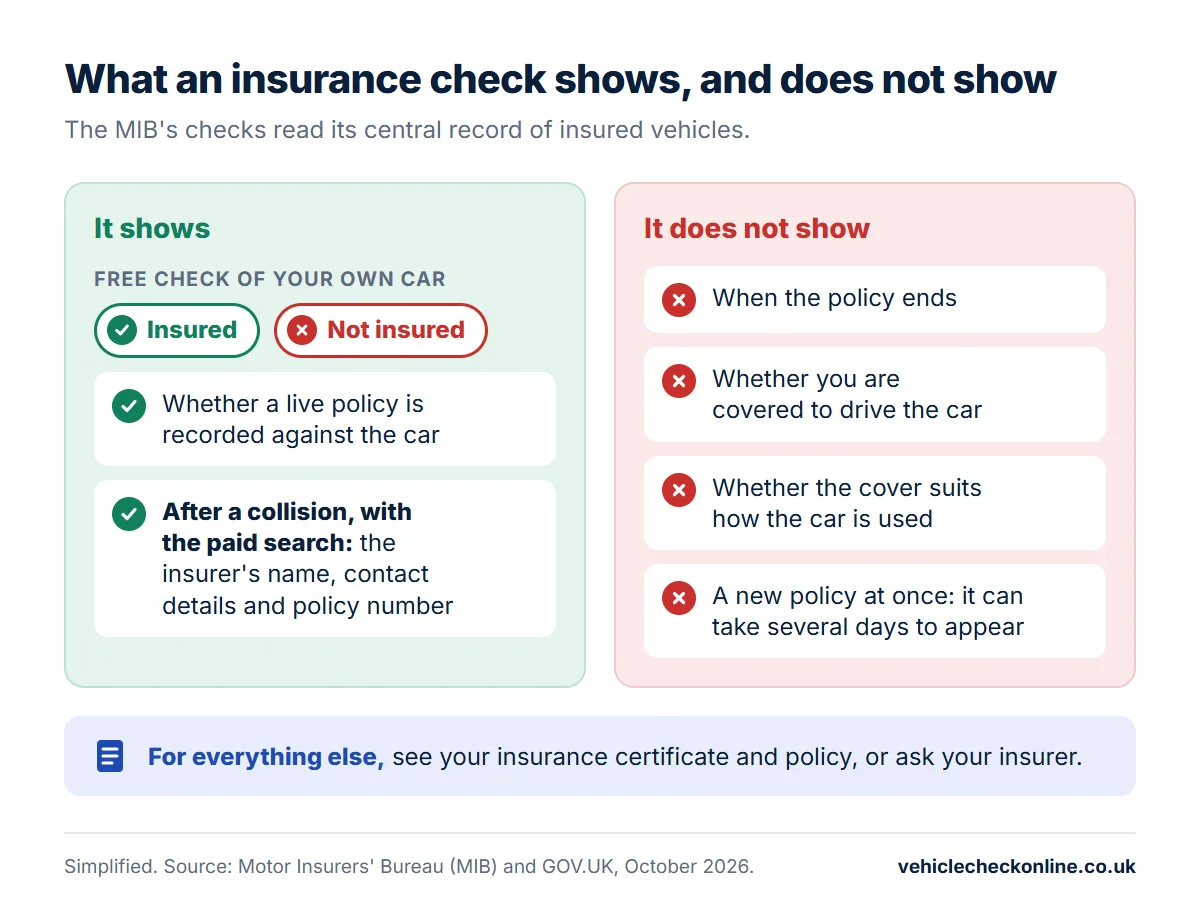
- Read the result. Insured means a live policy is recorded against the car. Not insured means none was found.
The MIB limits how many searches you can run in a short time. If the result surprises you, the sections below explain what it does and does not tell you, and what to do next.
What does an insurance status check show, and what does it not?
"Insured" tells you that a policy exists for the car, nothing more. The MIB says the result does not confirm that it is the right type of policy, for example for the way the car is used, and that for any detail of the cover you need your insurer or your policy documents.
It does not tell you whether you are covered, either. GOV.UK warns that even if a vehicle is insured, you can be penalised if you are not correctly insured to drive it.
How do you check your car insurance expiry date?
No public check shows when a policy ends, so look at your own paperwork. The certificate of motor insurance, in the form set by the Motor Vehicles (Third-Party Risks) Regulations 1972, gives the registration, the policyholder, the date the cover starts, the date it expires, who is entitled to drive and any limits on use. The policy itself gives the full details of the cover.
When your insurer sends a renewal notice, FCA rules say it must show last year's premium beside the new price, so that you can compare them, and must encourage you to check your cover and shop around.
You cannot look up when someone else's policy ends. Even the paid search after a collision gives only the insurer's name and contact details and the policy number.
How do you find out who your car is insured with?
Look at your own records. The insurer's name is on the certificate and the policy schedule, and you will usually find it on the renewal notice, in confirmation emails and against the payments on your bank or card statement. If you bought through a broker, it can tell you which insurer it placed you with.
The free status check will not help here. The MIB says it shows only that a policy exists, and sends you to your insurer or your documents for anything more. The paid askMID search, which does give an insurer's name, is for finding another driver's insurer after a collision, not your own.
Can you check if someone else's car is insured?
Only in one situation. If you have been in a collision with a car, askMID, the MIB's paid service, offers a one-off search for £10 that gives the name and contact details of its insurer and the policy number, so that you can make a claim. Solicitors and claims firms use the same service by subscription.
The MIB is moving askMID onto its Navigate platform and renaming it Check Their Vehicle. On 16 November 2026, askMID gave Monday 7 December as the planned switch and said the fee will stay the same, so you may find the service under either name.
Outside a collision, the free check is for your own car only. The MIB says that misusing it or giving false information may breach its terms of use and the law, and that insurers and solicitors check other vehicles on a separate platform.
So you cannot check the insurance on a car you are thinking of buying, and it would not tell you what matters anyway: whether you are covered to drive it.
For what to do after an accident, including when the other driver did not stop, see our guide to finding a car owner by registration number.
Can the police and the DVLA see if a car is insured?
Yes. The MIB says the police use its insurance data to check a vehicle's status on the road. When a policy or a change is too new to show, an officer can call the MIB's Police Helpline and ask it to contact the insurer for direct proof of cover.
The DVLA uses the same record for continuous insurance enforcement in Great Britain, explained below, but it does not run an insurance check for the public: GOV.UK sends you to askMID instead. Insurers and brokers use the data too, to check a vehicle's status and to fight fraud, on a platform that only authorised professionals can log in to.
Why might a car show as not insured?
A "Not insured" result on a car you thought was covered can have several causes:
- The policy is new. The MIB says it can take several days for a new policy to show. If you have just bought or renewed, search again after seven days, and keep your policy details to hand until the car shows as insured, in case the police stop you.
- The registration on the policy is wrong. The MIB tells drivers to make sure the number plate on their policy is correct, so check it matches the car.
- The policy is not genuine. The MIB warns about "ghost brokers", who sell fake or invalid policies, sometimes by buying a genuine policy with incorrect details and cancelling it soon after to keep the refund. Prices far below other quotes, pressure to pay at once, requests for cryptocurrency and dealing only through social media or messaging apps are all warning signs. Buy only from a regulated insurer or broker, which you can look up on the FCA register.
If the car still shows as not insured, the MIB says you need to act immediately. Contact your insurer, and do not drive the car until you know you are covered.
What is continuous insurance enforcement?
In England, Wales and Scotland, a vehicle must be insured unless it is kept off the road and declared off the road with a SORN, even if nobody drives it. GOV.UK calls this continuous insurance enforcement. Northern Ireland has different rules.
The MIB and the DVLA compare the DVLA's vehicle records with the insurance database, and each month they write to keepers of vehicles that show no live policy. The MIB says this insurance advisory letter is not a fine or a notice of legal action, but the DVLA may take enforcement action if nothing changes.
If you are the registered keeper of an uninsured vehicle that is not declared off the road, GOV.UK says you could be fined £100, have the vehicle clamped, impounded or destroyed, or be taken to court and fined up to £1,000, and you would still have to insure it. Vehicles between keepers, or registered "in trade" with the DVLA, are excluded.
What are the penalties for driving without insurance?
GOV.UK says it is illegal to drive a vehicle on a road or in a public place without at least third-party insurance. The penalties differ between Great Britain and Northern Ireland:
| Where and how | What can happen |
|---|---|
| Great Britain, fixed penalty from the police | A £300 fine and 6 penalty points |
| Great Britain, if the case goes to court | An unlimited fine and disqualification from driving |
| Great Britain, the vehicle | The police can seize it, and in some cases destroy it |
| Northern Ireland, in court | A fine of up to £5,000, up to six months in prison, 6 to 8 penalty points and a possible ban |
The MIB adds that after driving uninsured, any insurance you buy in future is likely to cost more.
Buying a used car: are you insured for the test drive and the drive home?
The MIB is clear that there is no grace period when you buy a car: once you drive it on a public road, you need valid insurance for it. Sort out cover before the test drive, not after you have paid.
- Your own policy. Do not assume it lets you drive other cars. The MIB says driving other cars cover is not always included, is often limited to third-party cover where it is, does not cover other vehicles in your household and is not usually allowed if you are under 25. Check your certificate, which lists who may drive and any limits on use, or ask your insurer.
- A private seller's policy. The seller's word that their insurance covers you is not enough. Check the cover yourself, or arrange your own for that car.
- A dealer. Ask whether its insurance covers you on the test drive, and get the answer before you set off.
- The drive home. The car must be insured for you and taxed in your name before you set off, because the seller's tax does not pass to you. The MIB reminds drivers that if they switch cars, even for a short time, the policy must cover that specific car.
Our guide to buying a car privately puts these steps in order, from the viewing to the drive home.
What can a car history check show, and what can it not?
A car history check cannot tell you whether a car is insured: that answer comes only from the MIB's record. What it can show is the history that shapes your quote. This is where each answer lives:
| What you want to know | Where the answer is |
|---|---|
| Is the car insured right now? | The MIB: free for a car you own or may drive, a paid search after a collision |
| Who insures it, and when the cover ends | The certificate, the policy or the insurer |
| Is it taxed, and does it have an MOT? | Free: our car tax and MOT check shows the MOT and links to the tax record on GOV.UK |
| Has it been written off, and in which category? | A write-off check, part of our Premium report |
| Is finance still owed, or is it recorded as stolen? | Our Premium report |
| Who is the registered keeper? | Not in any check we sell: the DVLA releases keeper details only for a reasonable cause, on form V888 |
What an insurer offers depends on the car's past as well as yours. GOV.UK warns that insuring a repaired write-off can cost more, that not every insurer will cover one, and that an insurer can reject a claim if you do not tell it the car was written off.
Our car history check shows whether an insurer recorded the car as a write-off, with the category and the date of the loss, plus the outstanding finance and stolen checks, in the Premium report, £7.99. It does not check insurance.
If the car turns out to be a repaired write-off, our guide to insuring a Cat S or Cat N car explains what to tell the insurer and why.
Questions and answers
Is askMID free?
Checking your own car is free, on the MIB's Check Your Vehicle service. A one-off askMID search on another car costs £10 and is meant for people involved in a collision with it; askMID says the fee stays the same after the move to Check Their Vehicle.
Does checking my insurance affect my credit score?
No. The MIB says a Check Your Vehicle search does not trigger red flags or credit checks, although every search is stored and shared with the Insurance Fraud Bureau for auditing.
Can I check if my motorbike is insured?
Yes, exactly as you would for a car. The MIB describes its record as covering all insured vehicles in the UK, and Check Your Vehicle works by registration for any vehicle you own or have the legal right to use.
How do I check my car is insured for a driving test?
Ask your insurer. GOV.UK says a car used for a driving test must be insured for a driving test and tells you to check with your insurance company. The free status check cannot answer that, because it only shows that a policy exists.
Is a taxed car always insured?
No. Tax and insurance are separate records, and a car can be taxed with no live insurance policy. Check the insurance on your own car separately.
Do I need insurance if I never drive the car?
Yes, unless you declare it off the road with a SORN and keep it off the road. In England, Wales and Scotland, the keeper of an uninsured car without a SORN can be fined.
Sources
- MIB: Check Your Vehicle, the free insurance check for your own vehicle
- MIB: askMID, insurance details after an accident or collision
- MIB: Resources for the police (the Police Helpline)
- GOV.UK: Vehicle insurance, uninsured vehicles (continuous insurance enforcement)
- GOV.UK: Vehicle insurance, driving without insurance
- nidirect: Penalties for motoring offences in Northern Ireland
Related guides
- Insuring and financing a Cat S or Cat N carCan you insure a Cat S car or get finance on one? What to tell the insurer or lender, why it matters, and what hiding a Cat S or Cat N category can cost you.
- How to buy a used car privately in the UKBuying a car privately in the UK, from advert to driving home: the checks before you view, the paperwork, paying safely and your rights as a private buyer.
- Find a car owner by registration number: what the law allowsCan you find a car owner by registration number? Not from any public lookup. When the DVLA releases keeper details on form V888, and what to do instead.
- What does SORN mean on a car?What does SORN mean? A Statutory Off Road Notification. Where a SORN car can be kept, when it can be driven, how to check SORN and buying a SORN car.
- What to check when test driving a used carA test drive checklist for a used car: what to check before you set off, what to feel and listen for on the road, the checks afterwards and how long to drive.
This guide is general information for people buying, owning or selling a car in the UK, not legal or financial advice. Vehicle Check Online is an independent service, not affiliated with the DVLA, the DVSA or GOV.UK.