
Buying a used car
BHP check: how to find out how much horsepower a car has
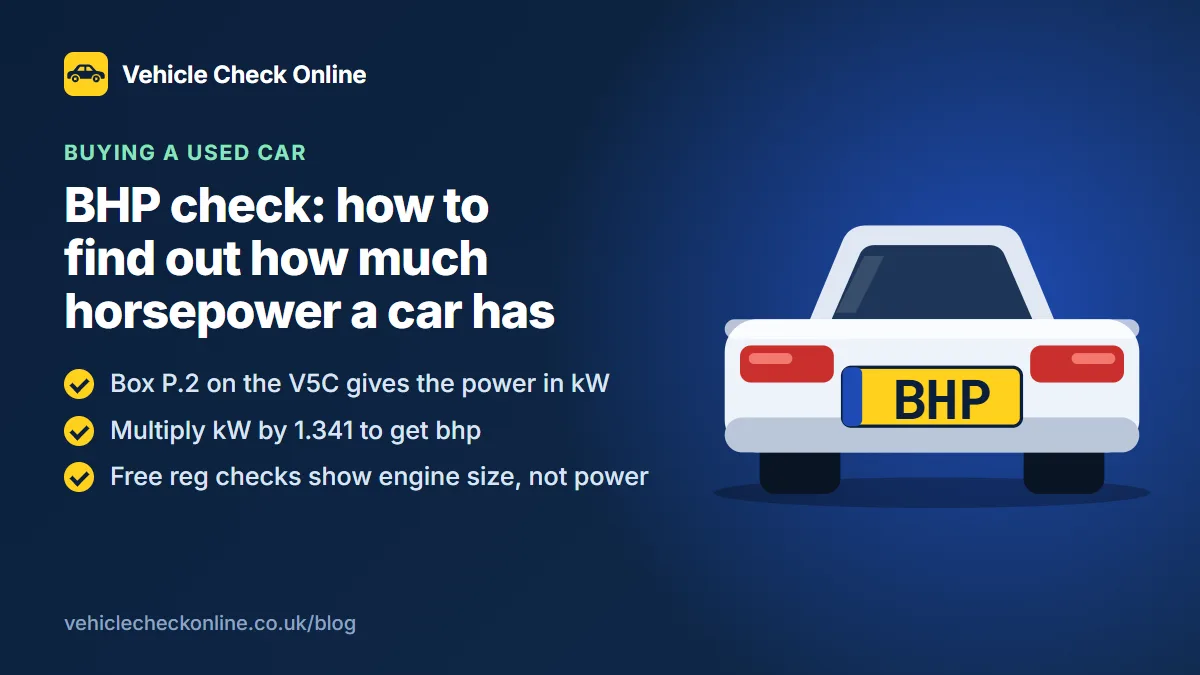
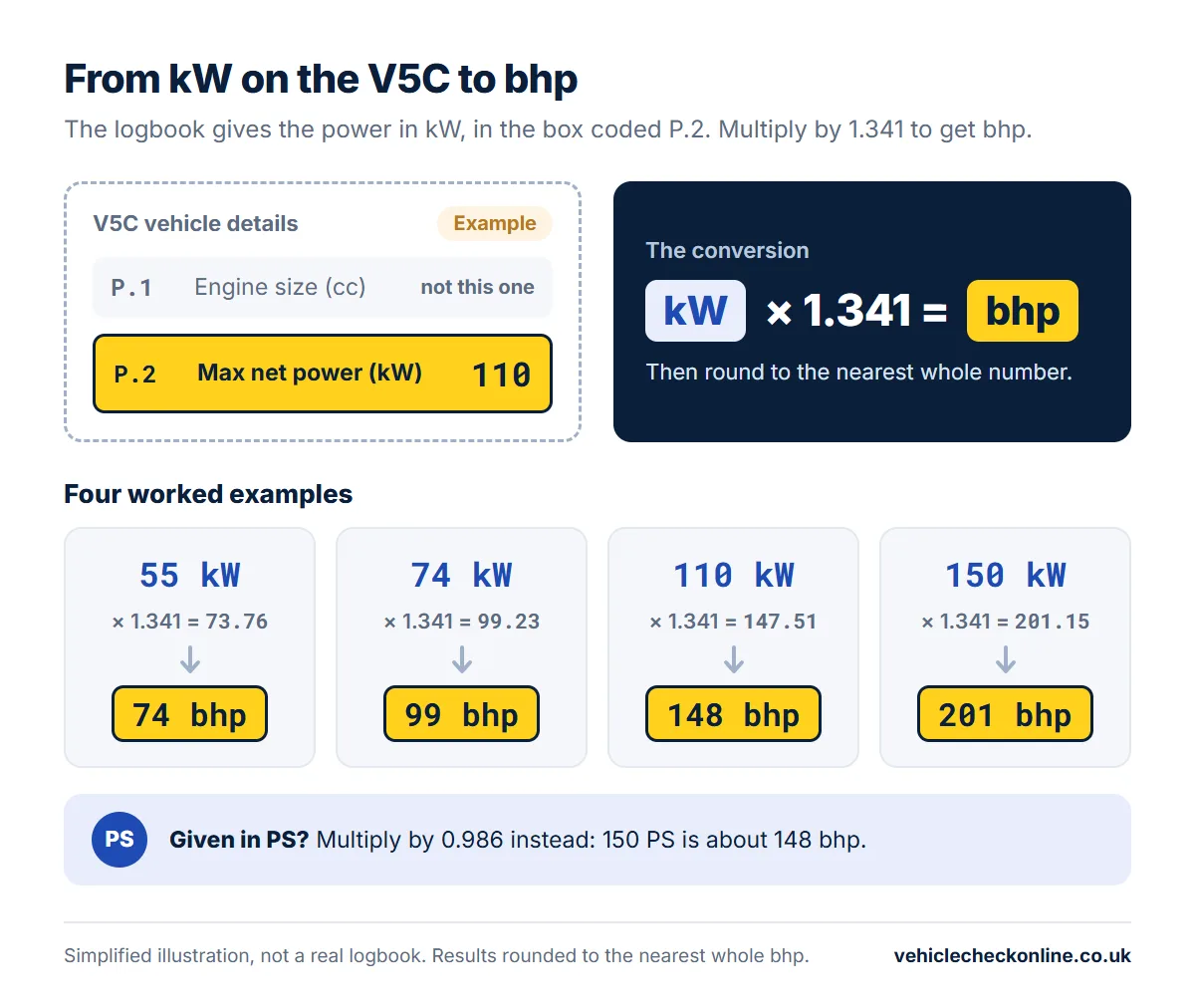
The free way to do a bhp check is your car's V5C logbook: the box coded P.2 gives the engine's maximum net power in kilowatts (kW). Multiply that figure by 1.341 to get brake horsepower (bhp), so 110 kW is about 148 bhp. GOV.UK's free vehicle checks do not show the power.
By registration, you need a report built from vehicle specification data. This guide sets out every route, what is free and what is paid, how to convert kW and PS into bhp with worked examples, and what to do when the power does not match the advert.
How do you check bhp for free on the V5C?
The V5C registration certificate, or logbook, labels the vehicle details with short codes from the common European format for registration documents, which the UK adopted in 2004. In that format, P.2 is the maximum net power, in kW, and P.1 is the cylinder capacity, the engine size, in cubic centimetres (cc). Make sure you read P.2, not P.1.
The figure is the maker's power rating for that version of the car, not a measurement of the car in front of you. The DVLA's guide to registering a new vehicle asks for it to be taken from the Certificate of Conformity and rounded to the nearest whole number of kW.
- Find the vehicle details on the V5C.
- Find the box coded P.2 and note the number. It is in kW.
- Multiply it by 1.341 and round to the nearest whole number. That is the power in bhp.
- Check that the logbook belongs to this car: the VIN printed on it should match the VIN on the car.
The box can be empty, because the European format asks for the power only "if available". In that case, use the maker's documents for the car or a report with its specifications, as explained below.
What horsepower is my car? Every way to find out
There are four places to look. Two are free and give the official or the maker's figure, the free online checks give only the engine size, and a paid report gives the power by registration.
| Where to look | What it gives | Cost |
|---|---|---|
| The V5C logbook, box P.2 | The maximum net power in kW, if it was recorded | Free |
| The maker's documents, such as the handbook or the Certificate of Conformity | The maker's power figure, often in kW or PS | Free, if you have them |
| GOV.UK's vehicle enquiry and MOT history, or our free car page | The engine size in cc, the fuel type and the emissions, but no power figure | Free |
| The Premium report, by registration | The power in bhp, with the torque, 0-60 mph time and top speed, when the data is available | £7.99 |
Whichever figure you find describes that version of the car as it left the factory. It cannot tell you whether the engine has been modified since, which is why the last sections of this guide matter.
Does GOV.UK show what horsepower my car is?
No. GOV.UK's free vehicle enquiry lists the details the DVLA shares about a car: its tax and SORN status, MOT expiry, first registration, the date of the last logbook, year of manufacture, type approval category, weight, engine size, fuel type, emissions and export status. There is no power figure, and the DVLA's description of the data behind the service has a field for the engine capacity in cc but none for the power.
The MOT history on GOV.UK does not give it either. The DVSA's MOT records hold the make, model, colour, fuel type and engine size, with the result and mileage of every test.
So for an official figure, look at the paper logbook rather than the online services. The power declared when the car was first registered is the one printed in box P.2, as explained above.
Can a BHP reg check find the power from the number plate?
Not a free one. Our free pages, such as the free MOT history, show what the MOT records release: make, model, colour, fuel and engine size in cc, with every MOT test. They do not show the power.
Engine size is not power. The cc figure is the volume of the engine's cylinders, while power is how much work the engine can do each second, so you cannot work out the bhp from the cc.
To get the power by registration, you need a report built from vehicle specification data. The Premium report (£7.99) includes a Specifications card with the power in bhp, the torque, the 0-60 mph time and the top speed when the data is available for the car, alongside the outstanding finance, write-off and stolen checks of a car history check.
Like the logbook, a report gives the figure for that version of the car, not a measurement of the car itself. If the report, the logbook and the advert disagree by more than rounding, the sections below explain what to check.
What do BHP, PS and kW mean?
The same engine power can be written in three units. The kilowatt (kW) is the metric unit, and the one the logbook uses. Brake horsepower (bhp) uses the imperial horsepower as its unit. PS, from the German Pferdestärke, is metric horsepower, which is slightly smaller.
| Unit | In watts | In bhp |
|---|---|---|
| 1 kW (kilowatt) | 1,000 W | 1.341 bhp |
| 1 bhp (imperial horsepower) | 745.7 W | 1 bhp |
| 1 PS (metric horsepower) | 735.5 W | 0.986 bhp |
So 1 PS is about 1.4% less than 1 bhp. On a small car the two figures look almost the same, but the gap grows with the power: 100 PS is 99 bhp, while 300 PS is 296 bhp.
Specifications sometimes just say "horsepower" or "hp", which can mean either kind, so check which one is meant before you compare figures.
How do you convert kW to bhp?
Multiply the kW figure by 1.341, then round to a whole number. To go the other way, divide bhp by 1.341: an advert that promises 150 bhp should match a logbook showing about 112 kW.
| kW on the V5C | kW × 1.341 | Power in bhp | The same in PS |
|---|---|---|---|
| 55 kW | 73.76 | 74 bhp | 75 PS |
| 74 kW | 99.23 | 99 bhp | 101 PS |
| 110 kW | 147.51 | 148 bhp | 150 PS |
| 150 kW | 201.15 | 201 bhp | 204 PS |
Expect a small difference from the maker's brochure. The logbook figure is a whole number of kW, and half a kW is about two-thirds of a bhp, so a result one bhp away from the advertised figure is just rounding. A bigger gap is worth a question.
Why does a car horsepower check matter when you buy?
Checking the power takes a minute, and it protects you in three ways.
- Insurance. Insurers use the 1 to 50 group ratings from Thatcham Research to help judge a car's risk. Performance, including the 0-60 time and the top speed, is one of the factors, and so is the price when new, which reflects the trim level. Thatcham says this system is being replaced by a new Vehicle Risk Rating model. Our guide to car insurance groups explains how the ratings work.
- The version you pay for. If the advert names a more powerful version than the logbook shows, you could pay for performance the car does not have. Compare the two before you agree a price, and get an insurance quote for the exact version.
- Modifications. A seller who quotes more power than the logbook shows may have had the engine tuned, for example with a remap of its electronic control unit. That changes what you must tell your insurer, as explained below.
What if the power does not match the advert?
Work out the reason before you go any further:
- Different units. The advert may give PS or kW rather than bhp. Convert it first, using the table above.
- Rounding. A difference of a bhp or two is normal, as explained above.
- A different version. The car may not be the version named in the advert. Our guide to car specs by reg shows how to pin down the model and trim.
- A replacement engine. GOV.UK says a change of engine or of cylinder capacity must be recorded on the V5C, so a swapped engine should show on the logbook. Ask for the paperwork.
- A modification. Ask what was done, by whom and when, and for the invoice. Then get an insurance quote that includes it.
If the engine number or the VIN on the car does not match the logbook, stop there. That is not a power question but an identity one, and our guide on how to tell if a car is cloned explains what it can mean.
Do you have to tell your insurer about a modified car?
The Financial Ombudsman Service says owners should tell their insurer about any modification, even one made before they bought the car. It lists a remap of the electronic control unit for better engine performance among the changes to declare.
Not declaring a modification can lead to the insurance being invalidated or a claim being rejected. When you buy a used car, the Ombudsman suggests asking questions and looking through the paperwork to find out whether it has been modified.
So if the power, the advert or the seller suggests the engine has been tuned, find out what was done before you insure the car, and include it when you ask for a quote. This is general information: your insurer can tell you what your own policy needs.
A car with more power than its logbook shows may have been modified. Tell your insurer about any modification before you drive the car, even if a previous owner made it.
Questions and answers
How many bhp is my car?
Look at box P.2 on your V5C logbook, which gives the power in kW, and multiply it by 1.341. For example, 81 kW is about 109 bhp. If the box is empty, the maker's documents or a specifications report may give the figure.
What kW is my car?
The kW figure is the one printed in box P.2 of the V5C, the maximum net power. If you only know the bhp, divide it by 1.341: 148 bhp is about 110 kW. For a figure in PS, multiply by 0.7355 instead.
Does the V5C show bhp?
No. The logbook gives the engine's maximum net power in kilowatts, in the box coded P.2. Multiply that figure by 1.341 to get the power in brake horsepower.
Is hp the same as bhp?
Not always. Horsepower can mean imperial horsepower, the unit bhp uses, or metric horsepower (PS), which is about 1.4% smaller. Check which one a specification means before you compare.
How do I convert PS to bhp?
Multiply the PS figure by 0.986. For example, 150 PS is about 148 bhp. To turn PS into kW instead, multiply by 0.7355.
Can I check a car's 0-60 time by registration?
Not from the free government services or the logbook, which hold no performance figures. The Premium report's Specifications card gives the 0-60 mph time and the top speed when the data is available; otherwise, look up the maker's figures for that exact version.
Does a car's bhp affect its road tax?
No. Car tax depends on when the car was first registered: engine size before 1 March 2001, then fuel type and CO2 emissions until 31 March 2017. Newer cars pay a first rate set by CO2, then a standard rate, plus a supplement if the list price was high. Power is not one of the factors.
Do I need to tell my insurer about a remap?
The Financial Ombudsman lists remaps among the modifications owners should declare, including ones made before they bought the car. Not declaring a modification can lead to a claim being rejected.
Sources
- GOV.UK: Get vehicle information from DVLA (what the free vehicle enquiry shows)
- GOV.UK: Apply for first vehicle tax and registration of a new motor vehicle (V55/4, with the V355/4 guide)
- legislation.gov.uk: Council Directive 1999/37/EC on registration documents, Annex I (code P.2)
- GOV.UK: Vehicle tax rate tables
- Financial Ombudsman Service: Car modifications and insurance
- Thatcham Research: Group Rating
Related guides
- Car specs by reg: how to check a car's full specificationCar specs by reg: what the free DVLA and MOT records show, what the V5C adds, and how to get the power, mpg, size and VIN in one report, plus the trim.
- Car insurance groups: what they mean and how to find yoursUK car insurance groups rate cars from 1, cheapest to insure, to 50. How to check your car's group by reg, what sets it, what 11E means and what's changing.
- VIN number check in the UK: what a VIN can and cannot tell youVIN number check in the UK: what a free VIN check shows, why history checks use the reg, how to find the VIN from a registration plate, and how to read it.
- Is the car insured? How to check, and what it showsCheck if a car is insured free on the Motor Insurance Database, why another car needs a collision first, and how to find your expiry date and insurer.
- How much is road tax? Check the cost for any carCheck road tax cost for any car: the 2026-27 rates for all three tax systems, how to find a car's figures by reg, and what paying monthly adds.
This guide is general information for people buying, owning or selling a car in the UK, not legal or financial advice. Vehicle Check Online is an independent service, not affiliated with the DVLA, the DVSA or GOV.UK.