
Stolen and cloned cars
VIN number check in the UK: what a VIN can and cannot tell you
A VIN number check does two jobs. Decoding the 17-character VIN shows who made the car and its possible model years, and comparing VINs proves that the car in front of you is the one on its V5C logbook. It cannot show finance, write-offs or theft: for those you need a history check by registration number, which is how the UK's official vehicle records are searched too.
This guide explains what a free VIN check shows and what it cannot, how to use the VIN to make sure a car matches its records, how to find the VIN from a registration plate, and what each of the 17 characters means.
What is a VIN, and how do UK records use it?
The vehicle identification number (VIN) is the code a manufacturer gives a vehicle when it is built. Under the type-approval rules kept in UK law, each VIN must be unique to one vehicle, and the maker must be able to trace the vehicle by its VIN for 30 years. ISO 3779 is the international standard for its layout.
In the UK, though, a car's official records are looked up by its registration number. The DVLA's vehicle enquiry service and the DVSA's MOT history both ask for the number plate, not the VIN, and neither shows the VIN in its results. History checks such as ours are run on the registration too.
So the VIN has a different job: proving that the car in front of you is the car those records describe. GOV.UK's advice to buyers is to check that the VIN and the engine number on the car match the logbook.
What does a free VIN check tell you?
A free VIN check decodes the number itself. Our free VIN decoder takes a 17-character VIN and shows:
- the manufacturer, from the first three characters
- the region the first character points to
- the possible model years, from the 10th character
- the serial part at the end of the number
That is enough to catch a VIN that cannot belong to the car: one that decodes to a different maker, or to model years that do not fit the logbook. The decoder also rejects a VIN that is not 17 characters long or that contains I, O or Q, letters a genuine VIN never uses, so it catches some misread numbers too.
What can't a free VIN check tell you?
A VIN decoder reads the number; it does not search any records. This is what each kind of check can answer:
| Question | Free VIN check | History check by registration |
|---|---|---|
| Who made the car? | Yes, from the first three characters | Yes |
| How old is it? | Possible model years, if the 10th character is a year code | The date of first registration |
| Is there finance outstanding? | No | Yes |
| Has it been written off? | No | Yes |
| Is it recorded as stolen? | No | Yes, with a stolen car check |
| Is this the car on the paperwork? | Only if you compare the VINs yourself | Shows the VIN on record, to compare |
Our car history check covers all of these in the Premium report (£7.99), with the previous keepers, plate changes and mileage history.
Be careful with websites that offer a free VIN check with accident or theft records. Ask which country's records they search: records kept abroad say nothing about a car's life in the UK.
How do you use the VIN to prove the car matches its records?
This is the most useful thing you can do with a VIN, and it takes a few minutes at the viewing.
- Read the VIN in two or more places on the car and make sure they agree.
- Compare it, character by character, with the VIN printed on the V5C logbook.
- Compare it with the VIN on record for the registration. The Premium report shows it, so you can tell whether the plates and the car belong together.
- Decode it, and check that the maker and the possible model years fit the car and the logbook.
Compare all 17 characters, not just the first few: the first nine describe the maker and the type of vehicle, so cars of the same model can share them. If any copy differs, the car is not the one the paperwork describes, which is how cloned cars are caught. Our guide on how to tell if a car is cloned covers the other signs.
A match is only as good as the logbook you compare it with. Our guide on how to check a V5C is genuine explains how to spot a forged or stolen one.
If the VIN on the car differs from the logbook, or looks tampered with, do not buy the car.
Can you find the VIN number from the registration plate?
You cannot get it from the free government services, because neither the DVLA's vehicle enquiry nor the MOT history shows it. There are three ways:
- From the V5C logbook. The VIN is printed in the vehicle details, so the keeper can read it to you before you travel, and you can check it again on the document at the viewing.
- From the car. Our guide to where the VIN number is shows every place to look, from the windscreen to the number stamped into the body.
- From a history report. The Premium report shows the full VIN on record for the registration, so you have it before you see the car, and it does not depend on the seller. See the VIN check by registration.
Asking a seller for the VIN before a viewing is reasonable. With it, you can decode the number and compare it with the VIN on record before you set off.
How do you read a 17-character VIN?
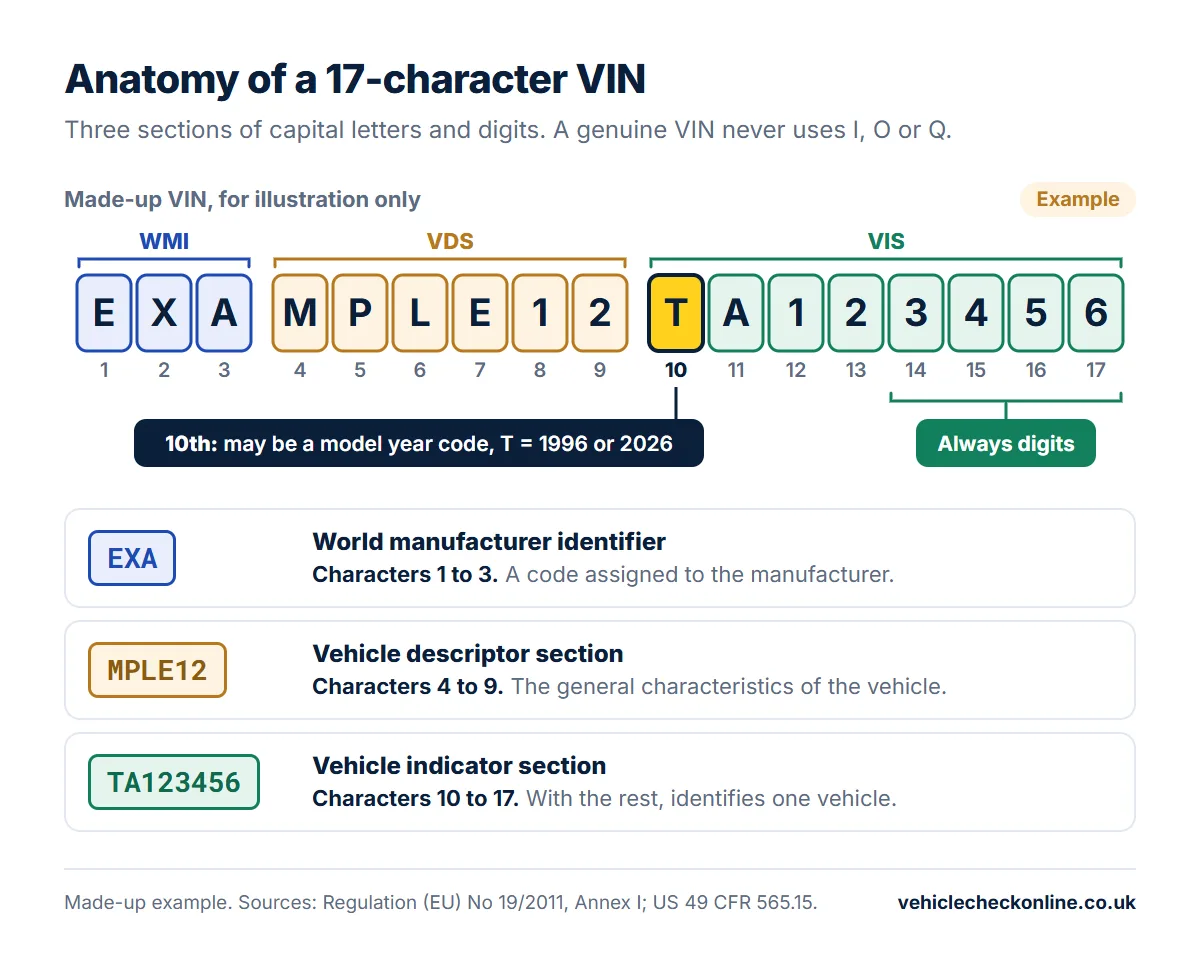
Under the type-approval rules, a VIN has 17 characters in three sections. It uses capital letters and digits only, never the letters I, O or Q, and the last four characters are always digits.
| Characters | Section | What it shows |
|---|---|---|
| 1 to 3 | World manufacturer identifier (WMI) | A code assigned to the manufacturer, so it can be identified |
| 4 to 9 | Vehicle descriptor section (VDS) | The general characteristics of the vehicle |
| 10 to 17 | Vehicle indicator section (VIS) | With the other two sections, one particular vehicle |
The made-up example in the picture below, EXAMPLE12TA123456, splits into EXA, the manufacturer code; MPLE12, which describes the vehicle; and TA123456, the vehicle indicator, which ends in four digits.
The 10th character may be a code for the model year. US rules require one there for vehicles made for that market, using codes that repeat every 30 years, so T stands for 1996 or 2026. The UK rules on the VIN do not mention the model year, so on other cars the 10th character may mean something else. Treat the decoded year as a clue, and check it against the date of first registration.
Questions and answers
Is a free VIN check enough before buying a car?
No. It tells you what the VIN says about the car, not what has happened to it. Use it alongside a history check by registration, and compare the VIN on the car with the logbook yourself.
Is a VIN check the same as a car history check?
No. A VIN check decodes the number. A history check searches records such as finance agreements, insurers' write-off records and stolen vehicle reports, and ours is run on the registration.
Which letters are never used in a VIN?
The letters I, O and Q are not allowed. If a VIN you have been given contains one of them, a character has been misread or the number is not genuine.
What does the 10th character of a VIN mean?
It may be a model year code. US rules require one for vehicles made for that market, and each code stands for two years 30 years apart, so a decoder gives two possible years. UK rules do not require a year code.
Does the VIN show the car's colour or engine size?
Not in a form a free decoder can read. The middle six characters describe the vehicle's general characteristics, so use the V5C and the official records for the colour and the engine size.
Sources
- legislation.gov.uk: Regulation (EU) No 19/2011, Annex I (VIN structure)
- ISO 3779:2009, Road vehicles: vehicle identification number (VIN), content and structure
- Cornell LII: US rules on VIN content, 49 CFR 565.15 (model year code)
- GOV.UK: Check a used vehicle you're buying
- GOV.UK: Get vehicle information from DVLA
Related guides
- Where is the VIN number on a car and on the V5C?Where is the VIN number on a car? The windscreen, door frame, under the bonnet and carpet, and the V5C. How to read it, and why every copy must match.
- How to tell if a car is cloned before you buy itHow to tell if a car is cloned: match the VIN, the V5C logbook and the official record, and meet at the keeper's address. Step-by-step checks for buyers.
- How to check a V5C logbook is genuineHow to check a V5C is genuine: the DVL watermark, the serial number and the stolen V5C serial numbers, and the VIN and keeper details to match.
- Car specs by reg: how to check a car's full specificationCar specs by reg: what the free DVLA and MOT records show, what the V5C adds, and how to get the power, mpg, size and VIN in one report, plus the trim.
- How to check if a car has been scrapped or exportedHow to check if a car is scrapped or exported: what a certificate of destruction and the DVLA record mean, why it matters, and the checks before you pay.
This guide is general information for people buying, owning or selling a car in the UK, not legal or financial advice. Vehicle Check Online is an independent service, not affiliated with the DVLA, the DVSA or GOV.UK.