
Stolen and cloned cars
How to tell if a car is cloned before you buy it
A cloned car is usually a stolen car wearing the identity of a similar, legitimate car. You can tell if a car is cloned by checking that its identity matches everywhere: the VIN on the car, the V5C logbook and the vehicle's official record must all describe the same car, and the seller must be the keeper named on the logbook.
Cloning works because a quick look at the number plate tells you nothing. This guide explains what cloning means, why a clean history check on the plates can miss it, and the checks that catch it: the VIN, the logbook, the record, the MOT history, the plates and the place you meet.
What is a cloned car?
A car is cloned when criminals give it the identity of another car of the same make, model and colour. They fit copies of that car's number plates and may bring a forged or stolen logbook to match. Police advice describes cloned or "ringed" vehicles as a common way to sell a stolen car.
The genuine car is still on the road somewhere, owned by someone who has no idea. Every check you run on the registration describes that genuine car, which is why a cloned car can look clean on paper.
This is different from plate cloning to dodge fines, where someone copies your plates and the speeding tickets or parking charges come to you. That is a problem for the owner of the copied plates, and something to report to the police. This guide is about the buyer's side: making sure the car in front of you is the car on the paperwork.
Why can a clean history check miss a clone?
A car history check searches by registration. If the plates belong to a genuine car that is not stolen, the stolen check comes back clear, because that car is not stolen. The PSNI warns that vehicle history checks may not reveal that a stolen vehicle has been cloned.
What does catch a clone is comparing identities. A good report shows the VIN and engine number recorded for the registration. If the numbers on the car in front of you are different, it is not the car the plates belong to, however clean the record looks. Our cloned car check page lists what to compare, line by line.
A clear stolen check on the plates is not proof that the car is genuine. The VIN comparison is what catches a cloned car.
How do you check if a car is cloned?
Every check below asks the same question: do all the sources describe one car? Work through them in order, and stop at the first one that fails.
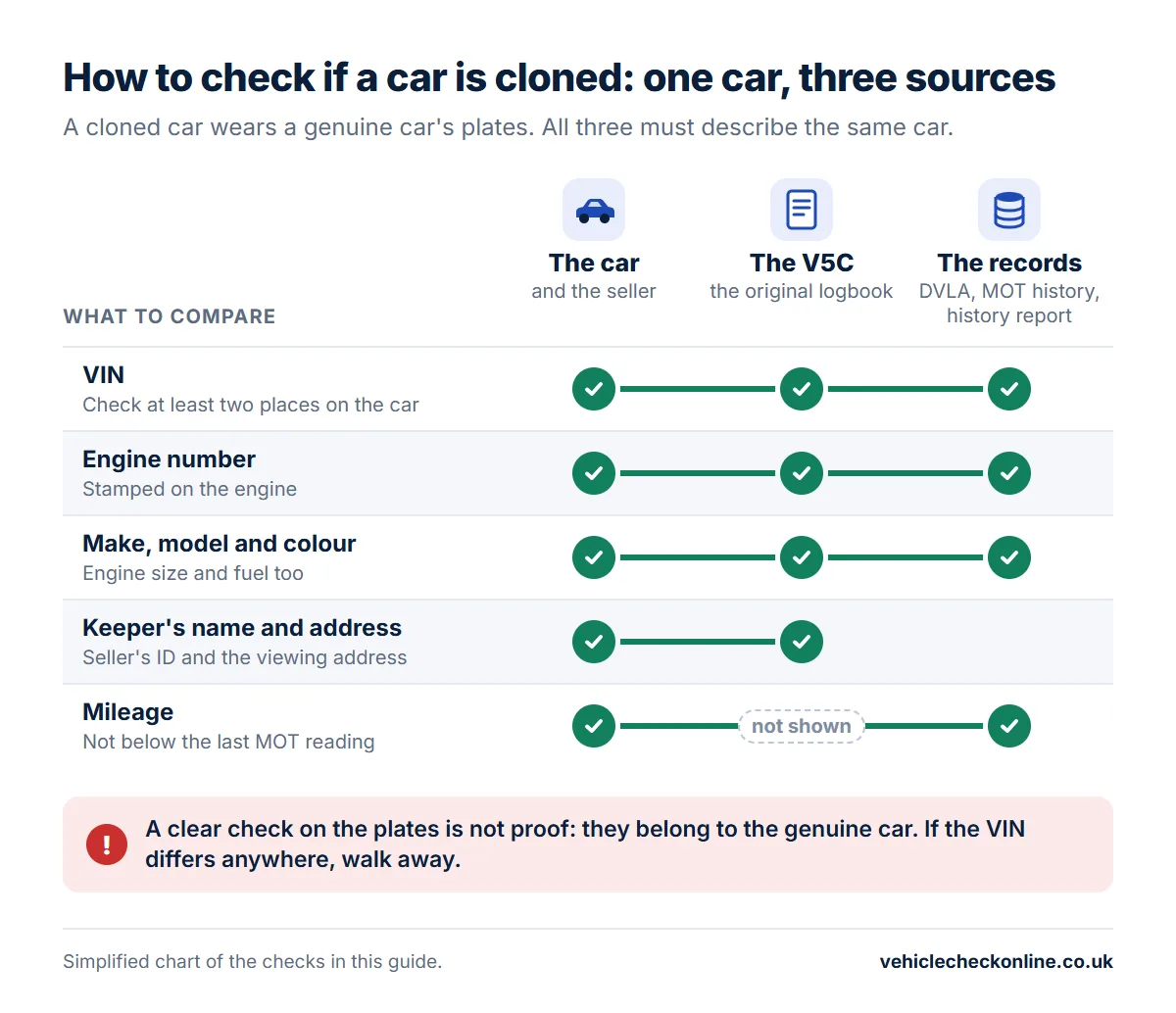
| What to compare | Where to find it | What should match |
|---|---|---|
| VIN | Stamped in the car's structure, on a plate or label, often visible through the windscreen, and on the V5C | Every copy, character for character, and the VIN on record |
| Engine number | Stamped on the engine, and on the V5C | The V5C and the record |
| Make, model, colour, engine size, fuel | The car itself, the V5C, the DVLA and MOT records | All of them |
| Keeper's name and address | The V5C, the seller's ID, the place you view | The seller is the keeper, at that address |
| Mileage | The dashboard and the MOT history | The dashboard is not below the last MOT reading |
- Before you view, ask for the registration, make, model and MOT test number, and compare them with the DVLA's free vehicle information on GOV.UK and the car's free MOT history.
- At the viewing, find the VIN in at least two places on the car and check they are identical.
- Compare that VIN, and the engine number, with the V5C logbook.
- Compare them with the VIN and engine number on record for the registration. Our stolen car check report lists both, with the stolen record and any plate changes, for £7.99.
- Check the logbook itself, and that the seller is the keeper it names.
Why check the VIN in more than one place?
The VIN (vehicle identification number) is the car's fingerprint: 17 characters, never using the letters I, O or Q. Under the type-approval rules, it is stamped into the chassis or body structure on the right-hand side of the car, and repeated on the manufacturer's plate. Many cars also show it through the base of the windscreen. Our guide to where the VIN number is goes through the usual places.
Thieves can swap an easy-to-reach plate or label more easily than they can change the number stamped into the metal, so check more than one location. Look for signs of tampering:
- A VIN plate held by screws or glue: the rules require metal plates to be riveted.
- A VIN label that is torn, bubbled or looks re-stuck: labels must be tamper-evident and break if someone tries to remove them.
- Scratches, grinding marks, fresh paint or filler around the stamped number.
- Characters that are uneven, misaligned or a different style from the rest.
- A windscreen VIN that is covered, missing or unreadable when the rest of the car is tidy.
If the VIN is missing or looks altered, do not buy the car, whatever the explanation.
Does the car match its official record?
Thieves pick a genuine car that looks like the stolen one, but the match is rarely perfect. Compare the car in front of you with the record, detail by detail: the model and body style, the engine size, the fuel type, the year of manufacture and the colour.
A colour change has to be recorded on the V5C, and so does a change of engine. A car that is silver when the logbook and the record say blue, or a diesel when the record says petrol, has either a change nobody declared or the wrong identity. Ask the seller to explain, and expect paperwork that proves it.
Use the free VIN decoder as well: it reads the manufacturer and model year from the VIN, which should fit the car and the logbook.
What can the MOT history reveal about a cloned car?
The MOT history is free and covers every test in Great Britain since 2005. It belongs to the genuine car, so anything that cannot be true of the car in front of you is a warning.
- Mileage: if the dashboard shows fewer miles than the last MOT reading, the car has either been clocked or is not the car on the record.
- Dates: a test passed recently somewhere else while the seller says the car has not moved is a question to ask.
- Places: GOV.UK shows where each test was done if you enter the 11-digit reference from the V5C. Tests far from where the seller lives are not proof of anything, but they are worth asking about.
Our guide on what to look for in an MOT history explains the rest of the record.
How do you check the logbook and the number plates?
A cloned car may come with a forged logbook or a stolen blank one. GOV.UK says a genuine V5C has a "DVL" watermark and lists serial number ranges of stolen blank logbooks. The keeper named on it should be the seller, and the VIN on it should match the car. Our guide on how to check a V5C is genuine covers each check.
Look at the plates too. Number plates must be made by a registered supplier, who has to see proof of identity and a document showing you are entitled to use that registration, such as the V5C. Plates must carry the British Standard number (BS AU 145e for plates fitted after 1 September 2021) and be marked to show who supplied them.
Plates with no supplier marking, or brand new plates on an older car, are not proof of cloning, but ask where they came from. A number plate history check that shows recent plate changes deserves the same question.
Why meet at the keeper's address, not a car park?
DVSA's Safe Driving for Life guidance says you should expect to view the car at the address on the V5C. A seller who has the car legitimately can show it at home. A seller of a cloned car usually cannot, because the address on the logbook belongs to the genuine keeper.
Be wary of these, especially together:
- The seller wants to meet in a car park, at a station or at the roadside.
- The name on the logbook is not the seller's, or they cannot show ID with the same name and address.
- The price is well below similar cars, and the seller is in a hurry.
- The seller wants cash and will not give a landline or home address.
- There is only one key, or the locks or ignition show damage.
What should you do if you think a car is cloned?
Do not buy it, and do not confront the seller. Make an excuse and leave. GOV.UK advises calling the police as soon as it is safe to if the logbook may be stolen; use 101, or 999 if you feel in danger.
Keep the advert, the seller's phone number and messages, and note the registration and anything you saw. The police can use all of it.
If you have already bought a car that turns out to be cloned, it is treated as a stolen car. Our guide on what happens if you buy a stolen car explains the general position and where to get help.
Questions and answers
Can a clean history check miss a cloned car?
Yes. The check describes the genuine car the plates belong to, so it can come back clear. Comparing the VIN on the car with the VIN on record for the registration is what shows the difference.
Is it illegal to buy a cloned car without knowing?
Citizens Advice says you should not get into trouble if you did not know a car was stolen when you bought it. You can still lose the car, because it will be returned to its owner or their insurer.
What if the VIN on the car does not match the logbook?
Walk away. A VIN that differs from the V5C, or differs between two places on the car, means the car is not the one on the paperwork. Tell the police once you have left.
Can I check a VIN for free?
You can read what a VIN says about the car, such as the manufacturer and model year, with a free VIN decoder. Checking which registration the VIN belongs to needs a history check that holds the VIN on record.
Does a cloned car always have fake plates?
Its plates show a real registration that belongs to another car, so the registration itself is genuine. That is why the plates, on their own, prove nothing about the car they are fitted to.
Are new number plates a sign of cloning?
Not on their own: plates are replaced after damage or for a private number. Ask where they were made, check they show the supplier and the British Standard marks, and check the VIN either way.
Sources
- GOV.UK: Check a used vehicle you're buying
- PSNI: Vehicle buying and selling advice
- GOV.UK: Check the MOT history of a vehicle
- GOV.UK: Getting number plates made up
- legislation.gov.uk: Regulation (EU) No 19/2011, Annex II (VIN marking)
Related guides
- Where is the VIN number on a car and on the V5C?Where is the VIN number on a car? The windscreen, door frame, under the bonnet and carpet, and the V5C. How to read it, and why every copy must match.
- How to check a V5C logbook is genuineHow to check a V5C is genuine: the DVL watermark, the serial number and the stolen V5C serial numbers, and the VIN and keeper details to match.
- Bought a stolen car without knowing? What happens nextWhat happens if you buy a stolen car: the police can return it to its owner or insurer. The law in plain English, options for your money and where to get help.
- Car buying scams in the UK and how to avoid themCar buying scams in the UK: fake sellers, deposit and delivery scams, cloned cars and hidden finance. The warning signs and the check that stops each one.
This guide is general information for people buying, owning or selling a car in the UK, not legal or financial advice. Vehicle Check Online is an independent service, not affiliated with the DVLA, the DVSA or GOV.UK.