
Buying a used car
Car buying scams in the UK and how to avoid them
The most common car buying scams in the UK are sellers who take a deposit or full payment for a car that does not exist, and cars that are stolen, cloned, still on finance, written off or clocked. Most of them fail against two simple rules: see the car at the seller's home before you pay anything, and check its history by registration.
UK Finance's Annual Fraud Report 2026 names a criminal posing as the seller of a car as a typical purchase scam. Purchase scams made up 71% of the bank transfer scam cases it recorded in 2025, with £118.1 million lost. This guide lists the car scams to look out for, how each one works, the warning signs, and the check that stops it.
Which car scams should you look out for?
| Scam | Warning sign | What stops it |
|---|---|---|
| Deposit for a car that does not exist | Seller cannot show the car, wants money first | Never pay before seeing the car and its logbook |
| Fake delivery or escrow service | Seller suggests a delivery or payment company | Collect in person; never pay a service the seller picked |
| Stolen or cloned car | Low price, meeting away from home, VIN that does not match | Stolen check and a VIN match |
| Car still on finance | Seller vague about who owns it | Outstanding finance check |
| Hidden write-off | Fresh paint, uneven panel gaps, "never been in an accident" | Write-off check |
| Clocked mileage | Wear that does not fit the miles | MOT mileage history |
| Fake or stolen logbook | No DVL watermark, serial in a stolen range | Logbook checks against the DVLA record |
| Trader posing as a private seller | Several cars for sale, car not in their name | Ask, and check the logbook |
What are deposit scams for cars you have never seen?
The advert shows a popular car at an attractive price. The seller is friendly but cannot meet, and always has an excuse. Other buyers are interested, so they ask for a deposit to hold the car, or the full price by bank transfer, and promise to deliver it. Once the money arrives, the seller disappears. There was never a car.
UK Finance reports that losses to advance fee scams rose by 65% in 2025, and says criminals targeting deposits for high-value goods such as motor vehicles that do not exist are one of the reasons.
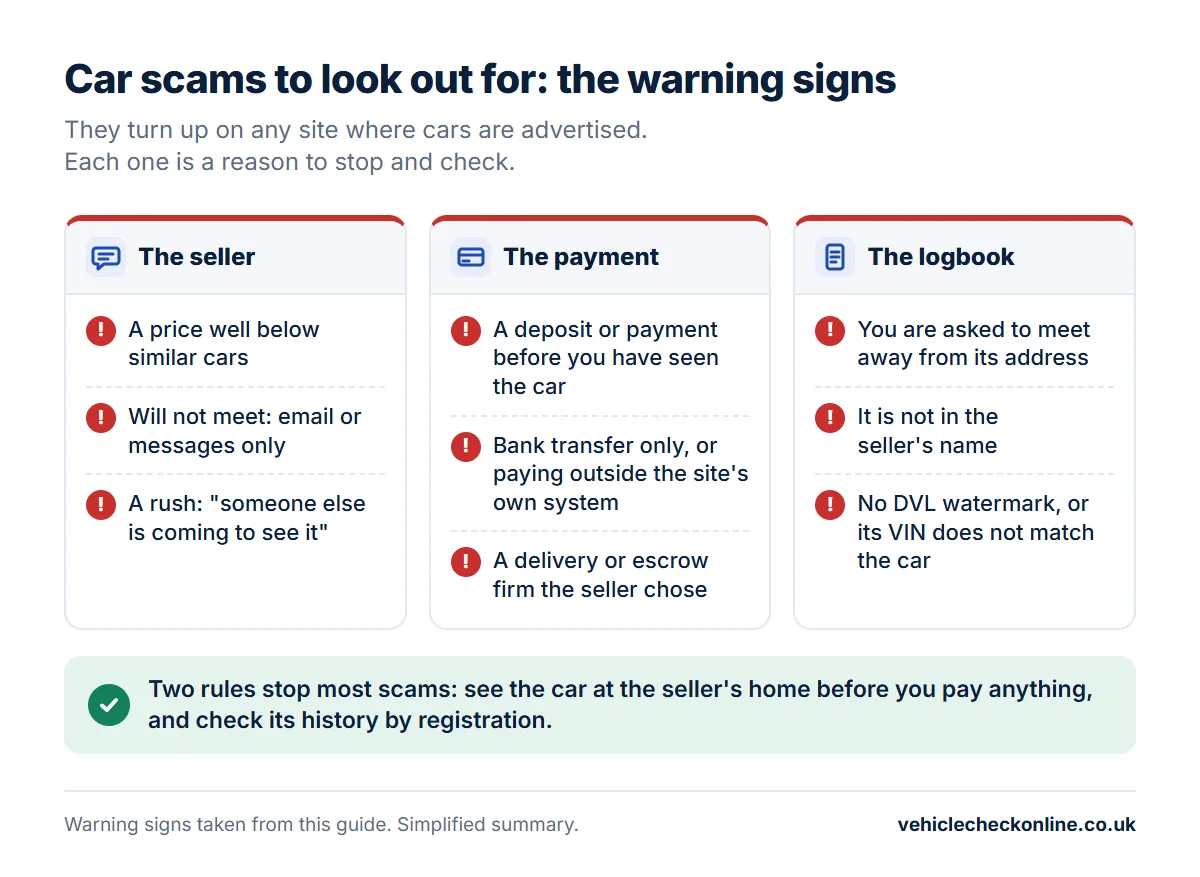
- The price is well below similar cars.
- The seller has a reason not to meet, and will only talk by email or message.
- You are pressed to decide quickly because "someone else is coming to see it".
- The seller insists on a bank transfer rather than meeting you with the car.
What stops it: never send money for a car you have not seen. Get Safe Online advises that if a seller does ask for a deposit, you pay no more than you are willing to lose and confirm that it will be refunded if you do not buy. Get that promise in writing.
How do fake delivery and escrow scams work?
A variation on the deposit scam adds a third party that seems to protect you. The seller suggests a delivery company, or an "escrow" service that holds your money until you accept the car. The emails and website look professional, but the company is fake and the money goes straight to the fraudster. The PSNI lists shipping and escrow frauds among the scams used against vehicle buyers.
Get Safe Online warns that requests for up-front transport fees could be a scam. UK Finance notes that while many online platforms offer secure payment options, the criminal persuades the victim to pay by bank transfer instead.
What stops it: collect the car yourself from the seller's address. Never pay a delivery or payment company that the seller chose, and never move a payment away from the site's own system because the seller asks.
How can you tell a car is stolen or cloned?
Here the car is real, but it is not the seller's to sell. The PSNI warns that vehicle identities are often changed to sell a stolen car, and that innocent buyers of stolen vehicles may have the car taken from them and lose the money they paid.
A cloned car wears the number plates of a similar car that is not stolen, so a check on those plates can come back clear. What exposes it is the VIN: the number on the car must match the logbook and the record. Our guide on how to tell if a car is cloned shows how.
What stops it: a stolen car check, a VIN match, and viewing the car at the address on the logbook with the keeper it names.
Why are cars with outstanding finance a risk?
The logbook shows the registered keeper, who may not be the legal owner. The PSNI points out that the owner may be a finance company. If money is still owed under a finance agreement, the lender may have a claim to the car after you have paid for it.
What stops it: an outstanding finance check before you pay.
If a check shows a live agreement, our guide to buying a car with outstanding finance explains the options.
How do you uncover hidden write-offs and clocked cars?
Some scams are about what the seller does not tell you. A car written off by an insurer and repaired can be advertised as "never been in an accident". A car whose odometer has been wound back looks less used and sells for more. Both leave traces in the records a car history check reads.
What stops it: a write-off check shows any Cat S, Cat N or older write-off recorded by insurers.
For mileage, the free mileage check lists every reading from the car's MOT tests, so a dashboard figure below an earlier reading stands out.
How do you spot fake and stolen logbooks?
A stolen or cloned car usually comes with paperwork to match. GOV.UK says a genuine V5C has a "DVL" watermark and lists two ranges of serial numbers from stolen blank logbooks: BG8229501 to BG9999030 and BI2305501 to BI2800000. A logbook in either range may be stolen, and GOV.UK says to call the police as soon as it is safe.
What stops it: check the watermark, the serial number, the keeper's details and the VIN, then compare the logbook with the DVLA's free vehicle record. Our guide on how to check a V5C is genuine goes through each step.
How do you spot traders posing as private sellers?
Some dealers advertise cars as private sales, because a private buyer has fewer rights than someone buying from a trader. Since 6 April 2025, the Digital Markets, Competition and Consumers Act 2024 lists falsely claiming not to be acting for business purposes, or posing as a consumer, among the commercial practices that are always considered unfair.
Warning signs include the same phone number in several car adverts, several cars for sale at once, and a logbook that is not in the seller's name. Ask directly whether they are a trader. Our guide to private sellers and dealers explains the difference in your rights.
How do you avoid car scams on Facebook Marketplace and other sites?
Car scams can turn up on any site where people advertise cars: social media marketplaces, classified sites and auction sites alike. As the PSNI puts it, an advert is just a way of putting a buyer and a seller in touch. Do not assume the site has inspected the car or checked that the seller owns it.
The same habits protect you wherever you find the car:
- Save the advert and the seller's profile, in case the listing disappears.
- Keep messages on the site rather than moving to email or another app.
- Use the site's own payment system if it has one, and never pay outside it because the seller asks.
- Report an advert you think is a scam to the site, so others are not caught out.
How you pay matters as much as where you find the car. Our guide to the safest way to pay for a car privately compares the options.
What should you do if you have been scammed?
- Call your bank straight away, using the number on your card or statement. Since October 2024, payment firms have had to reimburse many victims of bank transfer scams paid by Faster Payments or CHAPS, for payments up to £85,000 and claims made within 13 months. The sooner you ask, the better.
- Report it. In England, Wales and Northern Ireland, report fraud to Report Fraud, run by the City of London Police, at reportfraud.police.uk or on 0300 123 2040. In Scotland, call Police Scotland on 101.
- Report the advert and the seller to the site where you found them.
- Keep everything: the advert, messages, bank details you were given, receipts and the crime reference number.
- If you paid by card, ask your card provider about a chargeback or, for a credit card, a section 75 claim.
Questions and answers
What is the most common car buying scam?
Paying for a car that does not exist. UK Finance names a criminal posing as the seller of a car as a typical purchase scam, and purchase scams were the most common bank transfer scam it recorded in 2025.
Is it safe to pay a deposit on a used car?
Only after you have seen the car and its logbook at the seller's home. Keep it small, and get the seller's promise to refund it in writing if the sale does not go ahead.
Can I get my money back if I paid a scammer by bank transfer?
Possibly. Banks must reimburse many victims of bank transfer scams, within limits, but each case is assessed on its facts. Call your bank as soon as you realise, and report the fraud.
How can I tell if a car seller is genuine?
A genuine private seller can show you the car at the address on the logbook, has ID in the name of the keeper, and has details that match the DVLA record. Anyone who cannot do all three needs a good explanation.
Can a car history check stop a scam?
It catches cars recorded as stolen, written off or on finance, and shows mileage readings that do not fit. It cannot prove a car exists or that the seller owns it, so see the car and match its VIN as well.
Sources
- UK Finance: Annual Fraud Report 2026 press release (15 June 2026)
- UK Finance: Annual Fraud Report 2026 (purchase and advance fee scams)
- PSNI: Vehicle buying and selling advice
- Get Safe Online: Buying and selling vehicles online
- Gwent Police and Crime Commissioner: New Report Fraud service launched
- legislation.gov.uk: Digital Markets, Competition and Consumers Act 2024, Schedule 20
Related guides
- What is the safest way to pay for a car privately?The safest way to pay for a car privately: bank transfer at handover, name checks, transfer limits, cash and banker's drafts, and what to do if finance is owed.
- How to buy a used car privately in the UKBuying a car privately in the UK, from advert to driving home: the checks before you view, the paperwork, paying safely and your rights as a private buyer.
- How to tell if a car is cloned before you buy itHow to tell if a car is cloned: match the VIN, the V5C logbook and the official record, and meet at the keeper's address. Step-by-step checks for buyers.
- Buying a used car: private seller vs dealerPrivate seller vs dealer: your legal rights, returns, warranties, price and risks when buying a used car in the UK, and the checks you still need either way.
- Buying a car online without seeing it: is it safe, and what are your rights?Buying a car online without seeing it: the 14-day right to cancel a dealer sale, why private sellers differ, the checks before you pay, delivery and scams.
This guide is general information for people buying, owning or selling a car in the UK, not legal or financial advice. Vehicle Check Online is an independent service, not affiliated with the DVLA, the DVSA or GOV.UK.