
Buying a used car
Buying a car online without seeing it: is it safe, and what are your rights?
Buying a car online without seeing it can be safe if the seller is a genuine dealer and you check the car's history before you pay. When a trader sells you a car at a distance, the Consumer Contracts Regulations 2013 generally let you cancel within 14 days of delivery without giving a reason, alongside your Consumer Rights Act 2015 rights if it is faulty. A private seller offers neither.
This guide explains how those rights work and when they do not apply, why buying unseen from a private seller carries more risk, the checks to make before you pay, what to do when the car arrives, and where deposits fit in. The law is described here in general terms; Citizens Advice can tell you how it applies to your own purchase.
What are your rights when buying a car online from a UK dealer?
Two sets of rules apply when you buy from a dealer without visiting. The Consumer Contracts (Information, Cancellation and Additional Charges) Regulations 2013 give you a right to cancel, so you can change your mind. The Consumer Rights Act 2015 covers the car itself, which must be of satisfactory quality, fit for purpose and as described.
The right to cancel applies to a distance contract. The regulations define this as a contract between a trader and a consumer, made under the trader's organised system for selling at a distance, without the two of you being physically together and using only means such as a website, email or phone up to the moment the contract is made. A car ordered and paid for online can count even if you collect it later, but a deal you agree face to face at the dealership does not.
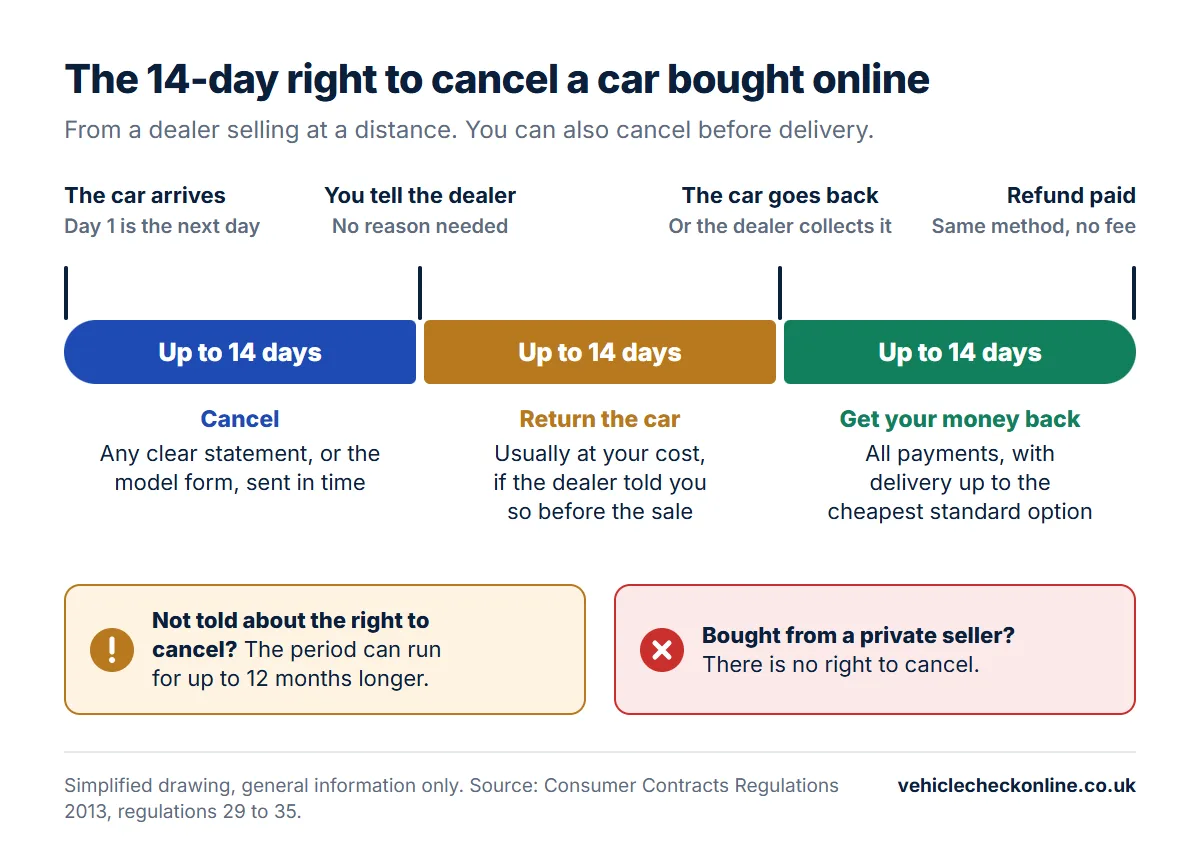
Within the cancellation period you can cancel without giving any reason. The period starts when the contract is made and ends 14 days after the day the car comes into your physical possession, or that of someone you nominated other than the delivery firm. Citizens Advice calls this a cooling-off period and points out that 14 days is the minimum: a dealer can offer longer.
| If you cancel | What the regulations say |
|---|---|
| Telling the dealer | Any clear statement, or the model cancellation form, sent before the period ends |
| Returning the car | Within 14 days of telling the dealer, unless the dealer has offered to collect it |
| Cost of returning it | Yours, unless the dealer agreed to pay it or did not tell you before the sale that you would have to |
| The refund | All payments, with delivery up to the cost of the cheapest standard option, by the same payment method and with no fee |
| When it is due | Within 14 days of the dealer getting the car back or proof you sent it, or of your notice if it offered to collect |
| Deductions | Only for loss in value from handling the car more than needed to establish what it is and how it works |
If the dealer never gave you the information about your right to cancel, the period is longer. It ends 14 days after you receive that information if it arrives within 12 months; otherwise it ends 12 months after the normal period would have ended, which Citizens Advice sums up as a year and 14 days. In that case the dealer cannot deduct anything for handling either.
When is there no right to cancel a car bought online?
The cancellation right is narrower than many buyers assume. It does not cover:
- Private sales. The regulations apply to contracts between a trader and a consumer. Citizens Advice says you get no cooling-off period when you buy from a private individual, giving people selling on social media marketplaces and online auction sites as examples.
- Deals agreed at the dealership. If you visit and agree the sale in person, it is not a distance contract, even if you found the car online.
- Public auctions. Contracts made at a public auction are excluded. In the regulations, that means an auction run by an auctioneer that consumers attend, or can attend, in person. Read the auction's terms either way.
- The finance itself. Credit agreements are outside the main rules, although cancelling a purchase also ends contracts that are ancillary to it. Citizens Advice says a hire purchase agreement signed online or by phone can be cancelled without charge within 14 days, so contact the lender as well as the dealer.
A seller who calls themselves private but sells cars as a business may in fact be a trader, because the regulations look at whether someone is acting for the purposes of their business. Our guide to private sellers and dealers explains how to spot one and what changes.
What if the car is faulty or not as described?
Cancelling is about changing your mind. A fault, or a car that is not as described, is covered separately by the Consumer Rights Act 2015, whether you bought online or in person:
- A short-term right to reject the car within 30 days, counted from when it has been delivered and ownership has passed to you.
- After that, a repair or replacement first; if that fails, a price reduction or a final right to reject. For a motor vehicle, the Act allows a refund at that stage to be reduced for the use you have had, even in the first six months.
- A fault that shows up within six months of delivery is presumed to have been there from the start, unless the dealer proves the car did conform.
When you buy unseen, the listing is most of what you know about the car, and the Act gives it weight. Under section 11, the information the dealer gives you about the car's main characteristics before you buy is treated as a term of the contract, and a later change to it only counts if you expressly agree. Save the listing, the photos, the stated mileage and your messages before you pay.
What are your rights buying a car online from a private seller?
A private seller who advertises online is outside both sets of consumer rules. Under the Sale of Goods Act 1979, a private seller needs the right to sell the car, and the car has to correspond with its description. The Act implies a promise of satisfactory quality only when the seller sells in the course of a business.
Buying unseen from a private seller removes the checks that protect you most. You cannot compare the VIN with the logbook, meet the seller at the address on the V5C or take a test drive, and an advert for a car that does not exist is enough to take a deposit. Our guide to car buying scams explains how those scams work.
Do not send money to a private seller for a car you have not seen in person, however convincing the photos or the story.
Is it safe to buy a car online, and what should you check first?
Buying online is only as safe as the checks you make first, and a car check needs nothing more than the registration in the advert. Before any money moves:
- Check the dealer exists. Before you order, a trader selling at a distance must give you its identity and the geographical address where it is established. Look the business up on the free Companies House register through GOV.UK, and check that the address is a real place of business.
- Look for the signs of a fake website. The government's fraud awareness campaign warns about websites set up to take payment for goods that do not exist. Its warning signs include bargain prices on high-value items, requests to pay by bank transfer rather than by card, very little company information, and no returns policy or terms.
- Check the MOT record. Our free MOT history shows every MOT test, the advisories and the mileage readings, so you can compare them with the advert.
- Check what the free record cannot show. Our car history check covers outstanding finance, write-off and stolen records, previous keepers and plate changes, in the Premium report (£7.99).
- Read the terms before you pay. Look for the cancellation conditions, who pays to return the car, whether the dealer will collect it, the delivery date and charges, and any returns policy beyond the legal minimum.
- Pay in a way that protects you. Citizens Advice says a credit card brings section 75 protection on goods costing between £100 and £30,000, even if only part of the price goes on the card, and that a debit card may have a chargeback scheme.
What should you check at delivery or collection?
Until the car reaches you, the risk stays with the dealer. Section 29 of the Consumer Rights Act 2015 says goods remain at the trader's risk until they come into the physical possession of you or someone you nominate, unless you hired your own carrier who was not one the dealer offered.
When the car arrives, or when you collect it, check it against the listing and the paperwork before you sign anything:
- The VIN on the car matches the V5C or the dealer's paperwork.
- The mileage, colour, trim and equipment match the listing you saved.
- Any damage, missing keys or missing documents are written on the delivery note.
- You know how to tell the dealer if you decide to cancel, and by when.
GOV.UK says to tax a vehicle immediately when you buy it, and you must have motor insurance to drive on UK roads.
What happens to a deposit when you buy a car online?
If a dealer asks for a deposit to reserve a car, ask in writing what happens to it if you change your mind or the sale falls through. GOV.UK's guidance for businesses that sell at a distance lists the conditions for money given as a deposit among the details to set out before you order.
If you cancel a distance contract within the period, the regulations say the trader must reimburse all payments it received from you. Withdrawing your order before the contract is made is treated the same way. Our guide on whether a car deposit is refundable covers deposits paid in other situations.
With a private seller none of this applies, so pay a deposit only once you have seen the car and have the terms in writing.
What should you do if something goes wrong?
- To cancel, tell the dealer in writing before the period ends and keep proof of when you sent it: in a dispute, the regulations say it is for you to show you cancelled in time. Citizens Advice has a template letter for cancelling goods bought online.
- For a fault, write to the dealer, say what is wrong and what you are asking for, and keep copies of everything: our guide to returning a car to a dealer sets out the steps.
- If you paid by card, ask your card provider about a section 75 claim or a chargeback.
- If you think you have paid a fraudster, call your bank at once on a number you trust or on 159, and report it to Report Fraud on 0300 123 2040, or to Police Scotland on 101 if you are in Scotland.
For advice on your own case, contact the Citizens Advice consumer helpline on 0808 223 1133 in England and Wales, Advice Direct Scotland on 0808 164 6000 in Scotland, or Consumerline in Northern Ireland.
Questions and answers
Can I return a car I bought online if I just change my mind?
From a dealer who sold it to you at a distance, generally yes: the regulations let you cancel without a reason until 14 days after the car reaches you. From a private seller, no. Citizens Advice can explain how the rules apply to your purchase.
Does collecting the car stop it being a distance sale?
Not by itself. What matters is how the contract was made: one agreed online or by phone without meeting the dealer is generally still a distance contract when you collect the car, while a deal agreed in person at the dealership is not one.
Who pays to send back a car I cancel?
Usually you pay the direct cost of returning it, unless the dealer agreed to pay or did not tell you before the sale that you would have to. If the dealer offered to collect the car, you pay nothing for collection unless you agreed to.
Can a dealer take money off my refund for the miles I drove?
The regulations allow a deduction for loss in value caused by handling the goods more than needed to establish what they are and how they work. They set no mileage, so keep driving to a minimum. No deduction is allowed if the dealer never told you about the right to cancel.
How long does a dealer have to refund me after I cancel?
The regulations allow 14 days from getting the car back, or from receiving proof that you sent it if that comes first. If the dealer offered to collect the car, the 14 days run from your notice. The refund goes back by the same payment method, with no fee.
Is it safe to buy a car online from a private seller?
Only once you have seen it. A private sale has no cooling-off period, and until you see the car you cannot check it, its logbook or the seller's address, so never pay for one unseen.
Sources
- legislation.gov.uk: Consumer Contracts (Information, Cancellation and Additional Charges) Regulations 2013, Part 3 (right to cancel)
- legislation.gov.uk: Consumer Rights Act 2015, Part 1, Chapter 2 (goods)
- Citizens Advice: Changing your mind about something you've bought (cooling-off period)
- Citizens Advice: Buying a used car
- Stop! Think Fraud: How to spot a fake website
Related guides
- Buying a used car: private seller vs dealerPrivate seller vs dealer: your legal rights, returns, warranties, price and risks when buying a used car in the UK, and the checks you still need either way.
- Car buying scams in the UK and how to avoid themCar buying scams in the UK: fake sellers, deposit and delivery scams, cloned cars and hidden finance. The warning signs and the check that stops each one.
- Can I get my deposit back on a car?Is a car deposit refundable? It depends on what you agreed and who you paid. Dealers, private sellers, the 14-day right to cancel, card payments and refusals.
- Can you return a car to the dealership, and how do you do it?Returning a car to a dealer: the 30-day right to reject, repairs and refunds, the deduction for use, cars on finance, and what to do if the dealer says no.
This guide is general information for people buying, owning or selling a car in the UK, not legal or financial advice. Vehicle Check Online is an independent service, not affiliated with the DVLA, the DVSA or GOV.UK.