
Buying a used car
Can you return a car to the dealership, and how do you do it?
Returning a car to a dealer is a legal right when something is wrong with it. Under the Consumer Rights Act 2015 you can reject a car that is faulty, not as described or unfit for purpose within 30 days for a full refund; after that, you ask for a repair or replacement first. If you simply changed your mind, there is no automatic right, unless you bought at a distance or away from the dealer's premises.
This guide sets out which right applies when, what to do and say in what order, what money comes back, what changes when the car is on finance, and where to turn if the dealer refuses. It is general information about the law, not legal advice: Citizens Advice can tell you how it applies to your own case.
Can you return a car to the dealership?
That depends on why you want to give it back and who sold it to you:
| Your situation | What the law gives you |
|---|---|
| Bought from a dealer: faulty, not as described, or unfit for a purpose you told the dealer about | The Consumer Rights Act 2015: reject it within 30 days, or ask for a repair or replacement, then a refund or a price cut if that fails |
| Bought from a dealer that had no right to sell it, for example because an earlier owner's finance was never paid off | A right to reject under the same Act, which the 30-day limit does not apply to |
| Bought at a distance (online or by phone, without visiting) or away from the dealer's premises, and you changed your mind | The Consumer Contracts Regulations 2013: cancel within 14 days of the car reaching you |
| Bought at the dealership, and you changed your mind | No automatic right: it is up to the dealer |
| Bought from a private seller | A claim if the car was misdescribed or not the seller's to sell, but not for a fault alone |
Satisfactory quality allows for the car's age, mileage and price, and faults the dealer pointed out before the sale are not covered: our guide to private sellers and dealers explains more.
What is the 30 day used car return law?
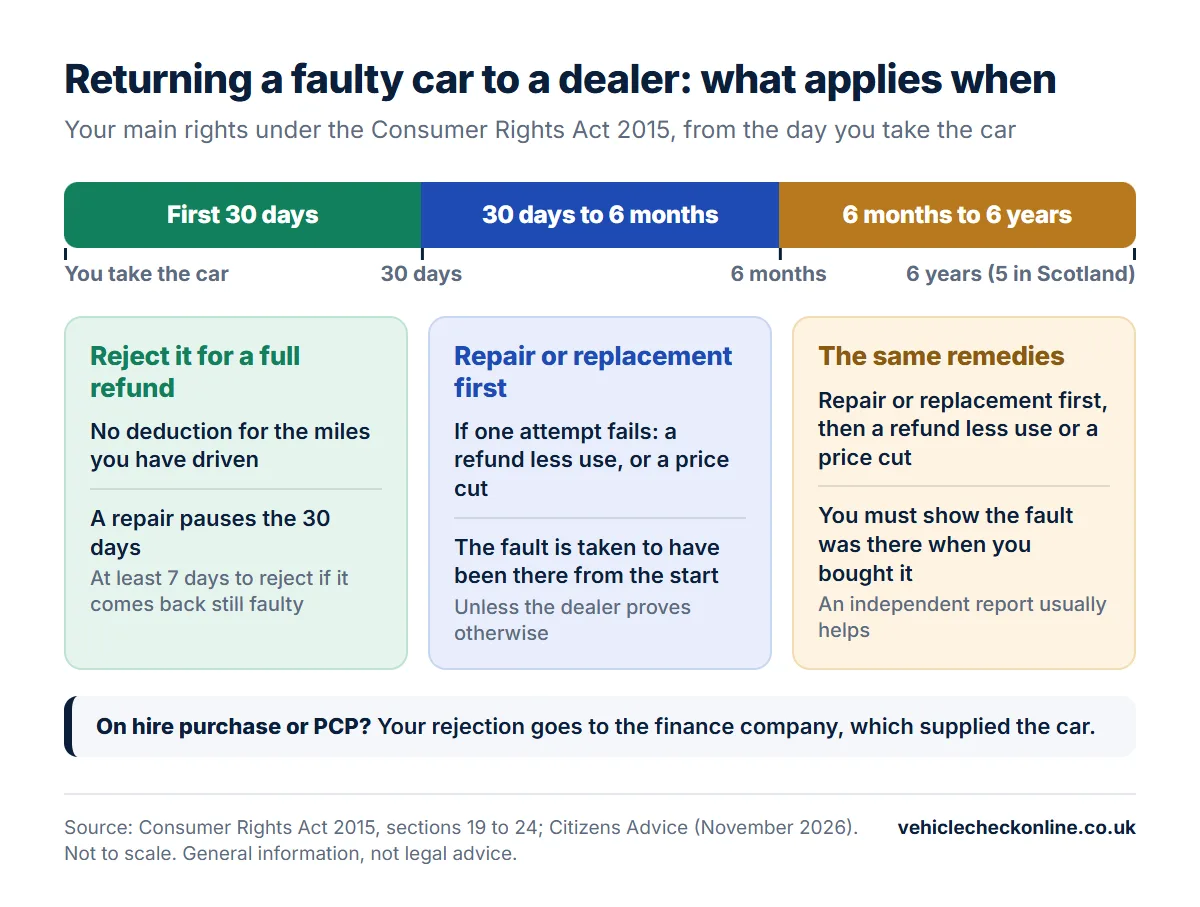
It is the short-term right to reject in section 22 of the Consumer Rights Act 2015. The 30 days start the day after you have taken ownership and delivery of the car, or possession on hire purchase or PCP. Citizens Advice puts it as 31 days, counting the day you bought the car.
Rejecting within that time entitles you to a full refund, with nothing taken off for the miles you have driven. You need to show the car was faulty, not as described or unfit when you got it, but Trading Standards guidance notes that so soon after the sale this is usually clear. A term in the contract that shortens the 30 days does not bind you.
If you ask for or agree to a repair or replacement instead, the 30 days stop while you wait. If the car comes back still faulty, you then have the rest of the 30 days, or 7 days if that is longer, to reject it.
What if the fault shows up after 30 days?
You still have rights, but they come in a set order:
- Repair or replacement. You choose which, unless one is impossible or unreasonably costly compared with the other. The dealer must do it within a reasonable time, without significant inconvenience to you, and pay the costs.
- Then a refund or a price reduction. If one repair or one replacement does not fix the car, or the dealer takes too long, you can reject the car under the final right to reject, or keep it for a lower price.
- Less a deduction for use. On a final rejection the dealer can take off an amount for the use you have had of the car, and for cars this applies even in the first six months. Trading Standards guidance says any deduction must be reasonable and justified.
Who proves the fault depends on timing. If it appears within six months of delivery, the law assumes it was there from the start unless the dealer proves otherwise. After six months it is for you to show, usually with an independent report: Citizens Advice suggests telling the dealer you are getting a second opinion and agreeing who will give it. Citizens Advice says your rights last up to six years, five in Scotland, but the proof gets harder with time.
How do you return a car to a dealer, step by step?
- Stop using the car, apart from getting it home or back to the dealer. Once you reject it, the law expects you to make it available for collection, and on a final rejection more miles can mean a bigger deduction. If it is unsafe or will not run, ask the dealer to collect it.
- Gather the evidence. The advert, the invoice, any finance papers, your messages with the dealer, photos or videos of the fault, breakdown reports and job sheets for any repairs, plus a note of what happened and when. The car's free MOT history shows the advisories and mileage recorded before you bought it.
- Reject it in writing, to the right business. Write to the dealer, or to the finance company if you have hire purchase, PCP or conditional sale. Say what is wrong, that you are rejecting the car under the Consumer Rights Act 2015 and treating the contract as at an end, and that you want a refund. Anything that makes the rejection clear counts in law, but a letter or email proves the date.
- Confirm everything in writing. If you agree something on the phone or at the dealership, such as a repair date or a courtesy car, follow it up by email.
- Hand the car back as agreed. The dealer must pay the reasonable cost of getting it back, apart from your own costs if you take it back to where you collected it.
- Ask for a final response if the answer is no. You will need it for the next steps.
On hire purchase, PCP or conditional sale, the finance company supplied the car, so your rejection goes to the finance company, not to the dealer.
What money do you get back when you return a car?
| How it ends | What you can get back |
|---|---|
| Short-term rejection, within 30 days | A full refund, with no deduction for use. If you part-exchanged a car, Citizens Advice says to ask for it back, or for the value the dealer gave it if it has been sold on. |
| Final rejection, after a failed repair | A refund less a deduction for use, but none for any time you kept the car only because the dealer did not collect it when agreed |
| Price reduction, if you keep the car | A reduction of an appropriate amount, which in some cases can be the full price |
| Rejecting a car on hire purchase or PCP | The part of the price you have paid, such as the deposit and instalments, and no further instalments to pay |
| Extra costs the fault caused you | Possibly damages, such as the cost of recovering a car that broke down |
The refund must come without undue delay and within 14 days of the dealer agreeing you are entitled to it, by the same method you paid unless you agree otherwise, and with no fee. The Act sets no formula for the deduction for use, so if the figure looks high, ask how it was worked out.
What changes if the car is on finance?
Who answers for the car depends on how you paid:
| How you paid | Who is responsible | Where your claim goes |
|---|---|---|
| Hire purchase, PCP or conditional sale | The finance company, which supplied the car | The finance company, then the Financial Ombudsman |
| Credit card, for a car priced over £100 and up to £30,000 | The dealer, with the card provider equally liable under section 75 of the Consumer Credit Act 1974 | The dealer, with a copy to the card provider |
| A loan arranged through the dealer | The dealer, and usually the lender too under section 75 | The dealer first, then the lender |
| Your own loan, a debit card, cash or a bank transfer | The dealer only | The dealer; with a debit card, ask your bank about a chargeback |
For a car over £30,000 bought with a loan linked to the sale, of up to £60,260, section 75A lets you claim from the lender once you have tried the dealer without success, or if the dealer cannot be traced, has not replied or is insolvent.
Handing a car back at the end of a PCP, or ending hire purchase or PCP early, is not a rejection and has its own rules, explained in our guide to how HP and PCP agreements work.
Changed your mind, or bought privately?
Citizens Advice says you have no automatic right to your money back just because you change your mind about something that is not faulty, however much it cost: it is up to the seller. Ask whether the dealer has its own returns policy, and get any offer in writing.
A car bought at a distance, or away from the dealer's premises, such as at your home, is different. The Consumer Contracts Regulations 2013 generally let you cancel until 14 days after the car reaches you, without giving a reason. Our guide to buying a car online without seeing it explains how cancelling works and what it costs.
A private seller does not promise the car is free of faults, so a fault alone gives you no claim. If the car does not match how it was described, such as a false mileage, Citizens Advice says you can usually ask for the difference in value, the cost of making it match, or a refund, as long as you have not altered the car, said you were happy with it or waited too long. Our guide to sold as seen explains what that phrase does not cover.
What can you do if the dealer refuses to take the car back?
- Complain formally. Use the dealer's complaints procedure, in writing, and ask for a final response, sometimes called a deadlock letter.
- Ask a trade association. If the dealer belongs to a motor trade association, its code of practice and its conciliation or arbitration service may help. Citizens Advice lists them.
- Try alternative dispute resolution (ADR). An independent body helps you agree, or decides the case. Citizens Advice says a judge will usually expect you to have tried ADR before going to court.
- Take finance complaints to the Financial Ombudsman. If the finance company or card provider has not sent a final response within eight weeks, or you disagree with it, the Ombudsman can look at it free of charge. Where it thinks rejection is reasonable, it can tell a finance company to let you give the car back and end the agreement.
- Make a small claim as a last resort. In England and Wales a small claim can be for up to £10,000. In Scotland, simple claims worth less than £5,000 go through the sheriff court's simple procedure, and in Northern Ireland a small claim is one of up to £5,000.
For advice on your own case, contact the Citizens Advice consumer helpline on 0808 223 1133 in England and Wales, Advice Direct Scotland, or Consumerline in Northern Ireland. Nobody can promise how a dispute will end, and this guide is not legal advice.
Questions and answers
Can a dealer refuse to take back a faulty car within 30 days?
The Consumer Rights Act 2015 gives you a short-term right to reject a car that is faulty, not as described or unfit for purpose within 30 days, and a contract term that cuts the period short does not bind you. If the dealer refuses, complain in writing and ask Citizens Advice for help.
Does the dealer have to give me a courtesy car?
No. Citizens Advice says a dealer does not have to lend you one while it repairs your car, but you can ask, and any promise is worth getting in writing.
Can the dealer charge me for the miles I have driven?
Not if you reject the car within 30 days. On a final rejection after a failed repair, the dealer can make a deduction for use, even in the first six months, because the Act treats cars differently from most other goods.
What if I bought the car on PCP and want to reject it?
On PCP, hire purchase or conditional sale, the finance company supplied the car, so you reject it in writing to the finance company. If it does not put things right, the Financial Ombudsman can look at the complaint for free.
How long do I have to complain about a faulty used car?
Citizens Advice says you have legal rights for up to six years after buying from a dealer, or five years in Scotland, but after six months you usually have to show that the fault was there when you bought the car.
Sources
- legislation.gov.uk: Consumer Rights Act 2015, Part 1, Chapter 2 (sections 19 to 24: rejection, repair and refunds)
- legislation.gov.uk: Consumer Credit Act 1974, section 75 (the lender's liability)
- Citizens Advice: Problem with a used car
- Citizens Advice: Solve an ongoing consumer problem with a business seller
- Financial Ombudsman Service: Car finance (faulty cars bought on finance)
- Business Companion (Trading Standards): Selling and supplying goods
Related guides
- Buying a used car: private seller vs dealerPrivate seller vs dealer: your legal rights, returns, warranties, price and risks when buying a used car in the UK, and the checks you still need either way.
- Buying a car online without seeing it: is it safe, and what are your rights?Buying a car online without seeing it: the 14-day right to cancel a dealer sale, why private sellers differ, the checks before you pay, delivery and scams.
- Used car warranty: is it worth it and what does it cover?Is a used car warranty worth it? How a warranty compares with your legal rights from a dealer, what it covers and leaves out, and the small print to read.
- What does "sold as seen" mean when you buy a car?Sold as seen means you accept a car as you saw it, faults and all. From a dealer it can't remove your legal rights; from a private seller it has limits too.
- Buying a car with outstanding finance: what the law saysBuying a car with outstanding finance? What the Hire Purchase Act 1964 says about private buyers, who it does not protect, and what to do if the lender calls.
This guide is general information for people buying, owning or selling a car in the UK, not legal or financial advice. Vehicle Check Online is an independent service, not affiliated with the DVLA, the DVSA or GOV.UK.