
Buying a used car
Used car warranty: is it worth it and what does it cover?
A used car warranty is worth it only if it adds something your legal rights do not: cover after the first six months, or if the dealer closes, for the parts most likely to fail on your car, with limits high enough to pay for real repairs. If you buy from a dealer, the Consumer Rights Act 2015 already protects you, and a warranty cannot take those rights away.
This guide sets your legal rights against a warranty, explains the main kinds of used car warranty in the UK, what they cover and leave out, the small print to read before you sign, and where a private sale leaves you. This is general information about the law rather than legal advice; Citizens Advice can help with your own situation.
How do your legal rights differ from a warranty?
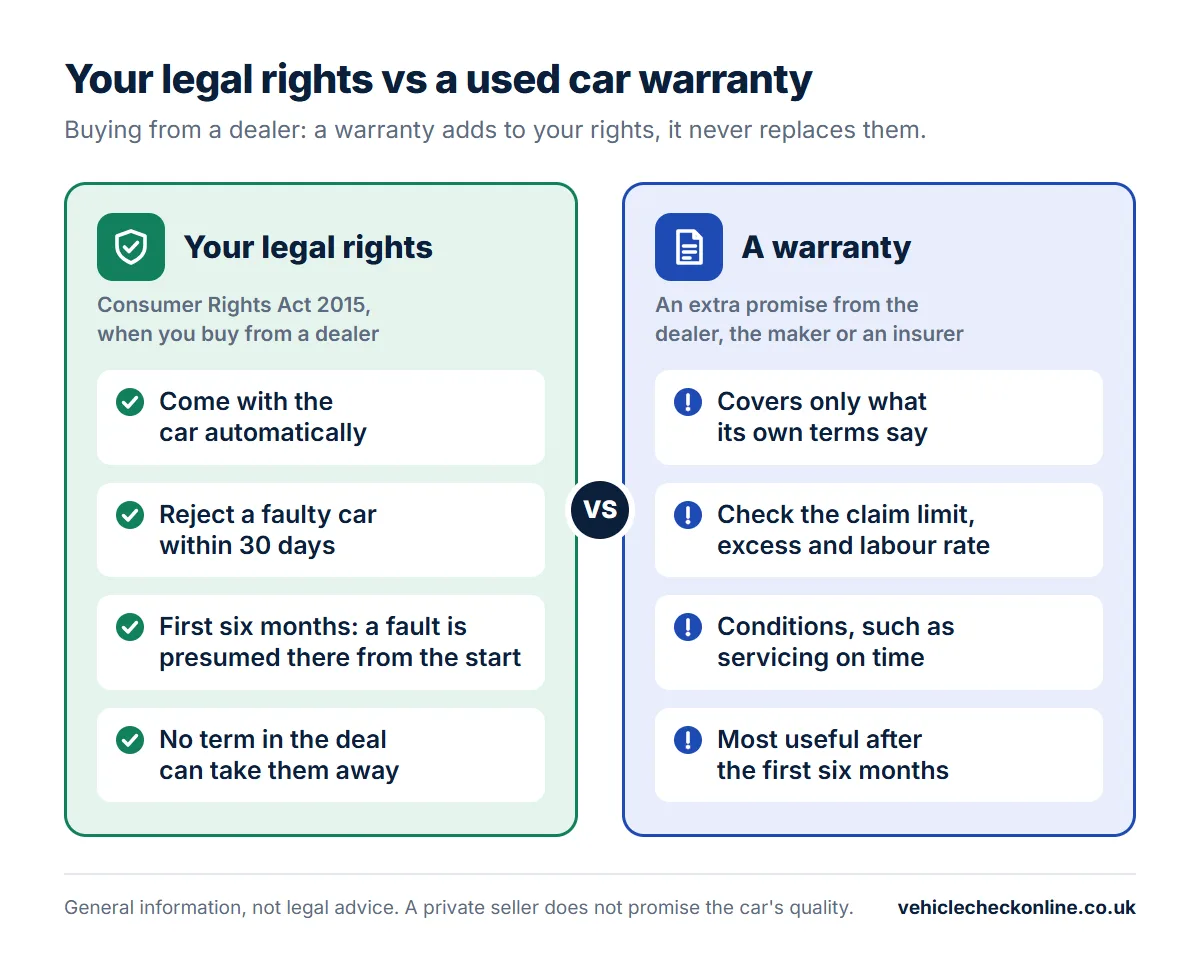
When you buy a car from a dealer, your rights come from the law, not from anything you sign. Under the Consumer Rights Act 2015, a car sold by a trader has to match its description, be fit for purpose and be of satisfactory quality. Any term in the deal that would cut down those rights does not bind you.
A warranty is different. It is an extra promise, made by the dealer, the maker or an insurer, and it covers only what its own terms say. Citizens Advice describes a warranty as something that adds to your legal rights. A fault that your rights cover remains the dealer's responsibility, whatever the warranty says.
What are your rights when you buy from a dealer?
If a car from a dealer turns out to be faulty, the Act sets out what you can ask for, and when:
- The first 30 days. The short-term right to reject lets you turn down a faulty car within 30 days of taking ownership and delivery.
- Repair or replacement next. Outside those 30 days, the remedy starts with a repair or a replacement. If one attempt does not fix the fault, you can then seek a price reduction or exercise the final right to reject. For a car, a refund at that stage may be reduced for the use you have had of it, even within six months of delivery.
- Up to six months. A fault that shows up within six months of delivery is presumed to have been there from the start, unless the dealer proves the car did not have the fault when you got it. Later than that, you may need to show the fault was already there.
- Up to six years. Citizens Advice says legal rights over a fault can last up to six years (five in Scotland), though they are easier to use early on.
Whether a car is of satisfactory quality depends on what a reasonable person would expect, given how it was described, what it cost and things like its age and mileage; durability counts too. Faults the dealer specifically drew to your attention before the sale are not covered, and nor are faults that an inspection you carried out should have shown up. Citizens Advice adds that fair wear and tear, such as brake pads worn down after long use, and faults you caused are not covered either.
Our guide to buying from a private seller or a dealer explains these rights in more detail.
Nothing in a warranty, or in the paperwork of the sale, can take these rights away. If a dealer tells you a fault is "a warranty matter only", check what the Act gives you before you accept that.
What are the main kinds of used car warranty in the UK?
Used car warranties come from three kinds of provider, and who gives the promise decides who you claim from and where a dispute can go:
| Kind | Who stands behind it | What to check first |
|---|---|---|
| The maker's warranty, if any is left | The car's manufacturer | When it ends, in years and miles, and whether a new owner can claim |
| A dealer's own warranty | The dealer, sometimes with an outside company handling claims | What it covers, and that you have it in writing |
| A warranty from an insurer or warranty company | A third party, usually under an insurance policy | The insurer's name and the full policy terms |
The maker's warranty on a newer car may still have time to run. Check whether a later owner can claim: Citizens Advice notes that usually only the person who bought a warranty can claim on it, unless it gives "third party rights".
A dealer may include its own warranty in the price or sell it separately. The Consumer Rights Act 2015 sets rules for a warranty given without extra charge: it is binding as a contract, must be in plain and intelligible language, must give the name and address of the business behind it, and must be given to you in writing if you ask for it.
Whether a warranty is insurance depends on how it is set up. The FCA's guidance says it does not usually treat typical dealer warranty schemes as insurance, but that a warranty provided by a third party, or one much more extensive than a seller's usual obligations, is likely to be a contract of insurance. When it is, the FCA's insurance rules apply and complaints can go to the Financial Ombudsman.
What does a used car warranty cover?
Only what its terms say. As Citizens Advice puts it, each warranty is different, so two products with similar names can cover very different things. Before you agree, find out:
- which parts are covered: a list of named parts, or the whole car apart from a list of exclusions;
- whether it pays for both parts and labour, and the hourly labour rate it will pay;
- the most it will pay on one claim and in total, compared with what the expensive parts on that car could cost to repair;
- the excess you pay on each claim;
- how it treats wear and tear, and faults that started before the cover began;
- whether damage to other parts, caused when a covered part fails, is included.
Your rights and a warranty do different jobs. Your rights deal with a car that was not of satisfactory quality when you got it, which includes how long its parts should reasonably last. A warranty may also pay when a covered part fails later, but only within its limits.
What small print should you read before you sign?
The conditions decide whether a claim is paid, so read the full terms, not only the summary:
- Servicing. Whether the car must be serviced on time, where, and what records you must keep. If the cover depends on it, a missed service could cost you a claim.
- Making a claim. Who you contact, whether a repair must be approved before work starts, and which garages you can use.
- Who can claim. Whether the cover stays with the car if you sell it.
- Cancelling. How to cancel, and what you get back if you do.
If the warranty is an insurance policy, FCA rules require the firm to give you an insurance product information document (IPID) for it, and generally let you cancel within 14 days without giving a reason. Citizens Advice says you may also get a 14-day cooling-off period if you bought a warranty by phone or online.
The policy should name the insurer, which you can look up on the FCA's Financial Services Register. Citizens Advice adds that terms so difficult that you cannot make sense of them may be unfair, which can give you extra rights.
Is a used car warranty worth it?
It depends on the car, how long you plan to keep it and what you already have. These questions help you decide:
- What do your legal rights already cover? From a dealer, your rights are easiest to use in the first six months, so a warranty adds most after that.
- Is any maker's warranty left? If the car is still covered and the cover passes to you, a second warranty may add little until it ends.
- Do the limits match the car? A claim limit below the cost of the repairs you are worried about, or a high excess, leaves you paying most of the bill.
- Who stands behind it? A dealer's warranty depends on that dealer. Citizens Advice explains that an insurance-backed warranty is meant to stay valid if the trader goes out of business.
- Would you rather keep the money for repairs? Compare what the warranty costs with the repairs it would realistically pay for on that car.
A warranty tends to be most useful on a car whose likely repairs are expensive and that you plan to keep well beyond the first months. It is least useful when its exclusions cover the very faults you are worried about.
Can you get a warranty when you buy privately?
A private seller makes no promise about the car's quality: the Sale of Goods Act 1979 only implies that promise when the seller is selling as a business. The car must still match the description you were given, so keep the advert and the seller's messages.
Any warranty on a privately bought car is likely to be the maker's remaining cover or a policy you arrange yourself. Check whether the maker's warranty lets a new owner claim before you count on it, and read any policy you buy as carefully as one offered by a dealer.
What can you do if a warranty claim is refused?
- Ask for the reason in writing, and check it against the terms: the exclusion or condition relied on, and how the policy defines it.
- Make a formal complaint to the company that refused the claim, with your service records, invoices and the garage's report.
- If the warranty is an insurance policy and you get no final response within eight weeks, or you disagree with it, you can take the complaint to the Financial Ombudsman, which is free to use.
- If the car came from a dealer, a fault that was there when you bought it is still the dealer's responsibility under your legal rights. If the dealer belongs to a trade association, such as The Motor Ombudsman, Citizens Advice says the association may offer conciliation or arbitration.
The outcome of any dispute depends on its facts. For advice on your own situation, contact Citizens Advice (England and Wales), Advice Direct Scotland or Consumerline (Northern Ireland).
Is a warranty the same as a history check?
A warranty deals with mechanical faults, not with the car's past. It will not tell you whether finance is still owed on the car, whether it has been written off or stolen, or whether the mileage is genuine.
Before you pay, check the car's free MOT history: every test result, with its advisories and the mileage recorded.
Then use a car history check to look for finance still owed, a write-off record or a theft report, along with previous keepers and plate changes. Our Premium report, £7.99, covers all of these in one report.
If the checks turn up problems the price does not reflect, our guide on how to negotiate a used car price shows how to use them.
Questions and answers
Can a dealer refuse a repair because my warranty has run out?
Your legal rights do not depend on the warranty. Citizens Advice puts the limit for legal rights over a fault at six years (five in Scotland), although after six months you may have to show the fault was there when you bought the car.
Does a used car warranty cover wear and tear?
It depends on the terms, so check how the warranty treats parts that wear out with use, such as clutches and brake pads. Your legal rights do not cover fair wear and tear either.
Is a car warranty regulated by the FCA?
Only some are. FCA guidance says typical dealer warranty schemes are not usually insurance, while a warranty provided by a third party usually is, and complaints about insurance can go to the Financial Ombudsman.
Can I cancel a used car warranty?
If it is an insurance policy, FCA rules generally allow you to cancel within 14 days without giving a reason, and a warranty bought by phone or online may come with a 14-day cooling-off period. Otherwise, the terms say how to cancel.
Does a warranty stay with the car when it is sold?
Only if its terms allow it. Citizens Advice notes that usually only the person who bought a warranty can claim on it, unless it gives third party rights, so check before you rely on a previous owner's cover.
Do I get a warranty when I buy privately?
A private seller does not have to give you one, and the law does not make them promise the car's quality. Any maker's warranty still running may help, if its terms let a new owner claim.
Sources
- Citizens Advice: Claim using a warranty or guarantee
- Citizens Advice: Problem with a used car
- legislation.gov.uk: Consumer Rights Act 2015, Part 1, Chapter 2 (goods and remedies)
- FCA Handbook: PERG 6.7, when a warranty is a contract of insurance
- FCA Handbook: ICOBS 7.1, the right to cancel an insurance contract
- Financial Ombudsman: Extended warranties
Related guides
- Buying a used car: private seller vs dealerPrivate seller vs dealer: your legal rights, returns, warranties, price and risks when buying a used car in the UK, and the checks you still need either way.
- What does "sold as seen" mean when you buy a car?Sold as seen means you accept a car as you saw it, faults and all. From a dealer it can't remove your legal rights; from a private seller it has limits too.
- Buying a used electric car: what to check before you payBuying a used electric car? How to check battery health, what the battery warranty covers, charging cables, tax since April 2025 and the history checks.
- How to negotiate a used car price, and how much to offerHow to negotiate a used car price: check similar adverts, use MOT advisories and history check findings, haggle at a dealer and know when to walk away.
- What is GAP insurance and do you need it?GAP insurance explained: what vehicle GAP insurance pays after a write-off or theft, the three main types, what drives the cost and when you may not need it.
This guide is general information for people buying, owning or selling a car in the UK, not legal or financial advice. Vehicle Check Online is an independent service, not affiliated with the DVLA, the DVSA or GOV.UK.