
Car finance
What is GAP insurance and do you need it?
GAP insurance covers the gap between what your motor insurer pays when your car is written off or stolen, which is the car's market value just before the loss, and a higher figure set by the policy: usually what you still owe on finance, what you paid for the car, or the price of a new one. It is a separate policy, often offered by the dealer or lender, but you can also buy it on its own.
This guide explains the main types of vehicle GAP insurance, when it pays out and when it may not, what drives the cost, what the FCA has found about its value, and the rules when a dealer sells it. It is general information, not advice on any policy, and we do not sell insurance.
What does vehicle GAP insurance cover?
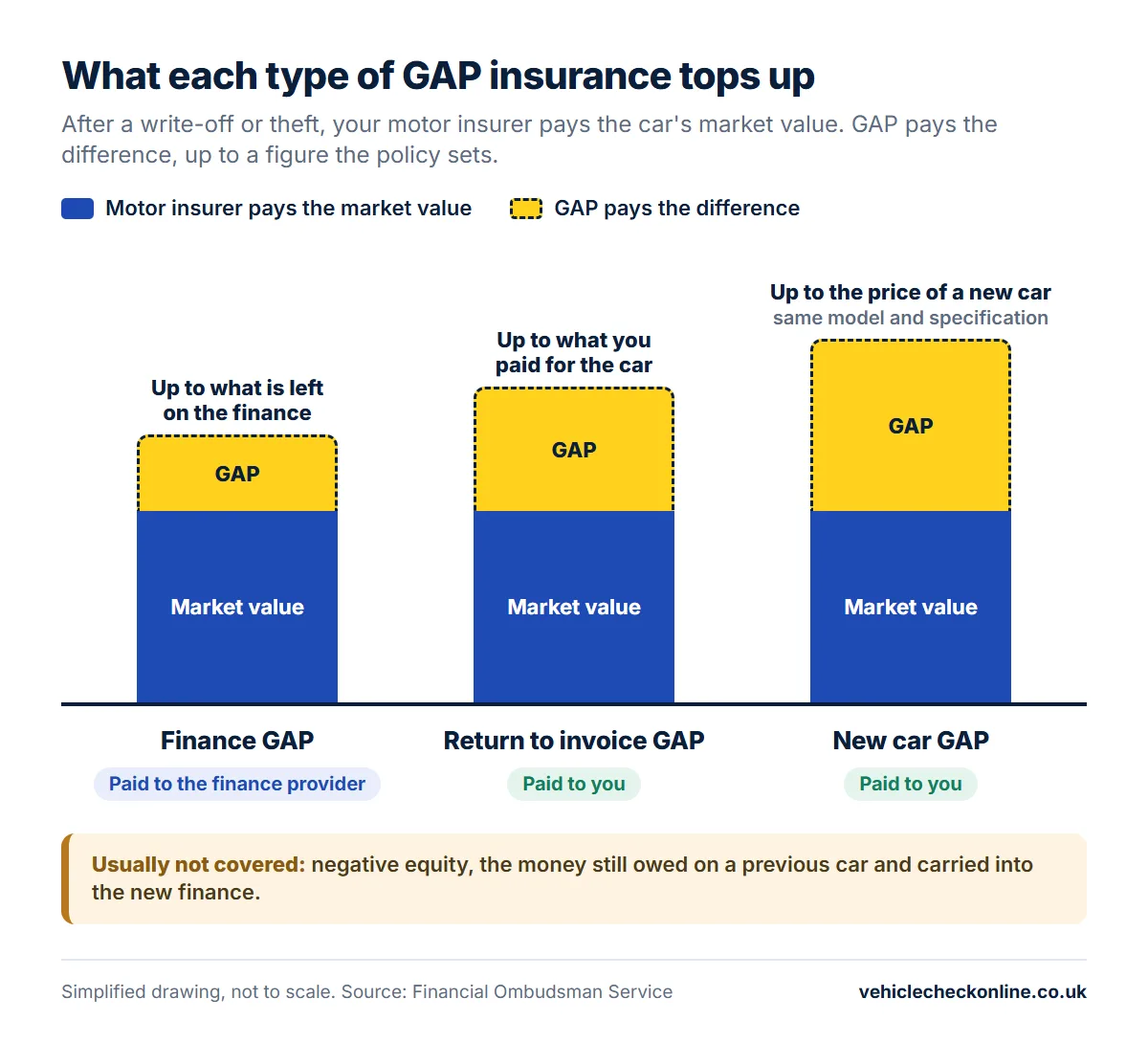
After a total loss, a motor insurer usually pays the car's market value: what it would have been worth just before it was stolen or damaged. That is often less than you paid for it, or less than you still owe on it. The Financial Ombudsman describes three main types of vehicle GAP insurance, each topping up that payout to a different figure:
| Type | Tops the payout up to | Paid to |
|---|---|---|
| Finance GAP | The amount left to pay on your car finance | Your finance provider |
| Return to invoice GAP | What you paid for the car | You |
| New car GAP | The price of a new car of the same model and specification | You |
Policies leave things out, so read the summary. GAP insurers normally exclude negative equity: money still owed on a car you traded in, carried into your new finance. The Ombudsman also says some buyers are wrongly led to think GAP covers the finance for extra products bought at the same time as the car.
When does GAP insurance pay out?
Only after a total loss: when the car is written off because it is not worth repairing, or stolen and never found. GAP is about the shortfall after that, not about repair bills. A GAP insurer can only pay once your motor insurance claim is settled, because until then the gap is not known.
The Financial Ombudsman lists common reasons GAP claims are turned down:
- the claim is for a vehicle you do not own;
- the claim is fraudulent, or the car was used for racing;
- you refused a new replacement car that your motor insurer offered;
- you did not have comprehensive motor insurance, though the Ombudsman will not always accept this, because the GAP insurer can work out what a motor insurer would have paid.
A dispute about the market value itself is for your motor insurer, not the GAP insurer, and if you accept an offer below the car's market value, the GAP insurer is not responsible for the difference. Our guide to how much a car is worth explains how insurers value a car after a write-off or theft.
Do you need GAP insurance?
It depends on the car, the finance and your other cover. Sellers often recommend GAP, and when they do they must make sure it suits you. The checks the Ombudsman makes in mis-selling complaints are useful questions to ask yourself first:
- Does your motor insurance already replace a new car? Most policies for new cars provide a new one if yours is written off within a certain time, so the Ombudsman says there is often no point having GAP in the first year. On HP or PCP, the replacement may need the finance company's agreement.
- Is it the right type? Finance GAP covers only what is left on the finance. After a large deposit there may never be a shortfall, and the deposit itself is not covered.
- Did you pay more than the car is worth? An insurer pays market value, not the price you agreed, and the Ombudsman looks at this when it judges whether GAP was suitable.
- Could you benefit from it at all? The Ombudsman counts a policy you could never have benefited from as obviously unsuitable.
If a policy was mis-sold, the Ombudsman is likely to tell the seller to refund the premiums with interest, unless it thinks you would have bought the policy anyway.
How much does GAP insurance cost?
GAP is priced policy by policy, and the FCA's published work explains what moves the GAP insurance cost rather than giving a price:
- Where you buy it. The FCA's 2014 market study found that many buyers did not know they could buy GAP separately from the car deal, often at a lower price.
- Commission. In February 2024, the FCA said it had seen some firms pay out 70% of the premium in commission to those involved in selling GAP. Firms that restarted sales from May 2024 did so with materially lower commission.
- The cover and the risk. The FCA's 2018 evaluation looked at the length of the policy, the value of the car insured and whether the car was on finance, and noted that the riskiness of the people insured affects part of the cost.
- How you pay. If the premium is added to your car finance, it becomes part of what you borrow.
So get a stand-alone quote before you agree to a dealer's, and compare the same type of cover for the same length of time.
Is GAP insurance worth it? What the FCA found
The FCA has questioned GAP's value for years. Its 2014 market study found that only 10% of premiums were paid out in claims, on average, between 2008 and 2012.
In February 2024 it said GAP was failing to provide fair value to some customers: its data showed only 6% of the premiums customers paid were paid out in claims. Firms with 80% of the market agreed to pause sales, and from May 2024 several were allowed to restart once they could show fair value, as the Consumer Duty requires.
In its latest figures, for 2025 and published in July 2026, claims costs for stand-alone GAP were 53% of premiums, though the FCA says the figures should still be used with caution. The FCA has also said GAP can provide a useful service. Whether it is worth it for you depends on how big your gap could be and what your motor insurance already covers.
Buying GAP from a dealer: the two-day rule
Since 1 September 2015, FCA rules have covered GAP sold in connection with buying a vehicle, by the dealer or a firm connected to it, including GAP sold with the finance. Before the sale, the seller must give you key information in writing, including:
- the total premium, shown separately from any other price;
- the main features and benefits, and the significant or unusual exclusions and limits;
- that GAP is also sold by other firms;
- how long the policy lasts, and whether it is optional or compulsory;
- when the sale can be completed, and the date you were given this information.
The seller then cannot complete the sale until at least 2 clear days have passed. It can do so the day after only if you start the purchase yourself, agree to it being completed early and confirm you understand the waiting period. In the Ombudsman's words, GAP can no longer be sold on the same day as the car and loan.
Use those days to compare quotes. The FCA reviewed these rules in 2025 and, in June 2026, said it was not proposing to change them while it collects more data on the market.
Can you cancel GAP insurance?
Yes. FCA rules generally give you 14 days to cancel a general insurance policy, such as GAP, though there are exceptions, and the firm must tell you about this right before you buy.
After that, it depends on the terms, and some policies give no refund once the cooling-off period has passed. The Financial Ombudsman may find that unfair: if you cancel early, for example because you sell the car, it is likely to expect a proportionate refund less a small administration fee, unless you have already claimed on the policy.
To complain about a GAP policy, go to the firm first. If you have no final response within eight weeks, or you disagree with it, the Financial Ombudsman Service can look at it for free.
What should you check on a used car before you insure it?
Check the car's history before you buy it, and before you pay for any cover on it. The Financial Ombudsman says a car that has been written off before can put buyers off however well it was repaired, so an insurer is likely to value it lower after a total loss. If you knew, or should have known, that it was a repaired write-off, a deduction may be fair.
Our write-off check shows Cat S, Cat N and other write-off records against the car by registration. It is part of the Premium report, £7.99, with the outstanding finance and stolen checks.
If the car does have a write-off record, tell your motor insurer when you buy cover. Our guide to insuring a Cat S or Cat N car explains what to say and why it matters for a claim.
Questions and answers
Is GAP insurance compulsory?
The legal minimum to drive on UK roads is third-party motor insurance, and GAP is not part of it. If a dealer sells you GAP with a car, FCA rules require it to tell you in writing whether the policy is optional or compulsory.
Does GAP insurance cover a stolen car?
Yes, if the car is stolen and never found. Your motor insurer then treats it as a total loss and pays its market value, and GAP can top that up, subject to the policy terms.
Does GAP insurance cover the deposit?
Finance GAP does not: it covers only what is left on the finance, so after a large deposit there may never be a shortfall to claim. Return to invoice GAP works from what you paid for the car instead.
Does GAP insurance cover negative equity?
Normally not. The Financial Ombudsman says GAP insurers normally exclude negative equity carried over from a previous car, and that this is usually fair as long as the policy makes it clear.
How long does a GAP claim take?
A GAP insurer can only pay once your motor insurance claim is settled. If it then delays without good reason, the Financial Ombudsman may tell it to pay compensation for the inconvenience.
Sources
- Financial Ombudsman Service: GAP insurance
- Financial Ombudsman Service: Motor valuations and write-offs
- FCA: GAP insurers agree to suspend sales over fair value (February 2024, updated May 2024)
- FCA: General insurance value measures data 2025 (July 2026)
- FCA: PS15/13, GAP insurance competition remedy (the rules for dealer sales, 2015)
- FCA: CP26/22, Simplifying the insurance rules (June 2026)
Related guides
- How does no deposit car finance work?No deposit car finance explained: HP, PCP and loans with nothing upfront, what a deposit changes, your rights and what to check before you sign for a used car.
- How much is my car worth, and how is it valued?How much is my car worth? Why retail, private and trade-in values differ, what moves a car's value, and how to check a valuation against real adverts.
- Insuring and financing a Cat S or Cat N carCan you insure a Cat S car or get finance on one? What to tell the insurer or lender, why it matters, and what hiding a Cat S or Cat N category can cost you.
- Can I sell my car with finance on it?How to sell a car with outstanding finance: why the lender is paid first, how to get a settlement figure, selling to a dealer or privately, and handing it back.
This guide is general information for people buying, owning or selling a car in the UK, not legal or financial advice. Vehicle Check Online is an independent service, not affiliated with the DVLA, the DVSA or GOV.UK.