
Selling your car
How much is my car worth, and how is it valued?
How much your car is worth depends on who is buying it. A dealer buying it pays a trade price, a private buyer usually pays more, and a dealer selling the same car asks more again. A valuation by reg estimates those prices from the car's age, mileage, specification and history, but it is a starting point: check it against adverts for similar cars.
This guide explains the three kinds of value, what pushes a car's value up or down, how online valuations are worked out, how to get an accurate figure for your own car and why a dealer's offer sits below the private and retail figures you see online. It gives no prices, because values move with the market and any figure soon goes out of date.
How much is my car worth: retail, private or trade-in?
The same car sells for different amounts depending on who is buying and who is selling, which is why a valuation can show more than one figure:
| Value | What it means | Use it when |
|---|---|---|
| Retail | What a dealer would ask for the car, prepared and ready to sell | You buy from a dealer, or check an insurer's offer after a write-off |
| Private sale | What a private buyer would pay a private seller | You sell or buy privately |
| Trade-in | What a dealer would pay you for the car, outright or in part exchange | You sell to a dealer or a car buying service, or part-exchange |
Retail sits at the top because a dealer takes on more than a private seller does. A car sold by a trader must be of satisfactory quality, while the Sale of Goods Act 1979 implies that promise only where the seller sells in the course of a business, so a private buyer gets less comeback and pays less.
Trade-in sits at the bottom because the dealer buying your car has to check it, prepare it and still make a margin when it sells it on. Always compare an offer with the matching figure: a dealer's offer with the trade value, a private buyer's offer with the private value.
What affects a car's value?
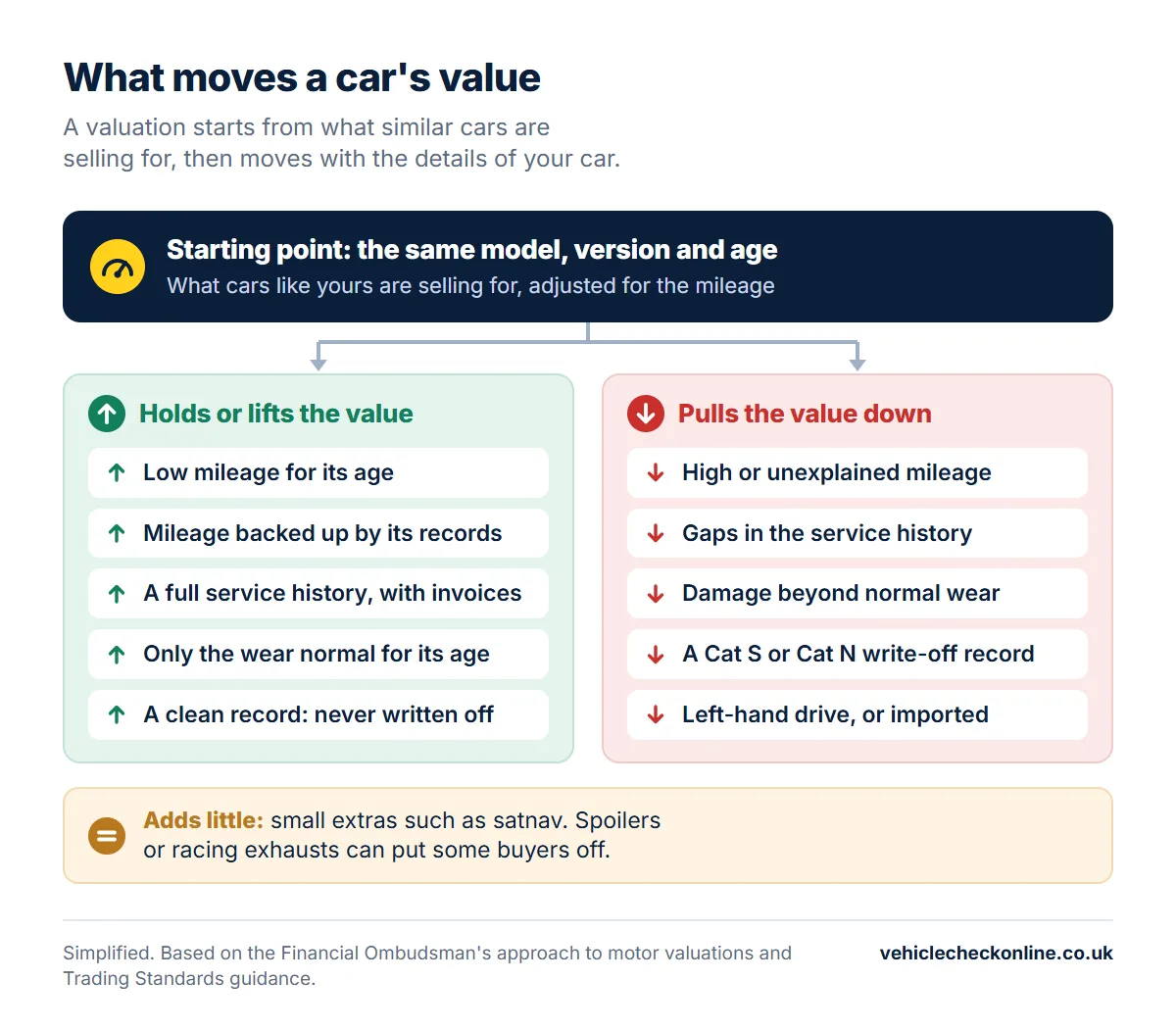
Valuations start from what similar cars are selling for, then adjust for the details of yours. These are the details that count:
- Age. The date of first registration fixes the car's age. The Financial Ombudsman notes that the valuation guides usually do not value cars over about 20 years old, so an older car needs other evidence, such as adverts for the same model.
- Mileage for its age. The guides take mileage into account, and Trading Standards guidance treats a car's mileage as information likely to affect a buyer's decision. Our guide to good mileage for a used car shows how to judge it against the car's age.
- Condition. A guide price already allows for the wear and tear normal for the car's age and mileage. What lowers the value is damage beyond that, judged against the car's age: the Financial Ombudsman's example is small scratches, which can matter on a brand-new car but not on a 15-year-old one.
- Service history. Invoices and stamps show the car was maintained and back up its mileage. Trading Standards guidance suggests dealers confirm them with the garages that did the work, and gaps leave a buyer allowing for jobs that may be overdue.
- Specification. The guides take the exact version into account: engine, gearbox, trim and body style. Extras matter less: the Financial Ombudsman says small additions such as satnavs are not likely to add much, and that spoilers or racing exhausts may put some buyers off as well as attracting others.
- Write-off record. A repaired Cat S or Cat N car is worth less than the same car with a clean record, and a dealer selling it on is expected to tell buyers about it. Our guide to how much Cat N reduces a car's value explains how to price the gap.
- Left-hand drive and imports. The Financial Ombudsman says left-hand-drive cars are usually worth less in the UK, and that being imported is likely to affect the value of a right-hand-drive car too.
- Previous keepers. A history report shows how many there have been and when the car last changed hands, so buyers can see both before they call you.
How are car valuations calculated?
A valuation by reg comes from a motor valuation guide: a database built from what cars are selling for across the country. The Financial Ombudsman, which compares insurers' valuations with these guides, describes them as based on nationwide research of likely, but not actual, selling prices, taking the car's specification and mileage into account.
In outline, the guide identifies the exact car from its registration, starts from what that version is selling for at that age, and adjusts for the mileage you enter. Three things follow from that.
- It is an estimate of a likely price, not a price anyone has paid for your car.
- It assumes ordinary condition for the age and mileage. It cannot see a dent, a tired clutch or a folder of invoices, so you have to allow for those yourself.
- It moves. The Ombudsman has noted that used car prices change regularly, up as well as down, and that the guides are updated to follow them; our guide to car depreciation shows how far the market has moved.
Different guides can also disagree. The Ombudsman says their values can vary significantly for the same car, and in one 2023 case it settled a claim at the average of four guide valuations rather than trusting any single one. That is a good habit for you too.
How do you get an accurate car valuation by reg?
- Check the car it has found. Compare the make, model, engine size, fuel and year with your V5C logbook, and choose the right trim and gearbox if asked. The Financial Ombudsman sees valuation disputes caused simply by the wrong vehicle details.
- Enter the exact mileage shown on the dashboard, not a round number. If the car is not with you, our free car mileage check shows the reading at its last MOT.
- Answer questions about condition and history honestly. An optimistic answer only produces a figure no buyer will pay. If you are not sure whether the car was ever written off, a write-off check shows any record.
- Get two or three valuations from different sources. If one is far from the others, find out why before you rely on it.
- Read the right line. Note whether each figure is retail, private or trade before you compare it with anything.
- Repeat it when you are ready to sell, because values move.
To confirm a valuation has picked the right car, our free car tax check shows the make, model, colour, fuel, engine size and month of first registration recorded for any registration.
How do you check the figure against real adverts?
Adverts show what you are really up against: the cars a buyer could choose instead of yours. The Financial Ombudsman says it has been told by the valuation guides that cars are generally selling at or close to their advertised prices, but it stresses that adverts must be for like-for-like cars, because small differences change the value.
- Search for the same make, model, engine and gearbox, registered within a year or so of your car.
- Narrow the results to a similar mileage and the same trim level.
- Keep dealer and private adverts apart: dealers advertise at retail prices, private sellers at private prices.
- Take the middle of at least five asking prices, not the cheapest or the dearest.
- Place your car against that middle figure: more miles, gaps in the history, damage or a write-off record put it below; low miles and a full history put it above.
If the valuation and the adverts disagree by a wide margin, look again at the details you entered before you decide which to believe.
A valuation is an estimate, not an offer. What a buyer pays depends on your car on the day: its condition, its paperwork and what else is for sale.
Why does a dealer offer less than the online figure?
A part-exchange or trade offer is a trade price, so set it against the trade figure, not the private or retail one. The dealer has to resell your car with the duties a trader owes its next buyer: the car must be of satisfactory quality and as described, and Trading Standards guidance advises dealers to check its mileage, service history and MOT records before they sell it. The gap between trade and retail pays for those checks, the preparation and the dealer's margin.
The offer also depends on what the dealer finds when it looks at the car and its paperwork. Our guide to selling privately or part-exchanging explains what a dealer checks and how to compare the two routes.
How does an insurer value your car after a write-off or theft?
After a write-off or theft, an insurer usually pays the car's market value, which the Financial Ombudsman measures by what a reputable dealer would have sold it for just before the loss, not what you paid or still owe: GAP insurance is the separate cover for that difference. The FCA, which regulates insurers, expects the first offer to be the insurer's best estimate of that value, and found that the firms it reviewed used retail valuations from the trade guides.
If the offer looks low, ask how it was worked out: which guides were used, and what was deducted and why. The FCA has said a deduction for wear and tear normal for the car's age and mileage may be unfair, because the guide price already allows for it. If the insurer will not move, complain to it first and then, if you are still unhappy, to the Financial Ombudsman Service, which is free.
Can you get a valuation with the car's history?
Our Basic report (£3.99) and Premium report (£7.99) include an estimated valuation of the car, where one is available, with retail, private sale and trade-in figures. Treat it as one estimate among several and set it beside the adverts you found. To get those three figures for a car now, run our car valuation check with its registration.
The Premium car history check puts the valuation next to the records a careful buyer will look for: outstanding finance, write-off and stolen checks, previous keepers and plate changes, with the MOT and mileage history. If you are selling, knowing what those checks show lets you answer a buyer's questions before they are asked.
You can see how the valuation and the other checks are laid out in the sample report.
Questions and answers
Does mileage affect a car's value?
Yes. Valuation guides take the mileage into account, so the same car is valued differently at different mileages. Enter the exact reading from the dashboard when you ask for a valuation.
Do modifications add value to a car?
Not often. The Financial Ombudsman says small additions such as satnavs are not likely to add much, and that changes like spoilers or racing exhausts can put some buyers off as well as attracting others.
Why do valuation websites give different figures for the same car?
Each works from its own research and data, and the Financial Ombudsman has said the guides can vary significantly. Compare two or three valuations and check them against adverts for similar cars.
Can I get a valuation for a car over 20 years old?
The main valuation guides usually do not value cars over about 20 years old, according to the Financial Ombudsman. For an older car, compare adverts for the same model in similar condition; the Ombudsman itself turns to evidence such as engineers' reports when the guides cannot help.
Is a left-hand-drive car worth less in the UK?
Usually. The Financial Ombudsman says left-hand-drive cars are usually worth less in the UK, and normally accepts an insurer deducting the difference from a car's market value.
Is the price I paid for my car its value?
Not necessarily. The Financial Ombudsman has noted that a buyer may simply have paid more than the guides suggested the car was worth, and values keep moving after you buy.
Sources
- Financial Ombudsman Service: Motor valuations and write-offs
- Financial Ombudsman Service: decision DRN-4107773 (how trade guides value a car)
- FCA: Findings of multi-firm review into insurers' valuation of vehicles
- Business Companion (Chartered Trading Standards Institute): Mileage of used vehicles
- legislation.gov.uk: Sale of Goods Act 1979, section 14 (quality only for business sellers)
Related guides
- Should you sell your car privately or part-exchange it?Sell privately or part exchange? Compare price, effort, risk and your legal duties, see what a dealer checks before it takes your car, and get a better offer.
- How much less is a Cat N or Cat S car worth?How much do Cat N and Cat S reduce a car's value? Why there is no fixed figure, what drives the discount, and how to work out a fair price for a write-off.
- What is good mileage for a used car?What counts as good mileage for a used car in the UK: how to judge miles against age and fuel type, whether 100k miles is a lot, and how to check the readings.
- Selling a car privately: what you need and how to do itHow to sell a car privately in the UK: the paperwork you need, pricing, an honest advert, safe viewings, getting paid and telling the DVLA, step by step.
- What is GAP insurance and do you need it?GAP insurance explained: what vehicle GAP insurance pays after a write-off or theft, the three main types, what drives the cost and when you may not need it.
This guide is general information for people buying, owning or selling a car in the UK, not legal or financial advice. Vehicle Check Online is an independent service, not affiliated with the DVLA, the DVSA or GOV.UK.