
The V5C and other documents
Year of manufacture vs date of first registration
The year of manufacture is when a car was built, and the date of first registration is when it was first registered for use on the road, usually when it was sold new. The two can be months apart, or years for an import. The registration date sets the number plate's age identifier and the tax rates, and usually the first MOT; the build year counts for a few rules of its own.
This guide explains why the dates differ, which one decides the plate, the MOT, tax and the historic vehicle rules, and how to find the year of manufacture of a car, and its registration date, from the V5C, GOV.UK and our free pages.
Which date counts: year of manufacture or first registration?
The year of manufacture is the year the car was built. The date of first registration is when it was first registered for the road and given its registration number; for a brand new car, GOV.UK says the dealer will usually do this for you. Each date decides different things:
| What it decides | The date that counts |
|---|---|
| The age identifier on a new car's plate | Date of first registration |
| The age identifier on an import's plate | First registration abroad, or the month and year of manufacture |
| When the first MOT is due in Great Britain | Third anniversary of first registration |
| The first MOT of a car driven abroad before it was registered here | Date of manufacture, taken as 31 December of the year it was built |
| Vehicle tax rates | Date of first registration |
| The historic vehicle tax exemption | Built before 1 January 1986, or first registered before 8 January 1986 if the build date is unknown |
| No MOT needed for a historic vehicle | Built or first registered more than 40 years ago |
| A recall check without the registration | Year of manufacture, with the make and model |
What does date of first registration mean?
It is the date a vehicle was first registered. For a car sold new in the UK, it is the day the car was registered with the DVLA and given its number. It tells you when the car joined the road, not when it was made.
An imported car has two such dates. Regulation 10A of the Road Vehicles (Registration and Licensing) Regulations 2002 requires a V5C logbook issued since the end of 2020 to show the date of first registration in the UK and, where it applies, the date of first registration in, and under the law of, a country outside the UK.
So for an import, "first registered" can mean the date abroad or the date here. When an advert, a document or a dealer gives a registration date, check which one it is before you rely on it.
Why can a car's two dates differ?
A gap between the dates is not a warning sign in itself. It can arise in several ways:
- Time between factory and buyer. A new car is usually registered when it is sold, not when it is built, so one that waited for a buyer can be registered months after it was made. A car built in December and registered in January has a different year on each date.
- A car registered abroad first. An import keeps its build year and its first registration abroad, but can be registered in the UK years later.
- An old vehicle registered for the first time. GOV.UK notes that a classic vehicle not taxed since 1983 might not be registered with the DVLA. When it is, the DVLA issues either its original number or another number appropriate to its age.
- A rebuilt or kit-built vehicle. A reconstructed classic gets a number based on the age of its youngest component, and the DVLA gives a Q number to a vehicle whose age or identity is in doubt.
Which date sets the number plate's age?
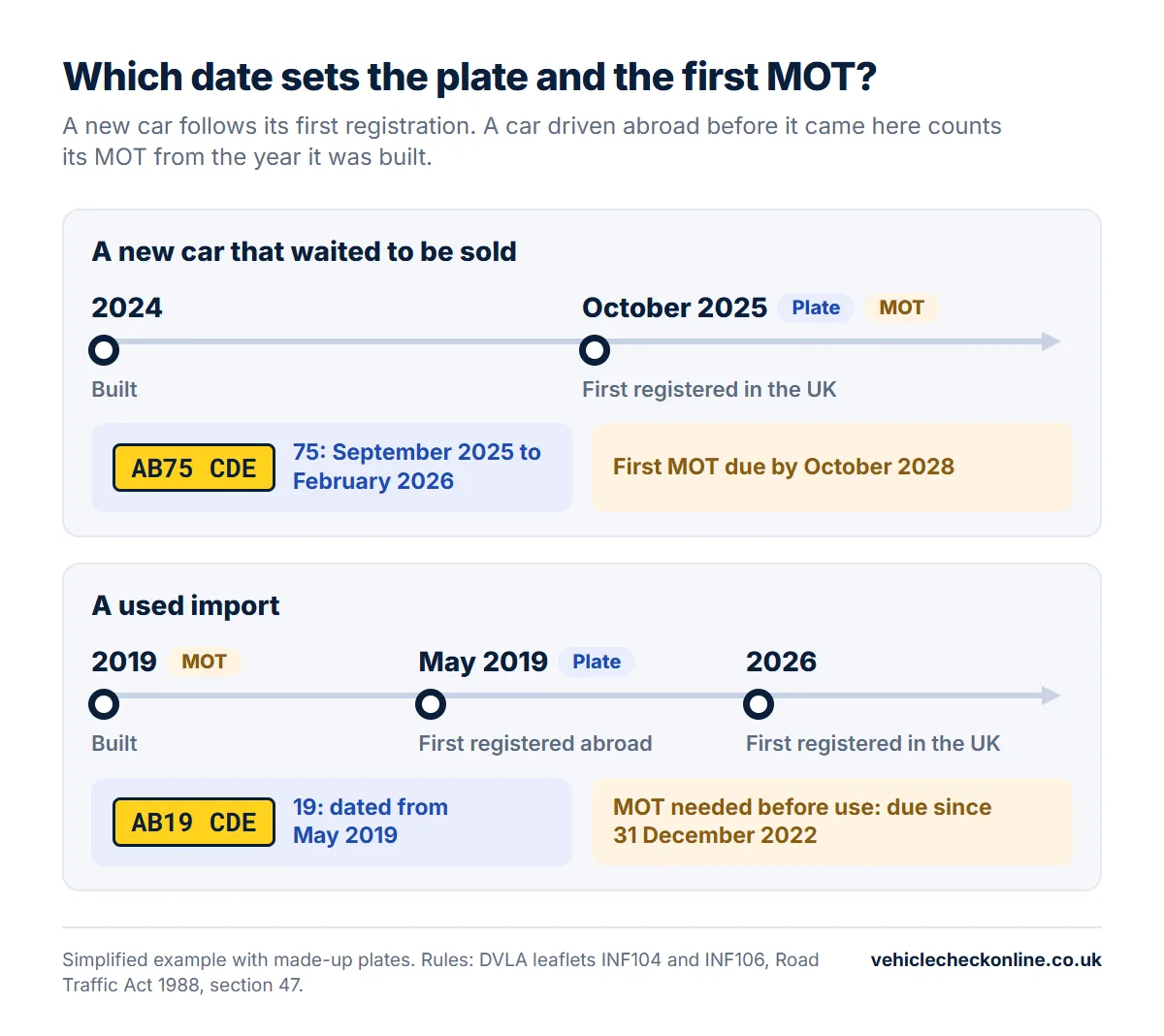
The date of first registration. The DVLA's leaflet on registration numbers (INF104) says the two numbers in a current-style registration tell you when it was issued, and a new car's number is issued when it is first registered. A car built in 2024 but first registered in October 2025 gets the identifier 75, the one used from September 2025 to February 2026, while its year of manufacture stays 2024.
Imports are dated from their first registration abroad. The DVLA's import leaflet (INF106) says it gives an imported vehicle a number appropriate to its age, using the full date of first registration on its foreign registration document. If that document does not show the full date, the keeper must give evidence of the month and year of manufacture; with no evidence of age, the vehicle gets a Q or QNI number.
A private number can make a car look older than it is, but never younger: INF104 says a registration number cannot be used to make a vehicle appear younger than it actually is. Our guide to number plate age identifiers has the full table of identifiers since 2001.
The first MOT: registration date or build date?
For most cars, the registration date. In Great Britain, GOV.UK says a car must have its first MOT by the third anniversary of its registration, so the car in the example above, first registered in October 2025, is due by October 2028 whatever year it was built. Northern Ireland runs its own MOT scheme, in which cars are tested from four years old.
The build date takes over for a car used on the road before it was registered here. Section 47 of the Road Traffic Act 1988 applies the three years to a vehicle's date of manufacture if it has been used on roads, in Great Britain or elsewhere, before being registered, and takes that date to be the last day of the year in which the car was finally assembled. Use before the car was sold by retail does not count, so for a new car that waited unsold, the three years still run from its registration.
Take a car built in 2019, first registered in another country in May 2019 and registered in the UK in 2026. Its number is dated from May 2019, so it gets the identifier 19. Its date of manufacture counts as 31 December 2019, so its three years ran out on 31 December 2022, and it needs a valid MOT before it is used on the road, even though its UK registration is new. Our guide on when an MOT is due covers the rest of the MOT timetable.
Age also decides which checks the test includes. Under the MOT inspection manual, for example, the tyre pressure warning system is checked only on cars first used on or after 1 January 2012. When a car's first-use date is not known, the manual tells testers to take its date of manufacture if it was used before being registered in Great Britain, as an import may have been, and in most other cases the earlier of its first registration or six months after it was made.
Which date do vehicle tax and the historic vehicle rules use?
Vehicle tax rates follow the date of first registration. GOV.UK sets out three systems: cars registered before 1 March 2001 pay by engine size, those registered from 1 March 2001 to 31 March 2017 pay by CO2 band, and those registered on or after 1 April 2017 pay a first rate based on CO2 and a standard rate after that.
The historic exemption is the exception, because it looks at when the vehicle was built. A vehicle built before 1 January 1986 can be taxed without paying from 1 April 2026, once its keeper applies, and GOV.UK accepts a first registration before 8 January 1986 when the build date is unknown. A vehicle used commercially, or for hire or reward, does not qualify.
The MOT exemption for historic vehicles accepts either date. GOV.UK says no MOT is needed if a vehicle was built or first registered more than 40 years ago and has had no substantial changes, such as a new chassis, body, axles or engine that changes the way it works.
How do you find the year of manufacture of a car?
- Look it up by registration. Our car tax and MOT check shows the year of manufacture and the month of first registration for any car, with its MOT status; the tax status is free on GOV.UK's vehicle enquiry.
- Use GOV.UK's vehicle enquiry service. It shows the year of manufacture and the date the car was first registered, from the DVLA's record.
- Read the V5C. One issued since the end of 2020 must show the date of first registration in the UK and, for an import, the date of first registration abroad.
- Decode the VIN. Our free VIN decoder lists the possible model years a VIN may point to. Treat them as a clue, not a build date.
- Ask the manufacturer. When an imported vehicle has no foreign registration document, the DVLA accepts a dating certificate from the manufacturer, or another acceptable source, as evidence of when it was made.
The year of manufacture also helps when you have no registration to hand: GOV.UK's recall checker can search by the manufacturer, the model and the year of manufacture.
What should you check when the dates are far apart?
A gap of a few months can simply be the wait between the factory and the first buyer. A gap of years, or dates that do not fit the plate, needs an explanation:
- The car may be an import. A V5C that shows a date of first registration abroad as well as one in the UK means the car began life elsewhere. Our guide on how to tell if a car is imported covers the other clues.
- The plate looks newer than the registration date. No number may make a vehicle appear younger than it is, so check that the VIN on the car matches the V5C before going any further.
- The car has a Q plate. The DVLA issues Q numbers when a vehicle's age or identity is in doubt, so ask why and see the paperwork.
When you compare prices, remember that a car registered long after it was built is older than its plate suggests. The Financial Ombudsman, which looks at car valuations in insurance disputes, stresses comparing like-for-like vehicles because small differences can change what a car is worth, and it treats being an import as likely to affect the market value of a right-hand-drive car.
Expect the plate, the V5C and the DVLA's record to agree. A registration date that does not fit the plate, with no import or private number to explain it, is a reason to stop and check the car's identity.
Questions and answers
Is the year on a number plate the year the car was made?
No. The two numbers show when the registration number was issued, which for a car sold new in the UK is its first registration. The car may have been built months earlier, sometimes in the previous year.
Can a car be first registered years after it was built?
Yes. It happens with imports registered here after years abroad, and with old vehicles that were never registered with the DVLA. Each is given a number that matches its age, or a Q number if its age cannot be shown.
Does a car's first MOT depend on when it was built?
Only if it was used on the road before being registered here, as a used import has been. Its three years then run from 31 December of the year it was built; otherwise they run from the date of first registration.
Why does my car's plate look older than its registration date?
Either it carries a private number, which may make a car look older but never younger, or it is an import, whose number is dated from its first registration abroad while the V5C also shows the later UK date.
Do I need an MOT if my car was built over 40 years ago?
Not if it was built or first registered more than 40 years ago and has had no substantial changes. You do not have to apply to stop the MOT, but the vehicle must still be kept in a roadworthy condition.
What is a dating certificate?
A document confirming when a vehicle was made, from its manufacturer or another acceptable source. The DVLA accepts one as evidence of age when an imported vehicle has no foreign registration document.
Sources
- legislation.gov.uk: Road Vehicles (Registration and Licensing) Regulations 2002, regulation 10A (what the V5C must show)
- legislation.gov.uk: Road Traffic Act 1988, section 47 (first MOT and date of manufacture)
- GOV.UK (DVSA): MOT inspection manual for cars, introduction (vehicle "first used" dates)
- DVLA: Import a vehicle into the UK (INF106)
- GOV.UK: Historic (classic) vehicles: MOT and vehicle tax
Related guides
- Number plate year check: how to read UK age identifiersHow to read the number plate age identifier, with every UK number plate year since 2001, the older styles and the plates that do not show a car's age.
- How to tell if a car is importedHow to tell if a car is imported: the logbook dates, MOT history, VIN and clues on the car, and what an import means for history checks, insurance and ULEZ.
- When is my MOT due? How to check the date and the rulesFind your MOT due date in seconds, see when a new or imported car needs its first MOT, and how early you can MOT a car and keep the same date.
- What is a Q plate car? The Q registration explainedQ plate meaning: why the DVLA gives a car a Q registration, and should you buy one? Insurance, finance, resale and the checks to make before you pay.
This guide is general information for people buying, owning or selling a car in the UK, not legal or financial advice. Vehicle Check Online is an independent service, not affiliated with the DVLA, the DVSA or GOV.UK.