
Write-offs and accident damage
How much less is a Cat N or Cat S car worth?
There is no official figure for how much Cat N reduces a car's value. What Car? says Cat N cars can sometimes cost as much as 20-40% less than a car with no write-off record, and Cat S cars as much as 50% less. On any one car, the gap depends on its age, value, damage and repair evidence.
This guide explains what drives the discount, how to work out a fair price yourself from real adverts, how Cat S compares, what happens to the value of your own car when it is made Cat N, and how to use all of this when you negotiate. It is general information, not financial advice.
Why is there no single figure for the Cat N discount?
Insurers decide the category; they do not set the price a car sells for afterwards. That is set by what buyers are willing to pay for a car with a write-off record, and it changes with the car, the damage and the market.
The What Car? figures above are useful as a sense of scale, but read the words carefully. "Sometimes as much as" describes the deeper end of the range for some cars, not a rule for all of them. The government's guide for buyers of repaired write-offs is more cautious still: it says only that Cat S cars are often slightly cheaper than similar cars of the same age and mileage.
So treat any percentage as a starting point for your own comparison, not as the answer for the car in front of you.
What makes the Cat N discount bigger or smaller?
- The damage. Bolt-on panels replaced with new parts worry buyers less than flood, fire or electrical damage, which is harder to judge.
- The repair evidence. Invoices, photos and a bodyshop you can call make a car easier to sell, so they support a higher price.
- The car's value. A car is written off when the repair would cost more than it is worth, so a cheaper, older car can be written off for fairly light damage. Ask what the damage was before you assume the worst, or the best.
- Demand for the model. A car many people want, and that is hard to find, can hold its price better than one that is easy to find with a clean history.
- Cat N or Cat S. Structural damage is harder to judge, so Cat S usually takes the bigger cut.
- Who is buying. A trader has to resell the car with its history, so trade and part-exchange offers sit lower than private prices.
How much does Cat S reduce car value?
Usually more than Cat N. Cat S means the structure was damaged and repaired, which buyers find harder to judge than a replaced bumper or door. What Car?'s figure for Cat S goes as far as half the price of a car with no write-off record, depending on how serious the damage was.
Cat S is also more visible. The DVLA records the category on the logbook of a repaired Cat S car, while a Cat N car keeps its logbook with no mention of it, so every buyer who reads the paperwork of a Cat S car sees its history.
If you are thinking of buying one, see should I buy a Cat S car for the checks that matter more than the price.
How do you work out a fair price for a Cat N car yourself?
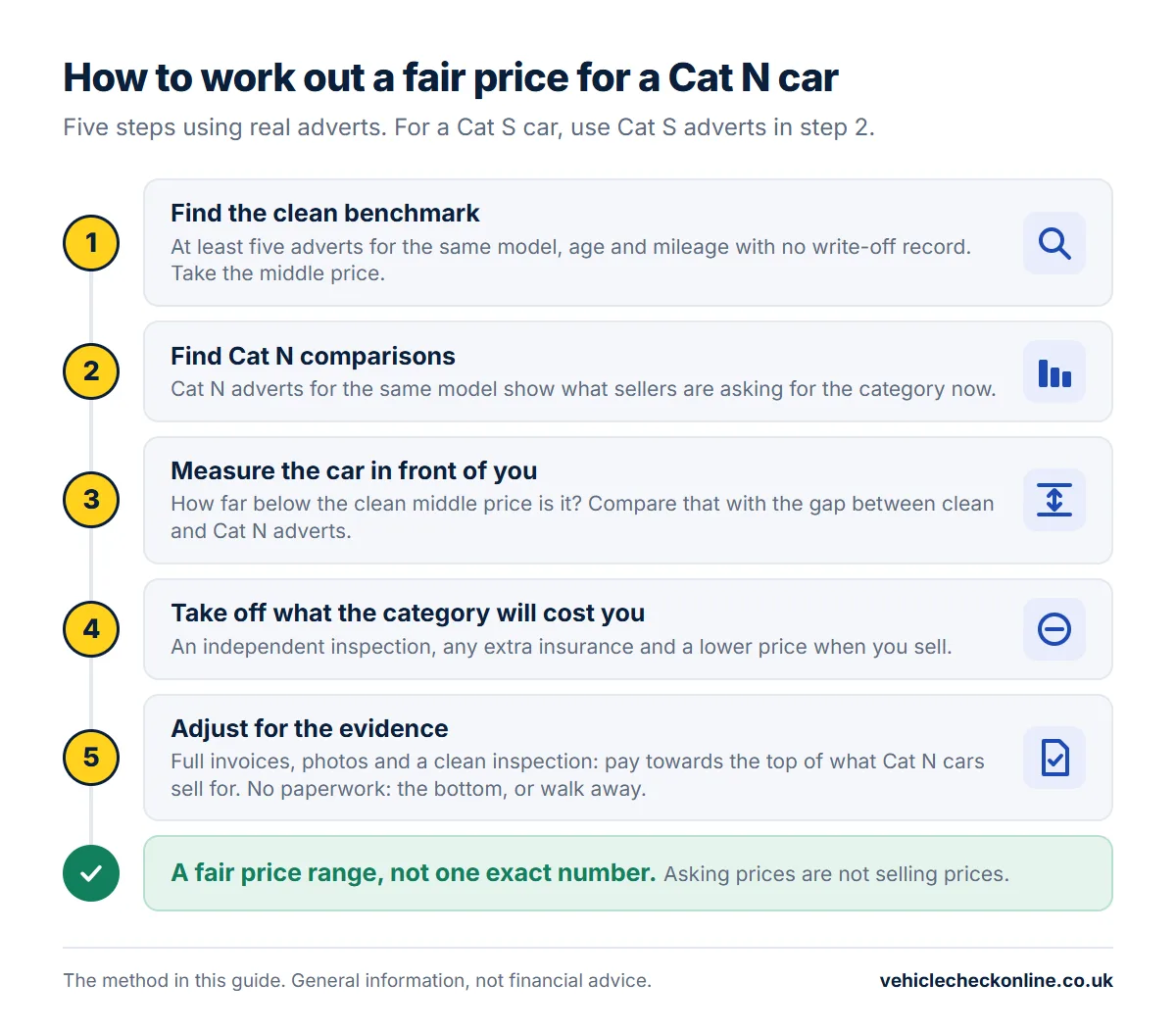
- Find the clean benchmark. Search adverts for the same make, model, engine and trim, within about a year of the car's age and at a similar mileage. Note the asking prices of at least five cars with no write-off record and take the middle one.
- Find Cat N comparisons. Search the same model for Cat N cars. If you find a few, their prices show what sellers are asking for the category now. For a Cat S car, do the same with Cat S adverts.
- Measure the car in front of you. Work out how far below the clean middle price it is, and compare that with the gap you found between clean and Cat N adverts.
- Take off what the category will cost you. An independent inspection, any extra insurance you were quoted, and the lower price you will get when you sell.
- Adjust for the evidence. Full invoices, photos and a clean inspection justify paying towards the top of what Cat N cars sell for. No paperwork justifies the bottom, or walking away.
Asking prices are not selling prices, and not every advert says the car is a write-off. Treat the result as a range rather than one exact number.
Should you sell a Cat N car privately or part-exchange it?
If you own a Cat N car, the same discount applies when you sell. The category stays on the insurers' record, so a buyer's write-off check will show it whether or not you mention it. Our guide to declaring Cat N when selling covers what to tell buyers.
A trader has to resell your car and allow for the category, so expect part-exchange and trade offers to be lower than a private sale. A car valuation check gives private sale and trade-in estimates to start from, before you allow for the category. Selling privately, have the repair invoices and photos ready: they answer a buyer's first question and support your price.
What happens if your own car has just been made Cat N?
When an insurer writes off your car, it pays you its market value. The Financial Ombudsman Service, which handles complaints about insurers, describes market value as the price the car would have sold for at a reputable dealer just before it was damaged or stolen.
If you want to keep a Cat N car, GOV.UK says the insurer gives you a payout and sells the car back to you. What you end up with is the payout less the price of buying the car back.
Once repaired, the car is worth less than before the loss, because it now has a write-off record that will weigh on its depreciation at every later sale. If you are deciding whether to keep it, compare the payout with the cost of the repair and what the car will be worth afterwards as a Cat N car, using the method above.
What happens if a Cat N car is written off again?
An insurer pays the market value of the car you had, and a car with a write-off record is worth less than a clean one. The Financial Ombudsman says that if you knew you were buying a repaired write-off, it may be fair for the insurer to make a deduction, but the insurer should show what effect the earlier write-off had on the market value.
If you could not reasonably have known the car had been written off, the Ombudsman says it is likely to tell the insurer to pay the full market value. Keep the advert and the seller's messages from when you bought the car: they show what you were told. For telling your insurer about the category in the first place, see our guide to insurance and finance on Cat S and Cat N cars.
How do you use the Cat N category to negotiate?
If a check shows a write-off the seller did not mention, or the price does not reflect it, you have good grounds to offer less. Keep it factual:
- Start with the record: tell the seller what the check shows, the category and the date of the loss.
- Show your comparison: the prices of similar clean cars, and of any Cat N cars you found.
- Name the costs: the inspection, the insurance quote and the lower price when you sell.
- Make one offer based on those figures, and be ready to walk away.
If the seller has full repair evidence and the price already reflects the category, a low offer may simply lose you a good car. The aim is a fair price, not the lowest one.
How does a report show the category and a valuation?
Our Premium report (£7.99) puts the write-off check next to an estimated valuation of the car, where one is available, with retail, private sale and trade-in figures. A valuation is an estimate, so use it alongside the adverts you compared rather than instead of them.
The same report shows outstanding finance and whether the car is recorded as stolen. You can see the layout in the sample report.
Questions and answers
Will a Cat N car ever be worth the same as a clean one?
Usually not. The MIB says it holds write-off data for seven years, and a buyer who finds the category will compare the car with clean ones with that history in mind.
Does Cat N affect a part-exchange price?
Yes. A trader has to resell the car with its history, so expect a lower offer than for the same car without a write-off record.
Can I get a valuation for a Cat N car?
Valuation tools give an estimate for the model, age and mileage. Check whether the figure allows for the write-off, and compare it with real Cat N adverts before you rely on it.
How much should I offer for a Cat N car?
Start from the middle price of similar clean cars, take off the gap you see between clean and Cat N adverts, then the cost of an inspection and any extra insurance. Make one offer based on those figures.
Is a Cat N car a good way to save money?
It can be, if you buy it cheaply enough and keep it for a long time. Expect to get less for it when you sell, and count that in the price you pay now.
Sources
- What Car?: What is a Cat A, Cat B, Cat S or Cat N write-off?
- Financial Ombudsman Service: Motor valuations and write-offs
- GOV.UK: Insurance write-offs (scrapping your vehicle and insurance write-offs)
- GOV.UK: Buying repaired written-off vehicles, a consumer guide
Related guides
- Should you buy a Cat N car?Should I buy a Cat N car? When a repaired write-off is a fair deal, when to walk away, and what to check on the repair, the price and the insurance.
- What does Cat N mean on a car?Cat N means an insurer wrote the car off after damage that did not reach its structure. What it covers, what it hides and how to confirm it.
- Should I buy a Cat S car?Should I buy a Cat S car? When a repaired Cat S is worth it, the repair proof to ask for, whether it needs an inspection or a new MOT, and when to walk away.
- Declaring Cat N when you sell a car: what the law saysDo I have to declare Cat N when selling? What the law says for private sellers and for dealers, what DVLA needs, and how to declare a write-off properly.
- Car depreciation: why cars lose value and how to work out the rateCar depreciation explained: what makes a car lose value, how the used market moves prices, what is different for electric cars and how to work out your rate.
This guide is general information for people buying, owning or selling a car in the UK, not legal or financial advice. Vehicle Check Online is an independent service, not affiliated with the DVLA, the DVSA or GOV.UK.