
Write-offs and accident damage
What does Cat N mean on a car?
Cat N means an insurer wrote the car off after damage that did not reach its structure: the frame and chassis were not harmed, but the insurer chose to pay out rather than repair it. Once it has been repaired and is roadworthy, it can legally be driven again.
N stands for non-structural. It is the lighter of the two categories that can return to the road, but "non-structural" does not always mean minor. This guide explains what a Cat N write-off covers, what can cause it, why it does not show on the logbook, and how to confirm it on the car you are looking at.
What does a Cat N write-off mean?
After a claim, an insurer either pays for the repair or treats the car as a total loss: it pays the owner the car's value and takes the car. A repairable car is written off when, in the words of the government's guide for buyers, the cost of repairing it would exceed its replacement value. It is a money decision, not proof that the car could not be fixed.
A written-off car is then given a category under the Association of British Insurers' code of practice for vehicle salvage. A qualified assessor decides which one applies. GOV.UK describes Cat N as a vehicle that can be repaired after non-structural damage and used again once it is roadworthy. The insurers' code puts it the other way round: a repairable vehicle that has not sustained damage to the structural framework or chassis.
Which parts count as non-structural?
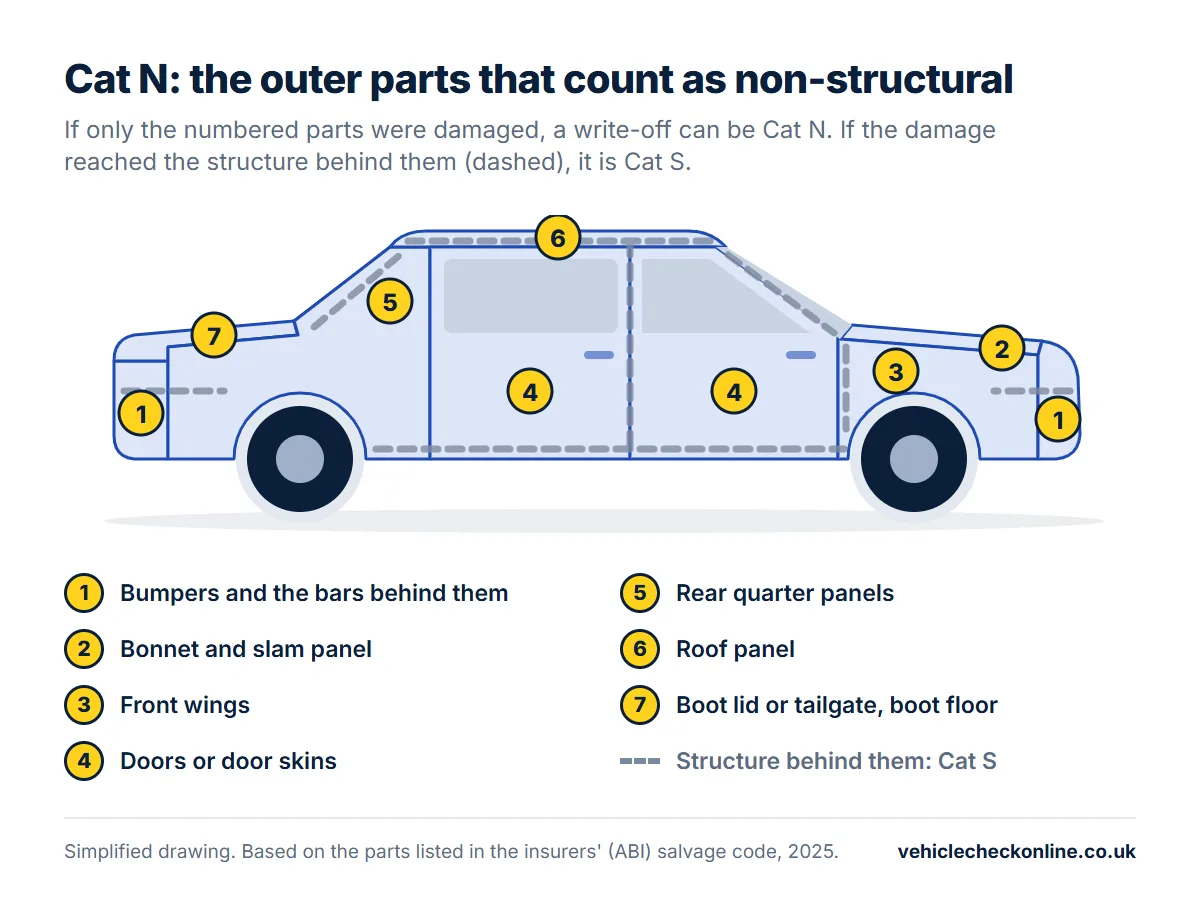
The insurers' code includes a diagram of the parts it treats as non-structural. If only these are damaged, the car is Cat N:
- The front and rear bumpers, and the reinforcement bars behind them
- The bonnet, the front wings and the slam panel at the front of the engine bay
- The door skins or complete doors
- The rear quarter panels and the roof panel
- The boot lid or tailgate, the boot floor and the outer rear panel
The structure sits behind those panels: the chassis legs, the pillars around the doors, the inner sills, the inner wings and the bulkhead between the engine and the cabin. If any of those needs straightening or replacing, the car is Cat S instead. The code tells the assessor to check whether a blow to an outer panel has pushed through to the structure behind it before choosing the category.
What can make a car Cat N?
A crash is the most common cause, but not the only one. The code asks the assessor to take the type of damage into account and lists theft, collision, impact, fire, electrical, flood and contamination. So a Cat N car might have had:
- Crash damage to bumpers, lights, wings or doors that would have cost too much to repair.
- Damage from theft, such as broken locks, a damaged ignition or missing parts. A stolen car found with no damage, or only minimal damage, falls outside the code and gets no category.
- Fire or heat damage that did not reach the structure.
- Water damage. Under the code, a car flooded inside badly enough to harm its electrics or safety systems should never return to the road, but other water-damaged cars can be Cat N.
- An electrical fault that was not worth repairing.
The letter alone does not tell you which of these happened. Ask the seller, and ask to see the repair invoices.
Does non-structural always mean minor?
The insurers' code itself warns that a Cat N car may still have safety-critical parts that needed replacing. When the category was introduced in 2017, Thatcham Research gave steering and suspension parts as examples.
Airbags are another. They are not part of the structure, so a car whose airbags went off can still be Cat N. The code lists airbags, seat belts and seat belt pre-tensioners among the parts that must never be sold on or re-used from salvage, so a proper repair uses new ones.
Electric and hybrid cars need extra care. Under the code, a damaged electric car can only be Cat N if its high-voltage battery is not part of the car's structure, and the code notes that the high-voltage system, battery included, may still be compromised.
Cat N tells you where the damage was, not how well it was repaired. The repair is what you are buying.
How do Cat N, Cat S and the old Cat D differ?
| Cat N | Cat S | |
|---|---|---|
| Damage | Non-structural: panels, bumpers, doors, trim, electrics | Structural: chassis legs, pillars, sills, bulkhead |
| Back on the road? | Yes, once repaired and roadworthy | Yes, once repaired and roadworthy |
| Logbook (V5C) | The owner keeps it; the category is not added | A new one is issued and records the category |
| In use since | 1 October 2017 | 1 October 2017 |
Before 1 October 2017, repairable write-offs were Cat C or Cat D. Those letters were based on the cost of the repair; the new ones are based on the type of damage. Cat N took over from Cat D, but they are different tests, so an old Cat D car could have had structural damage. Our guide to Cat C and Cat D explains the old letters.
For the structural category, see what Cat S means.
Does Cat N show on the logbook?
No, and this is the biggest practical difference from Cat S. GOV.UK says an owner who keeps a Cat N car can keep the existing logbook (V5C), and the insurers' code confirms that no comment about the category is added to it. A Cat S car, by contrast, gets a new logbook on which the DVLA records the category. Our car category check guide shows where each category does and does not appear.
So a clean-looking logbook proves nothing about Cat N. The record that counts is the one insurers keep. Every categorised car is entered on their write-off register, and the code says that information is passed to the companies that provide vehicle checks to the motor trade and the public.
What does Cat N mean on a car advert?
An advert may show it as "Cat N" or "Category N", in the title, the key details or the small print. An advert that says nothing is not proof of a clean history: the seller may not know, or may not mention it.
A price well below similar cars is a common clue. It is a reason to check, not proof either way. Ask the seller in writing whether the car has ever been written off, in which category and when, and keep the answer.
How do you check if a car is Cat N?
- Run a write-off check by registration. It searches the insurers' records, so it shows a Cat N record even though the logbook does not. Our write-off check gives the category and the date of the loss, as part of the Premium report (£7.99).
- Match the car to its paperwork. Check that the VIN on the car is the same as on the logbook, so you know the record belongs to this car.
- Read the free MOT history. A long gap between tests around the date of the loss, or new advisories after it, can show when the car was off the road and what followed.
- Ask for the repair invoices. They should say what was damaged and what was replaced.
If the check confirms Cat N, our guide on whether to buy a Cat N car covers the inspection, the price and the warning signs.
How does a Cat N record affect insurance and price?
A repaired Cat N car can be insured, but not every insurer will cover a car that has been written off, and you must tell yours that it is Cat N: if you do not, they may refuse a claim. Get a quote before you buy. Our guide to insurance and finance on Cat S and Cat N cars has the detail.
A Cat N car usually costs less than the same car with a clean history, and it will fetch less when you sell it. How much less varies from car to car: see how much Cat N reduces value.
Questions and answers
Is a Cat N car safe to drive?
It can be, if it was repaired properly. Cat N means the structure was not damaged, but parts such as airbags, steering or suspension may have been replaced, so have the car inspected before you buy.
Can a Cat N marker be removed?
Not once it is recorded correctly. The insurers' code only allows a record to be changed to correct an error or in exceptional cases, so the category stays with the car whoever owns it.
Why would an insurer write off a car with light damage?
Because the repair would cost more than the car is worth. The lower a car's value, the less damage it takes for that to happen, so older and cheaper cars can be written off for fairly light damage.
Can a Cat N car have had its airbags deployed?
Yes. Airbags are not part of the structure, so a car whose airbags went off can still be Cat N. Ask for proof that new airbag and seat belt parts were fitted, and check the airbag warning light goes out after you start the car.
How do I find out if a car is Cat N if the seller does not say?
Run a write-off check on the registration. Cat N is recorded on the insurers' register, not on the logbook, so a check is the reliable way to find out.
Is a Cat N car worth buying?
It can be, if the repair was done properly and the price is low enough to make up for higher insurance and a lower resale value. Compare it with similar clean cars and have it inspected first.
Sources
- GOV.UK: Insurance write-offs (scrapping your vehicle and insurance write-offs)
- GOV.UK: Buying repaired written-off vehicles, a consumer guide
- ABI: Code of Practice for the Categorisation of Motorised Vehicle Salvage (May 2025)
- Thatcham Research: Revised salvage code of practice comes into play on 1 October (2017)
Related guides
- Should you buy a Cat N car?Should I buy a Cat N car? When a repaired write-off is a fair deal, when to walk away, and what to check on the repair, the price and the insurance.
- What does Cat S mean on a car?Cat S means a car was written off after structural damage and can go back on the road once repaired: what the S stands for and how to tell if a car is Cat S.
- How much less is a Cat N or Cat S car worth?How much do Cat N and Cat S reduce a car's value? Why there is no fixed figure, what drives the discount, and how to work out a fair price for a write-off.
- What do Cat C and Cat D mean on a car?Cat D car meaning: a write-off that could be repaired for no more than the car's value. How Cat C and D differ from Cat S and N, and what to check.
This guide is general information for people buying, owning or selling a car in the UK, not legal or financial advice. Vehicle Check Online is an independent service, not affiliated with the DVLA, the DVSA or GOV.UK.