
Buying a used car
Car depreciation: why cars lose value and how to work out the rate
Car depreciation is the value a car loses over time: the gap between what it cost and what it would sell for today. How fast it goes depends on its age and mileage, its condition and service history, the number of keepers, any write-off record, its fuel type and what the used market is doing. The official figures we checked give no average rate, so the one that matters is your own car's.
This guide explains how each of those works over a car's life, how the whole used market moves values, what a PCP's balloon payment tells you, what makes electric car depreciation different, and how to work out a car depreciation rate, with an example. For how a valuation itself is put together, see our guide to how much your car is worth.
What is car depreciation, and when do you pay for it?
Depreciation is a loss on paper until the car changes hands. You meet it when you sell or part-exchange the car, when you settle or end a finance agreement, and when an insurer writes the car off: the Financial Ombudsman measures a written-off car at its market value just before the loss, not at the price you paid for it.
The sum you lose depends on where you start. The same share of a lower price is a smaller amount of money, so someone who buys a car a few years old has fewer pounds to lose than the person who bought it new, even if both lose the same share each year.
What makes a car lose value faster?
Most of what moves a car's value builds up over its life, and some of it only shows when you come to sell:
| Cause | How it works over the years |
|---|---|
| Age | Counted from the date of first registration. A car is valued against others of the same age, so the clock keeps running however little it is used. |
| Mileage | Valuations take the reading into account, so a car that covers more than usual for its age loses value faster. Our guide to good mileage for a used car shows what is usual. |
| Condition | Damage beyond normal wear for the car's age lowers its value, and the newer the car, the less wear a buyer expects to see. |
| Service history | The cost of a gap arrives on the day you sell, when a buyer who cannot see the record allows for work that may be overdue. |
| Number of keepers | Every change adds a keeper that buyers will see, and a run of short ownerships makes them ask why: see how many owners is too many. |
| Write-off record | A repaired write-off is worth less than the same car with a clean record, from the day of the loss and at every later sale. Our guide to how much Cat N takes off explains the gap. |
| Fuel type and emission rules | Rules change what a car is worth to the buyers they affect. Birmingham and Bristol charge petrol cars below Euro 4 and diesels below Euro 6 to enter their clean air zones: see our clean air zone check. |
| Demand | What buyers want, and what the used market as a whole is doing, which the next section shows. |
How does the used car market change your car's depreciation?
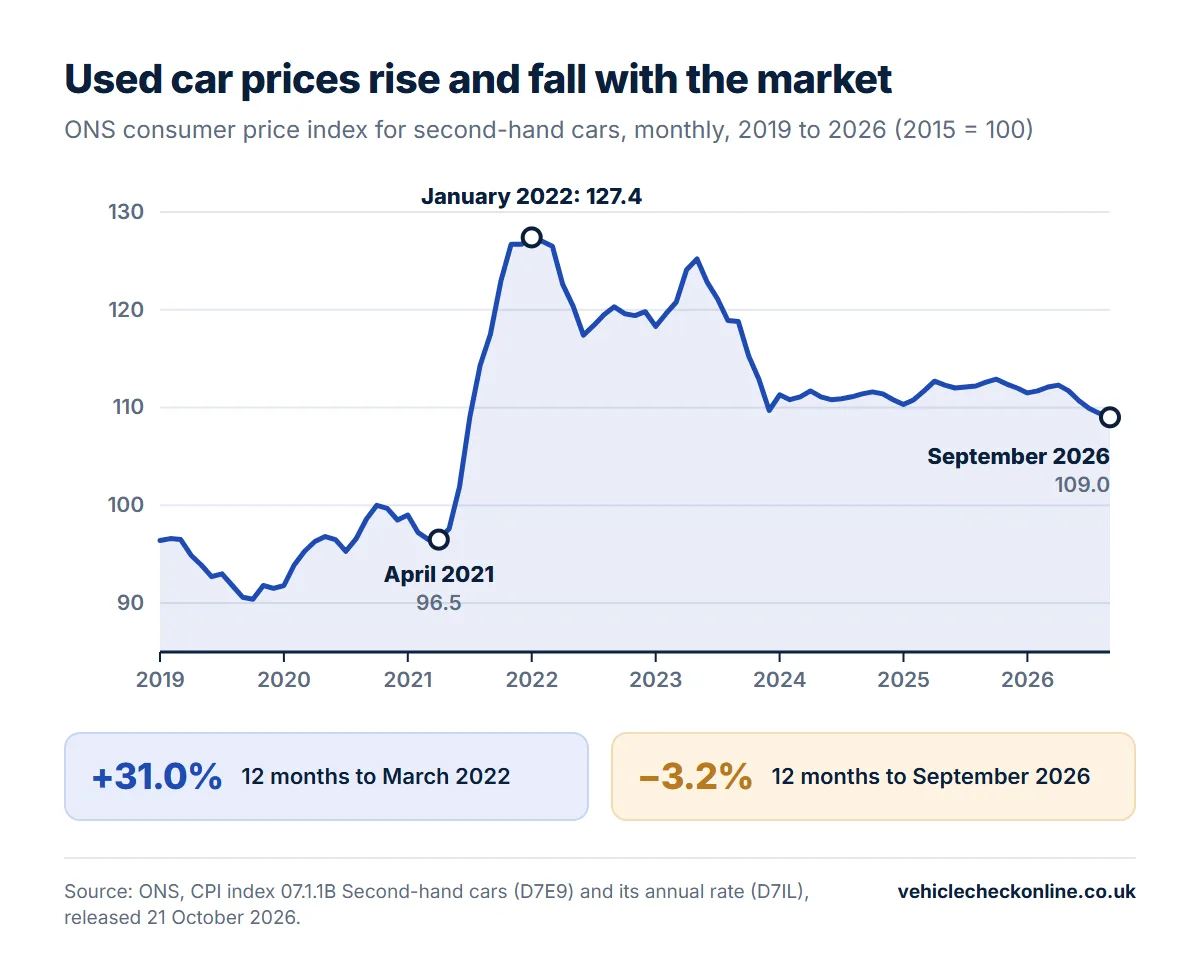
Depreciation is not a smooth curve, because used car prices rise and fall together. The Office for National Statistics (ONS) tracks the prices of comparable second-hand cars, matched by make, model, engine, mileage and age, in its consumer price index.
That index (2015 = 100) was 96.5 in April 2021 and 127.4 in January 2022. In the 12 months to March 2022, second-hand car prices were 31.0% higher than a year before, a rise that could cancel out some or all of what a car lost by being a year older. Prices have eased since: in September 2026 the index stood at 109.0, 3.2% lower than a year earlier.
So a rate worked out from another car, or from another year, may not fit yours. Use figures for your own car, and expect the market to move them again.
What does a PCP balloon payment tell you about depreciation?
On a personal contract purchase (PCP), the optional final payment, or balloon payment, is often called the GMFV: the minimum future value set for the car at the start. The FCA describes it as linked to the car's expected residual value and estimated when the agreement is made. In other words, it is the lender's own forecast of what the car will be worth at the end, and so of how much it will lose before then.
That forecast shapes what you pay. The more value the lender expects the car to lose, the lower the final payment and the more of the price you repay month by month.
At the end, the FCA says you can make the final payment and own the car, hand it back, or put any equity towards another car: equity is the amount by which the car is worth more than the final payment. If it is worth less, handing it back leaves that loss with the lender, but read your agreement's mileage and condition terms first, because the Financial Ombudsman sees complaints about excess mileage and damage charges at that point.
Electric car depreciation: what is different?
An electric car loses value for the same reasons as any other car, plus a few of its own. In its review of the zero emission vehicle mandate (August 2026), the Department for Transport said the first years of the switch brought change and uncertainty to the used market, but that used electric cars now sell faster and at more stable prices than before. These are the points that move an electric car's value, with their dates:
| What moves the value | What has changed, and when |
|---|---|
| Battery health | The government counts battery health among drivers' concerns. On 27 October 2026 it confirmed that most new cars registered in Great Britain from 29 November 2027 must meet Euro 7, which adds battery durability rules and accurate, comparable battery health monitors to help buyers of used electric cars. |
| Battery warranty | To qualify for today's grant, a new electric car's battery must have a warranty of 8 years or 100,000 miles, whichever comes first. A buyer will want to know how much is left and whether it passes to them. |
| Range and technology | In April 2025 GOV.UK said the government expects more electric cars with longer ranges as battery costs fall, so an older model has to compete with newer ones that go further. |
| Grants on new cars | The plug-in car grant closed to new orders on 14 June 2022. Since 16 July 2025, the Electric Car Grant has taken up to £3,750 off some new electric cars priced at or under £37,000, and a used car competes with those prices. |
| Vehicle tax | Paid by new and existing electric cars since 1 April 2025. In 2026-27 it is £20 a year for cars first registered from March 2001 to March 2017 and £200 for later ones, after a £10 first year for cars registered since April 2025, which also pay a supplement for five years if the list price was over £50,000. |
| Pay per mile | Announced on 26 November 2025: from April 2028, 3p a mile for electric cars and 1.5p for plug-in hybrids, collected with vehicle tax. Draft legislation was published for comment in July 2026. Mileage paid for in advance passes to the next keeper, and the government expects it to be reflected in the sale price. |
Of these, battery health is the one a viewing cannot show you. Our guide to buying a used electric car explains how to get it measured.
How do you work out your car's depreciation rate?
You need two values and the number of years between them:
- The starting value. What you actually paid, after any discount or grant, not the list price.
- The value now. A current valuation, such as a car valuation check, checked against adverts for similar cars. Compare like with like: if you bought from a dealer, use the retail value; if you bought privately, the private value. A trade-in figure also takes off the dealer's margin, so it makes the loss look bigger.
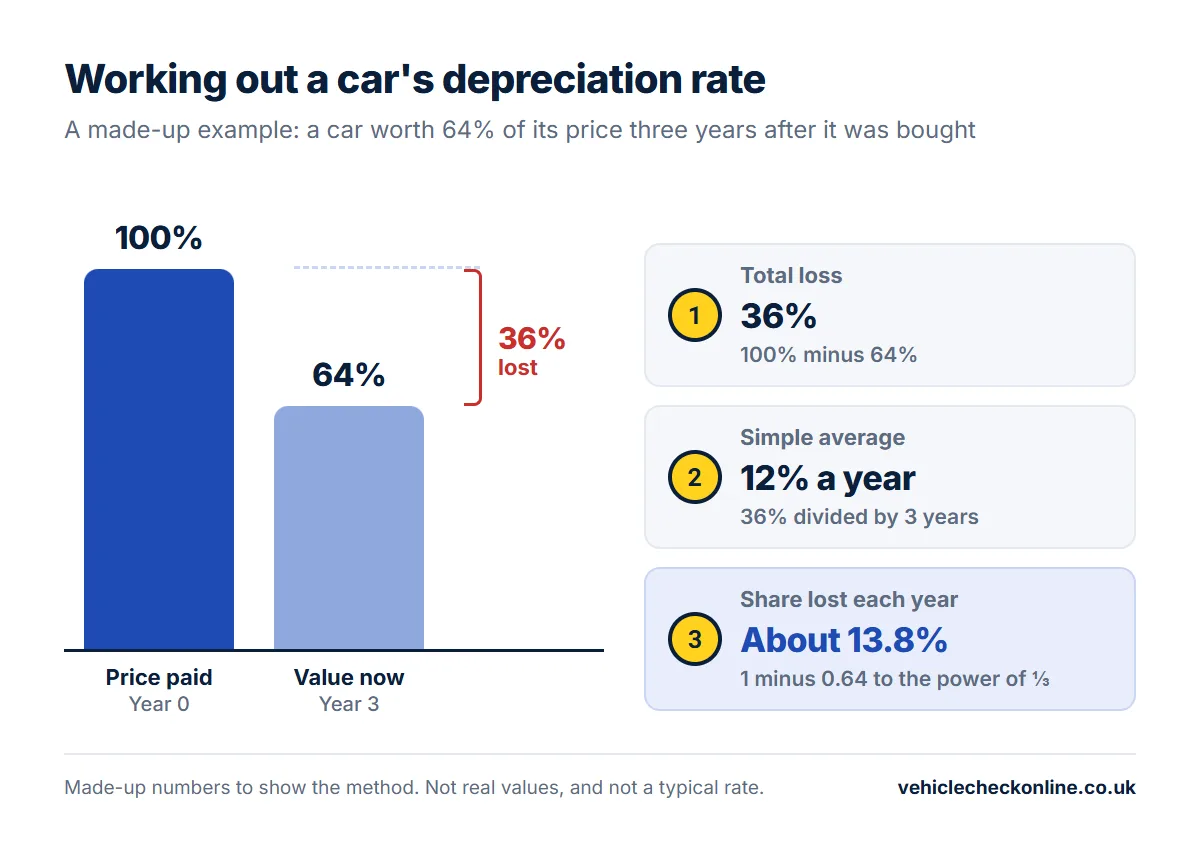
- The sums. Take the value now from the starting value, divide by the starting value and multiply by 100 for the total loss as a percentage. Divide that by the number of years for a simple average. For the share lost each year, work out 1 minus (value now ÷ starting value) to the power of (1 ÷ years).
A worked example, with made-up numbers. You paid £15,000 for a car, and three years later a valuation of the same kind says it is worth £9,600. It has lost £5,400, which is 36% of what you paid, so it keeps 64%. The simple average is 12% a year (36 ÷ 3). The share lost each year is about 13.8%, because 0.64 to the power of one third is about 0.862.
The yearly share is the better figure for looking ahead: at 13.8%, the car in the example would be worth roughly £8,300 a year later. Treat that as a guide, not a forecast, because the market can move the real figure either way.
How can you keep depreciation down?
You cannot stop a car ageing, but you can avoid the losses that come from its history:
- Check the history before you buy. A write-off record, a mileage that does not add up or a string of short ownerships will cut what the car fetches when you sell, and none of them shows on the car. A car history check finds them, with outstanding finance and previous keepers, in the Premium report (£7.99), which also gives an estimated valuation where one is available.
- Keep the paperwork. Service invoices and records of repairs back up the mileage and the condition when you sell. Buyers can already see the free MOT history, so deal with advisories rather than letting them repeat.
- Put damage right. The Financial Ombudsman accepts that damage beyond normal wear for the car's age can lower its market value, and the newer the car, the more it shows.
Questions and answers
What is the average car depreciation rate in the UK?
The official sources we checked publish no average rate. The ONS measures how the prices of comparable used cars change over time, which is a different thing, so the most useful figure is your own car's, worked out from what it cost and what it is worth now.
Do electric cars depreciate faster than petrol cars?
No official source we checked gives a comparison. The Department for Transport said in August 2026 that used electric car prices had stabilised after some uncertain years, but battery health, the battery warranty, newer models and tax changes can still move an electric car's value.
Can a used car go up in value?
It can, when the market rises faster than the car ages. In the 12 months to March 2022, the ONS measured second-hand car prices 31.0% higher than a year earlier. In the 12 months to September 2026 they were 3.2% lower.
Is depreciation worst in the first year?
No official figure shows how much an average car loses in its first year. If a car loses a similar share of its value each year, the loss in pounds is biggest early on, because the same share is taken from a higher value.
Does a PCP final payment tell me what my car will be worth?
It tells you what the lender expected when the agreement started. The FCA describes it as linked to the expected residual value, but the car's real value at the end can be higher or lower, depending on its mileage, condition and the market.
Does a write-off record make a car depreciate faster?
A repaired write-off is worth less than the same car with a clean record, and the category stays on the insurers' record, so the gap follows the car to every later sale.
Sources
- ONS: CPI index 07.1.1B, second-hand cars (2015 = 100), released 21 October 2026
- FCA: Updated diagnostic report, motor finance commission arrangements (March 2026), PCP and the GMFV
- FCA: Our work on motor finance, update (March 2018), the PCP final payment
- GOV.UK: Vehicle tax for electric, zero and low emission vehicles (updated 2 April 2026)
- GOV.UK: The introduction of Electric Vehicle Excise Duty (eVED), consultation response (13 July 2026)
- Department for Transport: Updating the minimum emission standard for new road vehicles, government response (27 October 2026)
Related guides
- How much is my car worth, and how is it valued?How much is my car worth? Why retail, private and trade-in values differ, what moves a car's value, and how to check a valuation against real adverts.
- What is good mileage for a used car?What counts as good mileage for a used car in the UK: how to judge miles against age and fuel type, whether 100k miles is a lot, and how to check the readings.
- Buying a used electric car: what to check before you payBuying a used electric car? How to check battery health, what the battery warranty covers, charging cables, tax since April 2025 and the history checks.
- How much less is a Cat N or Cat S car worth?How much do Cat N and Cat S reduce a car's value? Why there is no fixed figure, what drives the discount, and how to work out a fair price for a write-off.
- How many previous owners is too many for a used car?There's no fixed limit: about one keeper per three years of age is normal. Why short ownerships are the real warning sign, and how to check a car's true number.
This guide is general information for people buying, owning or selling a car in the UK, not legal or financial advice. Vehicle Check Online is an independent service, not affiliated with the DVLA, the DVSA or GOV.UK.