
Buying a used car
How many previous owners is too many for a used car?
There is no legal limit and no fixed number of owners that is too many. As a rough rule of thumb, about one keeper for every three years of a car's age is unremarkable. What matters more is how long each keeper had the car: several owners in a short time, especially recently, is the real warning sign.
This guide explains what the owner count actually measures, when a high number is perfectly normal, when it should make you ask questions, and how to find the real number for any car before you buy it.
Owners or keepers: what does the number count?
The number you see in an advert or on a history report is the number of registered keepers: the people or businesses recorded by the DVLA as responsible for the car. The keeper is not always the legal owner. The V5C logbook says on its front that it is not proof of ownership, and a car on finance, for example, belongs to the finance company while someone else is its keeper.
A "previous keeper" count includes everyone registered before the current keeper. So a car described as "two previous owners" is on its third keeper now.
Some changes add a keeper and some do not. A car passed from one partner to another in the same household counts as a new keeper if the logbook was changed. A dealer who buys a car to sell on usually does not: when a vehicle is bought into the trade, the DVLA removes the old keeper and notes the car as "in trade" until it is sold to the next keeper. A change of number plate is recorded as a plate change, not a change of keeper.
How many previous owners should a car have?
There is no correct number, but the table below is a sensible starting point. It is a rule of thumb, not a statistic: use it to decide whether to ask more questions, not to rule a car in or out.
| Age of the car | Keepers that would not worry most buyers | Worth asking about |
|---|---|---|
| Under 3 years | 1 or 2 | 3 or more |
| 3 to 6 years | Up to 3 | 4 or more |
| 6 to 10 years | Up to 4 | 5 or more |
| Over 10 years | Varies widely | Several short spells in the last few years |
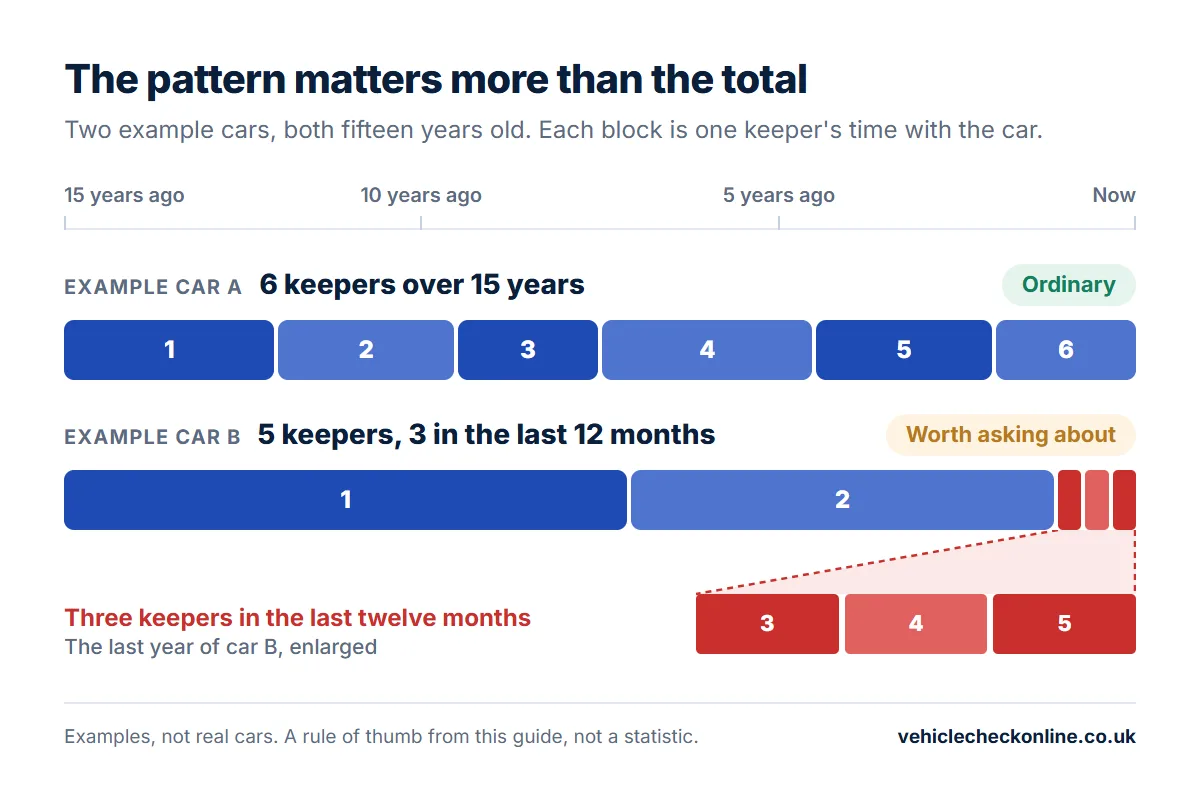
The pattern matters more than the total. Six keepers over fifteen years is ordinary; three keepers in the last twelve months is not.
Why do short ownership spells matter more than the total?
People rarely sell a car they are happy with after a few months. When a car changes hands quickly, again and again, it can mean that each owner found a problem and passed it on: an intermittent fault, an electrical gremlin, a gearbox that is starting to go, or damage that shows in the rain.
Quick changes can also point to a trader buying and reselling cars while posing as a private seller, which lets them avoid the legal duties a dealer has. That is why the date of the last keeper change is one of the most useful facts about a car. If the seller has had it only a few weeks, ask why they are selling so soon, and listen to how specific the answer is. Our previous owners check shows that date for any car, with the number of previous keepers.
None of this proves anything on its own. Someone may have bought the car, been moved abroad by their employer and had to sell. But a short spell is a reason to look harder at the car and its history.
When is a high number of keepers normal?
- Older and cheaper cars. A fifteen-year-old small hatchback has often been a first car, a second car and a runabout for several households.
- Cars that started life with a business. A car first registered to a leasing, rental or fleet company has a business as its first keeper. Many company and lease cars are replaced after a few years, which is an ordinary reason for an early change.
- Pre-registered cars. A car registered by a dealer or manufacturer before it was sold, often advertised as "pre-registered" or "delivery mileage", can show that business as its first keeper.
- Family transfers. A car handed from a parent to a son or daughter, then to a sibling, can add keepers without ever leaving the family.
When is the number of owners a warning sign?
- Several keepers who each had the car for months rather than years.
- The seller bought the car only recently, or is "selling it for a friend".
- The count does not match the advert: "one owner from new" on a car with four previous keepers.
- The MOT history shows gaps, a mileage that falls between tests, or the same advisories carried from test to test without being fixed.
- The seller's name or address is not the one on the V5C, and they cannot give a straight reason why.
- There are plate changes in the history that nobody mentioned. A number plate history check lists each one, with its date.
If you see one of these, it is not a reason to panic, but it is a reason to check the car properly before you hand over any money.
How many owners has my car had, and where can I find the number?
You can find the number of previous keepers, and when the car last changed hands, in three ways:
- The V5C logbook. It records the number of previous keepers and the date the current keeper acquired the car. Ask to see the original at the viewing, not a photo or a copy.
- A vehicle history check. Our car history check shows the number of previous keepers, the date of the last keeper change and any plate changes, with the finance, write-off and stolen checks in the same report. Keepers' names and addresses are never shown.
- The DVLA. If you are the current registered keeper, you can ask the DVLA for the number of previous keepers of your own vehicle by post on form V888, for a fee. The DVLA releases the names and addresses of previous keepers only where the law allows, for example when they are needed for court proceedings.
If you want to trace an earlier owner, for example to ask about the car's history, our guide to finding previous owners explains what is possible.
What should you ask the seller about previous owners?
- How long have you had the car, and why are you selling it?
- Do you know why the previous owner sold it?
- Was it a company, lease or rental car at any point?
- Does the service history cover the whole time, including the changes of owner?
- Is the V5C in your name, at this address?
Compare the answers with the logbook, the service book and the MOT history. A seller who has owned the car for years should be able to tell you about it in detail. For a fuller list, see our questions to ask when buying a used car.
Does the number of owners affect a car's value?
Many buyers prefer a car with fewer keepers, and "one owner from new" is a common selling point, so a long list of keepers can make a car harder to sell later and add to its depreciation. How much difference it makes varies with the car, its age and its price.
For the car's condition, the number matters less than what each owner did with it. A five-owner car with a full service history and steady mileage is usually a better buy than a two-owner car with no records. Judge the evidence, not the count.
Questions and answers
Does a dealer count as an owner?
Usually not. A dealer who buys a car to sell on normally has it recorded as in the trade, so the next buyer becomes the next keeper. A car registered in the dealer's own name, such as a pre-registered car, does count.
Does a private plate change count as a new owner?
No. Putting on or taking off a private plate changes the registration number, not the keeper. A history check lists plate changes separately from keeper changes.
Is a one-owner car always the better buy?
Not always. A single owner who skipped servicing can leave a car in worse shape than several careful ones. Look at the service history, the MOT history and the condition before the count.
Is 4 previous owners on a car bad?
Not on its own. As a rule of thumb, four keepers would not worry most buyers on a car six to ten years old, but on one under six years old they are worth asking about. How long each keeper had the car matters more than the total.
Does a lease or company car count as one keeper?
The keeper is whoever is registered with the DVLA. If a leasing or fleet company was the registered keeper, it counts as one keeper, however many employees drove the car.
Can I find out who the previous owners were?
Not easily. The DVLA gives out previous keepers' names only where the law allows, such as for court proceedings, and history checks show the number of keepers, not their names.
Does an advert saying one owner have to be true?
A seller should describe a car accurately, and a false description can matter if something goes wrong later. Check the number yourself on the V5C or with a history check instead of relying on the advert.
Sources
- GOV.UK: Check a used vehicle you're buying
- DVLA: Giving people information from our vehicle record (MIS546)
- DVLA: Digital services and motor dealers (INF275)
- GOV.UK: Action to protect second hand car buyers (V5C not proof of ownership)
Related guides
- What to ask when buying a used car: the questions that matterThe questions to ask when buying a used car, on the phone and at the viewing: what each answer tells you, the red-flag replies, and what to check for yourself.
- How to find the previous owners of a carHow to find previous owners of a car: what the V5C and a history check show, when DVLA releases names on form V888, and the free routes that still work.
- How to buy a used car privately in the UKBuying a car privately in the UK, from advert to driving home: the checks before you view, the paperwork, paying safely and your rights as a private buyer.
- Private plate history: how to see a car's old number platesHow to check if a car has had a private plate: read the age identifier, compare the paperwork, and see the full number plate change history in a report.
- Car depreciation: why cars lose value and how to work out the rateCar depreciation explained: what makes a car lose value, how the used market moves prices, what is different for electric cars and how to work out your rate.
This guide is general information for people buying, owning or selling a car in the UK, not legal or financial advice. Vehicle Check Online is an independent service, not affiliated with the DVLA, the DVSA or GOV.UK.