
The V5C and other documents
Private plate history: how to see a car's old number plates
To check if a car has had a private plate, use a private plate history check: a vehicle history report lists the plate changes recorded for the car, with each old number and the date it changed. You can spot many changes yourself, too, by comparing the plate's two-digit age identifier with the date the car was first registered.
This guide explains what happens to a car's record when its plate changes, how to read a plate, what a report shows, which patterns are normal and which are warning signs, and what to ask the seller.
What happens when a car gets a private plate?
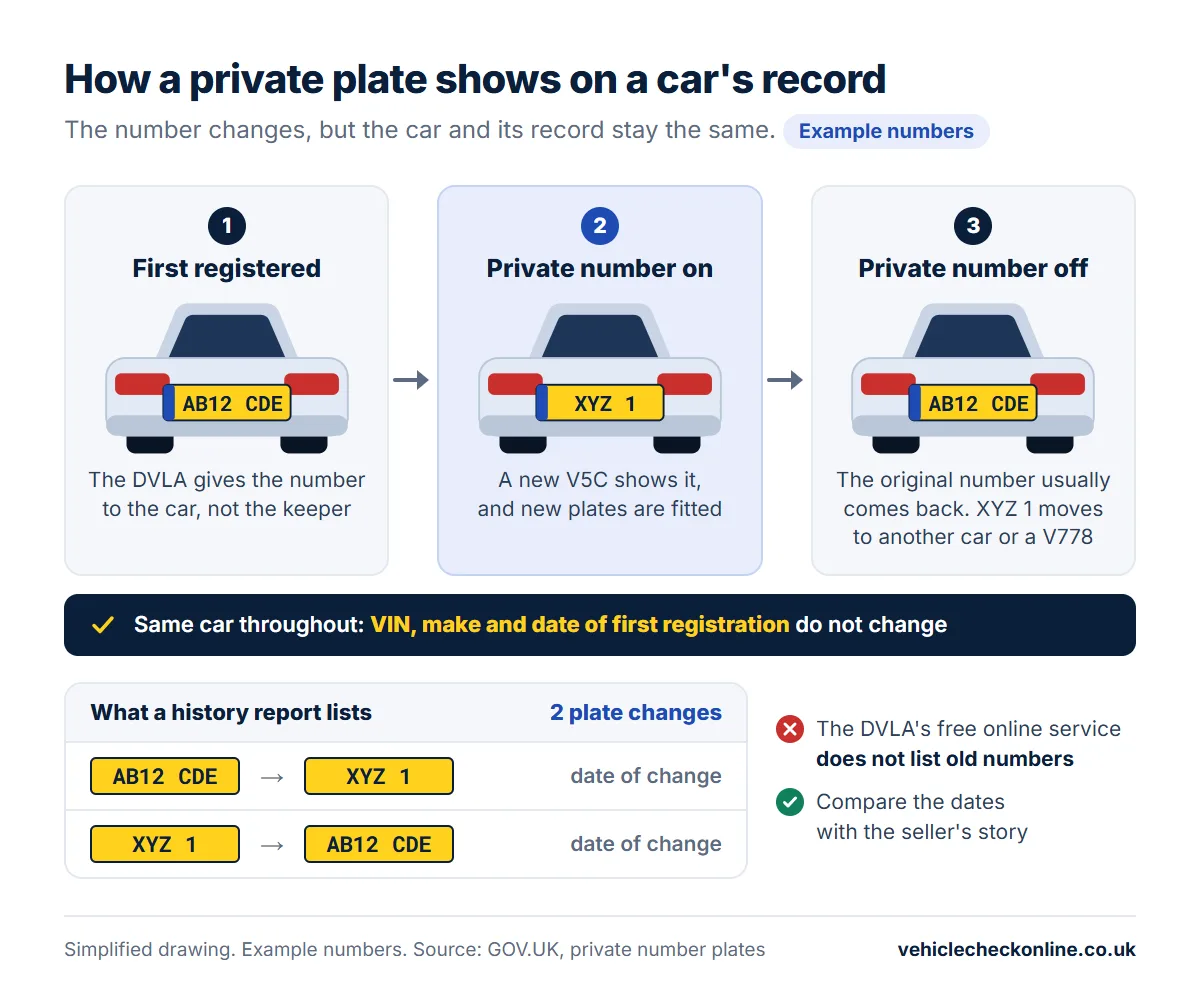
The DVLA gives a registration number to the vehicle, not to its keeper. It stays with that vehicle unless the keeper applies to take it off and put it on another vehicle or on a retention certificate (V778).
When a private number is put on a car, the DVLA issues a new V5C logbook showing it, and the keeper must fit new number plates before driving. When the private number is taken off, the car's original number is usually given back to it automatically. Either way, the car itself is the same: its VIN, make and date of first registration do not change.
There is one firm rule. You cannot use a private number that makes a vehicle look newer than it is. GOV.UK gives the example of an "07" number on a car first registered in 2003.
Why does plate history matter when you buy?
- Paperwork under the old number. Service invoices, old MOT certificates and stamps in the service book show the number the car had at the time. If you do not know the old number, you cannot match them to the car.
- The advert and the story. A seller who says "one owner from new" but whose car has had three numbers should be able to explain why.
- Hiding a past. A change of plate does not erase a car's records, but a run of quick changes can be a way to make a car harder to connect with its history. Cloned cars, which wear another car's number, are a separate problem: see our guide on how to spot a cloned car.
How can you check yourself if a car has had a private plate?
Since 1 September 2001, a standard number has two letters for the area where the car was first registered, two numbers that show when it was issued, and three random letters. The two numbers are the age identifier:
| Number issued between | Age identifier | Example |
|---|---|---|
| 1 March to 31 August | The last two digits of the year | 07 for March to August 2007 |
| 1 September to the end of February | The last two digits of the year plus 50 | 57 for September 2007 to February 2008 |
- Find the date the car was first registered. The DVLA's free vehicle enquiry service shows it, with the year of manufacture.
- Compare it with the age identifier on the plate. A 2015 car first registered in May should carry a "15" number.
- If the plate is older in style, has no year in it at all, or its age identifier does not fit the first registration date, ask the seller why before you go further.
- Look at the date the last V5C was issued, also shown on the vehicle enquiry service. A plate change produces a new logbook, so a very recent date is worth asking about.
This only tells you about the plate the car wears today. A car can have had a private number in the past and gone back to its original one, which looks perfectly normal. For that, you need the record of changes. Our number plate history check lists each earlier number recorded for the car with the date it changed.
What does a private plate history check show?
The DVLA's free online service does not list previous numbers. A history report does. Our car history check shows how many plates the car has had, each previous registration and the date it changed, with previous keepers and a valuation in the Basic report, £3.99. The Premium report, £7.99, adds the outstanding finance, write-off and stolen checks.
Compare the dates of the plate changes with the date of the last keeper change and with what the seller has told you. A plate changed shortly before the car went up for sale is worth asking about.
What number plate change history is normal?
| What you see | What it usually means | What to do |
|---|---|---|
| One private number, kept for years | An owner liked the number | Ask for the old number so you can match old paperwork |
| Private number taken off just before the sale | The seller is keeping their number for another car | Normal. The seller must do this before selling |
| Several changes in a short time | Possibly an attempt to separate the car from its records | Ask why, then run a stolen car check, with the finance and write-off checks |
| A change in the last few weeks and no logbook showing the current number | The new V5C has not arrived yet | Wait until it has before you pay |
| A number that makes the car look newer | Not allowed by the DVLA | Ask why, and treat it as a warning sign |
On its own, a plate change is not a problem. Many cars carry a private number for a while. What matters is whether the changes fit the seller's story and the rest of the car's history.
When does a plate change show up?
An application to put a private number on a car online takes effect straight away if the car does not need an inspection, but the new logbook usually takes about four weeks to arrive. When a private number is taken off, GOV.UK says the new logbook can take 4 to 6 weeks.
In that gap, the logbook the seller holds may show a number the car no longer carries. GOV.UK says a keeper who has just put a private number on a car must not sell it until the new V5C arrives, so a seller who wants to sell before then is a reason to wait.
What should you know about buying a car with a private plate?
Agree before you pay whether the private number comes with the car. If the seller wants to keep it, GOV.UK says they must apply to take it off before they sell. It costs £80, and the car usually gets its original number back.
If the number is included, it stays with the car and passes to you with it. Write down on the receipt which number the car is sold with. Our car sale receipt template has a line for it.
If you later change the number yourself, you must tell your insurer, and update any automatic payment accounts that use the number, such as the Congestion Charge, the Ultra Low Emission Zone, the Dart Charge or Clean Air Zones.
What should you ask the seller about plate changes?
- What number did the car have before, and when did it change?
- Do you have the old logbooks, or the V778 retention document if you took a number off?
- Are the service invoices under the old number, and does the VIN on them match the car?
- Is the number on the car the one that comes with it?
A genuine seller usually knows the answers and has the papers. Vague answers about a recent change are a reason to slow down.
Questions and answers
Does a private plate hide write-off or finance records?
It should not. The number belongs to the vehicle record, and a plate change is recorded against the same vehicle, which is why a history report can list previous plates. Read the plate history alongside the finance, write-off and stolen results rather than on its own.
Can I see a car's previous number plates for free?
Not from the DVLA's free online service, which shows the vehicle's details but not previous numbers. Ask the seller for old logbooks or invoices, or use a history report, which lists the changes.
How do I find the original number plate of a car with a private plate?
The DVLA's free online service does not show it. Ask the seller for an older logbook or invoices from before the private number was fitted, or use a history report, which lists each previous number and the date it changed. If the private number is taken off, the car usually gets its original number back.
Can a private plate make a car look newer?
No. DVLA rules do not allow a private number that makes a vehicle look newer than it is. A private number can make a car look older, or carry no year at all.
Does a car keep its private plate when it is sold?
Yes, unless the keeper applies to take it off before the sale. The number stays with the vehicle until someone takes it off.
How much does it cost to take a private plate off a car?
GOV.UK lists a fee of £80 to take a private number off a vehicle, online or by post. Putting a number on a vehicle is free.
Sources
- GOV.UK: Private (personalised) number plates
- DVLA: INF104, vehicle registration numbers and number plates
- GOV.UK: Selling a vehicle
- GOV.UK: Get vehicle information from DVLA
Related guides
- How to tell if a car is cloned before you buy itHow to tell if a car is cloned: match the VIN, the V5C logbook and the official record, and meet at the keeper's address. Step-by-step checks for buyers.
- How to check a car's service historyHow to check the service history of a car: there is no free government lookup, so here is how to verify the service book, digital records and invoices.
- How to find the previous owners of a carHow to find previous owners of a car: what the V5C and a history check show, when DVLA releases names on form V888, and the free routes that still work.
- Private car sale receipt: a free UK templateA free car sale receipt template for UK private sales: the wording to copy, what each line is for, the finance and write-off statements, and what to do next.
This guide is general information for people buying, owning or selling a car in the UK, not legal or financial advice. Vehicle Check Online is an independent service, not affiliated with the DVLA, the DVSA or GOV.UK.