
Buying a used car
Buying a used electric car: what to check before you pay
When buying a used electric car, start with the battery: ask for a battery health report, see the range on a full charge and find out how much of the battery warranty is left. Then check the charging socket and cables, the tax and the MOT history, and run a history check for outstanding finance, write-off and theft records.
Most of what you would check on a petrol or diesel car still applies, but an electric car adds a few things that are easy to miss at a viewing. This guide explains what battery state of health means and how to get it measured, what to try on the test drive, the charging kit, the tax rules since April 2025, the MOT and recalls, and the paperwork.
What should you check when buying a used electric car?
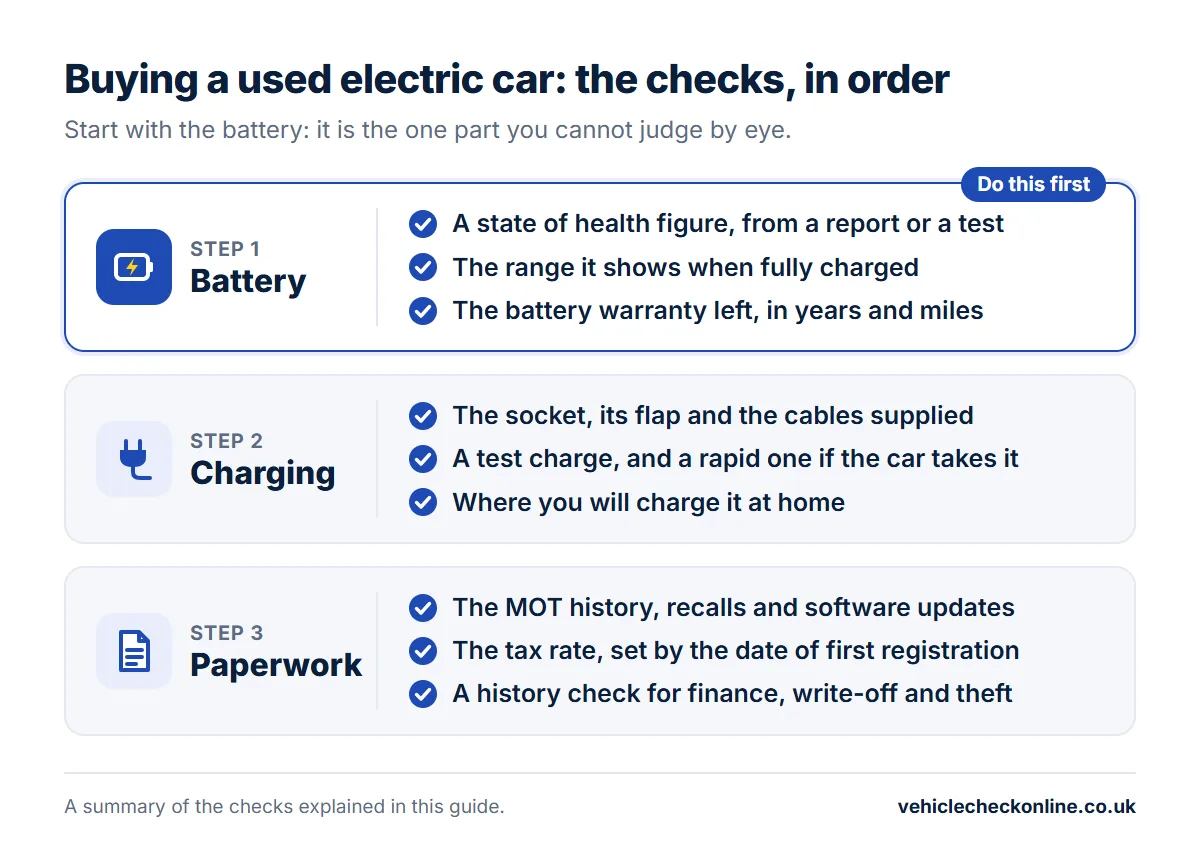
The checks fall into three groups. The battery decides how far the car will go on a charge, and it is the one part you cannot judge by eye. The charging equipment decides where and how fast you can charge. The paperwork, as with any used car, tells you whether the car is what the seller says it is and whether anyone else has a claim on it.
Take them in that order. A car whose battery or charging does not suit the way you drive is the wrong car for you, however clean its history.
What does battery state of health mean?
A battery's state of health compares the charge it can hold when full today with the charge it held when it was new, as a percentage. Batteries lose capacity gradually as they age and are used, so the battery in a used car will normally hold less than it did when the car was first registered.
Battery capacity is measured in kilowatt hours (kWh), and it is directly linked to range. A battery that holds less than it did when new takes the car less far on each charge, which matters most if you drive long distances or cannot charge at home.
How a battery has been charged and used affects how long it lasts: Suffolk County Council's advice, for example, is that keeping the charge between 80% and 90% for everyday use can help a battery last longer. Two cars of the same age can therefore have batteries in quite different condition, and battery health is one of the things that moves electric car depreciation.
How do you get a used electric car battery health check?
There are several ways to find out a battery's state of health. Use more than one if you can, and keep the result:
- The car's own screens. Suffolk County Council's guidance says most electric cars from 2020 onwards show battery health information in the settings menu. Ask the seller to show you, and take a photo of the screen.
- The seller's own report. A dealer may already have had the battery tested. Ask for the report before you travel to see the car, and check the date and the mileage on it.
- A dealer for the make. Ask whether they can read the battery's state of health from the car and give you a printout.
- A diagnostic app. On some models, an app connected to the car's diagnostic (OBD) socket can show battery health. Treat the reading as a guide rather than an official figure.
- A professional battery test. For an expensive car, a professional battery diagnostic service gives a more detailed assessment. Arrange it as you would a pre-purchase inspection, with the seller's agreement.
If the seller cannot show you any battery health information, get the battery tested before you pay, or walk away.
How can you check battery health of a used electric car at a viewing?
A report is the best evidence, but a viewing and a test drive add checks of your own:
- See it fully charged. Ask the seller to charge the car to full before you arrive, and note the range it shows. Treat that figure as a rough guide, but one far below what the same model and battery size offered when new needs explaining.
- Watch the figures on the drive. Note the range and the charge percentage before and after. A range that falls much faster than the miles you cover is worth asking about.
- Look for warning lights and messages when the car starts and while you drive, especially any about the battery, charging or the high-voltage system.
- Try charging it. Plug it in at a public chargepoint on the test drive, or at the seller's home charger, to check that the socket, the cable and the charging all work. If the car is meant to take rapid charging, try a rapid charger too.
- Inspect the charging socket and its flap for damage, and check that the cables in the advert come with the car.
Battery warranty: how much is left and does it pass to you?
Many makers give the battery a warranty of its own that runs longer than the warranty on the rest of the car. As a sign of what is now normal for new cars, GOV.UK says that to qualify for the government's grant, a new zero-emission car must have a warranty of 3 years or 60,000 miles and a battery with a warranty of 8 years or 100,000 miles, whichever is reached first. Older cars, and cars sold without the grant, may have different terms.
Get the terms for the car you are looking at from its warranty booklet, or from a dealer for the make using the VIN, and check:
- when the battery warranty started, and when it ends in years and in miles;
- what it covers: only a battery that fails, or also one whose capacity falls below a set level, and what that level is;
- whether it passes to a new owner, and on what conditions;
- whether it depends on the car being serviced on time, and whether the service record shows that it was.
A maker's warranty is not the same as a used car warranty sold by a dealer or another company, and neither replaces your legal rights when you buy from a trader. Our guide to used car warranties explains the difference.
What charging sockets, cables and speeds should you check?
Check that the car can use the chargers you will rely on, and that it comes with the right cables. These are the connectors used in the UK, as Herefordshire Council's guide to its chargepoints describes them:
| Connector | What it is for | Which cars use it |
|---|---|---|
| Type 2 | The standard connector for home wall boxes and public AC charging | Most new electric cars |
| Type 1 | AC charging on first-generation electric cars | Early models, such as the first Nissan Leaf |
| CCS | Rapid DC charging, now the industry standard | Most new electric cars |
| CHAdeMO | Rapid DC charging, now less common | Cars such as the Nissan Leaf; many public chargepoints do not include it |
Rapid chargers have their own cables attached, but most slower public chargepoints do not, so you need a cable that fits both the car and the chargepoint.
Speed depends on the car as well as the charger. Coventry City Council's guidance explains that rapid charging works only on cars built for it, and that on an AC chargepoint a car draws no more power than its on-board charger accepts.
Can you charge at home, and are there chargepoint grants?
Work out where you will charge before you choose a car. A domestic three-pin socket can charge an electric car slowly, but Coventry City Council's guidance strongly recommends a dedicated charging unit, installed by an accredited installer, for regular charging at home or at work.
Two government grants can help with the cost of a home chargepoint until 31 March 2027:
- Renters and flat owners. If you rent any home, or own and live in a flat, and you have private off-street parking, the grant pays 75% of the cost of buying and installing a socket, up to £500.
- Homes with only on-street parking. If you own or rent a home with only on-street parking, a grant of up to £500 can go towards a cross-pavement solution, such as a charging gully.
You cannot get the renters and flat owners grant if you live in a house you own, unless it has been converted into flats. You must also own, lease or have ordered an eligible electric car, so apply once the car is yours.
How much is tax on a used electric car since April 2025?
Electric cars were once free to tax. Since 1 April 2025 they pay vehicle tax, and the change covered cars already on the road as well as new ones. For the 2026-27 tax year, what an electric car pays depends on when it was first registered:
- 1 March 2001 to 31 March 2017: £20 a year.
- 1 April 2017 to 31 March 2025: the £200 standard rate, whatever the car cost new.
- On or after 1 April 2025: £10 for the first year, then the £200 standard rate, plus £440 a year for five years from the second year of tax if the list price was more than £50,000.
That extra £440 is the expensive car supplement, and it stays with the car when it is sold. For every rate and way of paying, see our guide to road tax costs.
GOV.UK is clear that the tax is not transferred to you when you buy a vehicle: you must tax it before you drive it. Our car tax and MOT check shows a car's month of first registration, which tells you which of the rates above applies; its tax status is free on GOV.UK's vehicle enquiry.
How do the MOT, recalls and software updates work on an electric car?
Electric cars need an MOT like any other car. In Great Britain the first is due by the third anniversary of registration and then every year, and in Northern Ireland cars are tested from four years old.
An MOT pass says nothing about the battery's capacity. GOV.UK's guidance for MOT testers describes a visual check for damage, tells testers not to touch high-voltage parts, and says to abandon the test if any orange high-voltage cables or components are damaged or the wires are exposed.
Read the car's free MOT history for failures, advisories and the mileage at each test. The same page shows the outstanding safety recall status reported by the DVSA.
A recall is not always about a part: the DVSA's code of practice says a safety defect can be in a physical component or in software. Ask the seller, or a dealer for the make, whether all recall work and software updates have been done, and see our guide on how to check car recalls.
How do you check insurance, service history and the car's history?
Get an insurance quote for the exact car, using its registration, before you agree a price. Ask for the service history as well, including any software updates and upgrades done at servicing.
Then check the car's history as you would any used car. Finance is common on newer cars: the FCA says around 80% of new cars bought in the UK in 2024 were funded through motor finance. If an agreement was not settled before the car was sold on, finance may still be owed on the car you are looking at.
A car history check searches the records for outstanding finance, write-offs and theft, and shows previous keepers, plate changes and the mileage history. Our Premium report, £7.99, includes all of them in one report.
Questions and answers
How long does an electric car battery last?
There is no single answer. It depends on the battery, how the car was charged and driven, and its age, which is why the battery's state of health now, and the warranty left, tell you more than the car's age.
Is a high-mileage electric car a bad buy?
Not necessarily. A state of health figure tells you more than the mileage, so ask for one, and check whether the car has passed the mileage limit of its battery warranty.
Is there a government grant for a used electric car?
GOV.UK describes the car grant as a discount on some new zero-emission cars, included in the price by the seller, and does not mention used cars. A separate grant can help with a home chargepoint if you rent or own a flat.
Can I charge an electric car from a normal plug?
Yes, a domestic three-pin socket can charge an electric car slowly with a suitable cable. For regular charging at home, a dedicated chargepoint fitted by an accredited installer is the recommended option.
Will the battery warranty still apply after I buy the car?
That depends on the maker's terms, which say whether the warranty passes to a new owner and on what conditions, such as servicing. Ask a dealer for the make to check the car by its VIN before you buy.
Can I check an electric car's history by registration?
Yes. Its MOT history, tax status and recall status are free by registration, and a full history check adds outstanding finance, write-off and theft records, previous keepers and plate changes.
Sources
- GOV.UK: Vehicle tax for electric, zero and low emission vehicles
- GOV.UK: Zero emission cars eligible for a grant (battery warranty condition)
- GOV.UK: Electric vehicle chargepoint grants
- Suffolk County Council: What to know about buying a second-hand EV (Plug in Suffolk)
- Coventry City Council: Electric vehicles and charging (connector types and speeds)
- FCA: CP25/27 Motor finance consumer redress scheme (motor finance in 2024)
Related guides
- How much is road tax? Check the cost for any carCheck road tax cost for any car: the 2026-27 rates for all three tax systems, how to find a car's figures by reg, and what paying monthly adds.
- How to check if your car has a safety recallHow to check car recalls free by registration, what the Outstanding, All fixed and None found statuses mean, who pays for repairs, and checking by VIN.
- The expensive car supplement on a used car: will you pay it?The expensive car supplement adds £440 a year (2026-27) to cars over £40,000 new, or £50,000 for EVs, even when bought used. How to tell if a car still pays it.
- Used car warranty: is it worth it and what does it cover?Is a used car warranty worth it? How a warranty compares with your legal rights from a dealer, what it covers and leaves out, and the small print to read.
- Buying a used hybrid car: what to check before you payBuying a used hybrid? Mild, full or plug-in, what makers' battery warranties cover, the problems to look for, tax since April 2025, clean air zones and the MOT.
This guide is general information for people buying, owning or selling a car in the UK, not legal or financial advice. Vehicle Check Online is an independent service, not affiliated with the DVLA, the DVSA or GOV.UK.