
Buying a used car
Buying a used hybrid car: what to check before you pay
When buying a used hybrid, start by finding out which kind it is: mild, full or plug-in. Then check the hybrid battery: how much of the maker's battery cover is left, whether the servicing kept it going, and how the battery behaves on a test drive. Since April 2025 a hybrid pays the same vehicle tax as a petrol or diesel car, and every usual used-car check still applies.
This guide explains the kinds of hybrid, what two makers actually promise about the battery, how to judge it at a viewing, the problems to look out for, servicing, tax, clean air zones and the MOT, and the history checks that matter for any used car.
Mild, full or plug-in: which kind of hybrid is it?
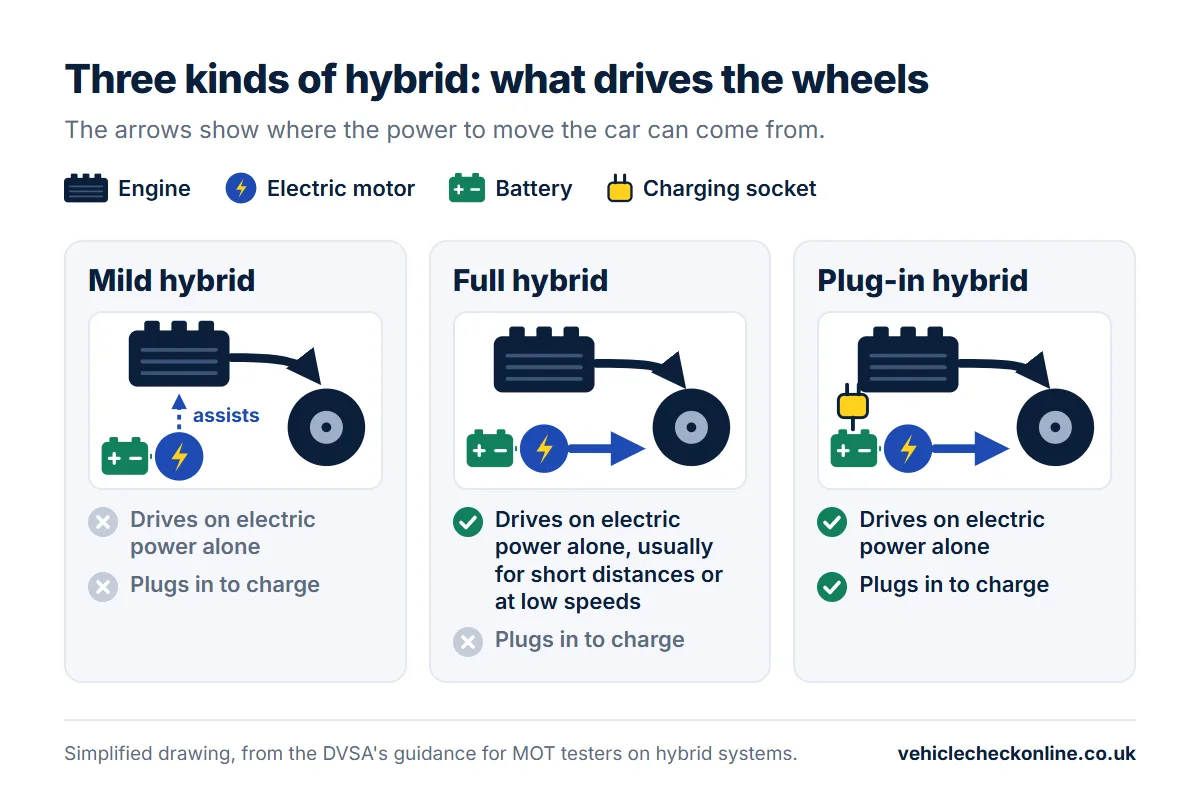
A hybrid has two sources of stored energy, usually petrol and electricity. The DVSA's guidance for MOT testers describes three common kinds, and what you need to check depends on which one you are looking at:
| Kind | How it works | Plugs in? |
|---|---|---|
| Mild hybrid | The engine drives the car. A motor-generator, usually running at 48 volts, assists it and can restart it, but cannot move the car on its own | No |
| Full hybrid | The car can run on the engine, on electric power alone (usually for short distances or at low speeds) or on both, and the engine recharges the battery | No |
| Plug-in hybrid | Like a full hybrid, but the battery can also be charged from an external supply | Yes |
To tell which kind you are looking at, read the advert and the badges, look for a charging flap and check the handbook. A mild hybrid can look and drive much like any petrol or diesel car.
Range extenders are different again: the wheels are always driven by electric motors, and a small engine only turns a generator on longer journeys. Judge one as you would an electric car, starting with its battery and charging.
What do makers promise about used hybrid battery life?
There is no single answer to how long a hybrid battery lasts: it depends on the car, how it was driven and how it was looked after. The clearest guide is the maker's warranty, which shows how long the maker will stand behind the battery and on what conditions. Terms vary, as the UK websites of two makers show at the time of writing (October 2026):
| Maker | What its UK website says |
|---|---|
| Toyota | Its 3-year or 60,000-mile manufacturer's warranty, for cars registered from 1 June 2021, covers the hybrid system; earlier cars came with a 5-year warranty. On top of that, each service at a Toyota dealer adds a new 12-month hybrid battery warranty, up to the 15th year from registration. |
| Honda | Specified hybrid system components on its e:HEV and e:PHEV models are covered for 5 years or 90,000 miles. On e:PHEV plug-in models, its warranty promises that the high-voltage battery keeps at least 70% of its original capacity for 8 years or 100,000 miles. |
Older cars can have different terms from new ones, so ask a dealer for the make to look the car up by its VIN and confirm what cover is left, when it ends and what it depends on. Note whether a battery that slowly loses capacity is covered, or only one that fails outright.
Battery cover from the maker is separate from any warranty a dealer sells with the car, so when a seller says the car is covered, ask which one they mean and for the terms in writing.
How can you judge a hybrid battery at a viewing?
You cannot see inside a hybrid battery, but you can see how it behaves. Before you travel, ask whether a dealer has checked the battery or the hybrid system, and for the date and mileage of that check. Then, at the viewing:
- Switch it on. A full or plug-in hybrid often starts silently: it shows that it is ready to drive, on some cars with a "ready" symbol that is usually green, while the engine stays off. No warning about the hybrid system should stay lit.
- Pull away gently. A full or plug-in hybrid can usually move off on electric power alone at low speed. The engine often runs when it is cold or the heater is on, but if it starts every time you move off, even when warm and with charge showing, ask why.
- Watch the battery display. The charge should rise as you slow down and fall as you accelerate. A level that jumps quickly between nearly full and nearly empty can point to a tired battery.
- Charge a plug-in. Ask for it to be fully charged before you arrive, note the electric range it shows, and check that it charges from its own cable.
- Look, but do not touch. High-voltage cables are usually orange, though the wiring of some 48-volt mild hybrids is blue. Damaged cables or components are serious: GOV.UK tells MOT testers to abandon a test if they find them. Keep your hands out of the engine bay while the car is ready to drive, because the engine can start without warning.
What hybrid car problems should you look out for?
Most of what goes wrong with a hybrid goes wrong with any car, but a few things are particular to them:
| What to look for | Why it matters |
|---|---|
| A warning light or message about the hybrid system | A fault in the battery or the electric drive can be costly: have it diagnosed before you agree a price |
| Little or no electric running on a full or plug-in hybrid | It can point to a battery or hybrid system that needs attention |
| A blocked battery cooling vent | Some hybrids cool the battery with air from the cabin, often through a vent near the rear seats; dirt, pet hair or bags over it can make the battery run hot |
| A car that will not switch on | Hybrids also have an ordinary 12-volt battery for the electronics, and a flat one can stop the car getting ready to drive |
| Rusty or scored brake discs | Hybrids slow down partly by recharging the battery, so the brakes do less work and the discs can corrode; check the MOT advisories |
| A damaged charging socket, or missing cables, on a plug-in | Charging is how a plug-in saves money, so test it |
The engine still needs the same checks as any other: see our guide on how to check a used car engine.
Why do servicing and history matter on a hybrid?
Ask for the full service record. On a hybrid it matters twice over: the engine needs its oil changes like any other, and the maker's battery cover can depend on the servicing. Toyota, for example, adds hybrid battery cover only after a service at a Toyota dealer, and says its service-activated warranty does not cover a fault caused by missed or improper maintenance in the past.
Ask too who has worked on the hybrid system. GOV.UK's guidance for MOT testers says repairs on high-voltage systems must not be done without recognised training for that type of vehicle, so look for invoices from a dealer for the make or a garage trained to work on hybrids, and ring the garage if an entry looks doubtful.
How is a used hybrid taxed since April 2025?
Hybrids used to get a £10 annual discount on vehicle tax. GOV.UK says it has been removed, with the changes that brought electric cars into vehicle tax from April 2025, so a hybrid now pays the same as a petrol or diesel car of the same age and CO2 figure. In the 2026-27 tax year, that means:
- First registered from 1 March 2001 to 31 March 2017: the rate for its CO2 band: £20 a year up to 110g/km, £35 for 111 to 120g/km, and more above that.
- First registered on or after 1 April 2017: the £200 standard rate, plus £440 a year for five years from the second tax payment if its list price was over £40,000. Hybrids use the £40,000 threshold, not the £50,000 one for electric cars registered from April 2025.
The government also plans a mileage-based charge, Electric Vehicle Excise Duty, from 1 April 2028: 1.5p a mile for plug-in hybrids, alongside vehicle tax. Its policy paper names plug-in hybrids, not other hybrids.
Our free car tax check shows the month a car was first registered, and GOV.UK's vehicle enquiry service shows its CO2 figure; together they tell you which rate applies.
Every band, and what paying monthly adds, is in our guide to road tax costs.
Are hybrids exempt from clean air zone charges?
Emission zones go by the Euro standard a car was built to. For cars, England's charging clean air zones and London's ULEZ ask for Euro 4 for petrol and Euro 6 for diesel. The government's framework for English zones says some hybrids that meet the definition of an ultra low emission vehicle may apply for an exemption, so do not assume either way. In Scotland, the Scottish Government says hybrids face the same restrictions as petrol or diesel vehicles.
Before you buy a hybrid you will drive in a zone, put its registration into that zone's official checker. Our guide to the clean air zone check lists the zones and the right checker for each.
Is the MOT different on a hybrid?
A hybrid needs an MOT on the same timetable as any other car, but the test treats it a little differently. The DVSA's inspection manual leaves hybrids, mild hybrids included, out of the exhaust emissions measurement, while the engine warning light and the exhaust system are still checked. Testers are told to look for damage to the battery, the charging plug and the cables, and to avoid touching high-voltage parts.
So a pass tells you nothing about how much life the battery has left. Read the car's free MOT history for brake, tyre and corrosion advisories and the mileage at each test; the same page shows the recall status the DVSA reports.
What usual checks still apply to a used hybrid?
Under the hybrid system, it is a used car like any other. Check that the V5C logbook is in the seller's name and its VIN matches the car, look over the bodywork and tyres, and take a proper test drive on different kinds of road.
Then check its records. A car history check searches for outstanding finance, an insurance write-off and a stolen record, and shows the previous keepers, plate changes and mileage readings, in the Premium report for £7.99. Take extra care with a hybrid that has been repaired after an accident, because damage can reach the high-voltage system.
Questions and answers
What mileage is too high for a used hybrid?
There is no set limit. Check whether the car has passed the mileage limits of its battery cover, how the battery behaves on a test drive, and whether the servicing kept pace with the miles.
Do hybrids need special servicing?
They follow the maker's service schedule like any car, and the engine still needs its oil changes. Work on the high-voltage system itself should only be done by someone trained for that type of vehicle.
Does a hybrid pay road tax?
Yes. The £10 discount hybrids used to get has been removed, so in 2026-27 a hybrid first registered from April 2017 pays the £200 standard rate, and an older one pays the rate for its CO2 band, like a petrol car.
Is a plug-in hybrid worth it if I cannot charge at home?
Think carefully first. The Energy Saving Trust says plug-in hybrids are only efficient if they are charged regularly, and can otherwise cost more to run than a petrol or diesel car.
Can a dealer tell me how much battery cover is left?
A dealer for the make can usually look the car up by its VIN and tell you what cover remains, when it ends and what it depends on, such as servicing at its dealers. Ask before you agree a price.
Sources
- GOV.UK (DVSA): Hybrid, electric and hydrogen fuel cell systems, guidance for MOT testers
- GOV.UK: Vehicle tax for electric, zero and low emission vehicles (hybrids)
- GOV.UK: Vehicle tax rates for cars
- Toyota UK: Toyota warranty, including the hybrid battery warranty
- Honda UK: Honda warranty, including hybrid and electric vehicle cover
Related guides
- Buying a used electric car: what to check before you payBuying a used electric car? How to check battery health, what the battery warranty covers, charging cables, tax since April 2025 and the history checks.
- How much is road tax? Check the cost for any carCheck road tax cost for any car: the 2026-27 rates for all three tax systems, how to find a car's figures by reg, and what paying monthly adds.
- Clean air zone checker: check your car for every UK zoneCheck clean air zone charges by registration: the official checker for each English zone, Scotland's LEZs, London's ULEZ and Oxford, and which cars pay.
- Used car warranty: is it worth it and what does it cover?Is a used car warranty worth it? How a warranty compares with your legal rights from a dealer, what it covers and leaves out, and the small print to read.
This guide is general information for people buying, owning or selling a car in the UK, not legal or financial advice. Vehicle Check Online is an independent service, not affiliated with the DVLA, the DVSA or GOV.UK.