
Imports, ULEZ and emissions
ULEZ compliant cars: the years, the standards and how to check
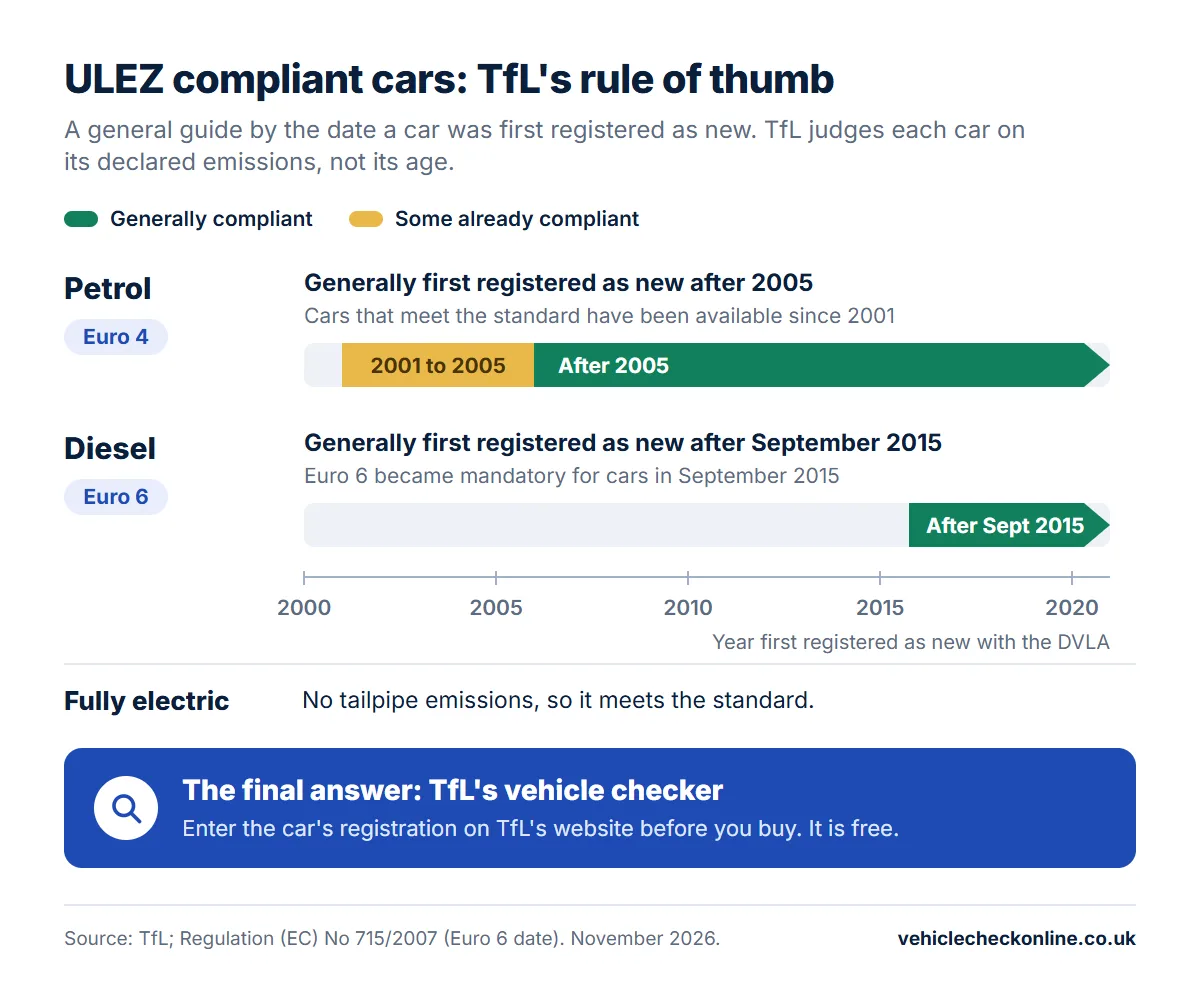
ULEZ compliant cars are petrol cars that meet the Euro 4 emissions standard and diesel cars that meet Euro 6. TfL says that generally means petrol cars first registered as new after 2005 and diesel cars first registered as new after September 2015. TfL's free vehicle checker gives the final answer for any car, by its registration.
This guide gives the years for petrol and diesel cars and why they are only a guide, explains the standards, shows where to find a car's Euro standard, lists the exemptions, and covers imported cars and the clean air zones outside London.
What year cars are ULEZ compliant?
TfL gives a general guide by the date a car was first registered as new. In its own words:
- "Petrol cars that meet the ULEZ standards are generally those first registered as new with the DVLA after 2005, although cars that meet the standards have been available since 2001."
- "Diesel cars that meet the standards are generally those first registered with the DVLA as new after September 2015."
| Car | ULEZ standard | Generally compliant if first registered as new | Check closely |
|---|---|---|---|
| Petrol | Euro 4 | After 2005, so from 2006 | Petrol cars from 2001 to 2005: some already meet Euro 4 |
| Diesel | Euro 6 | After September 2015 | Diesels from September 2014 to September 2015: some meet Euro 6, some do not |
| Fully electric | No tailpipe emissions | Any year | Nothing to check for the ULEZ |
The word "generally" matters. Some petrol cars built from 2001 already met Euro 4, so an older petrol car can pass. And a car registered close to either date can fall on either side, depending on the exact model and engine. Use the years to narrow your search, then check each car you are serious about.
What are the ULEZ standards for cars?
London's Ultra Low Emission Zone sets a minimum emissions standard. A car that meets it can drive in the zone free; a car that does not must pay a daily charge. The standards are the European "Euro" emissions standards that cars are built to:
| Vehicle | Minimum ULEZ standard | What it limits |
|---|---|---|
| Petrol car | Euro 4 | Nitrogen oxides (NOx) |
| Diesel car | Euro 6 | Nitrogen oxides (NOx) and particulate matter (PM) |
Fully electric cars have no tailpipe emissions, so they meet the standard. TfL is clear that the zone is enforced on a car's declared emissions rather than its age: what counts is the Euro standard the car was built to, not the year on the plate.
Is a 2006 petrol car ULEZ compliant?
Usually, yes. A petrol car first registered as new in 2006 falls inside TfL's rule of thumb, so it is likely to meet Euro 4. But "likely" is not a promise: check the exact car by its registration number before you buy.
The same goes the other way. TfL says petrol cars that meet the standard have been available since 2001, so a slightly older petrol car is not ruled out. If you need a car for London, the checker answer for that registration is what counts.
So, to answer the question most people ask: by TfL's rule of thumb, a petrol car needs to have been first registered in 2006 or later. Treat that as a guide to where to look, not as a test the car passes or fails.
What diesel cars are ULEZ compliant? The Euro 6 diesel year
A diesel car needs to meet Euro 6. TfL describes compliant diesel cars as generally those first registered as new after September 2015.
That date comes from the emissions law itself. Regulation (EC) No 715/2007, which sets the Euro standards and is published on legislation.gov.uk, gave Euro 6 two dates for cars: from 1 September 2014, a new type of car had to meet it to be approved, and from 1 September 2015, a new car that did not meet it could no longer be registered. So some diesels registered in the year before September 2015 already met Euro 6, and some did not.
A diesel registered in 2014 or 2015 needs the most care. TfL judges each car on its declared emissions, so look for the Euro standard on the logbook, or check the registration with TfL, rather than going by the year alone.
An older diesel is the car most likely to be caught by the ULEZ. If you will drive in London, check a diesel before you agree a price, not after.
Where can you find a car's Euro standard?
- The V5C logbook. TfL says the Euro standard may be listed on the logbook. Not every logbook shows it.
- The date of first registration. TfL suggests that if the Euro standard is not shown, you use the date the car was first registered with the DVLA, which is in section B of the logbook, and check GOV.UK's vehicle enquiry service.
- The manufacturer. The manufacturer can confirm the Euro standard the car was built to, for example with a certificate of conformity.
- TfL's vehicle checker, which answers by registration number.
You can see the fuel type and the date the car was first registered without the logbook too. Our free MOT history shows both, with every MOT test and mileage reading (GOV.UK's vehicle enquiry adds the Euro status when the DVLA holds it), so you can apply TfL's rule of thumb on the spot.
How do you check a car with TfL before you buy?
For a definite answer, enter the registration number in the vehicle checker on TfL's website. It tells you whether that car meets the ULEZ standards or needs to pay. It is free, so run it while you are still talking to the seller.
If you think the checker is wrong, TfL has said it can update its records when the keeper sends evidence of the car's Euro standard from the manufacturer, such as a certificate of conformity or a letter from the manufacturer's type approval (homologation) department, with a copy of the logbook. That takes time, so do not buy a car for London on the promise that it can be fixed later.
What does a car that is not compliant cost in the ULEZ?
The ULEZ covers all London boroughs and the City of London. It operates 24 hours a day, every day of the year except Christmas Day. The M25 is not in the zone.
A car that does not meet the standards pays £12.50 a day to drive in the zone. The charge runs from midnight to midnight, so a journey that crosses midnight means two charges. If you do not pay, the penalty charge is £180, reduced to £90 if paid within 14 days.
If you live in London or drive there often, those daily charges add up. That cost belongs in the price you agree.
Which cars are exempt from the ULEZ charge?
Meeting the standard is the usual way not to pay. For cars that do not meet it, TfL lists a few exemptions and time-limited grace periods:
| Who or what | What TfL says | Until |
|---|---|---|
| Historic vehicles | Exempt if built before 1 January 1973, or over 40 years old and registered with the DVLA in the historic vehicle tax class | No end date given |
| Disabled and disabled passenger tax classes | Exempt while the vehicle stays in that tax class, with no need to register a UK vehicle with TfL | 24 October 2027 |
| Wheelchair accessible cars and vans | A grace period for a converted vehicle with a qualifying adaptation, such as a ramp, lift, hoist or swivel seat: apply to TfL | 25 October 2027 |
| People on certain disability benefits | A grace period for one vehicle registered in their name or their nominated driver's name: apply to TfL | 25 October 2027 |
A Blue Badge on its own does not exempt a car: TfL says Blue Badge holders pay unless the car meets the standards or one of the grace periods covers it. The grace periods you apply for are given to a person, for one vehicle, so do not count on one coming with a car you buy.
The Mayor of London's scrappage scheme, which paid towards scrapping a vehicle that did not comply, closed to new applications on 8 September 2024.
How does the ULEZ work for imported cars?
TfL's rule of thumb uses the date a car was first registered as new with the DVLA. For an imported car, that date can be years after the car was built, so the rule of thumb does not fit. A car built for a market outside Europe, such as Japan, was not approved to European rules when new, so it may have no Euro standard on record.
For an import, the checker result is the only safe guide, and evidence from the manufacturer may be needed to change it. Our guide on how to tell if a car is imported explains how to spot one.
Which clean air zones are there outside London?
London is not the only place with emissions rules, and the car standards elsewhere are the same: Euro 4 for petrol and Euro 6 for diesel. What differs is who pays. GOV.UK lists seven clean air zones in England, and only two of them, Birmingham and Bristol, charge private cars. Scotland has low emission zones in the centres of Aberdeen, Dundee, Edinburgh and Glasgow, where a car that does not meet the standard should not enter at all and gets a penalty charge if it does.
Each zone has its own checker and its own rules on charges, hours and exemptions, so check the zone you will actually drive in. Our clean air zone check lists every zone with the official checker for each.
Questions and answers
What year petrol cars are ULEZ compliant?
TfL says petrol cars that meet the standard are generally those first registered as new after 2005, so from 2006, and that some from as early as 2001 meet it too. Check the exact car on TfL's vehicle checker before you buy.
What year diesel cars are ULEZ compliant?
Generally those first registered as new after September 2015, when Euro 6 became compulsory for every new car. Some diesels registered in the year before already met Euro 6, so check the registration rather than the year.
Can I check if a car is ULEZ compliant by registration?
Yes. TfL's vehicle checker on its website is free and answers by registration number. It is the final word for the London zone.
Do electric cars pay the ULEZ charge?
Fully electric cars have no tailpipe emissions, so they meet the ULEZ standards and do not pay the daily ULEZ charge.
Is the ULEZ the same as the Congestion Charge?
No. The Congestion Charge is a separate charge for driving in central London, and a car can have to pay both. Electric cars no longer go in free there either: since 2 January 2026, TfL gives them a 25% discount on Auto Pay instead.
Is there still a ULEZ scrappage scheme?
No. TfL says the Mayor of London's scrappage scheme closed to new applications on 8 September 2024, and the last grants were paid by the end of July 2025.
Does a ULEZ compliant car meet clean air zone rules elsewhere?
For cars, the standards in England's clean air zones and Scotland's low emission zones are the same: Euro 4 for petrol and Euro 6 for diesel. Each zone still has its own checker, so use the one for the zone you will drive in.
Sources
- TfL: Ultra Low Emission Zone, cars
- TfL: ULEZ where and when
- TfL: ULEZ discounts and exemptions
- legislation.gov.uk: Regulation (EC) No 715/2007, article 10 (Euro 5 and Euro 6 dates)
- GOV.UK: Driving in a clean air zone
- TfL: Freedom of information answer on evidence of ULEZ compliance (2023)
Related guides
- How to tell if a car is importedHow to tell if a car is imported: the logbook dates, MOT history, VIN and clues on the car, and what an import means for history checks, insurance and ULEZ.
- The expensive car supplement on a used car: will you pay it?The expensive car supplement adds £440 a year (2026-27) to cars over £40,000 new, or £50,000 for EVs, even when bought used. How to tell if a car still pays it.
- What to look for in a car's MOT historyWhat to look for in MOT history before you buy: repeated advisories, corrosion, gaps, mileage drops and fails, and which entries are red flags or harmless.
- Buying a used hybrid car: what to check before you payBuying a used hybrid? Mild, full or plug-in, what makers' battery warranties cover, the problems to look for, tax since April 2025, clean air zones and the MOT.
This guide is general information for people buying, owning or selling a car in the UK, not legal or financial advice. Vehicle Check Online is an independent service, not affiliated with the DVLA, the DVSA or GOV.UK.