
MOT, servicing and condition
What to look for in a car's MOT history
When you read a car's MOT history, look for patterns rather than single entries: the same advisory coming back year after year, corrosion on structural parts, mileage readings that fall or stall, and gaps with no test. One fail, or a few advisories on tyres and brakes, is normal for a used car. A trail of warnings that were never acted on is not.
This guide explains what each part of the record means, which signs are red flags and which are usually harmless, why a car can have missing MOT history, how far back the records go and what the history cannot tell you. Run a free MOT history check on the car and read it alongside.
How do you read an MOT history entry?
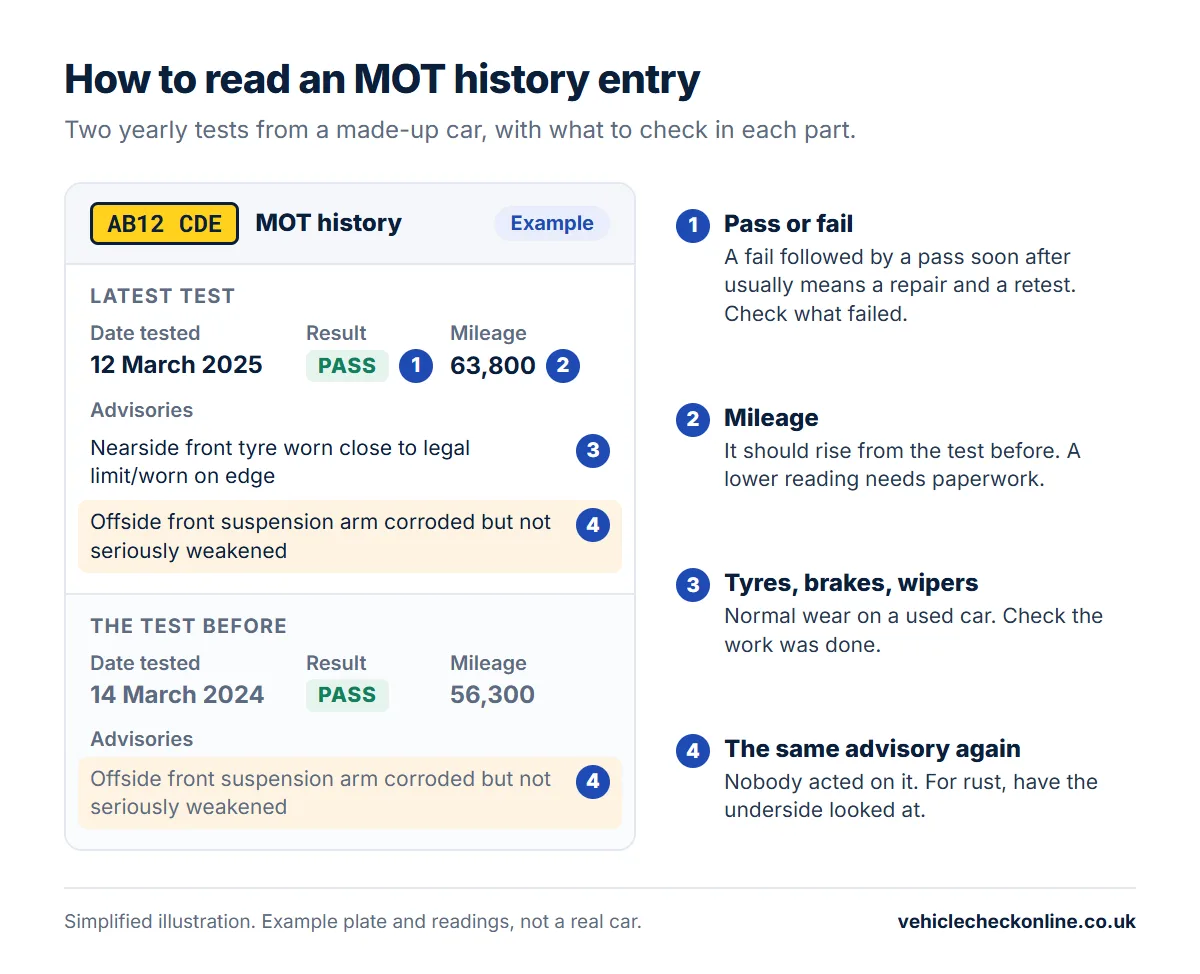
Each test in the history shows its date, whether the car passed or failed, the mileage recorded and when the next MOT is due. For tests in England, Scotland and Wales it also lists the parts that failed and any minor problems, and GOV.UK's service shows where each test was done if you enter the 11-digit number from the car's V5C logbook.
Since 20 May 2018, problems found at an MOT in Great Britain have been graded dangerous, major or minor, alongside advisories. Dangerous and major problems mean a fail; minor problems and advisories still allow a pass. Tests before that date list reasons for failure and advisories without those grades, so older entries look different. What each grade means is explained in our guide to MOT advisories.
Which entries are red flags, amber flags or normal?
Use this as a quick guide to how much each kind of entry should worry you.
| What you see | What it can mean | How worried to be |
|---|---|---|
| A few advisories on tyres, wipers, bulbs or brake pads | Normal wear on a used car | Green: check they were dealt with |
| A fail, then a pass the same day or within days | Repairs done after the test, then a retest | Green if the fail was routine wear; amber if it was brakes, steering or structure |
| The same advisory at several tests in a row | The warning was seen and not acted on | Amber; red if it then becomes a major fault |
| "Corroded but not seriously weakened" on suspension or sub-frames | Rust noted, not yet bad enough to fail | Amber: have the underside looked at |
| "Excessively corroded" or "seriously weakened" on structural parts | Structural rust that failed the test | Red: ask how it was repaired, and see the repair |
| A dangerous defect | The car was not safe to drive until repaired | Red if recent: ask for proof of the repair |
| A mileage reading lower than an earlier one | A typing slip, a replaced dashboard or clocking | Red until it is explained with paperwork |
| Mileage barely moving for years | A second car, a long lay-up, or an odometer fault | Amber: ask why |
| A gap with no test | Off the road, imported, exempt, or a record error | Amber: ask why |
What do repeated advisories on the same item mean?
An advisory means the tester found an item that is wearing or deteriorating but not yet bad enough to fail. The MOT inspection manual tells testers it is best practice to point out items that are near the point of failure. So an advisory is a warning with a clear message: deal with this before the next test.
When the same advisory appears at three or four tests in a row, nobody acted on it. For tyres or brake pads, it can simply mean they were replaced after each warning and had worn again by the next test, which is fine if invoices show it. For corrosion, suspension joints or oil leaks, it usually means the problem has been growing. Look at whether it eventually became a major fault, and ask the seller for invoices showing it was fixed.
Repeated advisories are also useful for negotiating. If the history shows a corroded sub-frame advised for three years, you can price in the repair before you buy.
Same-day fail then pass: is it a problem?
A fail followed by a pass on the same day, or a few days later, usually means the car was repaired after failing and then retested. That is how the system is meant to work. Under GOV.UK's rules, a car left at the test centre for repair and retested within 10 working days gets a free partial retest, and some items, such as lamps, wipers, mirrors and tyres, can be retested free if the car goes back to the same centre by the end of the next working day.
What matters is what failed. A blown bulb, a worn wiper or a bald tyre is routine. Brakes, steering, suspension or structural corrosion fixed in a hurry deserve a closer look: ask who did the repair and for the invoice.
What does the corrosion wording mean?
Rust is judged by where it is, not just how much there is. The MOT inspection manual pays most attention to "prescribed areas": the load-bearing parts that the brakes, steering, suspension and other tested items are mounted to, and any load-bearing structure within 30cm of those mountings. A tester fails corrosion in these areas if it has made a hole, if the metal does not feel firm when pressed with finger and thumb, or if a finger, thumb or the tester's corrosion tool makes a hole.
In the history, corrosion that passed is usually worded as an advisory such as "corroded but not seriously weakened" or "is corroded but structural rigidity is not significantly reduced". Corrosion that failed reads "excessively corroded", "corroded and seriously weakened" or similar.
Structural repairs must appear as strong as the original. The manual does not accept body filler, adhesive bonding, gas brazing, soldering or fibre reinforcement for repairs to load-bearing parts. If the tester cannot see how a repair was done, for example because it is under paint or underseal, the manual tells them to pass it and advise, so an advisory such as "repair covered in underseal" means nobody has seen the repair underneath.
Why would a car have missing MOT history?
A gap in the record is worth a question, but there are many innocent reasons for one:
- The car is new. In Great Britain the first MOT is due by the third anniversary of registration. In Northern Ireland cars are generally first tested at four years old, and some private cars have been given Temporary Exemption Certificates that extend their MOT.
- The car was off the road. A car without a valid MOT cannot be driven or parked on the road, so a car declared off the road (SORN) and kept off public roads can go years without a test.
- The tests are too old. Online records start in 2005 for cars tested in Great Britain and in 2017 for tests in Northern Ireland.
- The car was imported. Tests done abroad do not appear; the history starts with its first UK test.
- The car is historic. A car built or first registered more than 40 years ago, with no substantial changes, does not need an MOT.
- The record is wrong. If a test is missing, or a test appears that belongs to another vehicle, the DVSA can add or remove it.
If none of these fits, ask what the car was doing during the gap. Driving without a valid MOT can lead to a fine of up to £1,000, and a long gap can also hide a period off the road after serious damage, which a write-off check would show if an insurer wrote the car off.
How do you read the mileage trail?
The mileage at each test should rise in steps that fit how the car is used. A single reading far above its neighbours is often a typing slip at the test. A reading lower than an earlier one needs paperwork to explain it, and a year with almost no miles should have a reason. Our guide to a mileage discrepancy on MOT history explains how to tell a slip from clocking, and our free MOT history page flags any fall in the readings.
A free car mileage check puts every reading on a chart, with the average miles per year, so a fall or a stall stands out.
How far back does MOT history go?
For cars tested in England, Scotland and Wales, the online MOT history covers tests done since 2005. For tests done in Northern Ireland, it covers tests since 2017, and you cannot download MOT certificates for them through the GOV.UK service.
A car under three years old (four in Northern Ireland) will usually have no MOT history yet. The history may also show whether the car has been recalled for a safety reason, depending on the manufacturer.
What can MOT history not show?
An MOT records the car's condition on the day of the test against legal minimum standards. It does not cover the condition of the engine, clutch or gearbox, and a car can become unsafe between tests. It does not record servicing either: our guide on how to check service history covers that.
Nor does it show whether the car has been written off, has finance still owed on it, is recorded as stolen or has had several keepers. Those records are held elsewhere, and a car history check searches them by registration.
Questions and answers
Is a car with lots of advisories a bad buy?
Not necessarily. Advisories on tyres, wipers or brake pads are normal wear. What matters is whether the same items keep coming back, whether they involve corrosion or structural parts, and whether the price reflects the work needed.
Does MOT history show accident damage?
Not directly. An MOT records the car's condition on the day, not how it got that way. Damage can show indirectly, for example as tyres worn on one edge or a sudden suspension advisory after years of clean tests.
Can a seller hide a car's MOT history?
No. The DVSA holds the record, and anyone can look it up free with the registration number. Ask about any test that seems to be missing.
How can I see where an MOT test was done?
For tests in England, Scotland and Wales, the GOV.UK MOT history service shows the test location if you enter the 11-digit number from the car's V5C logbook.
Is it a good sign if a car always passes with no advisories?
Usually. It suggests the car was well kept, or was repaired before each test. Either way, check that the mileage trail is steady and that the service record supports it.
Sources
- GOV.UK: Check the MOT history of a vehicle
- GOV.UK: Getting an MOT (printable guide: results, retests and fixing mistakes)
- GOV.UK (DVSA): MOT inspection manual, Appendix A: structural integrity and corrosion
- GOV.UK: Historic (classic) vehicles: MOT and vehicle tax
- nidirect: How the MOT scheme works (Northern Ireland)
Related guides
- MOT advisories explained: what an advisory means and what to doWhat an MOT advisory means, how it differs from minor, major and dangerous defects, whether you can drive with advisories, and the advisory wording decoded.
- Mileage discrepancy on MOT history: what it means and what to doA mileage discrepancy on MOT history is usually a typing slip, a replaced dashboard or clocking. How to tell which from the paperwork, and get it corrected.
- How to check a car's service historyHow to check the service history of a car: there is no free government lookup, so here is how to verify the service book, digital records and invoices.
- How to tell if a used car has been in an accidentHow to tell if a car has been in an accident: the signs of crash repair to look for at a viewing, and the records to check before you buy, in plain steps.
- Average mileage per year in the UK: what the official figures sayThe average car in England covered 7,100 miles in 2025, official figures show. Averages by fuel type and per driver, and how to judge a used car's mileage.
This guide is general information for people buying, owning or selling a car in the UK, not legal or financial advice. Vehicle Check Online is an independent service, not affiliated with the DVLA, the DVSA or GOV.UK.