
MOT, servicing and condition
MOT advisories explained: what an advisory means and what to do
An MOT advisory is a note from the tester about a part that passed the test but is worn, damaged or corroded and could fail in future. It does not make the car fail, and the official advice is to monitor it and repair it if necessary. You can drive with advisories, but the car must stay roadworthy at all times.
This guide explains how advisories compare with minor, major and dangerous defects, when you can and cannot drive, what the standard advisory wording means and what would fail at the next test, what to do after an MOT with advisories, and how to read them in a car you are thinking of buying.
How does an advisory differ from minor, major and dangerous defects?
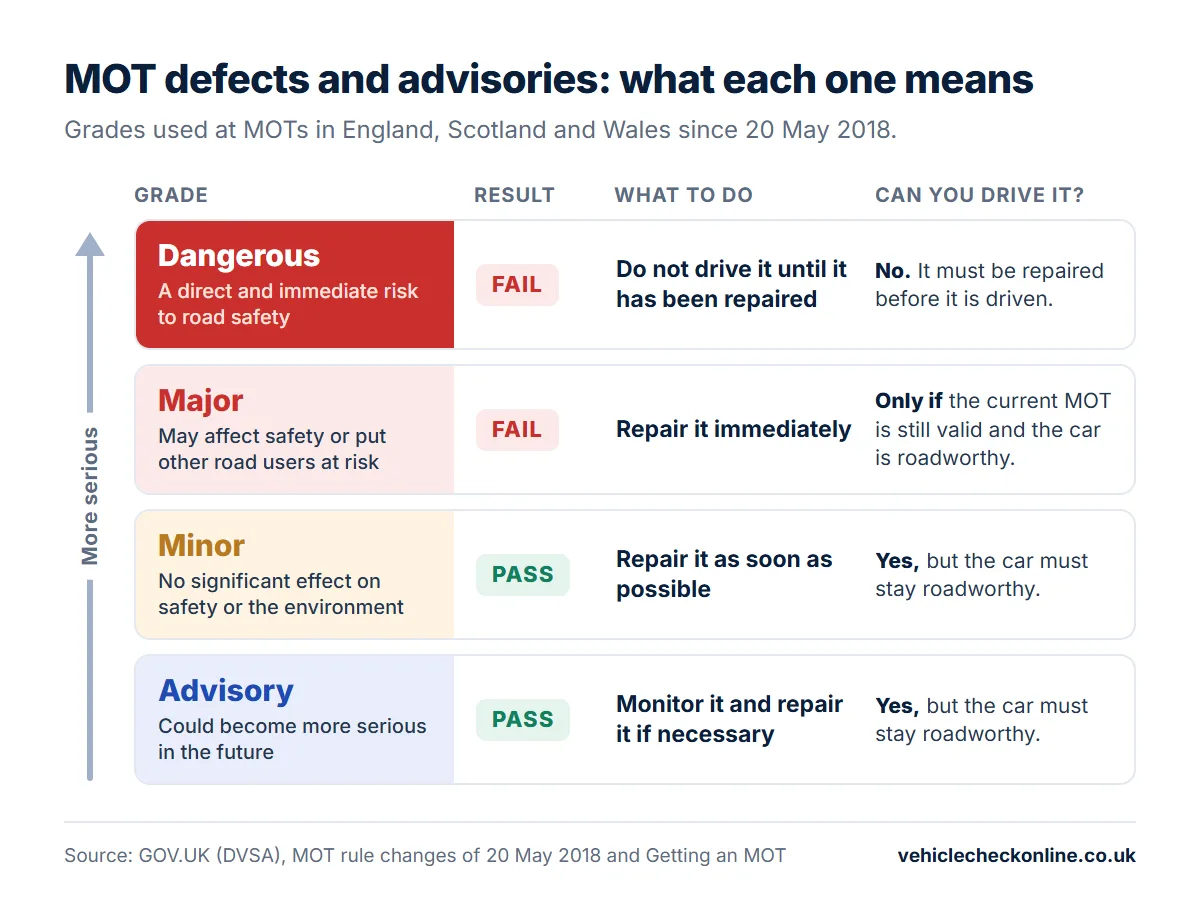
Since 20 May 2018, MOT testers in England, Scotland and Wales have graded the problems they find as dangerous, major or minor, and can add advisories as well. This is how GOV.UK describes each one:
| Result | What it means | Effect on the MOT |
|---|---|---|
| Dangerous | A direct and immediate risk to road safety, or a serious impact on the environment. Do not drive the car until it has been repaired. | Fail |
| Major | It may affect the car's safety, put other road users at risk or have an impact on the environment. Repair it immediately. | Fail |
| Minor | No significant effect on the car's safety or on the environment. Repair it as soon as possible. | Pass |
| Advisory | It could become more serious in the future. Monitor it and repair it if necessary. | Pass |
The difference between a minor defect and an advisory matters. The MOT inspection manual makes recording a minor defect compulsory wherever one applies, while advisories are at the tester's discretion. A minor defect is a fault, however small; an advisory is an early warning.
Tests before 20 May 2018 did not use the dangerous, major and minor grades, so older MOT histories show only reasons for failure and advisories.
What does an MOT advisory mean?
The inspection manual says testers can record an advisory when an item is not deteriorated enough to justify failing it. It also says it is best practice for testers to point out three kinds of thing:
- items that are near to, but have not yet reached, the point of failure;
- anything unusual about the car that the tester noticed during the inspection;
- defects on parts the MOT does not test.
So an advisory is not always about wear. The manual tells testers to advise, rather than fail, when they cannot tell how a structural repair was done, when a spare tyre has a defect, or when a tyre made to fit one way round has been fitted the other way. Testers judge condition using their knowledge, experience and judgement, so the advisories on a car can vary from one test to the next.
Can you drive with MOT advisories?
Yes. A car with only advisories, or advisories and minor defects, has passed its MOT. But GOV.UK is clear that you are responsible for keeping a car roadworthy at all times, and that a car can be unsafe even with a current MOT certificate. Driving a vehicle in a dangerous condition can lead to a fine of up to £2,500, a driving ban and 3 penalty points.
Tyres show why this matters. A car's tyres must have at least 1.6mm of tread across the middle three-quarters of the tyre and around its whole circumference. A tyre advised as "worn close to legal limit" can go below that well before the next MOT.
After a fail, the rules are stricter. You can take the car away only if its current MOT is still valid and no dangerous problems were listed, and it must still be roadworthy. A car that failed with a dangerous problem must be repaired before it is driven.
Advisories on tyres and brakes are the ones not to leave until next year: both can wear past the legal or safe limit well before the next MOT.
MOT advisory codes list: what does the wording mean?
Advisories are written in words rather than codes. The standard wording comes from a fixed list in the DVSA's testing system, and each standard advisory is paired with the defect that would fail the same part. The DVSA publishes that list with its open MOT data. If an item in a history has a number such as 5.2.3 or 1.1.13 after it, that is the section of the MOT inspection manual for the part: 5.2.3 is tyres and 1.1.13 is brake linings and pads.
This table decodes standard advisory wording, with the paired defect and its grade from the DVSA's list and the inspection manual.
| Advisory wording | Usually on | What it means | What would fail |
|---|---|---|---|
| "worn close to legal limit/worn on edge" | Tyres | Tread is near the legal minimum, or one edge is wearing faster than the rest | Tread below 1.6mm (dangerous) |
| "slightly damaged/cracking or perishing" | Tyres | Small damage or cracks in the rubber | A tear from failure of the tyre's structure (major or dangerous) |
| "has a cut but not deep enough to reach the ply or cords" | Tyres | A cut in the surface of the rubber | A cut deep enough to reach the ply or cords (major) |
| "wearing thin" | Brake pads or linings | The friction material is getting low | Worn down to the wear indicator (major) or below 1.5mm (dangerous) |
| "worn, pitted or scored, but not seriously weakened" | Brake discs or drums | Wear marks on the braking surface | Significantly and obviously worn (major), or fractured or likely to fail (dangerous) |
| "corroded, covered in grease or other material" | Rigid brake pipes | Rust on the pipe, or a coating that hides its condition | Excessively corroded (major) |
| "close to minimum mark" | Brake fluid | The fluid level is near the minimum | Significantly below the minimum mark (major) |
| "corroded but not seriously weakened" | Suspension arms, sub-frames, spring mountings | Rust is present, but the part's strength is not seriously reduced | Corroded and seriously weakened (major) |
| "is corroded but structural rigidity is not significantly reduced" | Body structure, chassis or sub-frame | Rust on the structure that has not yet weakened it significantly | Corroded so that rigidity is significantly reduced (major) |
| "pin or bush worn but not resulting in excessive movement" | Suspension pins and bushes | The bushes are wearing | Pin or bush excessively worn (major) |
| "ball joint has slight play" | Steering and suspension joints | A little movement in the joint | Excessive play or wear in the joint (major) |
| "has light misting of oil" | Shock absorbers | A light film of oil on the damper | A serious fluid leak (major) |
| "leak, but not excessive" | Engine, gearbox or hydraulic systems | A small fluid leak | A leak that makes a pool over 75mm across within 5 minutes (major), or a continuous leak that is a serious risk (dangerous) |
| "has a minor leak of exhaust gases" | Exhaust | A small leak from the exhaust system | A major leak of exhaust gases (major) |
The table shows the official wording and the defect it is paired with, not how likely each part is to fail. That depends on how fast the part is wearing and how far the car is driven.
Will an advisory fail at the next MOT?
It might. Tyres and brake pads wear with the miles, so a car that covers a lot of ground can wear them past the limit within the year. Corrosion does not repair itself either, and it carries on between tests however little the car is driven.
The simplest way to know is to ask. The tester or your garage can tell you how much life is left in the part and what the repair would involve. If the car fails for something else and has a partial retest, the manual tells the tester to look again at any item that was advised on at the first test.
What should you do after an MOT with advisories?
- Read each advisory and note the part. Anything on tyres, brakes or steering comes first.
- Ask the tester or your garage to show you the part and explain what they saw.
- Get quotes for anything structural, such as corrosion on sub-frames or suspension mountings, before it grows.
- Check the advised parts yourself between tests: tread depth, cuts and bulges in tyres, and any warning lights.
- Keep the invoice when you fix an advisory. If you sell the car, it shows a buyer that the warning in the MOT history was dealt with.
What do advisories tell you when buying a used car?
In a car you are thinking of buying, the advisories are a free list of what may need money soon. Check the car's MOT history free and read the advisories from the last two or three tests.
- The same advisory at several tests in a row means nobody acted on it. If the seller says it has been fixed since, ask for the invoice.
- Advisories on tyres, brakes or suspension at the latest test are costs to take off the price.
- Corrosion advisories that spread from one part to several over the years are a warning about the car's underside.
Our guide on what to look for in MOT history covers the rest of the record, from gaps between tests to the mileage trail.
Questions and answers
Why did my car get advisories this year but not last year?
Parts wear between tests, and testers use their own judgement about when something is worth noting. A new advisory on tyres or suspension can also follow damage since the last test.
Can I see the advisories from a car's past MOTs?
Yes. The MOT history lists them test by test, and our free MOT history page shows them for any car by its registration number.
Should I buy a car with corrosion advisories?
It depends where the rust is. Corrosion on load-bearing parts, such as sub-frames and suspension mountings, matters far more than rust on parts that carry no load, so have the underside looked at before you buy.
Do MOT advisories need a retest?
No. Advisories do not cause a fail, so there is nothing to retest. If the car failed for something else and has a partial retest, the tester looks at the advised items again.
What does monitor and repair if necessary mean?
It is the official description of an advisory: keep an eye on the part, check it between tests, and repair it when it gets worse or before it reaches the point of failure.
Sources
- GOV.UK (DVSA): MOT rule changes, 20 May 2018 (what each result means)
- GOV.UK: Getting an MOT, MOT test result
- GOV.UK (DVSA): MOT inspection manual for cars, introduction
- DVSA: Anonymised MOT data and lookup tables (advisory and defect wording)
- GOV.UK: Check your vehicle is safe to drive
Related guides
- What to look for in a car's MOT historyWhat to look for in MOT history before you buy: repeated advisories, corrosion, gaps, mileage drops and fails, and which entries are red flags or harmless.
- How to tell if a used car has been in an accidentHow to tell if a car has been in an accident: the signs of crash repair to look for at a viewing, and the records to check before you buy, in plain steps.
- What to ask when buying a used car: the questions that matterThe questions to ask when buying a used car, on the phone and at the viewing: what each answer tells you, the red-flag replies, and what to check for yourself.
- Buying a car with no MOT: what is legal and how to get it homeBuying a car with no MOT is legal, but you can't tax it, and it may only be driven to a booked MOT or for repairs. How to get it home, insurance, and the price.
This guide is general information for people buying, owning or selling a car in the UK, not legal or financial advice. Vehicle Check Online is an independent service, not affiliated with the DVLA, the DVSA or GOV.UK.