
Selling your car
Selling a car privately: what you need and how to do it
To sell a car privately in the UK, get the logbook (V5C) and service history ready, check what buyers will see in its MOT history, price it against similar adverts and describe it honestly. Show it at your home, hand over the keys only once the money is in your account, then give the buyer the green new keeper slip and a signed receipt, and tell the DVLA the same day.
This guide takes you through each step: the paperwork you need, what the law asks of a private seller, and how to keep viewings, test drives and payment safe. The legal points are general information rather than advice, and Citizens Advice can help with your own situation.
How do you sell a car privately in the UK, step by step?
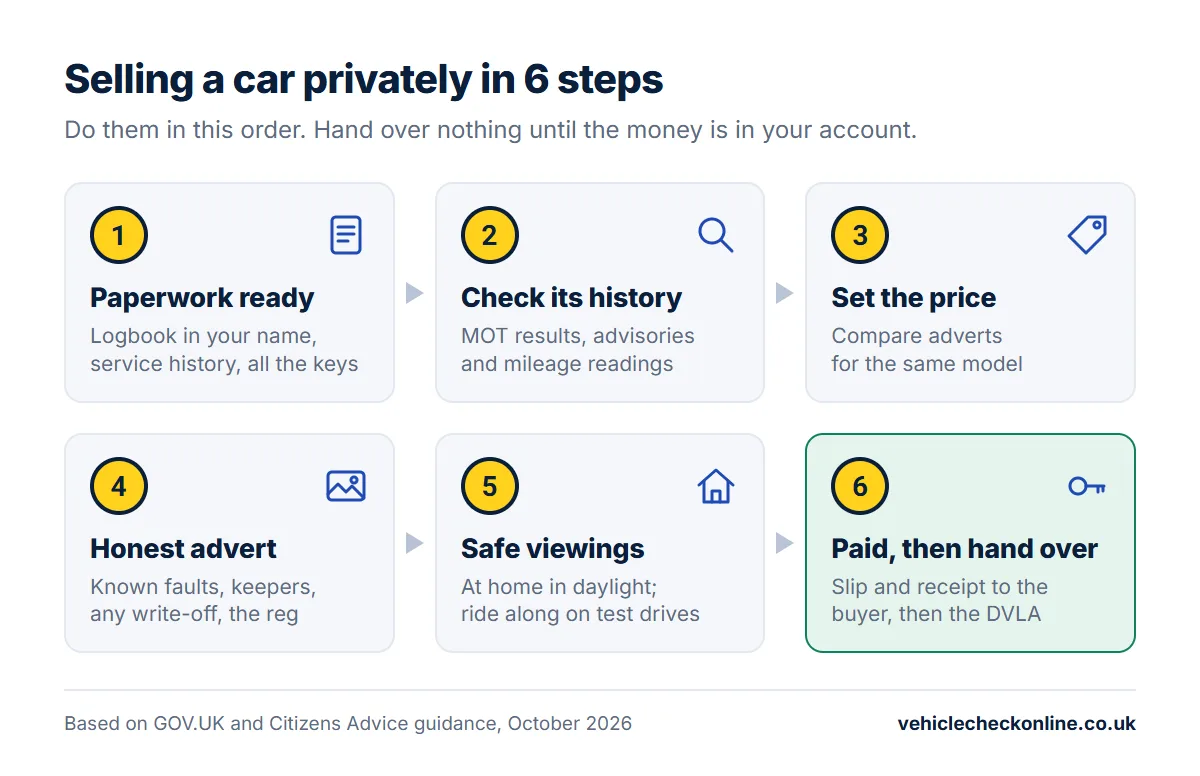
- Get the paperwork ready: the logbook in your name at your current address, the service history and all the keys.
- Check the car as a buyer will: its MOT history, the advisories and the mileage readings.
- Set a price from adverts for similar cars, and decide your lowest figure before anyone calls.
- Write an honest advert with clear photos, the faults you know about and the registration number.
- Show the car safely, at your home in daylight, and go with the buyer on any test drive.
- Get paid, then hand over the keys, the green new keeper slip and a signed receipt, and tell the DVLA.
What paperwork do I need to sell my car?
Citizens Advice tells buyers never to buy a car without its logbook, so that is the one document you cannot do without. Gather these before you advertise:
- The logbook (V5C) in your name, showing your current address. If you have moved, update it first, because the DVLA posts any tax refund to the address on the logbook. If it is lost, a replacement can be ordered online or by phone, usually for £25.
- The MOT certificate, if you have one. The results are also online, where any buyer can look them up.
- The service history: the service book, invoices and receipts for work such as tyres, brakes or a cambelt.
- All the keys, the handbook and the locking wheel nut key, if the car has one.
- The lender's letter confirming that nothing is owed, if the car was ever on finance. It settles any doubt if a buyer's car finance check still shows the agreement.
- Two copies of a receipt, ready to fill in and sign on the day.
If you are still paying for the car on hire purchase, settle the agreement before you sell. Citizens Advice says you do not own a car on hire purchase until the last payment is made, and it tells a buyer whose car is later taken back to ask a private seller for a refund, because the seller did not have the right to sell it.
A private number you want to keep has to come off before the sale. GOV.UK says the retention document (V778) and a new logbook must reach you before you sell, or the right to the number is lost.
How do you check your car as a buyer will?
Citizens Advice tells buyers to check a car's MOT history before they buy, so expect yours to be read closely. Look it up first on our free MOT history check: it shows every test with its result, the advisories and failures, the mileage recorded at each one and when the current MOT runs out.
Then read it as a buyer would. A tyre or brake advisory that is cheap to put right may be worth fixing before you advertise, or at least mentioning, since the buyer will see it anyway. If a mileage reading is lower than an earlier one, find out why before anyone asks you.
If you bought the car used and are not sure of its past, a car history check shows what a careful buyer's own check will find: outstanding finance, an insurance write-off record, a stolen marker, previous keepers and plate changes. Those checks are in the Premium report, £7.99. It is far better to learn about a problem before you describe the car than from the buyer.
How do you set a price for a private sale?
Look at adverts for the same model, with a similar age, mileage, specification and condition, on the sites where you plan to sell. Treat asking prices as a guide rather than what cars actually sell for. For a second opinion, a car valuation check estimates the private sale value from the registration.
Ask a little more than the lowest figure you would accept, so there is room to negotiate, and settle on that figure before anyone calls; our guide to selling a car fast explains what a quicker sale costs. A full service history, a long MOT and good tyres help you hold the price; known faults and a write-off record bring it down.
Our guide to car valuations explains what sets a used car's value and how to read an online valuation. The Basic report, £3.99, also includes a valuation, alongside the mileage verdict, the owner history and any plate changes.
What should you put in the advert when selling a car privately?
An accurate advert brings buyers who already know what they are coming to see. Include:
- The make, model, engine size, fuel, gearbox and year, checked against the logbook.
- The mileage, the MOT expiry date and how much service history there is.
- The faults you know about, and any major parts recently replaced.
- The number of previous keepers, and whether the car has ever been an insurance write-off.
- The registration number, or photos in which the number plate can be read, so buyers can check its history.
- Clear daylight photos of the outside, the inside, the tyres and the dashboard with the engine running.
Leave out the logbook's document reference number and any photo of the logbook itself. Keep a copy of the advert as it stood on the day you sold the car, along with your messages with the buyer.
What does the law ask of a private seller?
Selling your own car, you are not bound by the rules for dealers, but the law still asks two things of you. These are general points about the law, not advice on any particular sale:
- The right to sell. Under section 12 of the Sale of Goods Act 1979, a seller must have the right to sell the car, which is one reason to clear any finance first.
- An accurate description. Under section 13, a car sold by description must match it. Trading Standards guidance says anyone selling a vehicle, trader or not, must make sure the description is correct, such as the make, model and engine size.
A private seller does not promise the car is of satisfactory quality: section 14 applies that duty only where the seller sells in the course of a business. Citizens Advice describes a private sale as "buyer beware", in which the seller cannot misdescribe what they sell but does not have to volunteer every detail. A false statement that persuades someone to buy can still lead to a claim: in England and Wales, the Misrepresentation Act 1967 can make a seller liable unless they had reasonable grounds to believe what they said was true.
In England, Scotland and Wales, section 75 of the Road Traffic Act 1988 says no one may sell a vehicle in an unroadworthy condition, and Trading Standards point out that this includes private individuals. One defence is that the seller had reasonable cause to believe the car would not be used on a road until it was made roadworthy, so a car that is not fit to drive should be sold plainly as a non-runner and not driven away.
Trading Standards guidance lists a trader posing as a private seller among the practices banned outright, so if you buy and sell cars as a business, the rules for dealers apply to you. For advice on your own situation, contact Citizens Advice.
How should you handle viewings and test drives?
Show the car at your home, in daylight. Citizens Advice advises buyers to view a private car at the seller's house, so that they have a record of the seller's address. A careful buyer will also check that the address on the logbook matches.
Have someone with you if you can, and keep the keys in your hand whenever the car is parked. Let the buyer look at the logbook to check it matches the car, but do not let them photograph it or copy down its reference number.
Before a test drive, ask how the buyer is insured to drive your car. GOV.UK says anyone driving on a road needs at least third-party insurance, and Citizens Advice tells buyers to check with their own insurer or to ask whether the seller's policy covers them. If neither of you can confirm cover, do not let them drive. If they can, go with them, ask to see their driving licence, and start and finish at your home.
How do you get paid safely?
Agree how the buyer will pay before the day. A bank transfer at the handover is usually the simplest for both of you: it leaves a record, and nobody carries cash. Banks set limits on how much can be sent at once, so ask the buyer to check theirs in advance.
Check that the money has arrived using your own banking app or by calling your bank, not a screenshot or an email the buyer shows you. If someone pays more than the price and asks for the difference back, stop and talk to your bank before you send anything.
For cash, count it together at your home or at your bank. A banker's draft can be checked with the bank that issued it, on a phone number you find yourself. Our guide to the safest way to pay for a car privately compares the options from the buyer's side.
Do not hand over the keys, the green new keeper slip or the car until the full price is in your account.
How do you hand over the car and tell the DVLA?
- Fill in two copies of a receipt with the date and time, both names and addresses, the price, the registration, the VIN, the mileage and the faults you told the buyer about, and both sign each copy. Our car sale receipt template has wording you can copy.
- Give the buyer the green new keeper slip from the logbook, with the keys and the paperwork.
- Tell the DVLA you have sold the car, online with the logbook's 11-digit reference number or by post. Our guide on how to tell the DVLA you sold your car covers both ways.
- Contact your insurer to cancel the policy or move it to your next car.
Once the DVLA records the sale, your tax stops and any full months left are refunded to you by cheque. The tax does not go with the car, so the buyer has to tax it in their own name before driving away.
Questions and answers
Should I let a buyer test drive my car alone?
It is safer not to. Go with them, check first that they are insured to drive your car, and keep the keys yourself whenever the car is parked.
Can I sell my car without the logbook?
You can, by writing to the DVLA with the details of the sale, but buyers are advised not to buy a car without one and would have to apply for a logbook themselves. Ordering a replacement before you advertise is usually the better route.
Can I sell my car if the MOT has run out?
It can be sold, but the buyer cannot tax it until it passes a new MOT, and GOV.UK allows a car without a valid MOT on the road only to go to a pre-arranged test or to be repaired. Say clearly in the advert that the MOT has expired.
Do I have to tell a buyer about faults?
You must not misdescribe the car, and a false answer to a buyer's question can lead to a claim. Citizens Advice calls a private sale buyer beware, but listing the faults you know about in the advert and on the receipt helps protect you if there is a dispute later.
Can I sell a car that still has finance on it?
Citizens Advice says that with hire purchase you do not own the car until the last payment is made, so settle the agreement before you sell. Ask the lender for a settlement figure, pay it off and keep the letter confirming nothing is owed.
Who pays the tax after I sell?
The buyer. Your tax ends when the DVLA records the sale and any full months left are refunded to you, while the buyer must tax the car in their own name before driving it.
Sources
- GOV.UK: Selling a vehicle
- Citizens Advice: Buying a used car
- legislation.gov.uk: Sale of Goods Act 1979, section 13 (sale by description)
- legislation.gov.uk: Road Traffic Act 1988, section 75 (vehicles not to be sold unroadworthy)
- Business Companion (Trading Standards): Selling used vehicles
Related guides
- Sold your car? How to tell the DVLA and what else to doUse GOV.UK's "Tell DVLA you've sold, transferred or bought a vehicle" service: what you need, the steps, selling to the trade, posting the V5C, and your refund.
- Private car sale receipt: a free UK templateA free car sale receipt template for UK private sales: the wording to copy, what each line is for, the finance and write-off statements, and what to do next.
- Should you sell your car privately or part-exchange it?Sell privately or part exchange? Compare price, effort, risk and your legal duties, see what a dealer checks before it takes your car, and get a better offer.
- What is the safest way to pay for a car privately?The safest way to pay for a car privately: bank transfer at handover, name checks, transfer limits, cash and banker's drafts, and what to do if finance is owed.
- What is the quickest way to sell a car?Sell my car fast: how long each route takes, what slows a sale down, the price you give up for speed, and how to stay safe with a buyer in a hurry.
This guide is general information for people buying, owning or selling a car in the UK, not legal or financial advice. Vehicle Check Online is an independent service, not affiliated with the DVLA, the DVSA or GOV.UK.