
Buying a used car
What is the safest way to pay for a car privately?
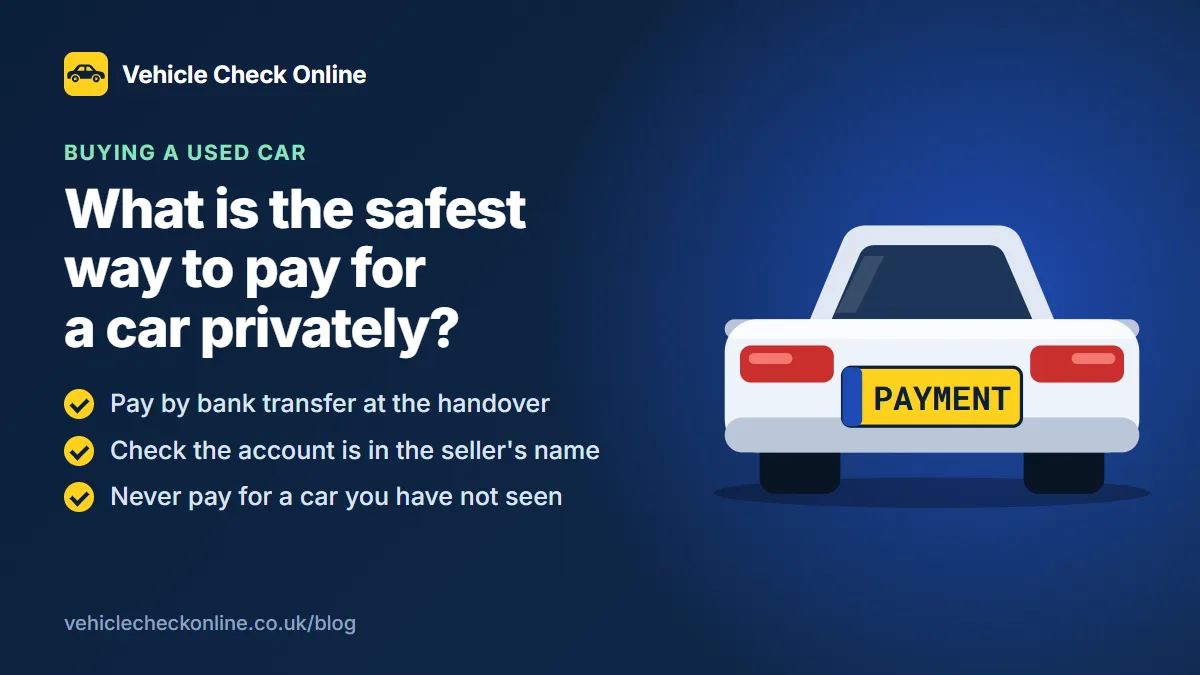
For most private sales, the safest way to pay is a bank transfer made at the handover: once you have seen the car, checked it and its V5C logbook, and confirmed that the account you are paying is in the seller's name. Never pay a deposit, or the full price, for a car you have not seen.
This guide compares the ways to pay a private seller and the risks of each, explains the transfer limits that can catch you out on the day, how refunds for fraud work, and what to do if the car still has finance owed on it.
How can you pay for a car in a private sale?
| Method | How it works | Main risks |
|---|---|---|
| Bank transfer (Faster Payments) | Usually arrives within seconds, day or night, up to your bank's limit | Hard to reverse once sent; a limit lower than the price |
| CHAPS transfer | Same-day bank payment with no maximum, arranged with your bank | Your bank usually charges a fee; it goes through on working days only |
| Cash | Counted out and handed over at the sale | Carrying a large sum; no record unless you get a receipt |
| Banker's draft | A cheque drawn by your bank on its own funds | Money leaves your account when the draft is issued; sellers may refuse it because fake drafts exist |
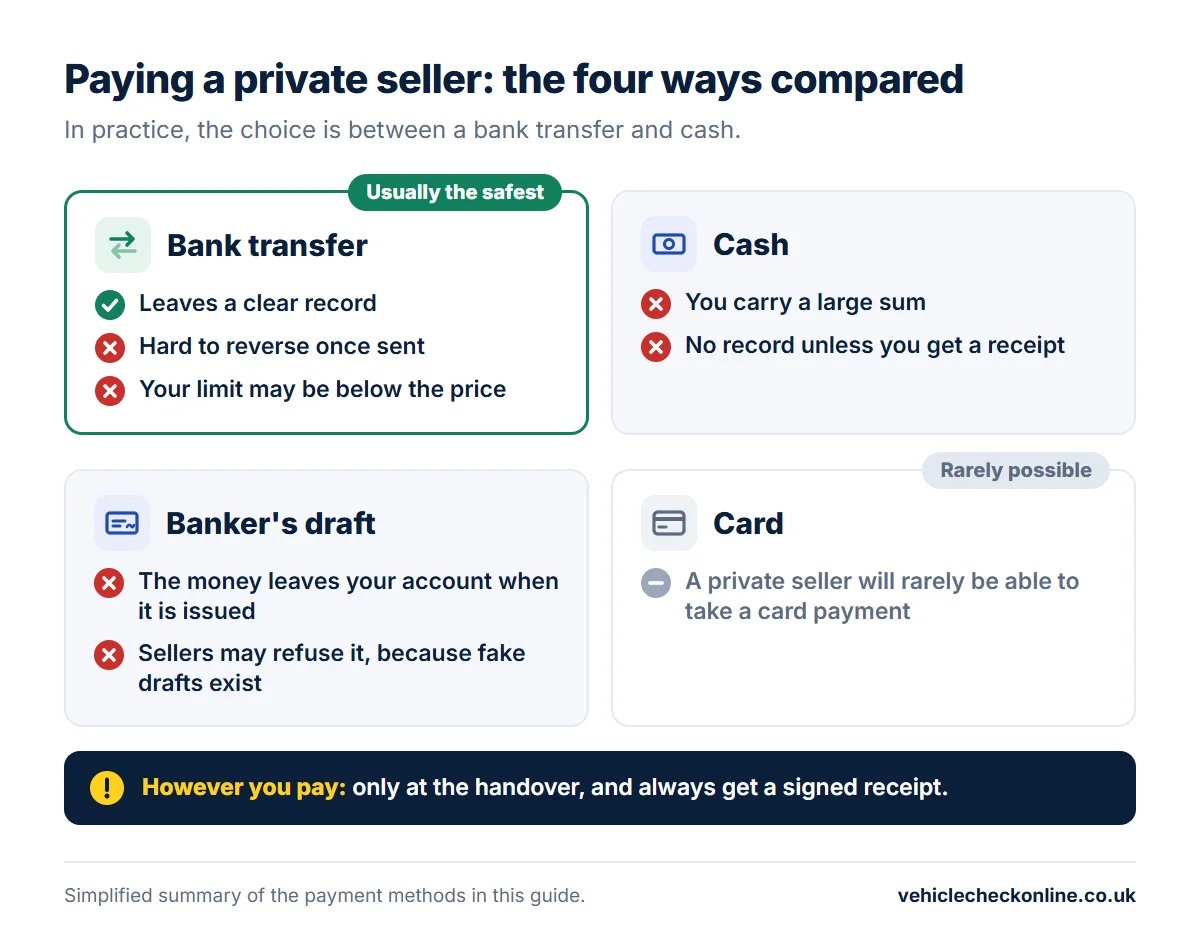
A private seller will rarely be able to take a card payment, and finance arranged by a dealer is not available in a private sale. In practice, the choice is between a transfer and cash.
Is bank transfer safe for buying a car?
Yes, when it is made at the right moment to the right person. A transfer leaves a clear record of who you paid, how much and when, and you do not have to carry cash. The risk is that a transfer is fast and hard to reverse, so it protects you only if you are sure of the seller and the car before you send it.
Make the transfer at the handover, with the car, the keys and the V5C in front of you, after the checks are done. The account should be in the name of the person on the V5C. If the seller asks you to pay a relative, a business or a "friend", ask why, and be prepared to walk away.
How does Confirmation of Payee check the name on the account?
When you set up a new payee, most UK banks run a name check called Confirmation of Payee. It compares the name you type with the name on the account you are paying, and tells you one of three things:
- Match: the name is right, and you can go ahead.
- Close match: the name is nearly right, and your bank shows you the actual account name to compare.
- No match: the name does not match, and you are advised to contact the person you are paying before you send anything.
A match tells you whose account it is, not whether that person is honest or owns the car. Pay.UK, which runs the service, says it will not always detect a fraudulent payment. Treat it as one check among several.
What are the transfer limits for Faster Payments and CHAPS?
The Faster Payments system can carry payments of up to £1 million, but every bank and building society sets its own limits, and on a personal account they can be lower than the price of a car.
Check your limit a few days before the sale, not at the handover. If it is lower than the price, ask your bank whether it can be raised, whether you can make the payment in a branch, or whether a CHAPS payment would suit. CHAPS has no maximum and pays the same day, but banks usually charge for it.
Your bank may ask questions about a large payment to someone new, or hold it while it checks. Since October 2024, banks that have reasonable grounds to suspect fraud can delay an outgoing payment for up to four business days. Answer honestly: the questions are there to protect you.
How do you pay cash for a car safely?
Cash is simple, and some sellers prefer it, but it carries risks for you. You have to carry a large sum, there is no bank record of the payment, and if the car later turns out to be stolen or to have finance on it, a signed receipt is the only proof of what you paid and to whom. A stolen car check before you pay is the better protection.
If you pay cash, hand it over at the seller's home, not in a car park, count it together, and get a receipt signed by the seller before you leave. Do not hand any cash over until you have the keys, the V5C and the green new keeper slip.
How does a banker's draft work, and will a seller accept one?
A banker's draft is a cheque that your bank draws on its own funds, so the seller knows the money is there. The money leaves your account when the bank issues the draft, not when the seller pays it in.
Many private sellers are wary of drafts, because forged ones have been used to take cars: the Financial Ombudsman lists complaints about drafts that turned out to be fake. A cautious seller may want to check a draft with the bank that issued it, so allow time for that if you offer one.
Should you pay deposits, holding fees or use "secure payment" sites?
Do not pay a deposit to hold a car you have not seen. Fraudsters advertise cars they do not have, take deposits to "hold" them, and disappear. Be just as wary of a seller who asks you to pay through an escrow, delivery or "vehicle protection" website they have chosen: some of these sites are fake.
These tricks, and how to spot them, are covered in our guide to car buying scams.
What if the car still has finance on it?
A car on hire purchase or PCP belongs to the finance company until the agreement is paid off. If you pay the seller and the debt is not cleared, the finance company may try to take the car back. A private buyer who did not know about the finance may be protected by law, but proving it can take time and effort.
Before you pay, run an outstanding finance check. If it shows an agreement, do not pay until it has been settled and the finance company has confirmed in writing that nothing is owed. If the seller wants to use your money to clear it, agree the arrangement with the finance company directly, using contact details you have found yourself, not ones the seller gives you.
Our guide to buying a car with outstanding finance explains the options and your position if you have already paid.
Can you get your money back if you are scammed?
If you were tricked into sending money to a fraudster by bank transfer between UK accounts, through Faster Payments or CHAPS, rules set by the Payment Systems Regulator mean your bank must normally refund you, within limits. For payments made since 7 October 2024, the maximum claim is £85,000, the bank can deduct an optional excess of up to £100, and you should report the scam within 13 months. You will not get your money back if you were complicit or grossly negligent.
These rules cover fraud, not disputes. If you paid a genuine seller for a real car that turned out to be faulty or not as described, that is a civil dispute between you and the seller, and the bank will not refund it under these rules. Cash payments are not covered either.
If you think you have been scammed, call your bank straight away, on a number you already know or on 159. Then report it to Report Fraud, the national reporting service for England, Wales and Northern Ireland, or to Police Scotland on 101 if you are in Scotland.
What should the receipt show, however you pay?
Whatever the method, ask for a receipt with the date, the price, how you paid, the registration and VIN, the mileage, and the names and addresses of both of you, signed by the seller. It is your proof of the sale if anything goes wrong. Our car sale receipt template shows what to include.
Questions and answers
Should I pay a private seller by cash or bank transfer?
A bank transfer at the handover is usually the safer choice, because it leaves a record and you do not have to carry cash. Pay only to an account in the seller's name, once the checks are done.
Can a bank transfer for a car be reversed?
Not normally, once it has been sent. If you were scammed, contact your bank at once, as it may be able to stop the payment or refund you under the fraud reimbursement rules.
What if my bank's limit is lower than the price of the car?
Ask your bank before the day whether the limit can be raised, whether you can pay in a branch, or whether a CHAPS payment would suit. Do not split the payment so that part is paid before you have the car.
What should I do if the seller asks me to pay someone else?
Stop and ask why. The account should normally be in the name of the seller on the V5C logbook. A request to pay a third party can be a sign of fraud, so walk away if the answer does not make sense.
Is it safe to pay a holding deposit by bank transfer?
Not for a car you have not seen. A deposit paid to a fraudster is hard to recover, and a genuine seller can wait until you have viewed the car.
Do I need a receipt if I pay by bank transfer?
Yes. The transfer shows that money moved, but a receipt signed by the seller shows what it was for: the car, its registration and VIN, the price and the date.
Sources
- Payment Systems Regulator: APP fraud reimbursement protections
- Pay.UK: Confirmation of Payee FAQs
- Pay.UK: Faster Payment System
- Bank of England: CHAPS
- Stop! Think Fraud: Reporting fraud
Related guides
- How to buy a used car privately in the UKBuying a car privately in the UK, from advert to driving home: the checks before you view, the paperwork, paying safely and your rights as a private buyer.
- Car buying scams in the UK and how to avoid themCar buying scams in the UK: fake sellers, deposit and delivery scams, cloned cars and hidden finance. The warning signs and the check that stops each one.
- Buying a car with outstanding finance: what the law saysBuying a car with outstanding finance? What the Hire Purchase Act 1964 says about private buyers, who it does not protect, and what to do if the lender calls.
- Private car sale receipt: a free UK templateA free car sale receipt template for UK private sales: the wording to copy, what each line is for, the finance and write-off statements, and what to do next.
- How to buy a car on Facebook Marketplace safelyBuying a car on Facebook Marketplace or Gumtree: the safe way step by step, traders posing as private sellers, your rights and the signs to walk away.
This guide is general information for people buying, owning or selling a car in the UK, not legal or financial advice. Vehicle Check Online is an independent service, not affiliated with the DVLA, the DVSA or GOV.UK.