
Buying a used car
How to buy a car on Facebook Marketplace safely
Buying a car on Facebook Marketplace can be done safely if you treat the advert as the seller's word rather than a fact, and check everything yourself. Run a history check before you set off, see the car where the seller lives, compare its V5C logbook with the car itself, drive it only once you are insured, and pay only when you collect it.
The same steps work on Gumtree and any other site where people advertise cars. This guide takes you through them in order, explains what changes when a "private seller" is really a trader, and lists the warning signs that should end a sale before any money moves.
How does buying a car from an online advert work?
A listing on Facebook Marketplace or Gumtree is the seller's own description of the car. Whatever the site, the deal itself is between you and the seller: the two of you arrange the viewing, agree the price, and settle payment and collection.
That description matters more than it seems. In a private sale, the Sale of Goods Act 1979 says the car must correspond with its description, so what the advert and the seller's messages say about the mileage, the owners or the service history is part of what you are buying. Screenshot the advert and the seller's profile, and keep the conversation in writing.
Beyond that, a private seller promises less than a dealer. The Act only implies a promise of satisfactory quality when the seller is selling in the course of a business, so a fault that nobody knew about is usually your problem, not the seller's. Citizens Advice adds that you can still expect a car from an individual seller to be roadworthy, unless you both clearly agree it is being sold for scrap or for spares or repair.
Being online does not make an advert safer. In 2024, the used car lead at National Trading Standards warned that there is just as much harm and bad practice behind used car adverts on online platforms, such as Facebook, as at the kind of trader buyers already distrust.
How do you buy a car on Facebook Marketplace safely?
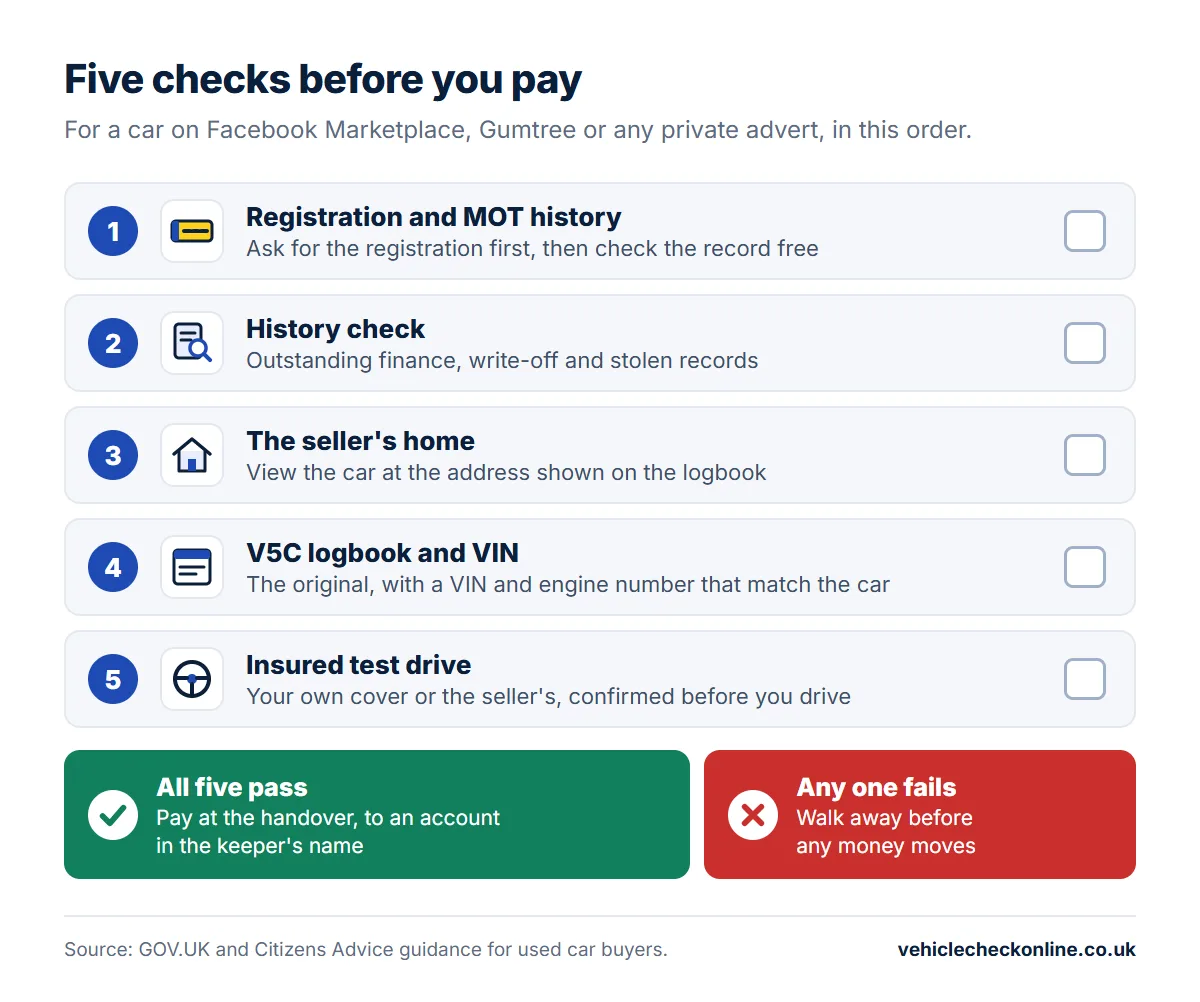
- Get the registration before you go. GOV.UK advises asking the seller for the registration number, make, model and MOT test number, and checking them against the official record. Our free MOT history shows the MOT status and every MOT test, so you can compare the mileage with the advert. GOV.UK's free vehicle enquiry service shows whether the car is taxed.
- Check what the free record cannot show. Finance owed on the car, an insurance write-off and a stolen record are not part of the free government record. Our car history check covers all three in the Premium report (£7.99), with previous keepers and plate changes. Run it before you travel: a bad result saves you the journey.
- View the car at the seller's home. Citizens Advice suggests meeting a private seller at their house, so you know where they live if something goes wrong later. Go in daylight, ideally when it is dry, and expect the address to match the one on the logbook.
- Compare the logbook with the car and the seller. Ask for the original V5C, never a photo. GOV.UK says to look for the "DVL" watermark, check that the serial number is not in the ranges it lists as possibly stolen, and confirm that the VIN and engine number are the same on the car and on the logbook. Our guide on whether a V5C is genuine shows each check.
- Take an insured test drive. You must have motor insurance to drive on UK roads. Citizens Advice says not to test drive a car without it, and notes that the seller's policy might cover you if you ask. Allow at least 15 minutes on different kinds of road; our test drive checklist lists what to try.
- Pay at the handover, not before. Once every check has passed, pay with the keys and the logbook in front of you, by bank transfer to an account in the keeper's name. For the pros and cons of each method, see our guide to paying a private seller safely.
- Leave with the paperwork. Take a receipt signed by the seller, and the V5C's green slip for the new keeper. GOV.UK says to tax the car immediately using that slip, and you need insurance in place before you drive it away.
Is buying a car from Gumtree any different?
The steps above apply unchanged on Gumtree. The main difference is how the site treats dealers. Gumtree's motors policy says professional sellers and businesses must choose "Trader" as their seller type, and that posting as private is misleading and not allowed. Its rules also say each motors advert should be for a single vehicle.
So check the seller type on the advert, then test it against what you find. A "private" seller with a run of different cars, or a phone number that appears in several adverts, does not fit the label. The same test works on Facebook Marketplace: look at what else the seller has listed.
What if a trader is posing as a private seller?
A dealer may advertise on Facebook Marketplace or Gumtree as if it were a private individual. It matters because a trader owes you more: when you buy from one, the Consumer Rights Act 2015 says the car must be of satisfactory quality, fit for a particular purpose you made known, and as described.
Posing as a private seller is banned outright. Schedule 20 of the Digital Markets, Competition and Consumers Act 2024, in force since 6 April 2025, lists the practices that are unfair in all circumstances. One of them is a trader falsely claiming, or creating the impression, that it is not acting for the purposes of its business, or falsely presenting itself as a consumer. The rule applies across the UK.
Under the Consumer Rights Act, a trader is a person acting for purposes relating to their trade or business. Whether you bought from a trader depends on what the seller was really doing, not on the label in the advert, so a "private" sale by someone selling cars as a business may carry the rights you would have with a dealer. This is general information, not legal advice. Citizens Advice can explain how it applies to your case, and in England its consumer service can pass a report on to Trading Standards.
Signs that a "private" seller may be in business:
- Several different cars for sale under the same name, profile or phone number.
- A logbook in someone else's name, with a story about selling it for a friend or relative.
- Photos taken on a forecourt or in a yard, or the same backdrop behind different cars.
- A viewing at a unit, a yard or the roadside rather than at a home address.
If you suspect a trader, ask outright and keep the answer in writing. The difference in your rights is set out in private seller vs dealer.
What are the warning signs in the advert and at the viewing?
- A price well below similar cars of the same age and mileage.
- The seller will not share the registration number you need for a reg check, or the details do not match the official record.
- They cannot show you the car at home, or want to meet in a car park, at motorway services or "near a friend's house".
- No V5C, only a copy of one, or a V5C with a name and address that are not the seller's.
- A VIN on the car that differs from the one on the logbook, a sign the car may be stolen: our stolen car check page lists the others.
- A request for a deposit, or for the full price, before you have seen the car.
- Pressure to decide on the spot, with talk of other buyers on their way.
- A request to pay someone other than the keeper, or to move the conversation or the payment off the site.
- A history check that shows finance owed, a write-off nobody mentioned, or a stolen record.
Do not pay anything until you have seen the car at the seller's home with its logbook in your hand. A genuine seller can wait for that.
How do Marketplace scams work?
UK Finance, the banking industry body, says purchase fraud, where people pay for something that never materialises, often starts on marketplace sites. With a car, that can mean a deposit or the full price sent for a car that does not exist, or is not the seller's to sell. Our guide to car buying scams explains each trick and the check that stops it.
What should you do if something goes wrong?
- If you think you have paid a fraudster, call your bank straight away, on a number you trust or on 159.
- Tell the police: Report Fraud (reportfraud.police.uk, 0300 123 2040) takes reports from England, Wales and Northern Ireland, and Police Scotland takes them on 101.
- Flag the advert and the seller's profile to Facebook or Gumtree, and keep your screenshots and messages.
- If the car is not as described, or the seller turns out to be a trader, contact Citizens Advice about your own case before you take any other step.
Questions and answers
Is it safe to buy a car on Facebook Marketplace?
It can be, if you make the checks you would make for any private sale: the car's history, a viewing at the seller's home, the logbook against the car, an insured test drive and payment only at the handover. The risk comes from skipping them.
Should I pay a deposit to hold a car on Marketplace?
Not until you have seen the car. A genuine seller can hold it until you view it, and money sent to a fraudster by bank transfer is hard to get back.
Can I return a car I bought privately online?
Not just because a fault appears later or you change your mind. In law, a private seller needs the right to sell it, and the car has to match its description, so contact Citizens Advice if either was not the case.
How can I tell if a Marketplace seller is a dealer?
Look at what else they are selling and where the car is kept. Several different cars, a logbook in another name or a viewing at a yard all suggest a business, so ask directly and keep the answer.
Do I need insurance to test drive a car from a private seller?
Yes. You must be insured to drive on the road, so check whether your own policy covers you to drive other cars, or ask whether the seller's policy covers you, before you set off.
Is Gumtree safer than Facebook Marketplace for buying a car?
The site matters less than the checks you make. On either one, a history check, a viewing at the seller's home, a logbook that matches the car and payment at the handover protect you in the same way.
Sources
- Citizens Advice: Buying a used car
- GOV.UK: Check a used vehicle you're buying
- legislation.gov.uk: Digital Markets, Competition and Consumers Act 2024, Schedule 20 (banned practices)
- Citizens Advice: top tips for buying used cars, with National Trading Standards (20 May 2024)
- Gumtree: Motors policies (trader and private sellers)
Related guides
- Car buying scams in the UK and how to avoid themCar buying scams in the UK: fake sellers, deposit and delivery scams, cloned cars and hidden finance. The warning signs and the check that stops each one.
- How to buy a used car privately in the UKBuying a car privately in the UK, from advert to driving home: the checks before you view, the paperwork, paying safely and your rights as a private buyer.
- What is the safest way to pay for a car privately?The safest way to pay for a car privately: bank transfer at handover, name checks, transfer limits, cash and banker's drafts, and what to do if finance is owed.
- Buying a used car: private seller vs dealerPrivate seller vs dealer: your legal rights, returns, warranties, price and risks when buying a used car in the UK, and the checks you still need either way.
- Is a car history check worth it?Is a car history check worth it? What a check shows, what it cannot tell you, what you can see free and when paying for a full report makes sense.
This guide is general information for people buying, owning or selling a car in the UK, not legal or financial advice. Vehicle Check Online is an independent service, not affiliated with the DVLA, the DVSA or GOV.UK.