
Buying a used car
Is a car history check worth it?
For most used cars you are serious about buying, a car history check is worth it, above all from a private seller. It tells you whether finance is still owed on the car, whether an insurer wrote it off and whether it is recorded as stolen, which the car will not show you and the logbook may not either. It cannot judge the car's condition, so it works alongside an inspection, not instead of one.
This guide explains what a history check is and where its records come from, what it shows and what it cannot, what you can see for free, when paying matters most, and what to do with the result.
What is a car history check?
A car history check is a search of the records held about one vehicle, run on its registration number. It brings together information that different organisations keep, so that one report answers questions that would otherwise take several enquiries, and some you could not ask at all.
Part of the picture is public. The DVSA records every MOT test, with its result and the mileage, and the DVLA holds the registration record: the vehicle's details, its tax, and when it changed keeper or number plate. The rest is held privately. Insurers enter written-off cars on the Motor Insurance Anti-Fraud and Theft Register, and finance companies record their interest in the cars they fund, because under hire purchase or PCP the lender owns the car until the final payment.
GOV.UK and Citizens Advice both call this a private history check, and Citizens Advice says to consider one whoever you buy from. It is a search of records, not an inspection: nobody looks at the car. The companies that sell checks are private businesses, and this site is independent, not linked to the DVLA, the DVSA or the police.
What does a car history check show?
| Record | What it can tell you |
|---|---|
| Outstanding finance | Whether a lender still has an interest in the car, and so a claim on it |
| Insurance write-off | Whether an insurer wrote the car off, in which category and when |
| Stolen record | Whether the car is recorded as stolen |
| Previous keepers | How many keepers the car has had and its keeper changes, not who the keepers were |
| Plate changes | Whether the car has carried a different registration number |
| Mileage | The reading at each MOT, and whether the readings run in order |
| MOT history | Every test result, with the failures and advisories |
| Valuation | A guide to what the car is worth |
The first three are the expensive surprises, because each can cost you the car itself or part of what you paid for it. The others help you judge whether the seller's story fits the car: the number of owners in the advert, the mileage on the dashboard, a private plate in place of the original registration.
Keeper names are not part of any check. GOV.UK says you have to write to the DVLA for information about a current or previous registered keeper.
What can a history check not tell you?
- The car's condition. The records say nothing about the state of the engine, the gearbox or the brakes today. Even the MOT history only shows what was tested, and GOV.UK says the test does not cover the condition of the engine, clutch or gearbox.
- Damage that nobody recorded. A write-off record exists only if an insurer wrote the car off. A crash repaired without a claim, or a claim settled with a repair, leaves no write-off record behind. Our car accident check guide sets out which records a buyer can see.
- Whether the car is the one on the record. A check runs on the registration you enter. A cloned car wears the plates of a genuine one, so the check returns the genuine car's history. Our guide on how to spot a cloned car shows how to match the VIN.
- Whether the seller owns it. The logbook names the registered keeper. The viewing at the address on the logbook, with the keeper it names, is still your check on the seller.
- The service history. Our reports do not include servicing: ask for the service book and the invoices.
- Anything recorded after you check. A report reflects the records on the day it is run. Finance can be taken out, or a theft reported, at any time.
A clean report means nothing bad is recorded against that registration. It is not a certificate of condition, and it is never a reason to skip the viewing, the logbook checks or the test drive.
Free checks and paid reports: what does each cover?
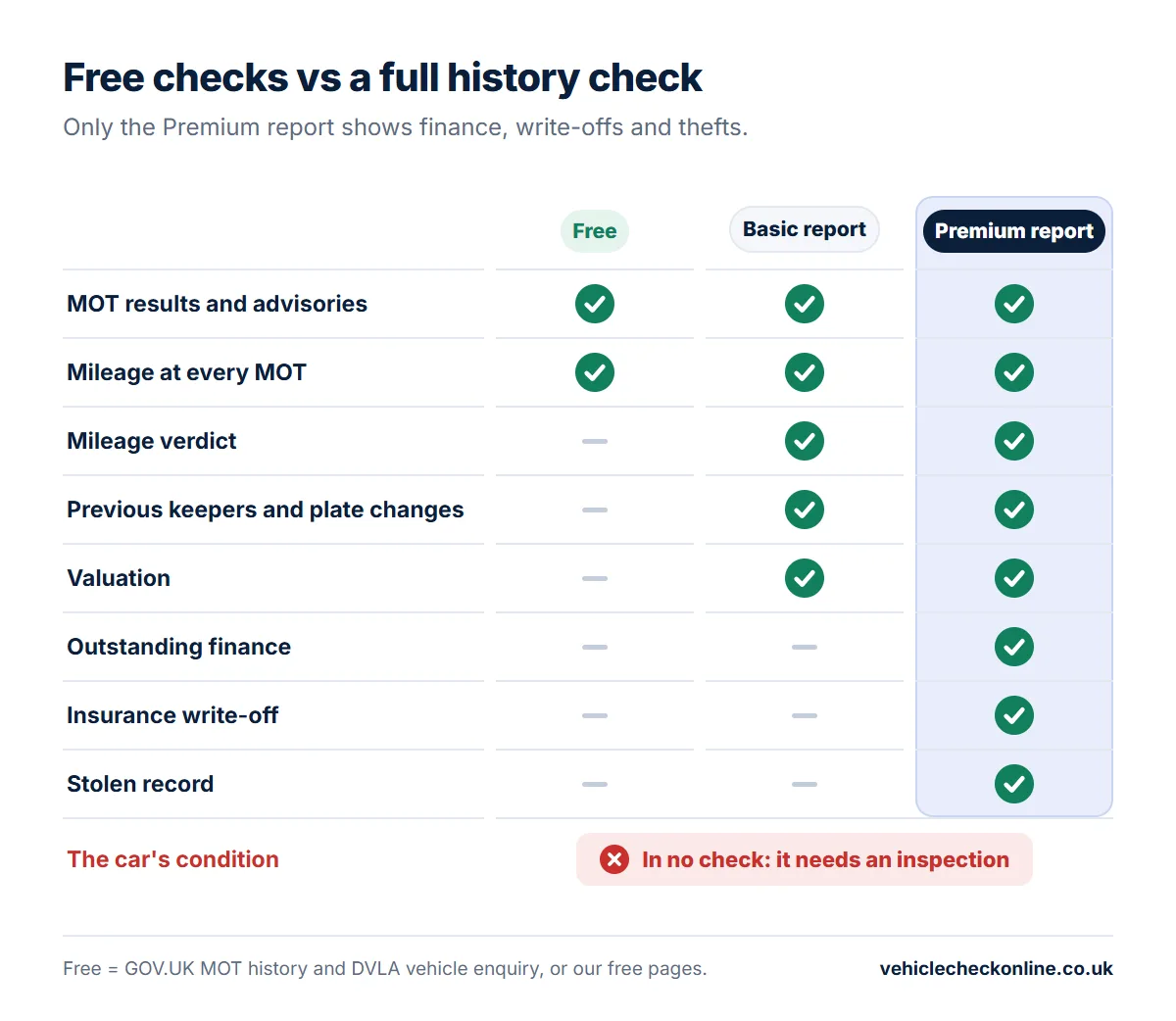
Some of a car's history costs nothing to see. GOV.UK's MOT history service shows whether each test was passed or failed and the mileage recorded at it, for cars tested since 2005 (since 2017 in Northern Ireland). The DVLA's vehicle enquiry shows the tax and MOT status and basic details. Our free MOT history page shows the MOT side for any registration, with every advisory and the outstanding recall status.
The paid reports on our car history check page add what the free record does not hold. The Basic report (£3.99) adds a mileage verdict, the number of previous keepers and changes, plate changes and a valuation. The Premium report (£7.99) adds the outstanding finance, write-off and stolen checks, the full VIN and, where the data supplier holds it, a specifications card.
In short, the free record tells you whether the car is taxed, has a current MOT and how it has fared at its tests. Only the paid records tell you whether someone else has a claim on the car, or whether it has been written off.
When does a history check matter most?
- Buying privately. A private seller gives you fewer legal rights than a dealer, and if the car turns out to be stolen or on finance, your claim is against a seller who may be hard to find.
- Buying from an online advert. UK Finance says purchase fraud often starts on marketplace sites. Our guide to buying a car on Facebook Marketplace covers the safe way to do it.
- A price that seems low for the age and mileage. GOV.UK's guide to repaired write-offs warns that if a price looks too good to be true, you should beware.
- Before you travel or pay a deposit. A bad result costs you nothing at that stage. After you have paid, the same result can cost you the car.
Buying from a dealer gives you more rights if something goes wrong, but a check before you buy can save you from having to use them.
Is a car history check worth the money?
Weigh the cost of the report against what the records protect you from. Under hire purchase or PCP, the lender owns the car until the final payment, so a car with finance still owed is not the seller's to sell outright. If the car is stolen, Citizens Advice's guidance for England says the police will try to return it to its original owner, and your money then has to be recovered from the seller. A hidden write-off usually means you paid too much, and you need to declare it to your insurer.
The law offers some protection. In England, Wales and Scotland, Part III of the Hire Purchase Act 1964 can protect a private buyer who bought a car in good faith without notice of a hire purchase or conditional sale agreement, but not someone who knew about it, and relying on it can mean a dispute with the lender. Our guide to finance markers explains how the finance record works.
Against that, the Premium report costs £7.99. On most cars, that is a small fraction of the price, and a bad result usually ends the deal before you have lost anything. On a very cheap car, weigh it against what you could lose, which is still the whole price.
A paid check tells you least when you already know the car's whole life, such as a car a relative has owned since new and paid off. Even then, the free MOT history is worth a look.
What should you do with the result?
- Finance recorded: do not pay until the lender confirms in writing that the agreement is settled. Our car finance check page sets out the other steps.
- A write-off: find out the category, what was damaged and who repaired it, then decide whether the price still makes sense. What Cat N means explains the lighter of the two repairable categories.
- A stolen record: do not buy the car, and tell the police on 101. Our stolen car check page explains what else to do.
- More keepers or plate changes than the seller mentioned: ask why. Neither is a problem in itself, but an answer that does not fit is.
- Mileage readings out of order: ask for an explanation and paperwork before you go any further.
- A clean result: carry on with the viewing, the logbook and VIN checks and the test drive. Our step-by-step guide to buying a car privately covers each one.
Questions and answers
How much does a car history check cost?
Ours costs £3.99 for the Basic report and £7.99 for the Premium report, which is the one with the finance, write-off and stolen checks. The MOT history, the mileage readings and the tax status are free.
Is a free car check enough?
It shows the MOT history, the mileage readings and the MOT status, and GOV.UK shows the tax status. It cannot show finance, write-offs or a stolen record, so for a car you are about to buy it is a start rather than the whole check.
Can a car history check be wrong?
A check shows what the records hold. If something was never recorded, or was recorded late or wrongly, the report cannot show it, which is why it works best alongside the logbook, the VIN and an inspection.
Does a history check show accident damage?
It shows an insurance write-off, with the category and the date. An accident that was repaired without a write-off, or without a claim at all, does not appear, so look for signs of repair at the viewing.
Do I need the V5C to run a history check?
No. A check runs on the registration number. You need the V5C at the viewing, to compare the VIN and the keeper's details with the car and the seller.
Should I trust a history check the seller gives me?
Run your own instead. A report the seller printed may be old or may not be for this car, and checking the registration yourself is quick.
Sources
- GOV.UK: Check the MOT history of a vehicle
- GOV.UK: Get vehicle information from DVLA
- Citizens Advice: Buying a used car (private history checks)
- Citizens Advice: If you think you've bought stolen goods
- Financial Ombudsman Service: Car finance
Related guides
- What is a finance marker on a car?A finance marker shows a lender still has an interest in a car. What it means when you buy, and how removal works after the finance is paid off.
- What does Cat N mean on a car?Cat N means an insurer wrote the car off after damage that did not reach its structure. What it covers, what it hides and how to confirm it.
- How to tell if a car is cloned before you buy itHow to tell if a car is cloned: match the VIN, the V5C logbook and the official record, and meet at the keeper's address. Step-by-step checks for buyers.
- How to buy a used car privately in the UKBuying a car privately in the UK, from advert to driving home: the checks before you view, the paperwork, paying safely and your rights as a private buyer.
This guide is general information for people buying, owning or selling a car in the UK, not legal or financial advice. Vehicle Check Online is an independent service, not affiliated with the DVLA, the DVSA or GOV.UK.