
Write-offs and accident damage
Car accident check: how to find out if a car has been in an accident
A car accident check shows whether an insurer wrote the car off after an accident, in which category and when, by searching the insurers' write-off records by registration; the free MOT history and the logbook (V5C) add clues. No UK check shows every accident: a car repaired without a write-off leaves no such record, and the MOT notes damage only if it causes a fault.
There is no single accident register in the UK. This guide sets out which records of accidents and damage exist, who holds each one and which of them you can see, how to check a car's accident history step by step, free and paid, how to get your own insurance claims history, and what to do with what you find.
Which records of car accidents exist in the UK?
Accident information is spread across records kept for other purposes: insurance, registration, roadworthiness and policing. Each catches only part of the story. You can see some for free and one through a paid check, and some are not open to buyers at all.
| Record | Who holds it | Can a buyer see it? | What it shows |
|---|---|---|---|
| Write-off register | The Motor Insurers' Bureau, for insurers | Through a paid write-off check | Cars written off, with the category, held for seven years |
| Logbook (V5C) | Issued by the DVLA, kept by the keeper | Yes, at the viewing | The category of a repaired Cat S car |
| MOT history | The DVSA | Yes, free online | Defects and advisories at each test |
| DVLA vehicle enquiry | The DVLA | Yes, free online | Tax, MOT expiry and logbook date, not write-offs |
| Insurers' claims records (CUE) | The Motor Insurers' Bureau, for insurers | No, though you can ask for your own | Motor claims and reported incidents |
| Police collision reports | The police force that dealt with it | No, only those involved and their insurers or solicitors | Collisions the police dealt with |
| Repair invoices and photos | The seller or the repairer | Only if the seller shows you | What was damaged and replaced, and who did it |
What makes a car a write-off, and what gets recorded?
After a claim for damage, the insurer decides whether to repair the car or write it off. GOV.UK explains that when a car is written off, the insurer pays the owner its current value instead of the cost of the repair. The government's guide for buyers separates write-offs that cannot or should not be repaired (Cat A and B) from those that could be repaired, but at a cost above the car's replacement value (Cat S and N).
Each write-off is given a category and entered on the insurers' register. When the insurers' salvage code was revised in 2017, Thatcham Research, its technical authors, said a qualified assessor must update the register with the category as soon as reasonably practical after inspecting the car. What each letter means is explained in our car category check guide.
The register is held by the Motor Insurers' Bureau (MIB). For years it was called MIAFTR, the Motor Insurance Anti-Fraud and Theft Register; since its data moved to a new MIB platform in November 2025 it has been called Vehicle Salvage and Theft Data. MIB describes it as the central record of claims for written-off and stolen vehicles, holding the vehicle's details, the claimant's details and the damage category, and says information is held on it for seven years.
You cannot search it yourself. MIB says it is only available to authorised professionals, and even an owner who asks MIB for their data cannot be told about markers recorded before they owned the car. MIB classes the DVLA and provenance companies, the businesses behind vehicle history checks, as recipients of its data. That is how a write-off check can show a category that the logbook does not.
Does the V5C logbook show accident damage?
Not in general. The logbook is a registration document, not a damage record, and what the DVLA puts in it after a write-off depends on the category:
- Cat S: an owner who keeps the car sends the complete logbook to the insurer and applies for a free duplicate on form V62, and GOV.UK says the DVLA records the category in the new logbook. Thatcham Research said in 2017 that the note would read: "This vehicle has been salvaged due to structural damage but following a technical evaluation declared suitable for repair."
- Cat N: the owner can keep the logbook issued before the write-off, so it does not mention the category.
- Cat A and Cat B: since 26 October 2015 the DVLA has not issued a logbook for these cars, and the government's guide says they will not be re-registered.
The DVLA's free vehicle enquiry on GOV.UK does not fill the gap. It shows details such as the tax, the MOT expiry date, the date of first registration and the date the last logbook was issued, but a write-off category is not among the details it lists. It is still worth running: the government's guide tells buyers to check that the logbook matches the DVLA's record.
What can MOT history tell you about accidents?
The MOT records the car's condition on the day of each test, not its past. The DVSA's inspection manual says the test is carried out without dismantling, and damage only fails a car when it reaches set limits, such as:
- A main load-bearing part of the structure that is fractured, deformed or inadequately repaired, so that the structure is significantly less rigid.
- A bumper, body panel or other body part that is insecure, or damaged so that it is likely to injure someone who brushes against it.
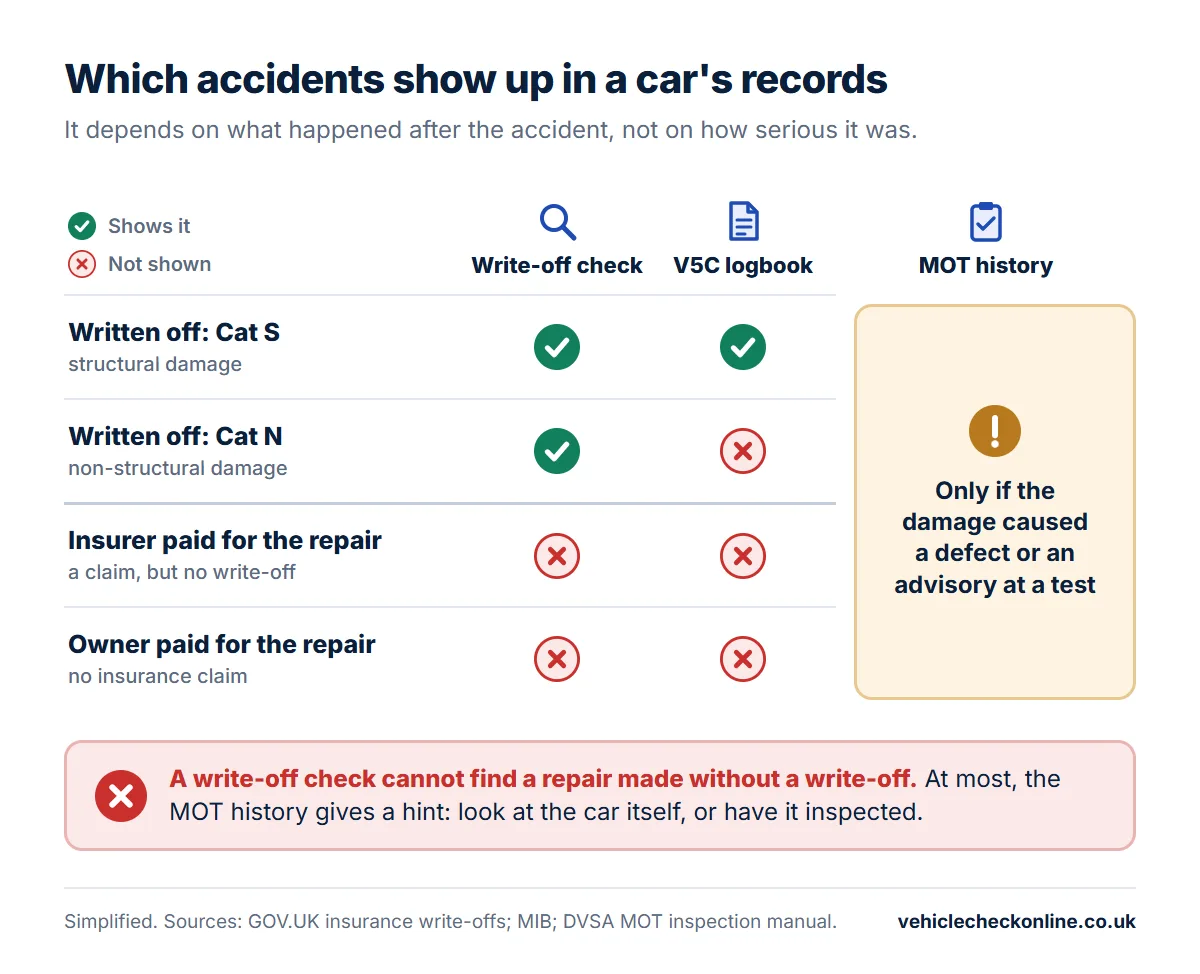
When an item is not bad enough to fail, the manual lets the tester add an advisory, but it is the tester's choice. A dent, a respray or a well-hidden structural repair can leave no trace at all. So the MOT history shows damage only when it caused a defect or an advisory.
Read it for clues rather than proof: a failure for the structure or an insecure panel, new advisories after years of clean tests, or a long gap between tests when the car may have been off the road. Our guide to what to look for in MOT history explains each kind of entry. GOV.UK lists the failed parts and minor problems only for tests in England, Scotland and Wales, which go back to 2005; Northern Ireland results start in 2017.
Which accident records can a buyer not see?
Two more records hold accident information, but neither is open to car buyers.
- Insurers' claims records. The Claims and Underwriting Exchange (CUE), also held by MIB, records reported motor, home and personal injury incidents, whether or not they led to a claim, for six years after the claim or notification is closed. MIB says it holds the claimants' names and addresses and the claim status, and that insurers, brokers and solicitors use it. A person can ask MIB for their own records, but a buyer cannot search it for a car's claims.
- Police collision reports. Police release these to the people involved and their representatives. Avon and Somerset Police, for example, deals with requests from the person involved, their solicitor or their insurer, and asks a member of the public who wants a copy of a report to make a subject access request, which is a request for their own personal information.
How do you check your car insurance claims history?
Your claims history is a record about you, not about a car. The main one is CUE, and MIB lets you ask for your own entries in two ways:
- A request for information. Through MIB's online form only, for up to two motor claims from the last six years (the two most recent if you give no dates). MIB says it can give the incident date, the insurer and the claim reference, and aims to reply within five working days once it can confirm who you are.
- A data subject access request. Online, by email, by phone or by post, for wider access to the personal data MIB holds about you. MIB answers within one calendar month.
You need proof of identity for either, and MIB says the information is free in most cases. You can also ask your insurer, or a past insurer, for a copy of the information it holds about you: GOV.UK says such requests are usually free, and the organisation must normally reply within one month.
None of this shows claims made by the car's earlier owners, and a buyer cannot search CUE for a car's claims. If what you need is to know whether a car is insured today, that is a different check: see how to check if a car is insured.
How do you check car accident history, step by step?
Do the free checks before you travel, the paid one before you pay a deposit, and the rest at the viewing.
- Read the free MOT history. Enter the registration on our free MOT history page or GOV.UK's service, and look for structural or body defects, advisories that appear suddenly and gaps between tests.
- Run a write-off check. It searches the insurers' register by registration and shows whether the car has been written off, in which category and when. Our write-off check is part of the Premium report (£7.99), with the outstanding finance and stolen checks.
- Ask the seller in writing. Has the car been in an accident, has there been an insurance claim, has it been written off, and who did any repairs? Keep the replies.
- Check the logbook at the viewing. A repaired Cat S car should have the category recorded in it. Match the VIN on the logbook to the car, so you know the records you checked belong to this car.
- Look at the car itself. Uneven panel gaps, paint that does not match and overspray are the usual signs of crash repair. Our guide on how to tell if a car has been in an accident takes you round the car point by point.
- Ask for the repair invoices and, if in doubt, an inspection. For a written-off car, the government's guide recommends a report from an independent expert or an engineer who can identify structural damage.
Steps 1 and 3 to 5 cost nothing. The write-off check is the paid step, and for a buyer it is the only way to see what the insurers' register holds. Our car history check page lists what else the same report covers.
What is an accident damage report, and how do you get one?
The phrase covers three different documents, and which one you can get depends on whether you were involved in the accident:
- A write-off record, by registration. This is the one a buyer can get. Our write-off check shows whether an insurer wrote the car off, the category and the date of the loss, and the areas of damage and the insurer when the record includes them.
- A police collision report. Only for the people involved and their solicitors or insurers, as explained above.
- An engineer's report. An inspection of the car itself, which you can arrange for any car you are buying. Our guide to a pre-purchase car inspection explains what one covers and when it is worth paying for.
Why does no car damage history check show every accident?
A write-off check is the closest thing to a car damage history check, but it can only show what was recorded. A category is given only when the insurer decides not to repair the car, so an accident the insurer paid to repair, or one the owner fixed without a claim, creates no write-off record, however serious it was. When the categories changed in 2017, the British Vehicle Salvage Federation pointed out that insurers repair structurally damaged vehicles every day.
The register also depends on insurers following their salvage code, which GOV.UK and Thatcham Research both describe as voluntary, and MIB keeps its information for seven years, so an older write-off may no longer show. The MOT history fills some gaps, but only where damage caused a defect or an advisory at a test.
A clean write-off check means no insurer has recorded the car as written off. It does not prove the car has never been in an accident, so the viewing and the inspection still matter.
What should you do if a check finds an accident?
- A Cat S or Cat N record: find out what was damaged and who repaired it, ask for the invoices, and read what Cat S means before you decide. Get an insurance quote first: the government's guide warns that not every insurer covers a written-off car, and that a claim can be rejected if you do not declare the write-off.
- A Cat A or Cat B record on a car sold to drive: walk away. The government's guide says these cars should never be repaired and returned to the road.
- Damage in the MOT history: ask what happened, when, and whether it went through insurance. A repair done well, with invoices, need not put you off; one the seller cannot explain is a reason for an inspection, or to walk away.
- Records that do not match the seller's story: do not pay anything until the answers fit. If you find out after buying that a write-off was hidden from you, Citizens Advice can explain your options.
Questions and answers
How can I find out if my car was in an accident before I bought it?
Look at the logbook for a Cat S note and read the free MOT history for damage-related defects or advisories. MIB can search its write-off records for a car you own, but not for markers from before your ownership, so a write-off check is the way to see earlier write-offs. A repair made without a write-off may show only on the car itself.
Does the DVLA keep a record of a car's accidents?
Not of accidents in general. It records the category of a repaired Cat S car in its logbook and does not issue logbooks for Cat A or B cars, but its free vehicle enquiry does not list write-offs or accidents.
Can I find out whether a car has had an insurance claim?
Not from the records. Claims are held on an insurance industry database that buyers cannot search, so ask the seller directly and ask to see any repair invoices. A write-off check shows only the claims that ended in a write-off.
Do police accident reports show up in a car check?
No. Police release collision reports to the people involved and their solicitors or insurers, so they are not a record you can look up by registration.
Does a write-off check show when the car was damaged?
Ours shows the date of the loss recorded with the write-off, and the areas of damage when the record includes them. The MOT history gives only the dates of tests, but a gap between them or a new defect can narrow down when damage happened.
Does a write-off record follow the car to a new owner?
Yes, for as long as it is held. The register records the vehicle and its damage category, not just the owner, so a write-off check still finds the record after the car changes hands. MIB says information is held on that database for seven years.
Can the Insurance Fraud Bureau tell me about a car's accidents?
No. The Insurance Fraud Bureau works against insurance fraud with insurers and the police. Members of the public can report suspected fraud to it, but it does not offer vehicle history or claims checks.
I have had an accident: how do I find the other car's insurer?
That is a different check. The Motor Insurers' Bureau offers people involved in a collision a paid one-off search, long known as askMID and now moving to the name Check Their Vehicle, which gives the other vehicle's insurer and policy number.
Sources
- GOV.UK: Insurance write-offs (scrapping your vehicle and insurance write-offs)
- GOV.UK: Buying repaired written-off vehicles, a consumer guide
- MIB: Resources for data recipients (Vehicle Salvage and Theft Data)
- MIB: Your data and privacy (CUE, Vehicle Salvage and Theft Data, how to request your data)
- GOV.UK: Data protection, find out what data an organisation has about you
- DVSA: MOT inspection manual for cars, section 6 (body, structure and attachments)
Related guides
- How to tell if a used car has been in an accidentHow to tell if a car has been in an accident: the signs of crash repair to look for at a viewing, and the records to check before you buy, in plain steps.
- Car category check: how to find out if a car is Cat S, N, C or DCar category check: find out if a car was written off as Cat S, N, A or B (or C or D before 2017), what the logbook shows free, and what needs a paid check.
- What does Cat S mean on a car?Cat S means a car was written off after structural damage and can go back on the road once repaired: what the S stands for and how to tell if a car is Cat S.
- Salvage cars in the UK: what they are and whether to buy oneWhat is a salvage car? One an insurer has written off. Which categories can return to the road, insuring one, salvage value and how to check a car.
This guide is general information for people buying, owning or selling a car in the UK, not legal or financial advice. Vehicle Check Online is an independent service, not affiliated with the DVLA, the DVSA or GOV.UK.