
Car finance
What is a finance marker on a car?
A finance marker is a record that a lender has a finance agreement on a car, such as hire purchase or PCP. Lenders register it with the data companies that vehicle checks search. While the agreement runs, the lender owns the car, and the marker should be removed once it is paid off.
This guide explains what a marker records, which kinds of finance it covers, what to do if the car you want to buy has one, and what to do as an owner if a marker stays after you have settled.
What does a finance marker record?
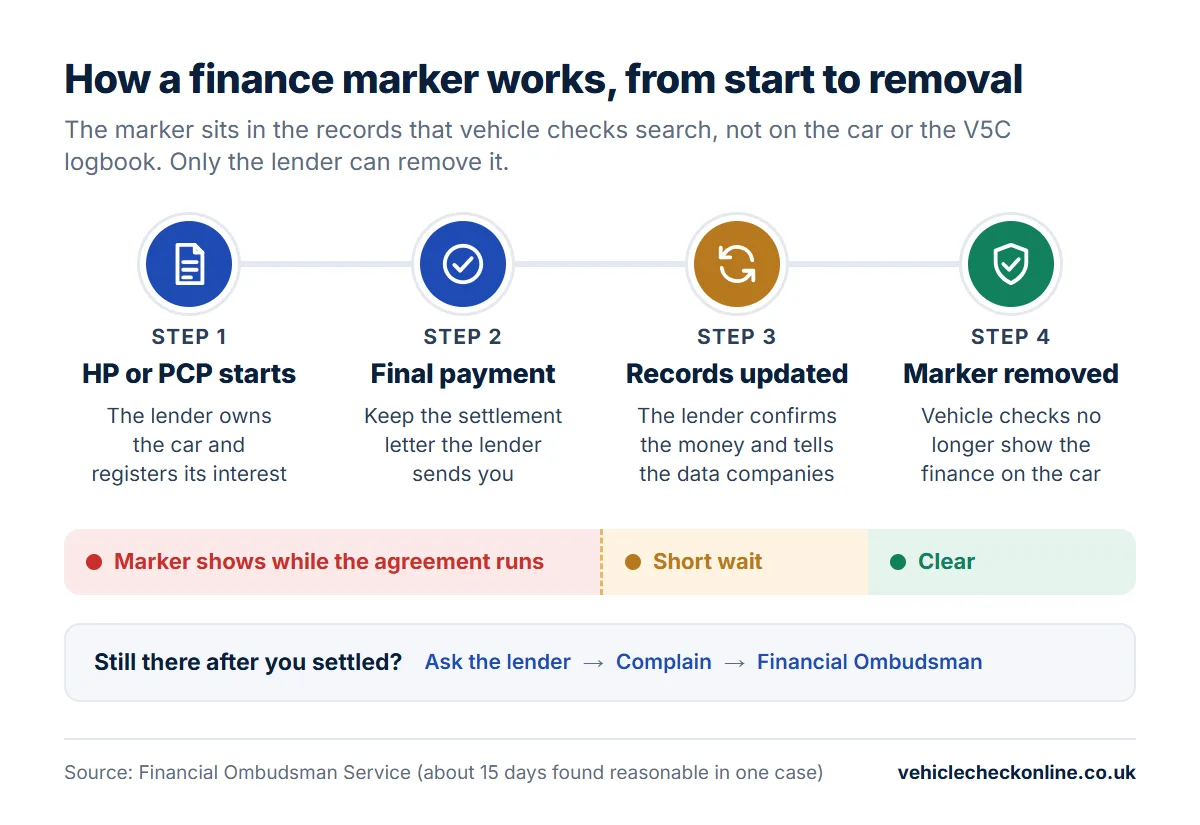
When you buy a car on hire purchase or PCP, the finance company buys the car and lets you use it while you pay. The Financial Ombudsman explains that the finance provider owns the car until the final payment is made. To protect its property, the lender registers its interest against the car.
That record is the marker. It usually names the lender and the type of agreement. It sits in the records of vehicle data companies, not on the car and not on the V5C logbook. The logbook names the registered keeper, the person responsible for the car, who is not always its owner.
So a seller can hand you a genuine logbook in their own name for a car that a finance company still owns. The only way to see the finance is to check the records.
Which kinds of finance are tied to the car?
The marker matters because some finance is tied to the car and some is not:
| Type of finance | Who owns the car while it is paid | What it means for a buyer |
|---|---|---|
| Hire purchase (HP) | The lender, until the final payment | The lender has an interest in the car itself |
| PCP | The lender, unless the final "balloon" payment is made | The Financial Ombudsman describes PCP as a type of hire purchase |
| Conditional sale | The lender, until the end of the agreement | Treated like hire purchase |
| Lease or contract hire | The leasing company, throughout | The car is never the driver's to sell |
| Personal loan | The borrower | Not secured on the car, so it does not follow the car |
| Logbook loan | The lender, under a bill of sale, until repaid | Can follow the car, with no protection for a buyer |
Logbook loans are the exception that worries people most. The Law Commission has said that bills of sale give no protection at all to people who unknowingly buy goods subject to them, and the government decided in 2018 not to change the law.
Why does a finance marker matter when you buy?
If the finance is still owed, the lender may try to take the car back from you. You would then have to claim your money from the seller, who may have spent it or disappeared.
There is some legal protection. Part III of the Hire Purchase Act 1964 can give good title to a private buyer who bought a car on hire purchase or conditional sale in good faith, without notice of the agreement. Our guide to buying a car with outstanding finance explains who it covers and who it does not.
The Act only protects a buyer who had no actual notice of the finance. If a check has shown you a marker and you buy anyway, you knew about it, and that protection is unlikely to help you.
What should you do if the car you want has a marker?
A marker does not have to end the deal. It means the finance must be paid off before, or as part of, the sale, and you need proof from the lender that it has been.
- Ask the seller which lender holds the finance and to get a settlement figure, the amount needed to pay it off. Under the Consumer Credit Act 1974, a lender must give the borrower one on request.
- Agree that the amount owed is paid straight to the lender, and only the rest to the seller. Never pay the seller in full on a promise to "clear it later".
- Get written confirmation from the lender that the agreement is settled and that it no longer has an interest in the car.
- Check that confirmation with the lender yourself, using contact details you find independently rather than ones on the letter.
- Only then pay the balance and take the car.
How to move the money safely is covered in our guide to the safest way to pay for a car privately.
If you are buying from a dealer, the finance should be cleared before the car is sold to you. Under the Consumer Rights Act 2015 a trader must have the right to sell the car, and it must be free from any charge you were not told about.
How is a finance marker removed after you pay off a car?
Only the lender can remove its marker. The check provider cannot, and neither can the DVLA, because the DVLA does not record finance.
Removal is not instant. In a published decision, the Financial Ombudsman said lenders do not have to remove a marker on the same day as the final payment: they need a short time to confirm the money has arrived, update their own systems and tell the data companies, which then update theirs. In that case, about 15 days was found reasonable.
Keep the settlement or completion letter the lender sends you. If you sell the car before the marker has cleared, that letter is what a careful buyer will ask to see.
What if the marker stays after you have settled?
- Contact the lender, give the agreement number and the date you settled, and ask it to remove its interest from the car.
- If that does not work, make a formal complaint to the lender and keep a copy.
- If the lender has not sent a final response within eight weeks, or you are unhappy with its answer, you can take the complaint to the Financial Ombudsman Service. It is free.
A marker that should have gone can cost you a sale or a part-exchange, so tell the lender if that has happened. The Ombudsman can look at the inconvenience caused, as well as the marker itself.
Can a finance marker be wrong or out of date?
Most markers are accurate. A marker can still show when it should not, for example:
- The agreement was settled recently and the records have not caught up yet.
- A dealer that once had the car left its own marker on it. In one case the Ombudsman looked at, a customer found two markers on his car, one from his lender and one from the dealership that supplied it.
- The lender made a mistake when it closed the agreement.
If you are the buyer, do not decide for yourself that a marker is out of date. Treat it as real until the lender named in it confirms in writing that nothing is owed.
How do you check a car for a finance marker?
Nothing on the car or the logbook shows finance, so the check has to search the records. Our outstanding finance check shows whether finance is recorded on the car, the finance company, the type of agreement, when it started and how long it runs. You get it in the Premium report (£7.99), together with the write-off and stolen checks.
Run it before you pay a deposit, and again shortly before you hand over the money if some time has passed. Finance can be taken out on a car at any time while the seller has it.
Questions and answers
Can I buy a car with a finance marker?
Yes, if the finance is settled before you take the car, ideally by paying the amount owed straight to the lender. Get written confirmation from the lender that nothing is owed before you pay the seller the rest.
Does a finance marker show on the V5C logbook?
No. The logbook names the registered keeper and says nothing about finance. A seller can have a genuine logbook in their name for a car that a lender still owns.
How long does it take for a finance marker to be removed?
There is no fixed time in the sources we checked. The Financial Ombudsman has said lenders need a short period after the final payment, and found about 15 days reasonable in one case.
Can the seller remove a finance marker themselves?
No. Only the lender can remove its interest, and it does so after the agreement is paid off. A seller who says the marker is wrong should be able to show you a letter from the lender.
Does a personal loan put a finance marker on a car?
No. An ordinary personal loan is not secured on the car, so it is not tied to it and does not pass to the next owner.
Sources
- Financial Ombudsman Service: Car finance
- Financial Ombudsman Service: decision DRN-6070833 (removal of a finance marker)
- legislation.gov.uk: Hire Purchase Act 1964, Part III
- Law Commission: Bills of sale
Related guides
- Buying a car with outstanding finance: what the law saysBuying a car with outstanding finance? What the Hire Purchase Act 1964 says about private buyers, who it does not protect, and what to do if the lender calls.
- What is the safest way to pay for a car privately?The safest way to pay for a car privately: bank transfer at handover, name checks, transfer limits, cash and banker's drafts, and what to do if finance is owed.
- Private car sale receipt: a free UK templateA free car sale receipt template for UK private sales: the wording to copy, what each line is for, the finance and write-off statements, and what to do next.
- What happens if you buy a car with a logbook loan on it?Buying a car with a logbook loan on it? What a logbook loan is, why the lender may take the car, whether you can check for a bill of sale, and what to ask.
- How does no deposit car finance work?No deposit car finance explained: HP, PCP and loans with nothing upfront, what a deposit changes, your rights and what to check before you sign for a used car.
This guide is general information for people buying, owning or selling a car in the UK, not legal or financial advice. Vehicle Check Online is an independent service, not affiliated with the DVLA, the DVSA or GOV.UK.