
Stolen and cloned cars
How to check if a car has been scrapped or exported
To check if a car is scrapped, look up its registration in a history check that shows scrapped and exported records. A car counts as scrapped once an authorised treatment facility has issued a certificate of destruction for it and told the DVLA, and as exported once its keeper has told the DVLA it is leaving the UK for 12 months or more. A car on sale with either record is a warning sign.
This guide explains what scrapping and exporting mean on a car's record, why a scrapped or exported identity on a car for sale can point to a stolen car, how to check both before you buy, and how to make sure a car you sent for scrap was really destroyed.
What happens when a car is scrapped?
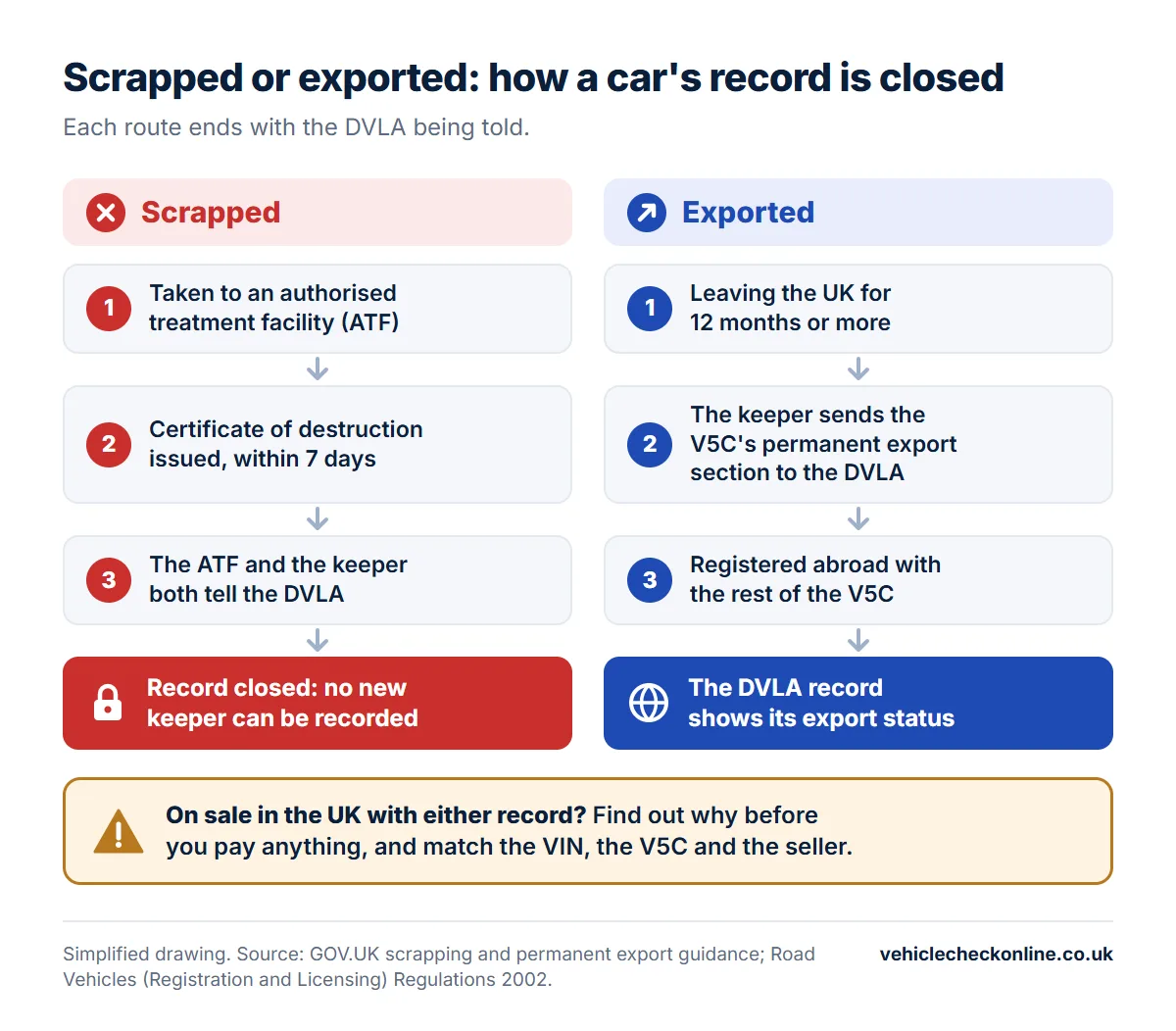
Scrapping has a precise meaning in the UK. GOV.UK says a vehicle that has reached the end of its usefulness must be scrapped at an authorised treatment facility (ATF), sometimes called a scrapyard or breaker's yard, and nowhere else. Each step leaves a record:
- The keeper hands over the car and its V5C logbook, keeping only the yellow section for selling to the motor trade.
- The ATF gives the keeper a certificate of destruction. GOV.UK says it comes within 7 days for a car, a light van or a three-wheeled motor vehicle, and the End-of-Life Vehicles Regulations 2003 say the ATF must not charge for it.
- The ATF tells the DVLA it has issued the certificate, as the Road Vehicles (Registration and Licensing) Regulations 2002 require.
- The keeper tells the DVLA as well, online with the 11-digit reference from the latest V5C, giving the scrapyard's name as the trader the car went to.
Once the DVLA has been told about a certificate of destruction, regulation 17A of those regulations says it must not record any further change of keeper for that vehicle, or accept a SORN for it. In effect, the car's identity is closed.
Not every car that reaches a scrapyard is destroyed, though. GOV.UK says an ATF can decide to repair and sell a car instead, and that no certificate of destruction is issued when it does. So a car sold to a scrapyard can come back on the road quite legitimately, without ever being recorded as scrapped.
Insurance write-offs go through a different process. GOV.UK says the insurer will usually deal with getting a written-off car scrapped, and the keeper tells the DVLA it has been written off. A Category A car must be crushed whole, and the body shell of a Category B car must be crushed, although other parts can be salvaged. A write-off check shows whether an insurer has recorded a car as written off, and in which category.
What does it mean when a car is exported?
GOV.UK says you must tell the DVLA if you take a vehicle out of the UK for 12 months or more, including to the Channel Islands, the Isle of Man or Ireland, and calls this permanent export. The keeper fills in the "permanent export" section of the V5C, sends it to the DVLA and keeps the rest of the logbook, which is needed to register the car in its new country. The 2002 regulations require the keeper to tell the DVLA immediately.
A trip abroad of less than 12 months is not an export. The car stays on the UK register, and GOV.UK says it must stay taxed in the UK, with a current MOT and UK insurance, while it is away.
A car can also have an export status before it has left. Under the Personal Export Scheme, someone who is leaving the UK can buy a car without paying UK VAT and use it here for a limited time, usually up to 6 months after delivery, before exporting it. HMRC's manual for the scheme says the dealer sends a copy of the application to the DVLA, and that new cars supplied this way usually get a registration number starting with X.
HMRC's VAT Notice 707 says a car bought under the scheme must not be sold, hired out, pledged as security or given away in the UK. If the conditions are broken, VAT becomes payable and the car may be liable to seizure, which makes it a car to avoid.
Scrapped, exported, written off or SORN?
These records are easy to confuse, but they mean very different things for a buyer:
| Record | What it means | Can it be used on UK roads? |
|---|---|---|
| Scrapped | An ATF has issued a certificate of destruction and the DVLA has been told | Not under that identity: no new keeper can be recorded |
| Exported | The keeper has told the DVLA it is leaving the UK for good | Only once it is brought back and registered again with the DVLA |
| Written off, Cat A or B | The insurer judged it beyond repair: Cat A is crushed whole, a Cat B body shell is crushed | Never |
| Written off, Cat S or N | Damaged, but judged repairable | Yes, once repaired to a roadworthy condition |
| SORN | The keeper has declared it is being kept off public roads | Yes, once it is taxed again |
Why is a scrapped or exported car for sale a warning sign?
A car recorded as scrapped should no longer exist. A car recorded as exported should be registered in another country, unless it has come back and been registered here again. So when either one turns up for sale in the UK, the first question is why. Our scrapped car check shows both markers for any registration, in the Premium report.
There may be an innocent answer, but the one to rule out first is a stolen car wearing another car's identity. When the Vehicles (Crime) Act 2001 was passed, its explanatory notes described vehicle cloning as using the identity of an existing or scrapped vehicle to disguise another. They also set out the motive: a criminal who gets hold of a cheap damaged or scrapped vehicle can move its identification plates to a similar stolen car, then sell that car to an unsuspecting buyer for much more. Our stolen car check page lists the other warning signs of a stolen car.
A scrapped identity suits this well, because the genuine car should not be on the road anywhere, so there is no twin to expose the copy. It also leaves the buyer with a car that cannot be put in their name, since the DVLA must not record a new keeper once a certificate of destruction has been recorded. Our guide on how to tell if a car is cloned shows how to match a car to its identity.
If a car for sale is recorded as scrapped, do not buy it, whatever the seller says. If it is recorded as exported, get a full explanation and check the V5C and the VIN before you pay anything.
How do you run a scrapped car check before you buy?
Do the first three checks before you travel, and the rest at the viewing:
- Ask the seller for the registration number and the VIN. Both are printed on the V5C, and a genuine seller has no reason to refuse.
- Check the export status for free. GOV.UK's vehicle enquiry service shows whether the DVLA has marked the car for export.
- Check the scrapped and exported records. Whether a certificate of destruction has been issued is not among the details GOV.UK lists for its free enquiry. Our car history check shows whether the car is recorded as scrapped or exported, in the Premium report (£7.99).
- Match the car to its paperwork. Find the VIN in more than one place on the car and compare every character with the V5C. Our VIN check guide explains how to read and compare it.
- Look hard at the logbook. GOV.UK tells a keeper who scraps a car to give the V5C to the ATF or destroy it, so a seller holding one for a car recorded as scrapped has some explaining to do. Our guide on how to check a V5C is genuine covers the watermark and the serial numbers.
- Ask the seller in writing whether the car has ever been scrapped, written off or exported, and keep the reply.
If any of these checks fails, leave without paying anything, including a deposit. The cloned car guide linked above explains what to keep and who to tell.
How do you check if a car has been exported?
The export status is the quick part. It shows on the DVLA's record by registration, which you can see free on GOV.UK. A car marked for export is not always a problem, but it always needs a reason. These are the explanations to ask about:
- It is about to leave the UK for good, and the keeper has already told the DVLA. Ask why it is being sold here instead.
- It was bought under the Personal Export Scheme, so it must not be sold in the UK at all.
- It went abroad and came back. GOV.UK says a car that was registered in the UK, exported and then reimported must be registered with the DVLA again, which gives it a registration number. Ask when that happened, and check the V5C against the record.
- Its identity is being used by another car, as described above.
If you are buying a car to take abroad yourself, the paperwork works differently. GOV.UK says the seller must give you the full V5C, not just the new keeper slip, because you need it to register the car in the other country.
Scrapped your own car? How can you check it was done properly?
Some people come to this from the other side: they sent a car for scrap and want to be sure it was destroyed and is no longer theirs. The certificate of destruction is the proof. GOV.UK warns that without it, you could still be liable for traffic offence penalties and vehicle tax on the car.
- Use an ATF. GOV.UK has a scrapyard finder, and points to separate lists for Scotland, Wales and Northern Ireland.
- Keep the certificate of destruction safe when it arrives.
- Tell the DVLA yourself. GOV.UK says you can be fined £1,000 if you do not, and that you should then get a letter confirming you are no longer the keeper.
- In England and Wales, expect to be paid by bank transfer or cheque: GOV.UK says a car scrapped there has to be paid for that way, not in cash, and our guide to scrap car value explains how the price is worked out.
If no certificate arrives, ask the ATF why. It may have chosen to repair and sell the car rather than scrap it, which GOV.UK says it can do, and then no certificate is issued. Either way, make sure the DVLA has heard from you that the car has gone.
Questions and answers
Can a scrapped car be put back on the road?
Not as the same car. Once the DVLA has been told that a certificate of destruction has been issued, the regulations say it must not record any further change of keeper for that vehicle, or accept a SORN for it.
Is a certificate of destruction free?
Yes. The End-of-Life Vehicles Regulations 2003 say an ATF must not charge the last owner for issuing it. Scrapping itself is usually free too, although GOV.UK says the ATF can charge a fee if essential parts such as the engine or gearbox have been removed.
Can I scrap a car without the V5C?
Yes, but you have to tell the DVLA another way. GOV.UK says to write to the DVLA with your name and address, the registration number, the make and model, the exact date, and the name and address of the scrapyard.
Does taking a car abroad for a few months count as exporting it?
No. Permanent export means taking it out of the UK for 12 months or more. For a shorter trip, GOV.UK says the car must stay taxed in the UK, with a current MOT and UK insurance.
Can I get cash for scrapping my car?
Not in England or Wales. GOV.UK says a vehicle scrapped there has to be paid for by bank transfer or cheque. Cash is allowed if the ATF repairs and sells the car instead of scrapping it.
What does marked for export mean on a car check?
It means the DVLA's record shows an export status for the car. That can follow a permanent export notice from the keeper or a tax-free purchase under the Personal Export Scheme, so ask the seller why before you go any further.
Sources
- GOV.UK: Scrapping your vehicle and insurance write-offs
- GOV.UK: Taking a vehicle out of the UK (permanent export)
- legislation.gov.uk: Road Vehicles (Registration and Licensing) Regulations 2002, regulation 17A
- legislation.gov.uk: Explanatory notes to the Vehicles (Crime) Act 2001 (cloning and ringing)
- GOV.UK: Personal Export Scheme (VAT Notice 707)
Related guides
- How to tell if a car is cloned before you buy itHow to tell if a car is cloned: match the VIN, the V5C logbook and the official record, and meet at the keeper's address. Step-by-step checks for buyers.
- How to check a V5C logbook is genuineHow to check a V5C is genuine: the DVL watermark, the serial number and the stolen V5C serial numbers, and the VIN and keeper details to match.
- VIN number check in the UK: what a VIN can and cannot tell youVIN number check in the UK: what a free VIN check shows, why history checks use the reg, how to find the VIN from a registration plate, and how to read it.
- How much will I get if I scrap my car?Scrap car value explained: what sets the price, how a quote is worked out, how and when you are paid, and what you hand over and get back when you scrap a car.
This guide is general information for people buying, owning or selling a car in the UK, not legal or financial advice. Vehicle Check Online is an independent service, not affiliated with the DVLA, the DVSA or GOV.UK.