
Selling your car
How much will I get if I scrap my car?
Your car's scrap value is what an authorised treatment facility (ATF) will pay for it as scrap, and there is no fixed price: it depends on the car's weight, what scrap metal is fetching, which parts can be reused and whether anything essential is missing. In England, Wales and Scotland you must be paid by bank transfer or cheque, not cash.
This guide covers what decides the price, how a quote works, the rules on payment and ID, checking a scrapyard, what changes hands, and cars with finance, write-offs and non-runners. For what happens to the car itself, see our guide on checking if a car is scrapped.
What is the scrap value of my car?
There is no official rate. GOV.UK says the ATF that takes your car pays you its scrap value, and each business sets its own offer, so quotes for the same car can differ. What you end up with comes from three places:
- The price for the car, paid by the ATF or scrap dealer.
- Less any fee for missing parts. Scrapping at an ATF is usually free, but GOV.UK says it can charge if essential parts such as the engine, gearbox, bodywork or wheels have been removed.
- Plus a tax refund from the DVLA for each full month of tax left. GOV.UK's free vehicle enquiry shows when your tax runs out.
A car worth nothing as scrap can still go for free. Car makers and importers must provide a network of ATFs that take back their brands, and since 1 January 2007 the End-of-Life Vehicles (Producer Responsibility) Regulations 2005 have barred any charge to the last owner of a car with no market value delivered to that network, unless essential parts are missing or waste has been added to it.
What decides a car's scrap value?
Each buyer works out its own offer, but these are the things that move it:
| What counts | Why it matters |
|---|---|
| Its weight | Scrap metal is traded by type and weight, which dealers in England and Wales must record for everything they take in. A heavier car has more metal to sell. |
| Scrap metal prices | They move with the market, so ask how long a quote stands. |
| Parts that can be reused | Motor salvage businesses recover parts to reuse or sell before scrapping the rest, so a car with parts in demand can be worth more to them. |
| Missing parts | Missing essential parts, including a catalytic converter the car was built with, can bring a fee from the ATF and lose free take-back. |
| Collection | Fetching a car that does not run takes time and transport. Ask whether collection is included. |
| Whether it could be driven again | GOV.UK says an ATF can repair and sell a car instead of scrapping it, so a car still worth something as a car may fetch more. |
How is a scrap car quote worked out?
A quote given before anyone has seen the car is based on what you tell the business, so describe it accurately: whether it starts and rolls, any damage or missing parts, and where it is parked. Then ask:
- Is collection included, and are there other fees?
- How long does the price stand, and on what grounds could it change at collection?
- When and how will I be paid?
- Which business will take the car, and is it an ATF that will issue a certificate of destruction?
- What licence or permit does it hold, so I can check it?
If the offer drops on the day for a reason you were not told about, you do not have to accept it. A business buying your car is a trader dealing with a consumer, and the Digital Markets, Competition and Consumers Act 2024 bans misleading and aggressive practices, such as harassment or undue influence; ignoring your request to leave your home is banned outright. Agree the final price in writing before the car is loaded.
How and when are you paid for a scrap car?
How you can be paid depends on where the car is scrapped:
| Where | How you can be paid | The law |
|---|---|---|
| England and Wales | By a cheque that cannot be transferred, or by electronic transfer. Paying cash is an offence. | Scrap Metal Dealers Act 2013, section 12 |
| Scotland | Since 1 September 2016, by a cheque that cannot be transferred, or by transfer to a bank or building society account in your name. | Civic Government (Scotland) Act 1982, section 33A |
| Northern Ireland | Neither law extends here, but a bank transfer still records who paid you, how much and when. | The 2013 Act covers England and Wales; the 1982 Act, Scotland only |
The rules come with identity checks. In England and Wales, the dealer must verify your full name and address before it takes the car, using documents set by regulations: photo ID showing your address, such as a photocard driving licence, or photo ID such as a passport plus a bank statement, council tax bill or utility bill (not a mobile phone bill) issued in the last three months. It keeps a copy, with the payment record, for three years. In Scotland, dealers must record your name and address and how they checked them.
Agree when you will be paid before the car goes, in writing. There is one exception to the cash rules: if the ATF decides to repair and sell your car instead of scrapping it, GOV.UK says you can be paid by any method, including cash, and you will not get a certificate of destruction. A car sold on that way should not show as scrapped in a scrapped car check.
How do you check a scrapyard is licensed?
GOV.UK says it is illegal to scrap a vehicle anywhere other than an ATF. Each part of the UK keeps a free public list of them:
| Where the car is | Where to check the ATF |
|---|---|
| England | The Environment Agency's public registers: the end-of-life vehicles (ATF) register |
| Wales | Natural Resources Wales: the end-of-life vehicle treatment facilities register |
| Scotland | SEPA: its register of authorised ATFs |
| Northern Ireland | DAERA: its ATF public register, updated monthly |
GOV.UK's "Find a vehicle scrapyard" searches England and links to the other three lists. ATFs work under an environmental permit in England and Wales, an authorisation from SEPA in Scotland and a waste management licence in Northern Ireland.
Whoever pays you needs a licence too. In England and Wales, a business buying scrap metal, motor salvage included, needs a scrap metal licence from the council, shown on the registers of the Environment Agency and Natural Resources Wales and displayed at its sites, or on its vehicle if it collects door to door. In Scotland, metal dealers need a licence under the 1982 Act.
What do you hand over, and what should you get back?
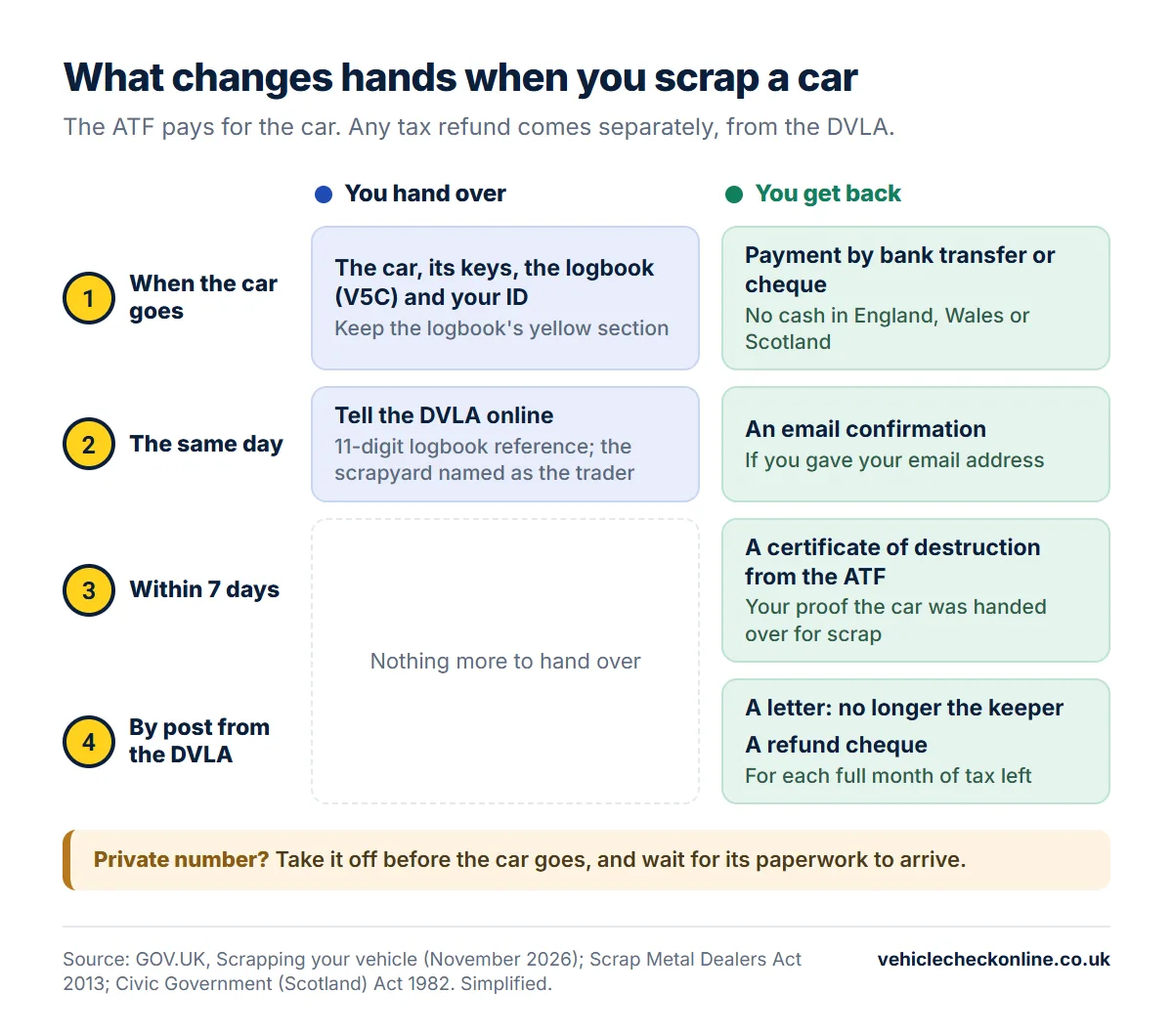
Before the car goes, take off any private number you want to keep: GOV.UK says the V778 retention document and the new logbook must reach you before you scrap the car, or you lose the number. It costs £80, and among other conditions the car must be able to move under its own power, so apply while it still runs.
| You hand over | You get back |
|---|---|
| The car and its keys | Payment, by transfer or cheque in Great Britain |
| The logbook (V5C), keeping its yellow section | A certificate of destruction from the ATF, within 7 days for a car |
| Your ID | A letter from the DVLA confirming you are no longer the keeper |
| The logbook reference, to the DVLA online | A refund cheque for each full month of tax left |
Tell the DVLA online the day the car goes, with the 11-digit reference from the latest logbook, naming the scrapyard as the trader even if it paid you nothing. You can be fined £1,000 if you do not, and the refund counts from the date the DVLA gets your information. Then cancel your insurance. If the certificate of destruction never arrives, our guide on how to check a car was scrapped explains what to do.
Can you scrap a car with finance on it, or one that is not yours?
Not without the owner's agreement. On hire purchase the lender owns the car until you have paid in full, and Citizens Advice says that while you are still paying you are not allowed to sell or dispose of the goods without the lender's permission, and that doing so is a criminal offence. With PCP, a lease or a logbook loan, read your agreement and ask the lender first.
In practice, ask the lender for a settlement figure, which it must send within 7 working days, and clear the agreement first or agree how the scrap money will be used. Scrapping the car does not clear what you owe. Our guide to selling a car with outstanding finance explains settlement figures.
Not sure an earlier owner's finance was cleared? An outstanding finance check shows any agreement recorded against the car, in the Premium report (£7.99).
- The keeper has died. GOV.UK's "Telling DVLA after someone dies" explains what to send the DVLA when the car is sold or kept, and says to deal with any private number before it is sold.
- Someone has abandoned a car on your land. It is not yours to scrap. Report it to the council: GOV.UK says councils must remove abandoned vehicles from land in the open air, including private land, without charging the landowner, after giving 15 days' notice.
What if your insurer writes the car off?
Then you are not selling it for scrap at all. GOV.UK says the insurer pays you the current value of the car instead of the cost of repairing it, and will usually deal with getting it scrapped. Check that payout against the car's market value, not a scrap price: our car valuation guide explains how insurers value a written-off car and how to challenge a low offer.
- Send the logbook to the insurer, keeping the yellow section, and tell the DVLA the car has been written off, giving the insurer's name as the trader: GOV.UK treats it as a sale to the insurer.
- Take off any private number first.
- If you want to keep a Cat N or Cat S car, the insurer gives you a payout and sells the car back to you. Category A and B cars cannot be repaired.
Could your car be worth more for parts or as a non-runner?
Possibly, if someone values it more than a scrapyard does. Compare a scrap price with what a car valuation check says the car is worth, and with these options:
- Sell it whole, as a non-runner or for spares or repair, to a private buyer or a trader who can fix or strip it. Say plainly that it is not roadworthy: in Great Britain, section 75 of the Road Traffic Act 1988 makes selling an unroadworthy vehicle an offence, unless, for example, you have reasonable cause to believe it will not be used on a road until it is put right.
- Take parts off yourself. GOV.UK allows this to repair another vehicle you own, if the car has a SORN, is kept off the road and no oil or fluids get into the ground or drains. Remove an essential part, though, and the ATF can charge when it takes the rest.
- Ask the ATF. It can repair and sell a car rather than scrap it, which is worth asking about if the car still runs.
A car that still drives and has some MOT left may be worth more sold as a car than as metal. Our guide to the quickest ways to sell a car compares the routes and what each one costs you.
Questions and answers
Do I have to pay to scrap my car?
Usually not. GOV.UK says scrapping at an ATF is usually free, and car makers must offer free take-back of their brands through a network of ATFs. An ATF can charge a fee if essential parts such as the engine, gearbox, bodywork or wheels have been removed.
Is the tax refund part of the scrap price?
No. The scrapyard pays you for the car, and the DVLA refunds any full months of tax separately once you tell it the car has gone, by cheque to the name and address on the logbook.
Can a scrapyard lower its price when it collects the car?
It may, if the car is not as you described it, so ask beforehand whether and why the quote could change. You do not have to accept a lower offer, and a trader must not mislead you or pressure you into taking it.
What ID do I need to scrap my car?
In England and Wales, photo ID that shows your address, such as a photocard driving licence, or photo ID such as a passport with a bank statement, council tax bill or utility bill issued in the last three months. A mobile phone bill does not count.
Should I scrap a car that has failed its MOT?
Not automatically. Compare a scrap quote with the cost of the repairs and what the car would be worth once fixed. If the repair is small, selling the car as it is, or repairing it first, may get you more than its scrap value.
Sources
- GOV.UK: Scrapping your vehicle and insurance write-offs
- legislation.gov.uk: Scrap Metal Dealers Act 2013
- legislation.gov.uk: Civic Government (Scotland) Act 1982, section 33A (payment for metal)
- legislation.gov.uk: End-of-Life Vehicles (Producer Responsibility) Regulations 2005, regulation 10
- GOV.UK: Find a vehicle scrapyard (with the lists for Scotland, Wales and Northern Ireland)
- Citizens Advice: Hire purchase and conditional sale
Related guides
- How to check if a car has been scrapped or exportedHow to check if a car is scrapped or exported: what a certificate of destruction and the DVLA record mean, why it matters, and the checks before you pay.
- Do you get a tax refund when you sell your car?Car tax refund when selling: how to cancel your tax, a worked example of the months you get back, how long the cheque takes and what to do if it never comes.
- Can I sell my car with finance on it?How to sell a car with outstanding finance: why the lender is paid first, how to get a settlement figure, selling to a dealer or privately, and handing it back.
- What is the quickest way to sell a car?Sell my car fast: how long each route takes, what slows a sale down, the price you give up for speed, and how to stay safe with a buyer in a hurry.
This guide is general information for people buying, owning or selling a car in the UK, not legal or financial advice. Vehicle Check Online is an independent service, not affiliated with the DVLA, the DVSA or GOV.UK.