
MOT, servicing and condition
MOT checklist: what is checked in an MOT and how to prepare
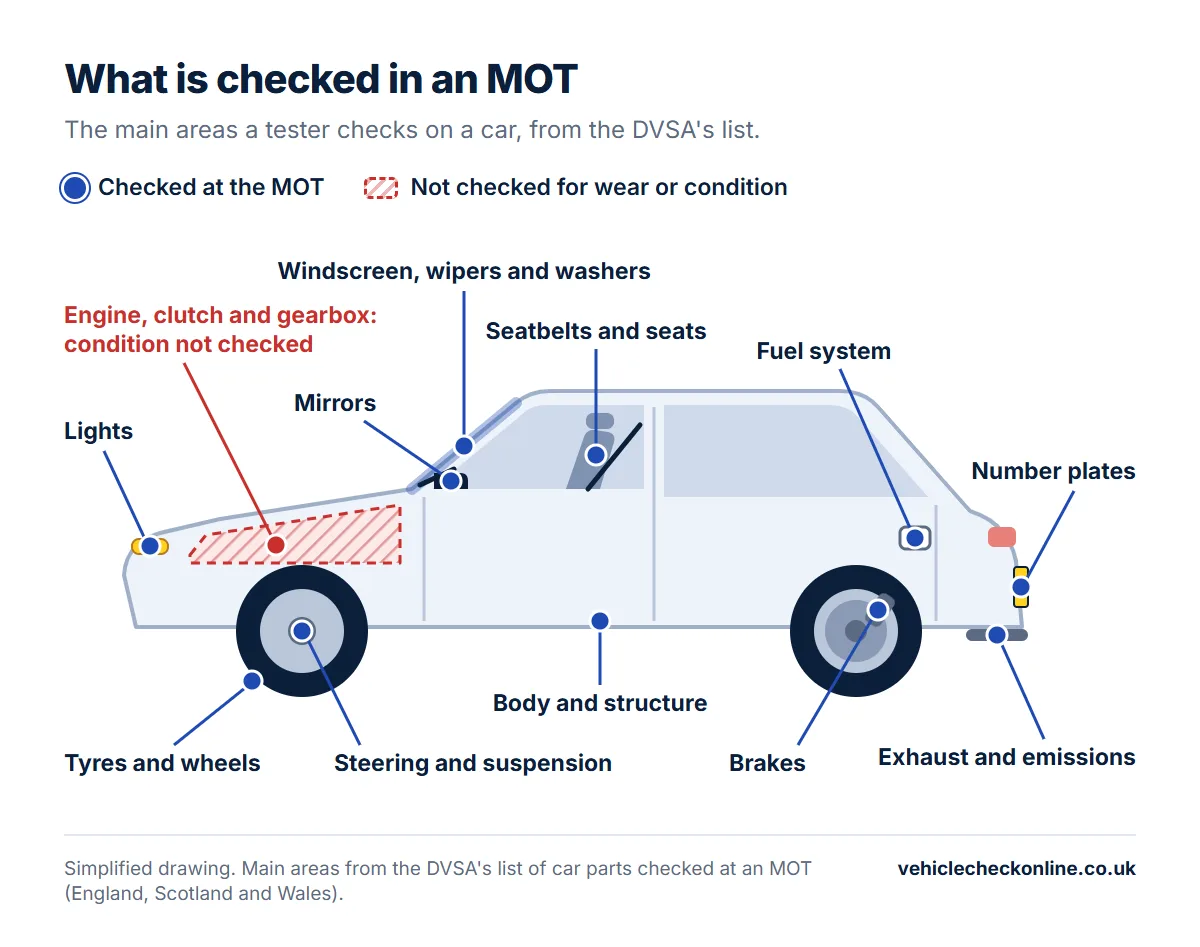
The MOT checklist for a car covers the parts that keep it safe and within emission limits: lights, brakes, tyres and wheels, steering and suspension, seatbelts and seats, the windscreen, wipers and mirrors, the exhaust and fuel system, number plates and the body structure. The test does not look at the condition of the engine, clutch or gearbox.
This guide sets out what is checked in an MOT, area by area, from the DVSA's own list, then what the test leaves out, the pre-MOT checks you can do at home, what can stop a test going ahead, what it costs and what happens after a fail. It covers England, Scotland and Wales; Northern Ireland runs its own MOT system through the Driver and Vehicle Agency (DVA).
What is checked in an MOT?
The MOT checks that a car meets road safety and environmental standards. The DVSA publishes a list of the main parts checked at a car MOT, and its inspection manual sets out how the tester examines each one and what makes it fail. In short, these are the areas the tester works through:
| Area | What the tester checks |
|---|---|
| Lights | Every lamp works and is in good condition, including LED and HID lamps, plus the headlamp aim and the main beam warning light |
| Brakes | Their condition, how well they work in an efficiency test, the ABS and stability control where fitted, and the brake warning lights |
| Tyres and wheels | Condition, security, size and type, and tread depth; on cars first used from 1 January 2012, the tyre pressure warning light |
| Steering and suspension | Condition, how they work, the power steering fluid level, the steering lock, and unsafe repairs or modifications |
| Seatbelts and seats | Every belt the car must have is fitted, secure and working; the warning lights for the airbags and belt pretensioners; secure seats and a driver's seat that adjusts |
| Windscreen, wipers and mirrors | Damage that affects the driver's view, wipers and washers that clear the screen, and enough mirrors, secure and in good condition |
| Exhaust and emissions | A secure, complete exhaust without serious leaks or too much noise, the catalyst if one was fitted as standard, and emissions for the car's age and fuel |
| Fuel system | No leaks, secure pipes and hoses, and a fuel cap that fastens and seals |
| Body and structure | No excessive corrosion or damage in specific areas, no sharp edges, and doors, bonnet and boot that close and latch properly |
| Number plates and VIN | Plates that are secure, in good condition and the right colour, with characters correctly formed and spaced; one VIN shown on cars first used from 1 August 1980 |
| Horn, electrics and towbar | A horn that works and suits the car, the visible wiring and the battery, and a towbar's condition and electrical socket |
The tester also checks that the speedometer works and that the engine mountings are secure. The wheels and trims are not taken off for the brake test.
What does the MOT not check?
The DVSA is plain that an MOT is not a service and does not check a car's general mechanical condition. The engine, clutch and gearbox come into the test only through things like emissions, leaks and secure mountings, never for how worn they are, so a car can pass with a slipping clutch or an engine that needs work.
Some parts are not inspected at all: the spare wheel and tyre are left out. Nor does an MOT tell you anything about the car's past, such as how it was serviced, how many keepers it has had or whether it has been written off. Those records sit elsewhere, and a car history check searches them by registration.
And a pass describes the car on the day of the test only: parts keep wearing, and the car must stay roadworthy until the next one.
Buying a car with a fresh MOT? Treat it as one check among several: test-drive the car, ask for the service history and read its MOT record too.
What pre-MOT checks can you do at home?
Some of the faults that fail an MOT are easy to spot yourself, such as a blown bulb, a worn wiper blade or an empty washer bottle. Go round the car a few days before the test, so there is time to put right what you find:
- Lights. Switch on each lamp in turn and walk round the car: headlamps on dipped and main beam, side lights, indicators, hazard warning lights, fog lamps, reversing lamps and the number plate light. Ask someone to press the brake pedal while you watch the brake lights.
- Tyres. The legal minimum tread for a car is 1.6mm, measured across the central three-quarters of the tread and all the way round. Look for cuts, lumps and bulges, and check that the two tyres on each axle are the same size.
- Wipers and washers. Run the wipers with the washers on. The blades must clear the screen, and the washers must give enough fluid to clear it, so an empty washer bottle can fail the test.
- Windscreen. Damage can fail if it affects your view of the road: anything over 10mm across in the strip 290mm wide centred on the steering wheel, or over 40mm elsewhere in the area the wipers sweep.
- A clear view. Take down stickers, mounts and anything else that seriously blocks your view through the area the wipers clear.
- Mirrors and horn. Check that each mirror is there, secure and undamaged, and give the horn a press.
- Warning lights. Start the engine and look at the dashboard. On a petrol car first used from 1 July 2003, or a diesel first used from 1 July 2008, an engine warning light that stays on fails the test. The lights for the airbags, ABS, stability control and power steering are checked too.
- Seatbelts and seats. Pull each belt all the way out, let it wind back, and make sure it locks into its buckle. Check that the seats are firmly fixed and the driver's seat adjusts.
- Number plates. Clean them and make sure they are secure, undamaged and easy to read.
- Doors, bonnet, boot and fuel cap. Each should open and close properly from where it is meant to: the front doors from inside and outside, the rear doors from outside.
- Fluids. Check that the brake fluid is between its minimum and maximum marks, fill the washer bottle, and make sure there is enough fuel and engine oil for the test.
Our guide to the most common MOT failures shows which of these areas fail most often in the DVSA's figures.
What can stop the MOT going ahead?
A tester can refuse to test a car that is not ready for it. The DVSA's guide for test centres lists the grounds, and these are the ones a driver can avoid:
- the car, or any part of it, is so dirty that examining it is unreasonably difficult;
- it cannot be driven as the test needs, because it is short of fuel or oil or for another reason;
- a load or loose items, such as a full boot, would get in the way of a proper test, unless they are secured or removed;
- a door, the tailgate, the boot lid, the bonnet or the fuel cap cannot be opened;
- the car gives out a lot of smoke that could have been avoided;
- the test centre asks for the fee in advance and it is not paid.
The tester can also ask for the V5C logbook, or other proof of when the car was first used, if the test needs that information. Taking the logbook, and the key for a locking fuel cap, saves a wasted trip.
How much does an MOT cost?
There is a maximum fee that MOT test centres can charge. For a car with up to 8 passenger seats it is £54.85, and no VAT is added. It is a cap rather than a fixed price, so ask what the test centre charges when you book.
A retest after a fail can cost nothing. If you leave the car at the test centre for repair and it is retested within 10 working days, the partial retest is free. If you take it away and bring it back to the same centre before the end of the next working day, a partial retest of simpler items is free too: among them the lamps, mirrors, windscreen, wipers and washers, tyres, seatbelts, horn and number plates.
For other repairs done away from the centre, bringing the car back within 10 working days means a partial retest, for which the centre can charge a fee. In every other case, the car needs a full retest at the full fee.
What happens if the car fails?
The tester grades each problem found. The car fails if the result lists any dangerous or major problem; minor problems and advisories are recorded on a pass, for you to monitor or fix. Our guide to MOT advisories explains each grade and the standard wording testers use.
Whether you can drive away after a fail depends on two things: the car's current MOT must still be valid, and no dangerous problem can be on the list. Otherwise it must be repaired before you drive it. GOV.UK warns that driving a car that failed with a dangerous problem can lead to a fine of up to £2,500, a driving ban and 3 penalty points.
Every result, pass or fail, goes into the MOT database. A fail therefore stays in the car's MOT history, where any future buyer can see it next to the repairs and the retest that followed.
How can you read a car's past MOT results free?
Because every result is recorded, you can read a car's past tests before its next one, or before you buy it. Enter the registration in our free MOT history check to see each test with its result, failures, advisories and mileage, and the outstanding safety recall status reported by the DVSA.
Read the last two tests as your own checklist. The advisories name parts that were already wearing, and items that failed before, such as tyres or brake pads, can come round again as they wear. Our guide on what to look for in MOT history explains how to read the whole record.
If you are buying, our car buying checklist is made for one car from its MOT history, with a full inspection and test-drive guide, and is sent by email as a PDF.
Questions and answers
Is the spare wheel checked in an MOT?
No. Only the tyres fitted to the road wheels are inspected. A tester who notices a problem with the spare may point it out to you, but it cannot make the car fail.
Can I watch my car being tested?
Yes. You can watch the MOT from a viewing area at the test centre, but you are not allowed to interrupt the tester.
How do I know a garage can do MOTs?
Only approved MOT test centres can carry out the test, and they show a blue sign with 3 white triangles. Look for it before you book.
Can someone else take my car for its MOT?
Yes, as long as they are insured to drive it. Some test centres will also collect the car, test it and bring it back, so ask when you book.
Is there anything special about an MOT for a diesel?
The DVSA advises taking a diesel to the test with the engine fully warmed up, because it produces less smoke and is safer to test. Tell the tester at the start if you think the smoke test could damage the engine: they will refuse to test it if they think so.
When does a new car need its first MOT?
In England, Scotland and Wales, by the third anniversary of its registration, then by the anniversary of its last MOT each year. In Northern Ireland, cars are first tested at four years old.
Sources
- GOV.UK (DVSA): Car parts checked at an MOT
- GOV.UK: Getting an MOT (the test, fees, results and retests)
- GOV.UK (DVSA): MOT inspection manual for cars and passenger vehicles
- GOV.UK (DVSA): MOT testing guide, Appendix 3: grounds for refusal
- nidirect: How the MOT scheme works (Northern Ireland)
Related guides
- MOT advisories explained: what an advisory means and what to doWhat an MOT advisory means, how it differs from minor, major and dangerous defects, whether you can drive with advisories, and the advisory wording decoded.
- The most common MOT failures, and why cars fail their MOTThe most common MOT failures in DVSA's latest data: lights, suspension, tyres, brakes and visibility, plus fail rates by car and age and how to avoid a fail.
- When is my MOT due? How to check the date and the rulesFind your MOT due date in seconds, see when a new or imported car needs its first MOT, and how early you can MOT a car and keep the same date.
- What to look for in a car's MOT historyWhat to look for in MOT history before you buy: repeated advisories, corrosion, gaps, mileage drops and fails, and which entries are red flags or harmless.
- How old are your tyres, and is the tread legal?How to check tyre age from the sidewall date code, the legal tyre tread depth in the UK and the penalty, and what to look for on a used car's tyres.
This guide is general information for people buying, owning or selling a car in the UK, not legal or financial advice. Vehicle Check Online is an independent service, not affiliated with the DVLA, the DVSA or GOV.UK.