
Common problems by car model
Volkswagen Polo common problems found at the MOT
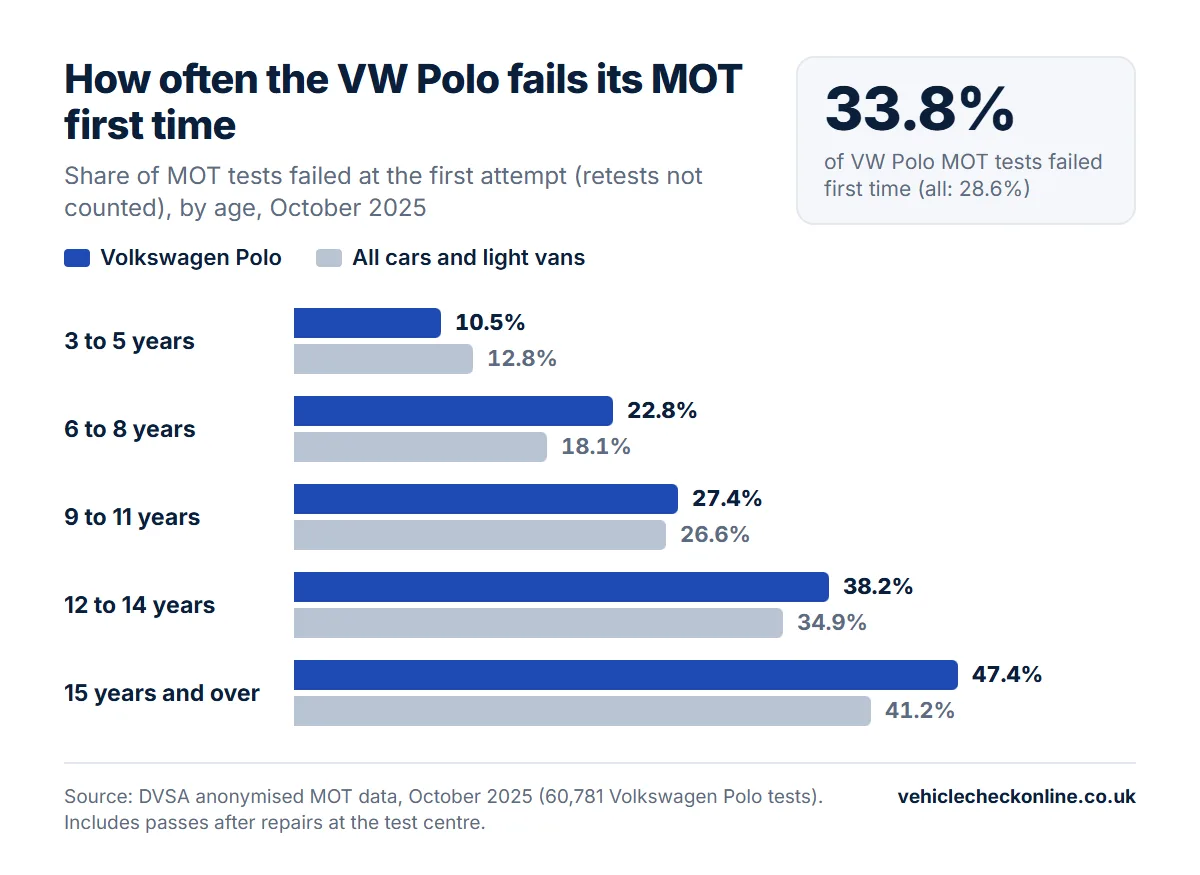
VW Polo common problems, judged by MOT results, are headlamp aim, worn suspension bushes, split covers on steering and drive shaft joints, worn tyres, and washers and lamps that do not work. In the DVSA's October 2025 data, 33.8% of Polos failed first time against 28.6% of all cars and light vans: young Polos did better than average, but from six years old they failed more often in every age band.

The figures describe what MOT testers recorded, which is the state of parts that wear, not breakdowns or build quality. This guide covers the Polo's fail rate by age, its low mileage, the failures and advisories at the top of its list, and what to look at when you are buying a used VW Polo.
How often does a VW Polo fail its MOT?
The numbers come from our analysis of the DVSA's anonymised MOT data for tests in October 2025, in which Polos had 60,781 tests. Each one is the car's first go at that MOT: retests do not count, while a Polo that needed faults fixing at the test centre before it passed is treated as a fail. Trims that the data names separately, such as Polo Life and Polo Match, are included. The method, with a table comparing 14 models, is in our explanation of how we worked these figures out.
The Polo's record changes with age. At three to five years it beat the average, 10.5% against 12.8%, but from six years old it failed more often in every band. The change came early: 22.8% of Polos aged 6 to 8 failed, where the all-car figure was 18.1%, and at 15 years and over the gap was wider still, 47.4% against 41.2%.
In between, the Polo was close to average at 9 to 11 years (27.4% against 26.6%) and above it at 12 to 14 (38.2% against 34.9%). The commonest years of first registration among the Polos tested were 2016, 2015 and 2014.
Does low mileage mean fewer Polo MOT fails?
Polos are driven less than the average car. At each age, the Polos tested showed a lower average reading than the national figure:
| Age at the test | Polo average mileage | National average |
|---|---|---|
| 3 to 5 years | 30,018 | 38,187 |
| 6 to 8 years | 45,357 | 55,582 |
| 9 to 11 years | 64,177 | 76,786 |
| 12 to 14 years | 80,165 | 93,592 |
| 15 years and over | 93,640 | 108,155 |
Yet Polos aged six and over still failed more often than the average for their age. On this data a low reading does not by itself promise an easy MOT, so judge the car on its test history rather than the number on the clock.
Petrol Polos made up 92.7% of those tested, and diesels 7.3%.
What are the most common VW Polo MOT failures?
Headlamp aim heads the Polo's list, ahead of worn suspension pins and bushes. Each share is of all the failure items recorded on Polos that month, faults put right at the test centre during the test included, and a single test can have several.
| DVSA failure item, shortened | Share of Polo failure items | What the tester found |
|---|---|---|
| Headlamp aim outside the limits | 6.9% | A headlamp pointing outside the permitted area |
| Suspension pin, bush or joint excessively worn | 5.2% | Excessive wear or play in a suspension pivot |
| Track rod end dust cover missing or not keeping dirt out | 4.0% | The cover on a steering ball joint split or missing |
| Tyre tread depth too low | 3.7% | Under 1.6mm at any point in the central three-quarters |
| Windscreen washers not working or not clearing the screen | 3.5% | Too little fluid, or none, for the wipers to clear the glass |
| Position lamp missing or not working | 3.5% | A front or rear position lamp not lighting |
| Coil spring fractured or seriously weakened | 3.1% | A spring that has snapped, or is badly weakened |
| Tyre seriously damaged | 3.0% | A cut that reaches the cords, or a lump, bulge or tear |
| Transmission shaft CV joint boot missing or not keeping dirt out | 2.9% | A split, missing or insecure boot on a drive or prop shaft joint |
| Anti-roll bar link joint cover missing or not keeping dirt out | 2.8% | A suspension joint cover no longer doing its job |
| Headlamp missing or not working | 2.7% | A headlamp out, or more than half of an LED one |
| Shock absorber not working or leaking badly | 2.5% | Severe leakage, or damage that stops it working |
Three of the twelve are lamps, and three more are covers that keep dirt out of joints: on the steering, on the transmission shafts and on the anti-roll bar links.
Why do split covers on steering and suspension joints fail the MOT?
Several joints under a car sit inside flexible covers, and the MOT fails any cover that has stopped protecting its joint from dirt. The inspection manual treats the three on the Polo's list in a similar way:
- Track rod end covers (4.0%). A track rod end is a ball joint in the steering linkage. The steering section of the manual fails a ball joint dust cover or rack gaiter that is missing or has stopped keeping dirt out, and records one that is only damaged or deteriorated as a minor defect.
- Anti-roll bar link joint covers (2.8%). In the suspension, the manual counts a missing joint dust cover, or one that has stopped keeping dirt out, as a major defect, and a severely deteriorated one as a minor defect.
- CV joint boots (2.9%). On drive shafts and prop shafts, the manual fails a constant velocity joint boot that is missing, split or insecure and so lets dirt in; if it is only severely deteriorated, it is a minor defect.
A minor defect does not fail the car, but it is listed on the result for the next owner to see. A cover recorded as deteriorated at the last MOT has passed, and it can become a fail at the next one.
Does steering cause more Polo MOT failures than average?
Steering accounts for 5.5% of Polo failure items, compared with a national 3.7%, and most of that is the track rod end covers above.
Look for a warning sign in the advisories as well. "Play in steering rack inner joint(s)" is one of the DVSA's standard advisory notes, and the manual fails a steering ball joint that has excessive wear or free play, so a Polo with that advisory in its history is worth having checked before you buy.
How often do lights, washers, brakes and the exhaust fail on a Polo?
Lights, reflectors and electrics are the Polo's largest area, 23.9% of its failure items, close to the 24.9% for all cars and light vans. Headlamp aim alone accounts for 6.9%, with position lamps at 3.5% and headlamps missing or not working at 2.7%. A position lamp fails if it is missing or does not work, or if more than half of a lamp with several light sources is out.
To check the aim, the tester lines up headlamp aim testing equipment with the car. On a European-type lamp, the horizontal cut-off along the top of the dipped beam has to fall between two lines just below the horizontal; a beam set too high can dazzle other drivers. The tester may make minor adjustments to the aim during the test, but not repairs, and an aim fault corrected that way is still counted in these figures.
Windscreen washers came fifth, at 3.5%. The manual requires them to deliver enough fluid for the wipers to clear the windscreen, so washers that do not work, or squirt too little, are a major defect.
Brakes take 16.0% of Polo failure items, a little above the national 14.8%, although no single brake fault made the Polo's top twelve. Noise, emissions and leaks are 7.8%, against 5.9% nationally. At the advisory stage, oil leaks "leak, but not excessive" (3.4%) and exhausts with "a minor leak of exhaust gases" (3.3%) are worth tracing before they grow.
Which VW Polo MOT advisories should you watch?
Tyres lead the Polo's advisories, even though tyres are a smaller share of its failure items (9.7%, against 12.6% nationally). Tread "worn close to legal limit/worn on edge" is 18.6% of all Polo advisories, and "slightly damaged/cracking or perishing" 11.0%. The rest of the top of the list:
- Suspension pins and bushes "pin or bush worn but not resulting in excessive movement": 9.4%, the third most common Polo advisory and the early stage of the second item on its failure list.
- Brake discs "worn, pitted or scored, but not seriously weakened": 8.4%. A disc fails only once it is significantly and obviously worn.
- Shock absorbers "has light misting of oil": 5.3%. Light seepage passes the test; severe leakage, or a damper that has stopped working, fails.
- Brake pads "wearing thin": 3.8%. Pads fail at the wear indicator, and below 1.5mm the manual grades them dangerous.
- Coil springs "corroded": 3.7%, the advisory that can come before a spring seriously weakened by rust.
What should you check when buying a used VW Polo?
Before the viewing, pull up the car's free MOT history and list every advisory and fail from the last few years. On a Polo, pay most attention to:
- Joints and covers: fails or advisories for suspension bushes, track rod ends, anti-roll bar links or CV boots, and any note of play in the steering rack inner joints.
- The steering on the drive: a knock, a wander or a loose feel can point to worn joints and deserves a mechanic's opinion.
- Tyres: all four, including the inner edges, for tread and for cracks or cuts in the sidewalls.
- Lights, washers and the parking brake: every lamp working, washer jets that wet the screen, and a handbrake strong enough to hold the car on a hill.
- The mileage trail: low readings are normal for a Polo, but they should rise steadily from one test to the next, which our free mileage check shows at a glance.
For everything else at the viewing, work through our used car checklist.
Our test drive checklist covers the noises and the steering feel to notice on the road.
How do you check for recalls on a VW Polo?
Safety recalls are checked separately from the MOT. The car's recall status, as the DVSA reports it, appears on our free MOT history page, while GOV.UK's recall service searches by registration number. Recall repairs are carried out by the manufacturer, and GOV.UK's guidance is that you will not usually be charged for them, so an outstanding recall is worth having done before or soon after you buy.
Is a used VW Polo a good buy?
On MOT results, a young Polo does better than average, but from six years old Polos failed more often than the average car of their age, while covering fewer miles. The items at the top of its list are lamps and washers, and wear on joints, covers and tyres; that kind of wear can show in the MOT history as advisories before it becomes a fail.
An MOT pass also says nothing about the engine, clutch or gearbox, whose condition the test does not cover, so look at the service record and drive the car before you decide.
For an older Polo, budget for the suspension and steering joints unless invoices show they have been done, and think twice about one whose advisories have been carried from test to test without repair.
Outstanding finance, a write-off and a stolen record sit in other databases, not in the MOT history; our car history check searches them by registration in the Premium report, £7.99.
Questions and answers
What fails most on a VW Polo MOT?
Headlamp aim outside the limits, at 6.9% of all failure items on Polos in October 2025, including aim corrected at the test centre during the test. Worn suspension pins and bushes (5.2%) and missing or split covers on track rod ends (4.0%) came next.
Do VW Polos fail their MOT more than other cars?
Young ones do not: at three to five years, 10.5% of Polos failed, compared with 12.8% across all cars and light vans. Polos aged six or more failed more often than average in every band, most of all at 15 years and over.
What does play in steering rack inner joints mean?
An advisory: the tester found a little movement in the steering rack's inner joints, not enough to fail. A steering ball joint with excessive wear or free play would fail as a major defect, so have the joints checked.
Is a low-mileage Polo less likely to fail its MOT?
Not on this data. Polos had covered fewer miles than average at every age, yet once past five years old they failed more often than average. Mileage is one guide to wear; the car's own MOT history is a better one.
Does the MOT check a Polo's CV boots?
Yes. The tester inspects the drive shafts and fails a constant velocity joint boot if it is missing, split or insecure, letting dirt in. In October 2025 that made up 2.9% of Polo failure items.
Sources
- DVSA open data: anonymised MOT tests and results
- GOV.UK (DVSA): MOT inspection manual for cars and passenger vehicles
- GOV.UK (DVSA): MOT inspection manual, section 2: steering
- GOV.UK: Getting an MOT (what the test covers)
- GOV.UK: Check if a vehicle, part or accessory has been recalled
Related guides
- The most common MOT failures, and why cars fail their MOTThe most common MOT failures in DVSA's latest data: lights, suspension, tyres, brakes and visibility, plus fail rates by car and age and how to avoid a fail.
- MOT advisories explained: what an advisory means and what to doWhat an MOT advisory means, how it differs from minor, major and dangerous defects, whether you can drive with advisories, and the advisory wording decoded.
- Used car checklist: what to check before you buyWhat to check when buying a used car, in order: the records, V5C and VIN, bodywork, tyres, engine, interior, test drive and seller, and what each sign means.
- Volkswagen Golf common problems: what the MOT data showsVW Golf common problems from DVSA MOT data: headlamp aim, springs, shock absorbers and tyres, fail rates by age and mileage, and what to check when buying.
- Ford Fiesta common problems: what MOT testers find most oftenFord Fiesta common problems in DVSA MOT data: brake lights, worn suspension joints and tyres, how often Fiestas fail by age, and what to check before you buy.
This guide is general information for people buying, owning or selling a car in the UK, not legal or financial advice. Vehicle Check Online is an independent service, not affiliated with the DVLA, the DVSA or GOV.UK.