
Common problems by car model
What goes wrong on a Ford Focus? Common problems at the MOT
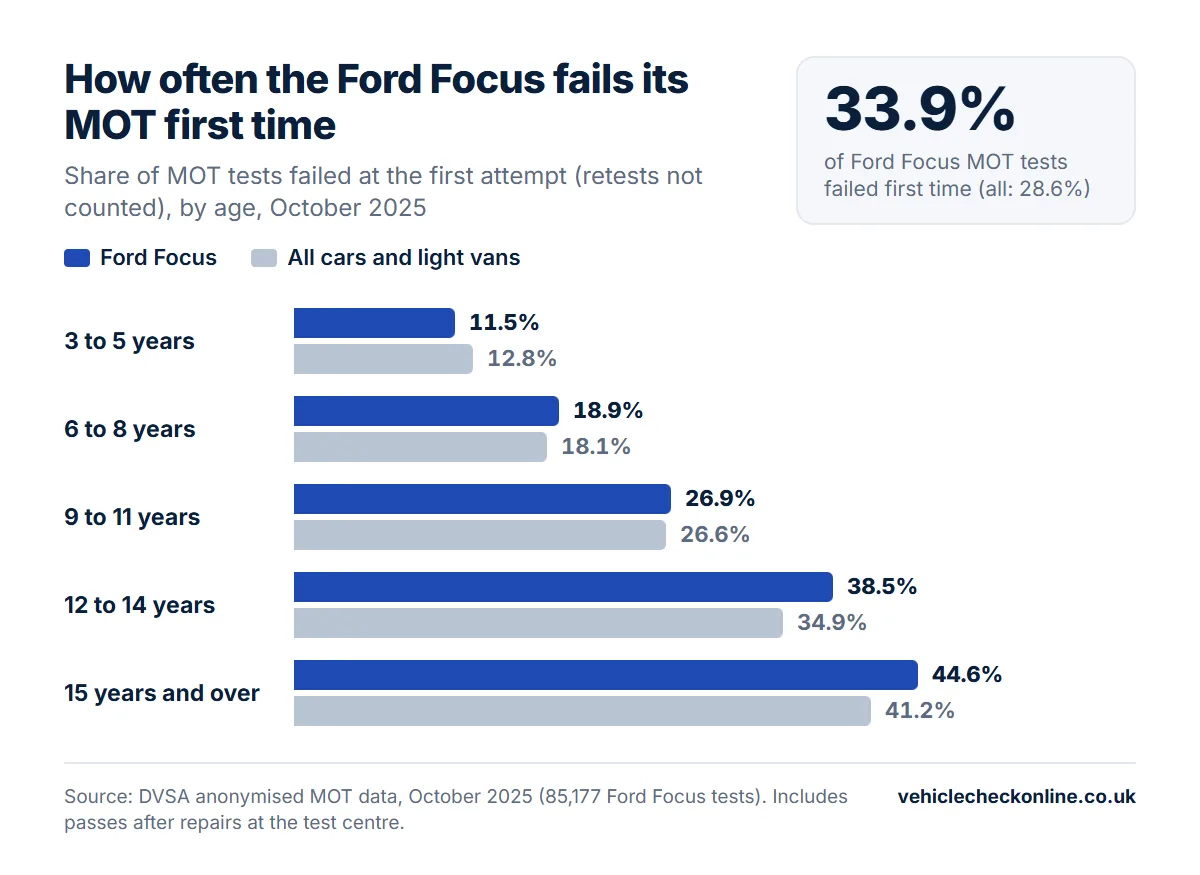
Judged by MOT results, the Ford Focus common problems are lamps (headlamp aim, sidelights and brake lights), worn or damaged tyres, broken coil springs, windscreen washers and worn suspension bushes. In October 2025, 33.9% of Focus MOTs ended in a first-time fail, compared with 28.6% for cars and light vans as a whole, but up to 11 years old the Focus failed about as often as the average car.
In this guide, "common problems" are the faults MOT testers recorded, which show a car's condition on the day of its test rather than how often it breaks down. The sections below cover the Focus's fail rate by age, its most frequent failure items and advisories, its mileage and fuel, and what to look at when buying a used Ford Focus.
Is the Ford Focus MOT fail rate close to average?
Compare the Focus with cars of its own age and the gap shrinks or vanishes. Among 3 to 5-year-olds, 11.5% of Focus tests were first-time fails, below the 12.8% for all vehicles that age. At 6 to 8 years the Focus scored 18.9% against 18.1%, and at 9 to 11 years 26.9% against 26.6%: as near to average as makes no difference.
The difference opens up later. At 12 to 14 years old the Focus's rate was 38.5%, above the 34.9% for all vehicles that age, and among cars of 15 or more it was 44.6%, against 41.2%. Those older cars weigh heavily in the total: cars of 15 or older accounted for 29,212 of the 85,177 Focus tests, and those of 12 to 14 for 20,290. The registration years that came up most were 2014, 2015 and 2013.
The numbers are our own analysis of DVSA's anonymised MOT data for October 2025, counting every MOT that was a first attempt rather than a retest. A pass that came only after repairs at the test centre still counts as a fail, because the car had a failure item when it arrived. How we worked these figures out gives the full method, with the other 13 models in our comparison.
Ford Focus MOT failures: which parts fail most?
Lamps are the Focus's biggest failure area by a wide margin. One failed test can record several failure items, and this is how all the items recorded on Focuses were spread across the car, with faults fixed at the test centre during the test included:
| Area | Ford Focus, share of failure items | All vehicles tested |
|---|---|---|
| Lamps, reflectors and electrics | 31.9% | 24.9% |
| Suspension | 20.7% | 21.4% |
| Tyres | 14.1% | 12.6% |
| Brakes | 10.6% | 14.8% |
| Noise, emissions and leaks | 6.4% | 5.9% |
| Visibility | 6.2% | 7.3% |
| Body, chassis and structure | 5.4% | 6.4% |
| Steering | 2.3% | 3.7% |
The shares add up to the whole, so a bigger share for lamps and tyres leaves smaller ones for brakes and steering. They describe the faults found on Focuses, not the chance that any one Focus fails for each.
How often do headlamp aim, sidelights, brake lights and washers fail a Focus?
Four of the Focus's ten most frequent failure items are lamps, including the top two. Headlamp aim outside the limits came first, with 5,929 (8.6% of failure items), and a position lamp (a sidelight or rear light) that was missing, not working or more than half out came second, with 4,204 (6.1%). A faulty brake light came eighth (2,249, 3.3%) and a headlamp missing or not working tenth (1,819, 2.6%).
For the aim, the tester parks the car on the centre's headlamp aim area and checks where each beam falls with aiming equipment. A beam pointing outside the permitted band is a major defect. Testers may nudge the aim slightly while testing, although the manual does not let them carry out repairs.
A car needs two position lamps at the front and two at the rear, though daytime running lamps or headlamps may do the job of the front pair, and they must light up together with the number plate lamps. Brake lights have to come on the moment the pedal is pressed: with one out the car fails on a major defect, and with none working at all the defect is dangerous. All of these can be checked in a minute at a viewing, with the seller working the switches.
Windscreen washers that did not work, or did not give the wipers enough fluid to clear the screen, were the sixth most common failure item, with 2,481 (3.6%). That is a major defect, so a Focus can fail simply because its washer bottle is empty.
The engine warning light (the manual's malfunction indicator lamp), checked with the emissions rather than the lamps, came twelfth (1,589, 2.3%). It should light up when the ignition is turned on and then go out; one that stays lit to show a fault is a major defect.
How common are broken coil springs and worn suspension bushes on a Focus?
The suspension item that failed Focuses most often was a coil spring fractured or seriously weakened, fourth on the overall list: 3,170 times, 4.6% of all its failure items. Testers check that each spring still seats properly once the car has been lifted and lowered again, and a spring found broken fails as a major defect.
Worn suspension pins and bushes came seventh (2,427, 3.5%). Some movement in a rubber bush is normal, since it is designed to flex, and the manual tells testers to fail a bush only when they can see serious deterioration of the rubber or of the bonding that holds it.
The warning signs come earlier. "Pin or bush worn but not resulting in excessive movement" was the Focus's second most common advisory, recorded 13,446 times (9.0% of its advisories).
How often do tyres and brake pads fail a Focus MOT?
Tyres make up more of the Focus's failure items than they do for cars overall. Tread below the legal minimum was the third most common failure item, with 3,371 (4.9%), a tyre seriously damaged fifth (2,501, 3.6%) and a tyre with its cords visible or damaged ninth (2,230, 3.2%).
In the manual, the damage that fails a tyre ranges from a cut deep enough to reach the cords inside it, a major defect, to a lump, bulge or tear from its structure failing, or cords exposed or damaged, both graded dangerous. A car tyre fails, too, if its main grooves are less than 1.6mm deep anywhere across the middle three-quarters of the tread, which the manual likewise grades as dangerous. Worn tyres are also the top advisory: "worn close to legal limit/worn on edge" made up 19.2% of all the Focus's advisories, and tyres "slightly damaged/cracking or perishing" another 7.9%.
Brake pads worn below 1.5mm were recorded 1,767 times (2.6%). That is a dangerous defect, one grade above a pad that has only reached its wear indicator. Brake wear shows in the advisories as well: discs "worn, pitted or scored" (6.4% of advisories) and pads "wearing thin" (5.5%).
Does the Focus rust underneath on sub-frames, suspension arms and springs?
Corrosion under the car runs through the Focus's advisories. Coil springs were noted as corroded 8,078 times (5.4% of advisories), the sub-frame as "corroded but not seriously weakened" 7,407 times (5.0%) and the suspension arms with the same words 5,816 times (3.9%). Corroded rigid brake pipes add 2,536 (1.7%).
None of these is a fail on its own. The manual warns testers that some suspension parts are pressed from thin steel, with hollow box sections or upward-facing surfaces where road grime and salt build up and eat into the metal locally. The fail point, in the manual's words, is a suspension component that is excessively damaged or corroded.
On an older Focus, corrosion advisories on the sub-frame or suspension arms at two or more tests in a row are the ones to have looked at before you buy.
What mileage does a typical Focus have, and is it petrol or diesel?
The Focus comes to its MOT with close to average miles for its age, and at 12 to 14 years with slightly more:
| Age at the MOT | Focus average mileage | Every car and light van |
|---|---|---|
| 3 to 5 years | 36,868 | 38,187 |
| 6 to 8 years | 53,906 | 55,582 |
| 9 to 11 years | 76,535 | 76,786 |
| 12 to 14 years | 97,494 | 93,592 |
| 15 years and over | 106,731 | 108,155 |
Almost a third of the cars were diesels: 31.6% of the Focus tests, with 68.4% petrol. Our figures do not split the fail rate by fuel, so they cannot tell you whether one type fails more often than the other.
What should you check when buying a used Ford Focus?
Before you travel, read the car's record in our free MOT history. On a Focus, look hardest at entries on lamps, tyres, springs, bushes and rust underneath, and ask the seller about every advisory from the latest test.
- Lamps and washers. With the seller working the switches, walk round and check the sidelights, dipped and main beams, brake lights and indicators, then try the washers. Note any past fail for headlamp aim.
- Springs. Look at the car from each corner on level ground. One corner sitting lower than the others can be a sign of a broken spring.
- Bushes and joints. Over speed bumps on the test drive, listen for knocks and clonks from the suspension, and check whether the advisories mention pins, bushes or ball joints.
- Tyres. Check the depth across each tyre, including the inner edges, and look over the sidewalls for cuts and bulges, and for the cracks behind a "cracking or perishing" advisory.
- Underneath. Shine a torch under the car, front and back, for flaking rust on the sub-frames and suspension arms, especially if the history already mentions corrosion there.
The used car checklist takes you through the rest of the viewing, from the logbook to the interior.
Then take the car for a proper drive with our test drive checklist to hand.
How do you check a used Focus for recalls?
Safety recalls sit outside the MOT: a manufacturer issues one for a serious safety fault, and GOV.UK's guidance is that the owner is not usually charged for the repair or the parts.
Our free MOT history includes the recall status that the DVSA holds for the registration. GOV.UK's vehicle recall service can be searched by registration too, or by make, model and year if you do not have it. If a recall is still open on the car you want, ask for it to be completed before you buy.
Is a used Ford Focus worth buying?
The MOT data gives the Focus a fair report up to 11 years old: it fails about as often as the average car of its age and covers about average miles. From 12 years old it falls a little behind. Its usual failures are lamps, tyres, springs and bushes, all parts that wear on any car.
What the figures cannot tell you is how one particular Focus has been kept. GOV.UK makes clear that the condition of the engine, clutch and gearbox is not checked at the MOT, so the service record, a careful test drive and, on an older car, a mechanic's look underneath fill the gaps the data leaves.
Questions and answers
Is the Ford Focus a reliable car?
MOT data cannot measure reliability, only the condition testers found. In October 2025, Focuses up to 11 years old failed about as often as the average car, and older ones somewhat more often, mostly for lamps, tyres, springs and bushes.
What does a headlamp aim fail mean?
The tester measured the beam with aiming equipment and found it pointing outside the permitted limits. It is a major defect, although testers are allowed small tweaks to the aim while the test is under way.
Can a Focus pass its MOT with a corroded sub-frame?
Yes, if the rust has not seriously weakened it: the tester can record an advisory instead of a fail. It fails once the sub-frame is excessively damaged or corroded.
What mileage is normal for a 10-year-old Focus?
At their October 2025 MOT, Focuses aged 9 to 11 showed 76,535 miles on average. The average for every car and light van that age was 76,786, so a typical Focus is right in line.
Do older Focuses fail more than other cars their age?
From 12 years old, yes. In October 2025 the Focus failed first time in 38.5% of tests at 12 to 14 years, where the national figure was 34.9%, and in 44.6% at 15 years and over, against 41.2%.
Sources
- DVSA: Anonymised MOT tests and results (data.gov.uk)
- GOV.UK (DVSA): MOT inspection manual for cars, section 4: lamps, reflectors and electrical equipment
- GOV.UK (DVSA): MOT inspection manual for cars, section 5: axles, wheels, tyres and suspension
- GOV.UK (DVSA): MOT inspection manual for cars, sections 3 and 8: washers and the engine warning light
- GOV.UK: Getting an MOT, how the MOT test works
- GOV.UK: Check if a vehicle, part or accessory has been recalled
Related guides
- The most common MOT failures, and why cars fail their MOTThe most common MOT failures in DVSA's latest data: lights, suspension, tyres, brakes and visibility, plus fail rates by car and age and how to avoid a fail.
- MOT advisories explained: what an advisory means and what to doWhat an MOT advisory means, how it differs from minor, major and dangerous defects, whether you can drive with advisories, and the advisory wording decoded.
- Used car checklist: what to check before you buyWhat to check when buying a used car, in order: the records, V5C and VIN, bodywork, tyres, engine, interior, test drive and seller, and what each sign means.
- Ford Fiesta common problems: what MOT testers find most oftenFord Fiesta common problems in DVSA MOT data: brake lights, worn suspension joints and tyres, how often Fiestas fail by age, and what to check before you buy.
- Nissan Qashqai common problems and MOT failuresNissan Qashqai common problems from DVSA MOT data: worn steering and suspension joints lead, and older Qashqais fail far more often than average.
This guide is general information for people buying, owning or selling a car in the UK, not legal or financial advice. Vehicle Check Online is an independent service, not affiliated with the DVLA, the DVSA or GOV.UK.