
Common problems by car model
Common problems on a Honda Jazz, from its MOT results
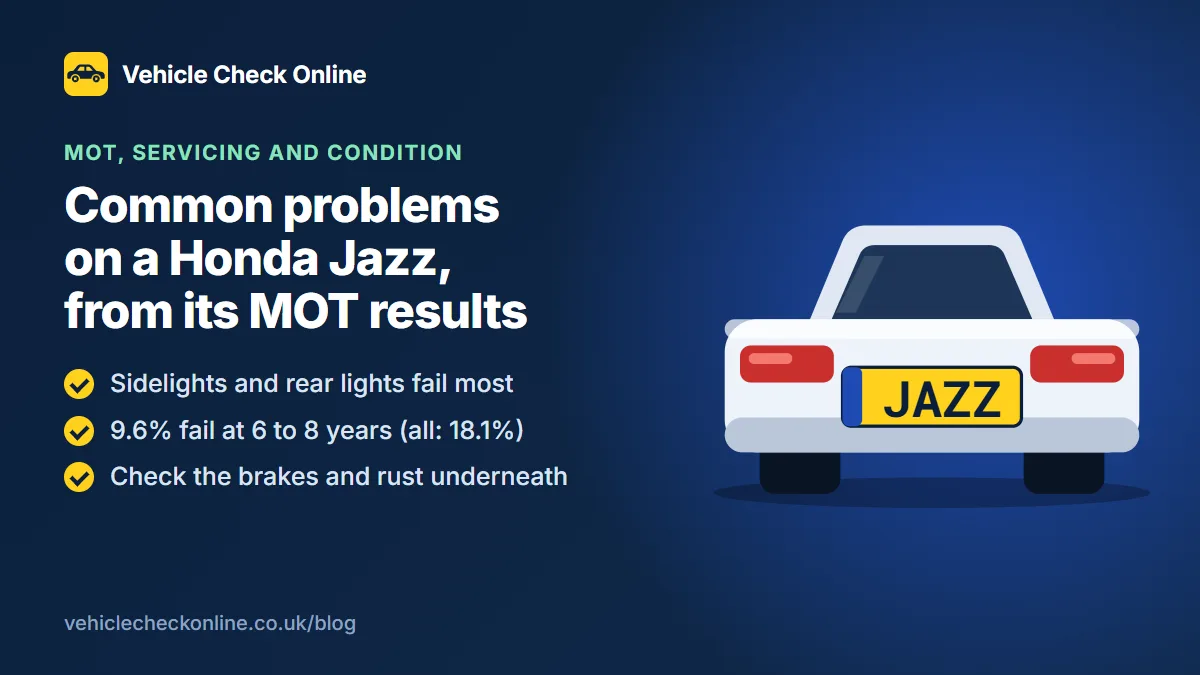
The Honda Jazz common problems that MOT testers write up most often are dead sidelights and rear lights, badly aimed headlamps, wiper blades that no longer clear the screen, weakened metal around the suspension mountings and worn brake pads. Even so, a Jazz under 15 fails its MOT far less often than other cars of its age: at 9 to 11 years, 16.4% failed first time, against 26.6% of all cars and light vans.
Common problems, here, are the faults found at the MOT, not breakdowns or owner surveys. Below: how the Jazz's fail rate changes with age, why so many Jazzes on the road are old, what fails and why, the brake and rust advisories to look for, and what to check when buying a used Honda Jazz.
Is the Honda Jazz MOT fail rate below average?
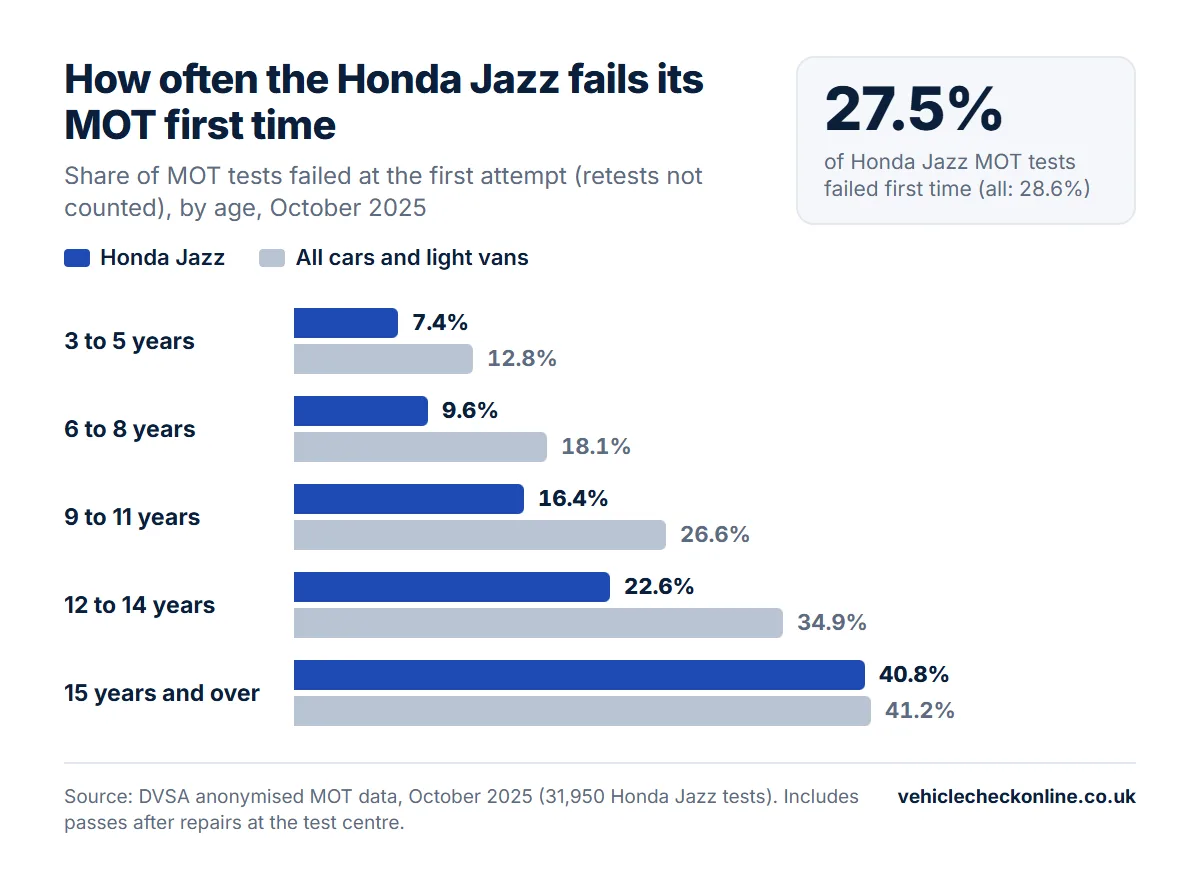
Age for age, the Jazz's record is strong. Its first-time fail rate was 7.4% at 3 to 5 years (all cars and light vans: 12.8%), 9.6% at 6 to 8 (18.1%), 16.4% at 9 to 11 (26.6%) and 22.6% at 12 to 14 (34.9%). Only from 15 years does the gap close, at 40.8% for the Jazz and 41.2% overall.
The percentages are our own count from DVSA's anonymised MOT results for October 2025, 31,950 Jazz tests in all. Each MOT is taken at its first attempt, without retests, and where the test centre had to repair a car before it passed, that counts as a fail. Anyone wanting the detail can read how we worked these figures out, which also lists the rates for 13 other common models.
Why is the Jazz's overall fail rate close to average?
Over all ages, 27.5% of Jazz tests failed first time, just under the 28.6% average for every car and light van tested. That small gap hides a much better record at each age, because so many of the Jazzes tested were old: 14,888 of the 31,950 tests, almost half, involved Jazzes aged 15 or more, the oldest band and the one with the highest fail rates. The years of first registration that came up most were 2009, 2011 and 2010.
So the overall figure says more about the age of the cars than about the model, which is why the chart sets each age band side by side.
Which areas fail most on a Honda Jazz MOT?
A single failed MOT can list several failure items, including faults put right at the test centre during the test. Split by the part of the car, the Jazz's items compare with the average like this:
| Part of the car | Share of Jazz failure items | Cars and light vans overall |
|---|---|---|
| Lamps, reflectors and electrics | 29.6% | 24.9% |
| Brakes | 19.1% | 14.8% |
| Suspension | 18.3% | 21.4% |
| Visibility | 9.0% | 7.3% |
| Tyres | 8.9% | 12.6% |
| Noise, emissions and leaks | 5.5% | 5.9% |
| Body, chassis and structure | 5.1% | 6.4% |
| Steering | 1.9% | 3.7% |
Three areas take a bigger share than usual: lamps and electrics, brakes (19.1% of the Jazz's failure items, against 14.8%) and visibility, which here means mostly wipers and washers. Tyres, suspension and steering take less. The shares are parts of one whole, so they describe the pattern of a Jazz's failures, not how often it fails.
Which brake, handbrake and brake pipe faults fail a Jazz MOT?
Two brake items are among the Jazz's most frequent failures:
- Brake pads below 1.5mm, 4.1%. The manual grades a pad worn under 1.5mm as dangerous, and one worn to its wear indicator as major. Some pads carry a metal indicator that squeals against the disc once they are worn out.
- Handbrake efficiency, 3.2%. On the brake tester, the parking brake has to reach a minimum efficiency, 16% for most vehicles. Falling short is a major defect, and reaching less than half the required figure is dangerous.
The Jazz's brake advisories follow the same pattern: pads wearing thin (7.8% of its advisories), discs worn, pitted or scored (7.5%), metal brake pipes noted as corroded, or as covered in grease or other material (6.4%), flexible brake hoses with slight corrosion on their metal end fittings, the ferrules (2.5%), and brakes binding slightly (2.3%), meaning the brake tester picked up some braking effort at a wheel with the brake off.
Watch the brake pipe advisory in particular: the manual allows a metal pipe to be rejected once corrosion or damage has taken away about a third of its wall thickness.
Which light, headlamp aim, wiper and washer faults fail a Jazz?
- Position lamps, 8.6%. The Jazz's single most common failure item, 1,924 in the month. These are the small front sidelights and the rear lights that come on with them, and a lamp that is missing or dark is a major defect, as is a multi-source lamp with over half its sources out.
- Headlamp aim, 6.9%. Testers check each dipped beam against set limits using aiming equipment at the test centre. A beam pointing outside them fails.
- Wiper blades, 5.0%. Blades that are missing or leave the screen obviously uncleared.
- Windscreen washers, 3.5%. Washers that do not work, or cannot supply enough fluid for the wipers to clear the glass, are a major defect.
- Number plate lamp, 2.3%. A plate lit by a single lamp fails when that lamp is out; one lit by two or more fails only when every one of them is out.
Two lighting advisories are common too: a product on a headlamp lens that does not yet seriously reduce the light (3.7% of Jazz advisories), and number plates that have deteriorated but can still be read (2.6%). A coating that obviously dims a headlamp or changes the colour of its light is a fail.
Is rust and wear under an older Jazz a problem?
The fourth most common failure item on the Jazz, with 1,085 in the month (4.8%), is not a part but the structure around the suspension. In the manual's terms it is a prescribed area, meaning any load-bearing metal no more than 30cm from where a sub-frame, spring or other suspension part is mounted. A fail means its strength or continuity has been significantly reduced, by rust, damage or a crack, or that it has been inadequately repaired.
To judge it, testers look, press the metal between finger and thumb and, if needed, scrape or tap it with a corrosion tool. A hole, or metal that gives under pressure, means a fail.
Other underside items in the Jazz's list are worn suspension parts: dust covers on linkage ball joints that are missing or no longer keep dirt out (2.6%) and worn pins and bushes (2.4%). Among the advisories, corroded coil springs (3.6%) and corroded suspension arms (2.8%) point to rust that has started but not yet failed.
Does a Honda Jazz have low miles for its age?
Jazzes come to their MOT with low mileage for their age. At 3 to 5 years the average Jazz had covered 23,542 miles, against 38,187 for all cars and light vans; at 9 to 11 years, 46,826 against 76,786; and at 15 years and over, 88,281 against 108,155. The bands in between show the same gap: 33,808 against 55,582 at 6 to 8 years, and 66,499 against 93,592 at 12 to 14.
Fewer miles mean less wear on tyres, brakes and suspension joints, which may help explain the Jazz's low fail rates. Low mileage does not stop corrosion, though, and by 15 years old the Jazz's fail rate has caught up with the average. Tyres are worth a close look whatever the mileage. A seriously damaged tyre was the Jazz's sixth most common failure item (3.9%), ahead of tread below the legal limit (2.9%); the manual fails a cut deep enough to reach the ply or cords, and treats a lump, bulge or tear from the structure separating as dangerous. Slight damage, cracking or perishing appeared in 12.1% of the Jazz's advisories, close behind tread worn near the limit at 13.2%.
What should you check when buying a used Honda Jazz?
Read the last few tests in the car's free MOT history for the items above, then check these at the viewing:
- Ask when the brake pads were last replaced, look at the discs through the wheels, and on the test drive, stop on a slope and see whether the handbrake alone holds the car.
- With a torch, follow the metal brake pipes along the underside and look for flaking rust.
- Look under the car around the suspension mountings, sills and sub-frames, and match what you see with any corrosion advisories in the history.
- Turn on the sidelights, dipped beams and hazard lights and walk round the car, including the number plate.
- Run the wipers and washers, and look at the headlamp lenses for a coating or damage.
- Measure the tread at several points across each tyre, and look for cuts, bulges, cracks or perishing in the rubber.
For everything else at the viewing, from the paperwork to the bodywork, use our used car checklist.
On the road, the test drive checklist goes through the brakes, steering and suspension in turn.
Nine in ten Jazz tests (90.1%) were on petrol cars and 9.7% on hybrids; the hybrids do not get a fail rate of their own in this data. If the car you want is a hybrid, read up on the battery and servicing in buying a used hybrid.
If the handbrake struggles to hold the car on a slope, have the brakes checked before you agree a price: handbrake efficiency is among the Jazz's more common MOT failures.
How do you check for Honda Jazz recalls?
Recalls are dealt with by the manufacturer, not at the MOT, and GOV.UK's guidance is that the owner will not usually have to pay for recall repairs or parts. On our free MOT history page, the recall status the DVSA holds for the Jazz you are viewing appears with its test results. GOV.UK's recall checker gives a second view: search it with the registration, or with the make, model and year the car was built. An outstanding recall is best put right by a Honda dealer before you hand over any money.
Is a used Honda Jazz a good buy?
On MOT results the Jazz stands out. Until 15, it failed far less often than cars of the same age in general, and from 15 it was level. Its low mileage may account for part of that, and MOT figures cannot measure reliability, only the condition testers found on the day.
A younger Jazz has the data on its side, with fail rates well below average. For an older one, the frequent failures and advisories show where to look: lamps and wipers, brakes and handbrake, the metal brake pipes underneath, and the metal around the suspension mountings. Price any work the advisories show into your offer.
Finance still owed, an insurance write-off or a stolen-vehicle record will never show in an MOT history. To rule them out, run a car history check on the registration.
Questions and answers
What is the most common MOT failure on a Honda Jazz?
A sidelight or rear light that does not work, recorded as a position lamp failure: 8.6% of all Jazz failure items in the October 2025 figures. Badly aimed headlamps came second, at 6.9%.
Is the Honda Jazz reliable?
MOT results cannot measure reliability, only condition at the test. On that measure the Jazz does well: its first-time fail rate stayed far below the overall rate in each age band up to 14 years.
Why do some Jazzes fail on the handbrake?
The parking brake must reach a minimum efficiency on the test centre's brake tester. A handbrake that fell short made up 3.2% of the Jazz's failure items. On a test drive, check that it holds the car on a slope.
How many miles has a typical Honda Jazz done?
Jazzes aged 9 to 11 averaged 46,826 miles at their October 2025 MOT, compared with 76,786 across all cars and light vans in that band. At 15 years and over, the Jazz average was 88,281 miles.
Are hybrid Jazz models included in these figures?
Yes. Hybrids made up 9.7% of the Jazz tests and petrol cars 90.1%, though this data has no fail rate for each fuel.
Which years of Honda Jazz were tested most?
Cars first registered in 2009, 2011 and 2010 were the most common among the Jazzes tested in October 2025.
Sources
- DVSA: Anonymised MOT tests and results (data.gov.uk, Open Government Licence)
- GOV.UK (DVSA): MOT inspection manual for cars, section 1: brakes
- GOV.UK (DVSA): MOT inspection manual for cars, section 3: visibility
- GOV.UK (DVSA): MOT inspection manual for cars, section 4: lamps, reflectors and electrical equipment
- GOV.UK (DVSA): MOT inspection manual, Appendix A: structural integrity and corrosion
- GOV.UK: Check if a vehicle, part or accessory has been recalled
Related guides
- The most common MOT failures, and why cars fail their MOTThe most common MOT failures in DVSA's latest data: lights, suspension, tyres, brakes and visibility, plus fail rates by car and age and how to avoid a fail.
- MOT advisories explained: what an advisory means and what to doWhat an MOT advisory means, how it differs from minor, major and dangerous defects, whether you can drive with advisories, and the advisory wording decoded.
- Used car checklist: what to check before you buyWhat to check when buying a used car, in order: the records, V5C and VIN, bodywork, tyres, engine, interior, test drive and seller, and what each sign means.
- Toyota Yaris common problems: what the MOT data showsToyota Yaris common problems in DVSA MOT data: lamps, coil springs and wipers fail most, yet the Yaris beats the average fail rate at every age to 14.
- Fiat 500 common problems and MOT failures by ageFiat 500 common problems from DVSA MOT data: how often it fails at each age, why suspension wear leads, and what to check when buying a used Fiat 500.
This guide is general information for people buying, owning or selling a car in the UK, not legal or financial advice. Vehicle Check Online is an independent service, not affiliated with the DVLA, the DVSA or GOV.UK.