
Common problems by car model
Renault Clio common problems and MOT failures
The Renault Clio's most common problems at the MOT are broken or weakened coil springs, worn suspension and steering joints, misaimed or faulty lamps, and washers that do not work. In October 2025, 45.6% of Clios failed first time, the highest rate of the 14 models in our comparison, against 28.6% for all cars and light vans.
Common problems, in this guide, are the faults MOT testers recorded most often, from our analysis of DVSA's anonymised MOT data. A high rate can simply mean older cars, so the guide first compares the Clio with cars of the same age, then explains each frequent failure and advisory, and what to check when buying a used Renault Clio.
What is the Renault Clio MOT fail rate at every age?
The DVSA's anonymised MOT results for October 2025 hold 29,118 tests on Clios. Retests are not counted, and a car that only passed after repairs at the test centre is treated as a first-time fail, just like one that failed outright. The method, and a table of all 14 models, is in how we worked these figures out.
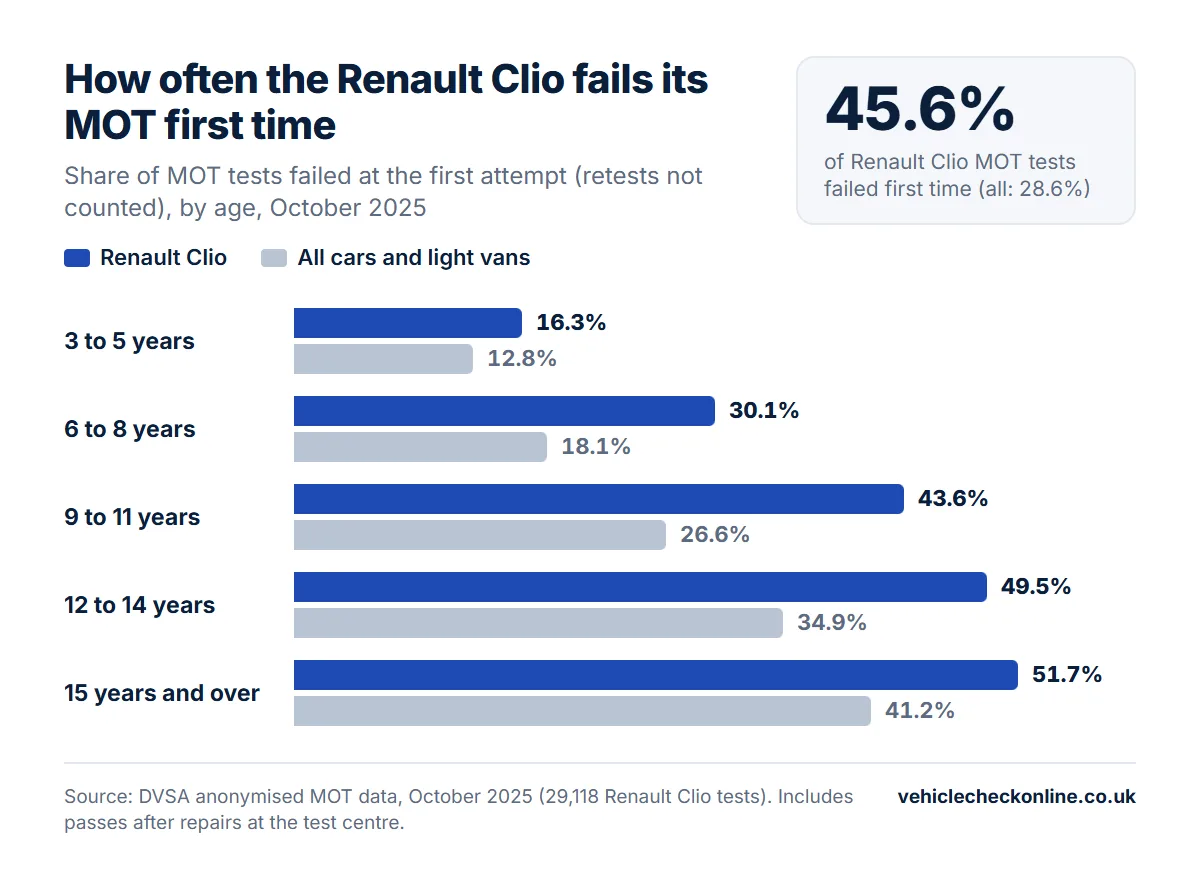
Part of the Clio's high rate comes from age. More of its tests were on cars aged 15 or over than in any other band: 11,706 of the 29,118. But the Clio was above the average for all cars and light vans at every age:
| Age at the test | Clio tests | Clio failed first time | All cars and light vans |
|---|---|---|---|
| 3 to 5 years | 621 | 16.3% | 12.8% |
| 6 to 8 years | 3,743 | 30.1% | 18.1% |
| 9 to 11 years | 6,915 | 43.6% | 26.6% |
| 12 to 14 years | 6,023 | 49.5% | 34.9% |
| 15 years and over | 11,706 | 51.7% | 41.2% |
The gap was widest at nine to 11 years, with 43.6% against 26.6%. The youngest group is small, at 621 tests, so its figure is the least certain of the five.
These are MOT results. They show the condition the cars were in on the day of the test, after years of use and maintenance by many different owners, and they are not a measure of how well the Clio was built.
Which areas cause most Renault Clio MOT failures?
One failed test can record several failure items, and those put right at the test centre during the test are counted too. Grouped by the part of the car they concern, the Clio's items follow the national pattern quite closely, with a few differences:
| Area of the car | Share of Clio failure items | All cars and light vans |
|---|---|---|
| Lights, reflectors and electrics | 26.9% | 24.9% |
| Suspension | 23.9% | 21.4% |
| Brakes | 14.9% | 14.8% |
| Tyres | 9.1% | 12.6% |
| Visibility | 7.6% | 7.3% |
| Body, chassis and structure | 6.4% | 6.4% |
| Steering | 5.4% | 3.7% |
| Noise, emissions and leaks | 3.3% | 5.9% |
Lights, suspension and steering take a bigger share than average; tyres, and noise, emissions and leaks, a smaller one. So the Clio stands out for how often it fails rather than for what fails: its faults are mostly the same kinds that fail other cars.
Are broken coil springs the Clio's most common failure?
The single item that failed Clios most often was a coil spring fractured or seriously weakened: 3,127 times, or 8.5% of all the Clio's failure items. Coil springs support the car's weight at each corner. In the DVSA's list of defects, this item covers a spring that has broken and one so corroded or worn that it is seriously weakened. Either is a major defect, so the car fails.
Rust on a spring can be noted as an advisory before it gets that far. "Coil spring: corroded" was the Clio's fifth most common advisory, at 4.2%, and the DVSA pairs it with the corroded and seriously weakened spring defect.
A broken spring is not always easy to see, but it can make one corner sit lower than the others, or knock over bumps. If a Clio's MOT history shows a coil spring advisory or failure, ask what was replaced and when.
What are the other common Clio failure items?
After coil springs, these were the items that failed Clios most often, grouped by the part of the car:
- Suspension and steering joints. Suspension ball joints excessively worn (7.0%), and track rod ends with excessive wear or free play (4.0%). Track rod ends are the ball joints at the outer ends of the steering linkage, and wear in them can show as knocks or vague steering.
- Lamps. Headlamp aim outside the limits (6.3%); position lamps, the sidelights and rear lights, missing or not working (5.4%); stop lamps not working (3.4%); headlamps missing or not working (2.6%). A lamp made of several light sources fails when more than half of them are out. Testers check the aim of each headlamp with beam-setting equipment, and may make minor adjustments to it during the test but no repairs. One stop lamp out fails as a major defect, and if none work at all the defect is dangerous.
- Washers. Windscreen washers not working, or not supplying enough fluid for the wipers to clear the screen (4.3%), a major defect.
- Drive shaft boots. A constant velocity joint boot missing, split or insecure so that it no longer keeps dirt out (4.2%). The boot is the rubber cover over the joint at the end of a drive shaft.
- Tyres. Tread below the legal minimum (3.3%), a dangerous defect, and a tyre seriously damaged (2.7%). That damage can be a cut reaching the cords, a major defect, or a lump, bulge or tear where the tyre's structure is failing, which is dangerous.
- Brake pipes. A metal brake pipe damaged or excessively corroded (2.4%). The manual treats a pipe whose wall thickness has been reduced by a third as bad enough to fail.
Which Clio MOT advisories should you look out for?
Advisories are the tester's notes on parts that passed but are wearing or corroding. These were the Clio's most frequent, with their share of all its advisories:
- Tyres: tread worn close to the legal limit or on one edge (16.5%), and slight damage, cracking or perishing (10.1%).
- Brake pipes: corroded, or covered in grease or other material (8.8%). The DVSA pairs this advisory with an excessively corroded pipe, a major defect.
- Brake discs: worn, pitted or scored (8.4%), paired with a seriously weakened disc, a dangerous defect.
- Coil springs: corroded (4.2%).
- Oil: an engine oil leak that is not excessive (4.0%). A leak fails once it makes a pool more than 75mm across within five minutes.
- Brake pads: wearing thin (3.4%), paired with pads worn below 1.5mm, a dangerous defect.
- Wheels: a road wheel slightly distorted (3.0%).
- Joints: slight play in a suspension ball joint (2.9%) or a track rod end (2.1%), and a suspension pin or bush worn but not yet moving excessively (2.4%).
- Binding brakes: a service brake binding, but not excessively (2.3%).
What mileage and fuel do Renault Clios have at the MOT?
Higher mileage does not explain the Clio's fail rate. At every age, the Clios tested had covered fewer miles on average than all cars and light vans:
| Age at the test | Renault Clio, average miles | All cars and light vans |
|---|---|---|
| 3 to 5 years | 33,950 | 38,187 |
| 6 to 8 years | 46,907 | 55,582 |
| 9 to 11 years | 66,932 | 76,786 |
| 12 to 14 years | 82,143 | 93,592 |
| 15 years and over | 88,941 | 108,155 |
Most Clios tested ran on petrol (78.6%), and 21.4% were diesels. They were first registered between 1992 and 2023, most often in 2014, 2015 and 2010, and the figures include cars recorded as a Clio Iconic TCe or Clio RS Line TCe.
What should you check when buying a used Renault Clio?
Read the car's free MOT history before you go. On a Clio, look hardest at anything about coil springs, ball joints, track rod ends, brake pipes and lamps, and at any advisory that comes back at test after test.
At the viewing:
- Stand back and look at the car on level ground, from each side and from behind. A corner sitting lower than the others can point to a broken or weakened spring.
- Shine a torch into each wheel arch at the coil springs, looking for a break or heavy rust, and behind the front wheels at the drive shaft boots, looking for splits or grease thrown around them.
- Turn the steering from lock to lock, then drive slowly on full lock. Knocks or clicks can come from worn steering joints or drive shaft joints. What else to listen for on the road is in our test drive checklist.
- Check every lamp with someone outside: sidelights, rear lights, brake lights, indicators and both headlamps.
- Run the wipers and washers, and check the tyres from edge to edge for tread, cracks, cuts and bulges.
Brake pipes run under the car and are hard to judge without a ramp. If the history advises corroded pipes, ask whether they have been replaced, or have the car inspected before you pay.
Our used car checklist has the full routine for a viewing, from the paperwork to the interior.
On a Clio, an advisory for coil springs, ball joints, track rod ends or brake pipes is worth a question before you agree a price: each of those parts is also among the model's most common failures.
How do you check for Renault Clio recalls?
Safety recalls are carried out by the manufacturer and, according to GOV.UK, owners do not usually pay for the repairs or parts. Look the car up by its registration: our free MOT history shows whether the DVSA reports a recall as outstanding, all fixed, none found or not available, and GOV.UK runs its own recall check.
An outstanding recall is something to settle with the seller before any money changes hands.
Is a used Renault Clio a good buy?
On this data, Clios failed their MOT more often than the average car at every age, and the model had the highest overall rate of the 14 compared. That is a reason to read a Clio's MOT history closely, not a judgement on its design: the results reflect wear, corrosion and maintenance at the time of each test.
The failures recorded most often are springs, joints, lamps and washers. These are parts that can be replaced, and parts you can ask about. A Clio whose recent tests show them dealt with, and no repeated advisories, is a very different purchase from one with the same warnings year after year.
Two things the MOT cannot tell you: the state of the engine, clutch and gearbox, which GOV.UK says the test does not cover, and what other records hold about the car. A car history check shows whether finance is still owed on the car, and whether it has been written off or recorded as stolen.
Questions and answers
Why does the Renault Clio fail its MOT so often?
The figures show how often, not why. MOT results reflect each car's condition on the day of the test, which depends on its age, use and upkeep as well as the model. On Clios, the items that failed most often were coil springs, suspension ball joints and lamps.
Is the Clio's high fail rate just because the cars are old?
Only partly. Many of the Clios tested were 15 years old or more, and older cars fail more often, but the Clio was also above average within every age band, from 16.3% against 12.8% at three to five years to 51.7% against 41.2% at 15 and over.
Does a broken coil spring fail the MOT?
Yes. A coil spring that is fractured, or so corroded or worn that it is seriously weakened, is a major defect. It was the item that failed Clios most often, at 8.5% of all their failure items.
What is a CV joint boot?
It is the rubber cover over a constant velocity joint on a drive shaft. The MOT fails a boot that is missing, split or insecure so that it no longer keeps dirt out of the joint.
Are diesel Clios included in these figures?
Yes. All fuel types recorded as a Clio are included: 78.6% of the tests were on petrol cars and 21.4% on diesels.
Can I see the MOT failures of a particular Clio?
Yes. Its registration is all you need: our free MOT history page and GOV.UK's service both list every test, with the failure items, advisories and mileage the tester recorded.
Sources
- DVSA open data: anonymised MOT tests and results
- GOV.UK (DVSA): MOT inspection manual for cars and passenger vehicles
- GOV.UK (DVSA): MOT inspection manual, section 5 (springs and suspension joints)
- GOV.UK: Getting an MOT (what the test does not cover)
- GOV.UK: Check if a vehicle, part or accessory has been recalled
Related guides
- The most common MOT failures, and why cars fail their MOTThe most common MOT failures in DVSA's latest data: lights, suspension, tyres, brakes and visibility, plus fail rates by car and age and how to avoid a fail.
- MOT advisories explained: what an advisory means and what to doWhat an MOT advisory means, how it differs from minor, major and dangerous defects, whether you can drive with advisories, and the advisory wording decoded.
- Used car checklist: what to check before you buyWhat to check when buying a used car, in order: the records, V5C and VIN, bodywork, tyres, engine, interior, test drive and seller, and what each sign means.
- Ford Fiesta common problems: what MOT testers find most oftenFord Fiesta common problems in DVSA MOT data: brake lights, worn suspension joints and tyres, how often Fiestas fail by age, and what to check before you buy.
- Fiat 500 common problems and MOT failures by ageFiat 500 common problems from DVSA MOT data: how often it fails at each age, why suspension wear leads, and what to check when buying a used Fiat 500.
This guide is general information for people buying, owning or selling a car in the UK, not legal or financial advice. Vehicle Check Online is an independent service, not affiliated with the DVLA, the DVSA or GOV.UK.