
Common problems by car model
Which problems are common on a Vauxhall Corsa?
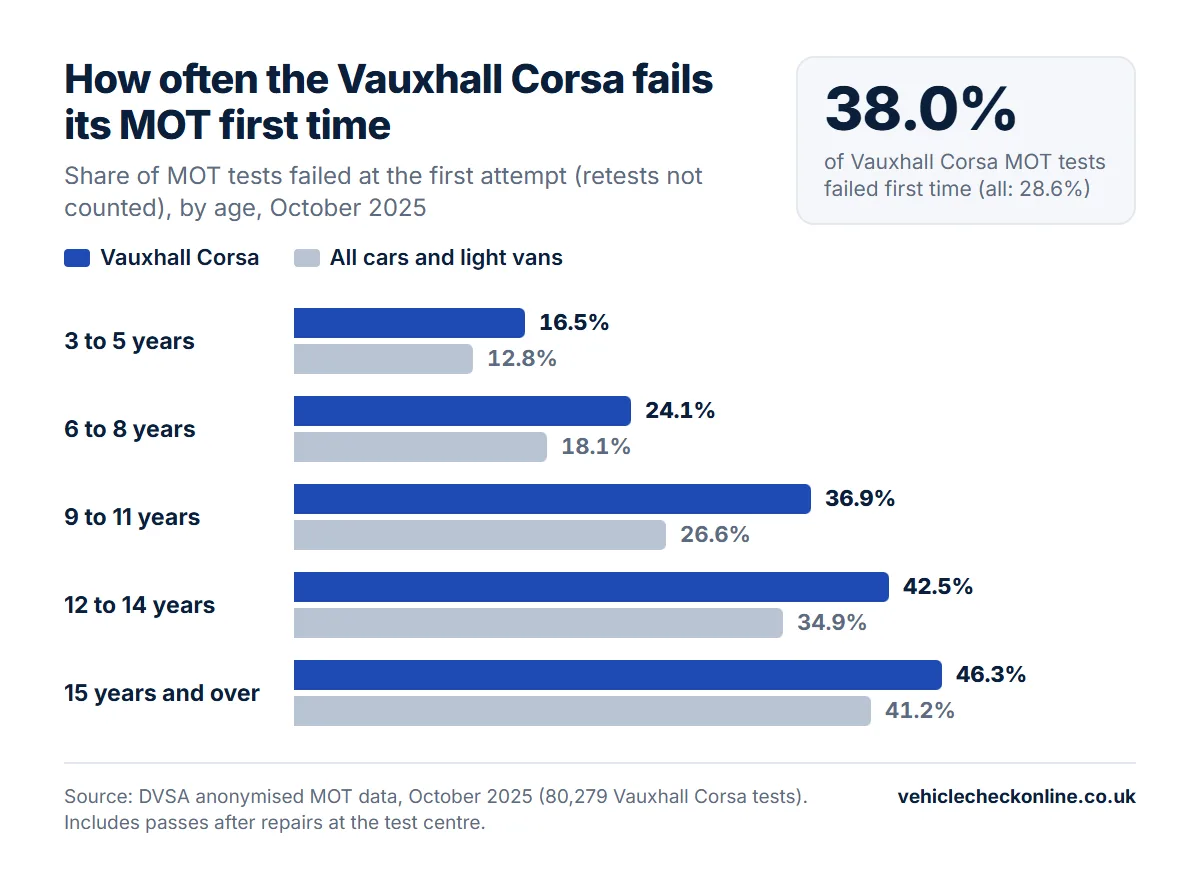
Broken coil springs, steering gaiters and joint covers that no longer keep dirt out, misaimed headlamps and other lamp faults, and washers that do not work are the Vauxhall Corsa common problems MOT testers record most. In October 2025, 38.0% of Corsas failed their MOT first time, while the national figure for cars and light vans stood at 28.6%, and Corsas of every age did worse than the average.
Common problems, for this guide, means what testers found and wrote down at the MOT: the condition of each car on the day, not breakdowns. You will find the Corsa's fail rate by age, its top failure items and advisories explained, its low mileage, and the checks to make when buying a used Vauxhall Corsa.
How does the Corsa's MOT fail rate compare at every age?
The Corsa fails more often than average from its first MOTs. At 3 to 5 years old, 16.5% of Corsas failed first time, while the rate for all vehicles that age was 12.8%, and at 6 to 8 years the two figures were 24.1% and 18.1%.
The widest gap comes at 9 to 11 years, where 36.9% of Corsas failed first time and 26.6% of all vehicles. Older Corsas stay above the average too: 42.5% against 34.9% at 12 to 14 years, and among Corsas of 15 or more, 46.3% failed against 41.2%.
The largest group of tests was on Corsas aged 15 or more (23,202 of 80,279), followed by those aged 9 to 11 (21,890). Among the Corsas tested, 2015 was the most common year of first registration, followed by 2014 and 2016.
We worked these rates out from the DVSA's anonymised records of every MOT in October 2025, looking only at initial tests, with retests excluded, and treating a car that passed only after on-the-spot repairs at the test centre as a fail. Read how we worked these figures out for the full method, and to see the Corsa beside 13 other popular models.
Which areas fail most on a Vauxhall Corsa at the MOT?
Each failed MOT can list several items, and the count takes in faults the test centre put right during the test. These are the shares of all the Corsa's failure items by area, set against the shares for every car and light van tested:
| Part of the car | Corsa share | National share |
|---|---|---|
| Lamps, reflectors and electrics | 25.9% | 24.9% |
| Suspension | 21.3% | 21.4% |
| Brakes | 11.4% | 14.8% |
| Tyres | 9.5% | 12.6% |
| Steering | 9.3% | 3.7% |
| Visibility | 8.1% | 7.3% |
| Noise, emissions and leaks | 7.1% | 5.9% |
| Body, chassis and structure | 5.6% | 6.4% |
Steering stands out at more than twice the national share. Brakes and tyres take smaller slices than average, but these are slices of the Corsa's own failures, so a smaller share does not mean its brakes or tyres fail less often.
Are broken coil springs and worn shock absorbers common on a Corsa?
Coil springs top the Corsa's list: a spring fractured or seriously weakened was recorded 5,995 times, 8.3% of every failure item on the model, or about one in twelve.
A spring in that state is a major defect. If a coil spring does not settle back into its seat when the car is let down after jacking, the manual says to fail it as insecure. A broken spring can leave a car sitting lower at one corner, though not every break shows from outside.
Corrosion alone does not fail a spring, but it is worth noticing in a car's history: "Coil spring: corroded" was noted 6,531 times on Corsas, 5.1% of their advisories.
A shock absorber that no longer works, or shows signs of severe leakage, was the eleventh most common failure item, with 2,204 (3.0%). The advisory "has light misting of oil" was noted 7,476 times (5.8% of advisories). Testers are told to let slight seepage pass, even when it leaves a film of fluid on the damper, so misting is an early warning rather than a fail.
Other suspension wear shows in the advisories: pins and bushes "worn but not resulting in excessive movement" (5,853, 4.5%), and corrosion "not seriously weakened" on the sub-frame (5,130, 4.0%) and the suspension arms (3,162, 2.5%).
How often do steering rack gaiters and ball joint covers fail?
The second most common failure item sets the Corsa apart: a steering rack gaiter or ball joint dust cover "missing or no longer prevents the ingress of dirt", recorded 5,338 times (7.3%). It is the main reason steering makes up so much of the Corsa's failures.
The gaiters are the rubber boots over each end of the steering rack, and the dust covers sit over the steering ball joints; both are there to keep dirt out. The manual grades a gaiter or cover that is merely damaged or deteriorated as a minor defect, which still passes, and one that is missing or no longer does its job as a major defect.
How common are engine warning light, oil leak and exhaust faults?
An engine malfunction indicator lamp (MIL), the engine management light, showing a fault was recorded 2,381 times (3.3% of failure items). With the ignition switched on, the tester watches for the lamp to light up and then go out; some cars only put it out once the engine is running. A lamp that stays lit, or never lights, is a major defect. It is checked on petrol cars from 1 July 2003 (by date of first use) and on diesels from 1 July 2008.
An MOT does not examine whether the engine, clutch and gearbox are in good condition, as GOV.UK points out, so if a car's history shows this fail, ask what the fault was and how it was put right.
Oil leaks are the Corsa's third most common advisory: "leak, but not excessive", 9,553 times (7.4% of advisories). The manual only fails a leak when it is excessive, judged with the engine idling: one that leaves a puddle wider than 75mm within 5 minutes fails. A minor exhaust leak was advised on 4,184 times (3.3%).
Which tyre, lamp, wiper and washer faults does a Corsa get?
Tyres come first among the Corsa's advisories. Tread "worn close to legal limit/worn on edge" accounted for 15.7% of them and "slightly damaged/cracking or perishing" 12.7%, and tread below the legal limit was the sixth most common failure item, with 2,441 (3.4%), just ahead of a tyre seriously damaged (2,435, 3.4%). Such damage can be a cut that reaches the cords inside the tyre, a major defect, or a lump, bulge or tear from the tyre's structure breaking down, which the manual grades as dangerous.
Lamps are the Corsa's largest failure area, and the faults are spread over several items: headlamp aim outside the limits (4,280, 5.9% of failure items), brake lights (3,242, 4.5%), sidelights and rear lights (2,378, 3.3%) and headlamps out (2,375, 3.3%).
Headlamp aim is measured with beam-setting equipment at the test centre, and a beam outside the set limits is a major defect, although the tester may make small adjustments to the aim during the test. The Highway Code requires lights to be properly adjusted so that they do not dazzle other road users. A car first used from 1971 needs a working brake light on each side: one out fails as a major defect, and all of them out is dangerous.
Washers that did not work or gave too little fluid were the fourth most common failure item, with 3,472 (4.8%), and wiper blades missing or not clearing the screen added 2,080 (2.9%). The washers must give the wipers enough fluid to clear the screen, so even a dry washer bottle can mean a fail.
Is the Corsa's mileage below average?
Corsas arrive at their MOT having covered far fewer miles than other cars their age, and the shortfall grows as they get older:
| Age band | Corsa, average miles at the MOT | Cars and light vans overall |
|---|---|---|
| 3 to 5 years | 33,001 | 38,187 |
| 6 to 8 years | 44,708 | 55,582 |
| 9 to 11 years | 65,273 | 76,786 |
| 12 to 14 years | 78,818 | 93,592 |
| 15 years and over | 86,641 | 108,155 |
So hard use does not explain the Corsa's record: at every age it fails more often while covering fewer miles. Petrol accounted for 92.7% of the Corsas tested and diesel for 7.3%.
What should you check when buying a used Vauxhall Corsa?
Start with the registration: our free MOT history lists the failures and advisories from each test on record. On a Corsa, these are the entries and checks that matter most:
- Coil springs. Look for a past spring failure or a corrosion advisory, and view the car on level ground to see that it sits evenly.
- Rubber gaiters and boots. With the wheels turned fully to one side, shine a torch on the gaiters at the ends of the steering rack and the boots on the drive shafts. A split or missing one can fail the test.
- Shock absorbers. Press firmly down on each corner of the car and release it. If the body carries on bouncing, the Highway Code's verdict is that the shock absorbers are worn.
- Warning lights. With the ignition on, the engine warning light should come on and then go out once the engine starts. If it stays lit, find out why before you agree a price.
- Tyres. Check the tread depth across each tyre and look at the sidewalls for cracks, the two things Corsa advisories mention most.
- Oil. Check the ground where the car was parked and the underside of the engine for fresh oil, especially if the history mentions a leak.
- Lamps, wipers and washers. Check every lamp with a helper, run the wipers and try the washers.
If you would like a list on paper, our car buying checklist turns a car's own MOT history into a printable list of things to inspect.
For everything else at the viewing, take our used car checklist and go through it step by step.
On the road, follow the test drive checklist.
How do you check a Corsa for safety recalls?
Recalls deal with serious safety defects and are put right by the manufacturer, usually free of charge according to GOV.UK. To see whether a particular Corsa has an open recall, enter its registration on our free MOT history page, which shows the DVSA's recall status, or use GOV.UK's recall checker. Ask for any outstanding recall to be done before you pay.
Is a used Vauxhall Corsa a sensible buy?
The data is not flattering: the Corsa's fail rate topped the national figure in all five age bands, even at 3 to 5 years old, and despite fewer miles on the clock.
Most of what fails, though, is routine wear and upkeep: springs, rubber gaiters and covers, bulbs, headlamp aim, washers, shock absorbers and wiper blades. A Corsa whose history shows those dealt with promptly can still be a sound buy. Give the service record and a proper test drive as much weight as the MOT history, and if you are unsure about what you find, pay for an independent inspection before you commit.
Questions and answers
How common are broken coil springs on a Corsa?
They were the Corsa's most frequent MOT failure in October 2025: 5,995 fractured or seriously weakened springs, 8.3% of all its failure items. Corroded springs were noted in another 6,531 advisories.
What is a steering rack gaiter?
A rubber boot over each end of the steering rack that keeps dirt out of the joint inside. A gaiter that is missing, or split so that dirt can get in, fails the MOT; one that is only damaged or perished is a minor defect.
Will a Corsa fail its MOT with the engine light on?
Yes, if the car is covered by the check, which applies to petrol Corsas first used since July 2003 and diesel ones since July 2008. A warning lamp showing a fault, or one that never lights at all, counts as a major defect.
Is a newer Corsa less likely to fail?
Newer Corsas fail less often than older ones, but still more than average: 16.5% of Corsas aged 3 to 5 failed first time in October 2025, where the national rate was 12.8%.
How many miles has a typical 12-year-old Corsa done?
Corsas aged 12 to 14 had covered 78,818 miles on average at their October 2025 MOT, well below the 93,592 average for all cars and light vans that age.
Is oil misting on a shock absorber an MOT fail?
No. Light misting means the damper is only seeping slightly, which the manual accepts, so it goes down as an advisory. A shock absorber that no longer works or leaks severely does fail.
Sources
- DVSA open data: Anonymised MOT tests and results
- GOV.UK (DVSA): MOT inspection manual for cars (sections 2 to 8)
- GOV.UK: Getting an MOT, how the MOT test works
- GOV.UK: Check if a vehicle, part or accessory has been recalled
- The Highway Code, Annex 6: vehicle maintenance, safety and security
Related guides
- The most common MOT failures, and why cars fail their MOTThe most common MOT failures in DVSA's latest data: lights, suspension, tyres, brakes and visibility, plus fail rates by car and age and how to avoid a fail.
- MOT advisories explained: what an advisory means and what to doWhat an MOT advisory means, how it differs from minor, major and dangerous defects, whether you can drive with advisories, and the advisory wording decoded.
- Used car checklist: what to check before you buyWhat to check when buying a used car, in order: the records, V5C and VIN, bodywork, tyres, engine, interior, test drive and seller, and what each sign means.
- Vauxhall Astra common problems and MOT failuresVauxhall Astra common problems from DVSA MOT data: coil springs, headlamp aim, washers, tyres and brakes, fail rates by age, and what to check before you buy.
- Ford Fiesta common problems: what MOT testers find most oftenFord Fiesta common problems in DVSA MOT data: brake lights, worn suspension joints and tyres, how often Fiestas fail by age, and what to check before you buy.
This guide is general information for people buying, owning or selling a car in the UK, not legal or financial advice. Vehicle Check Online is an independent service, not affiliated with the DVLA, the DVSA or GOV.UK.