
Buying a used car
Buying a car at auction: how UK car auctions work
Buying a car at auction in the UK can get you a car for less than a dealer would charge, but you usually cannot test drive it, you pay fees on top of the winning bid, and you have far fewer rights if something turns out to be wrong. Citizens Advice calls auctions probably the riskiest way of buying a used car.
That does not mean you should avoid them, only that the checks have to happen before you bid, because there is little you can do afterwards. This guide explains how car auctions work, the types of auction, the real cost, your rights, written-off cars at salvage auctions, and what to check on a lot before the hammer falls.
How do car auctions work in the UK?
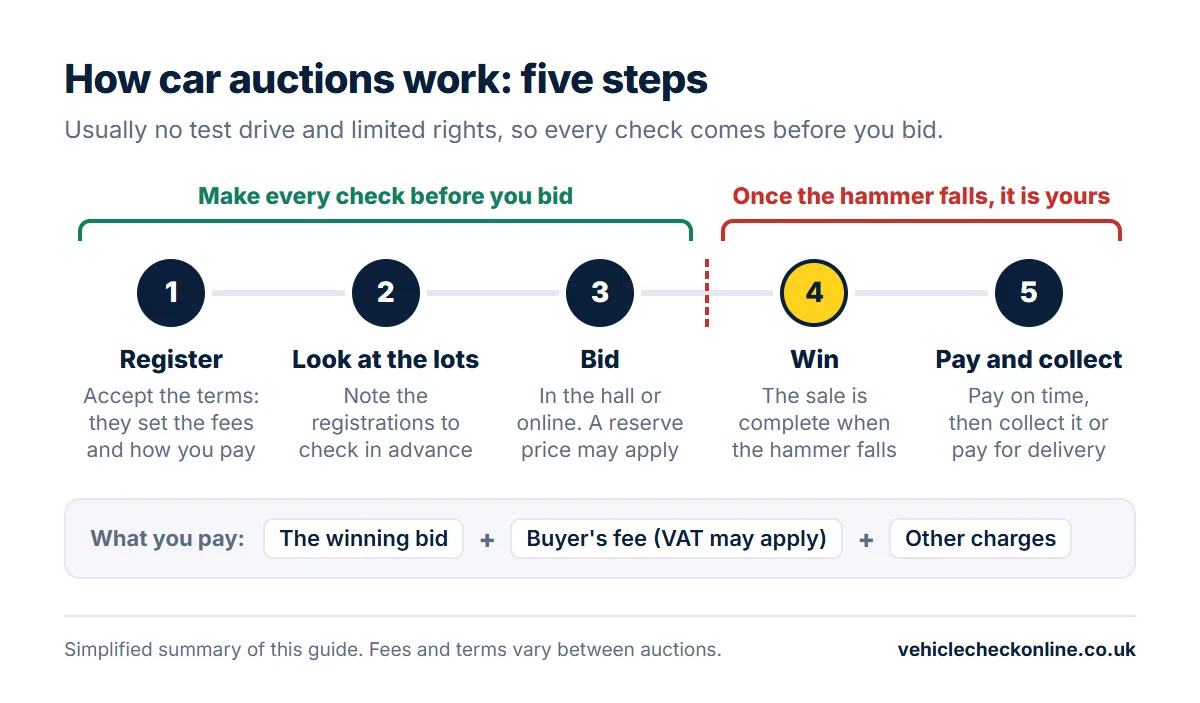
- Register. Most auctions ask you to register before you bid, in person or online, and to accept their terms and conditions. Read them: they set the fees, how and when you pay, and what you can do if the car is not as described.
- Look at the lots. The catalogue describes each car, and you can usually look the cars over before the sale. Note the registrations of the cars you like, so you can check them in advance.
- Bid. Bidding happens in the auction hall, online during a live sale, or on a timed online auction. A seller can set a reserve price, below which the car is not sold.
- Win. Under the Sale of Goods Act 1979, an auction sale is complete when the auctioneer announces it, usually with the fall of the hammer. Until then, you can withdraw a bid; after it, you have bought the car.
- Pay and collect. The terms say how quickly you must pay and what methods are accepted. You usually collect the car yourself, or pay extra for delivery.
What types of car auction are there, and who can buy?
| Type | Who can buy | What is sold |
|---|---|---|
| Public auction | Anyone who registers | Used cars entered by traders, businesses and private sellers |
| Trade-only auction | Motor traders only | Used cars sold to dealers |
| Online auction | Depends on the site | Any of the above, bought without seeing the car in person |
| Salvage auction | Varies: some are open to the public | Cars written off or damaged, sold for repair or for parts |
Check which kind of sale you are looking at before you register. A salvage auction is a different market from a public car auction: many of its cars have been written off by an insurer, and some can never legally go back on the road.
What fees do you pay on top of the hammer price?
The winning bid, the hammer price, is not what you pay. Auctions usually add a buyer's fee, sometimes called the buyer's premium, and VAT may be charged on it. Some add a charge for bidding online, for storage if you do not collect the car on time, or for paperwork.
The fees are set out in the auction's terms or fee list, and they vary between auctions. Work out the total before the sale and set your maximum bid with the fees included, not on top of it.
Then add the cost of getting the car home and on the road: transport if it has no MOT or you are not insured to drive it yet, tax, insurance, and any repairs the car turns out to need.
What are the pros and cons of buying a car at auction?
| Pros | Cons |
|---|---|
| Prices can be lower than at a dealer | Fees are added to the winning bid |
| A wide choice of cars in one place | Test drives are usually not allowed |
| A quick way to buy, with no haggling | Fewer legal rights than buying from a dealer |
| Online bidding saves travelling | Online, you may not see the car before you buy |
| Repairable write-offs at salvage auctions, for people able to repair them | Little or no comeback if the car is faulty |
Auctions suit buyers who know cars, have time to inspect them and can cope with a repair bill. If you need a car you can rely on from day one and want a warranty or the right to return it, a dealer may suit you better.
What are your rights when you buy at auction?
Your rights at auction are limited. Under the Consumer Rights Act 2015, section 2(5), a buyer of second-hand goods at a public auction that individuals can attend in person is not treated as a consumer for most of the Act's rights about goods, such as the right to goods of satisfactory quality. Only a few provisions still apply, such as those on delivery and on information given before the sale.
Citizens Advice says that at auction you are likely not to get the protection you would have buying from a trader, and advises reading the auction's terms and conditions carefully before you bid. In Northern Ireland, nidirect notes that the conditions of sale must be displayed prominently at the auction or in the catalogue.
Online-only sales, which you cannot attend in person, can work differently, so check who is selling and on what terms. Our guide to what "sold as seen" means covers the limits of that phrase. This is general information: for your own case, contact Citizens Advice.
Assume that once the hammer falls, the car and any problems with it are yours. Make every check before you bid.
What can you do with a Cat S, Cat N or Cat B write-off from a salvage auction?
Cars written off by insurers are sold on as salvage, and salvage auctions are one place they end up. What you can do with one depends on its category:
- Cat S and Cat N: repairable after structural (S) or non-structural (N) damage. Each can be used again once repaired to a roadworthy standard. For a Cat S car, the DVLA records the category on the logbook; a car category check shows the others.
- Cat B: the body shell has to be crushed, but other parts can be salvaged. A Cat B car must never go back on the road, so buy one for parts only.
- Cat A: the whole vehicle has to be crushed.
A repaired write-off is only as good as its repair, and an unrepaired one may need more work than it seems from a quick look. Our guide to what Cat S means explains the risks before you take one on.
What should you check on a lot before you bid?
Your inspection at an auction is limited. Test drives are usually not allowed, though you may be able to start the engine. Arrive early, look the car over in good light, and bring someone who knows cars if you are not confident. Then check everything you can by registration, before the sale:
- MOT history: the free MOT history shows every test result, the advisories, the mileage readings and when the current MOT runs out.
- Write-off record: a write-off check shows whether an insurer has written the car off, and in which category, whatever the catalogue says.
- Finance and theft: the Premium report (£7.99) also checks for outstanding finance and a stolen record. A car can reach an auction with either.
- Identity: if the catalogue or the car shows the VIN, compare it with the record and the logbook. Our guide on where to find the VIN shows where to look.
- Mileage: compare the reading on the dashboard with the last MOT reading. A lower figure needs an explanation.
Listen to the auctioneer as well as reading the catalogue: details about the car, such as its mileage, MOT or service history, may be announced as it comes up for sale.
After you win, what paperwork do you need to drive it home?
Before you leave, make sure you know how you will get the logbook. GOV.UK says you need the green "new keeper" slip from the V5C to tax a car you have just bought, and the full logbook should follow in your name. If the auction cannot give you either, read our guide on buying a car without a V5C first.
GOV.UK says to tax the car immediately, and you need insurance before you drive it on the road. Our guide on how to tax a car you have just bought explains the steps.
Check the MOT too. A car that needs one and has none can only be driven to a pre-arranged MOT test or to somewhere it is being repaired, and driving without a valid MOT can bring a fine of up to £1,000. If the car has no MOT, arrange transport or book the test before you collect it.
Questions and answers
Can anyone buy a car at auction?
Anyone can bid at a public auction once registered. Some auctions are open only to motor traders, and salvage auctions vary, so check who can bid before you go.
Can I return a car bought at auction?
Usually not. At a public auction you can attend in person, most of your consumer rights about the condition of second-hand goods do not apply, so it depends on the auction's terms and how the car was described.
Can I withdraw a bid at an auction?
Yes, until the auctioneer announces the sale is complete, usually with the fall of the hammer. Once it has fallen, the sale is complete and you have bought the car.
Do cars at auction come with an MOT?
Some do and some do not. The free MOT history shows whether a car has a current MOT and when it runs out, so you can plan how to get it home before you bid.
Are cars cheaper at auction?
They can be, but the buyer's fee, transport and any repairs come on top of the hammer price. Compare the total cost with what similar cars sell for elsewhere before deciding.
Sources
- Citizens Advice: Buying a used car (auctions)
- legislation.gov.uk: Consumer Rights Act 2015, section 2
- legislation.gov.uk: Sale of Goods Act 1979, section 57 (auction sales)
- GOV.UK: Insurance write-offs
- GOV.UK: Getting an MOT
- nidirect: Buying a new or used car
Related guides
- What does Cat S mean on a car?Cat S means a car was written off after structural damage and can go back on the road once repaired: what the S stands for and how to tell if a car is Cat S.
- What does "sold as seen" mean when you buy a car?Sold as seen means you accept a car as you saw it, faults and all. From a dealer it can't remove your legal rights; from a private seller it has limits too.
- Buying a car without a V5C logbookBuying a car without a V5C logbook is risky and the DVLA advises against it. Why it may be missing, how to register the car, and selling without one.
- Should I buy a Cat S car?Should I buy a Cat S car? When a repaired Cat S is worth it, the repair proof to ask for, whether it needs an inspection or a new MOT, and when to walk away.
This guide is general information for people buying, owning or selling a car in the UK, not legal or financial advice. Vehicle Check Online is an independent service, not affiliated with the DVLA, the DVSA or GOV.UK.