
The V5C and other documents
How to transfer a private number plate, or take it off and keep it
A DVLA number plate change puts a private number on a vehicle, takes it off to keep, or moves it to another vehicle. To transfer a number, you take it off the first vehicle, which costs £80, and assign it to the second, which is free, online or with form V317. Online, each step usually takes effect at once unless the DVLA needs to inspect the vehicle, and new logbooks follow by post.
This guide walks through each kind of change, which vehicles and numbers qualify, how long it all takes, what happens to the car's original number, who you must tell, and what to do about a private plate when you sell.
What are the three kinds of DVLA number plate change?
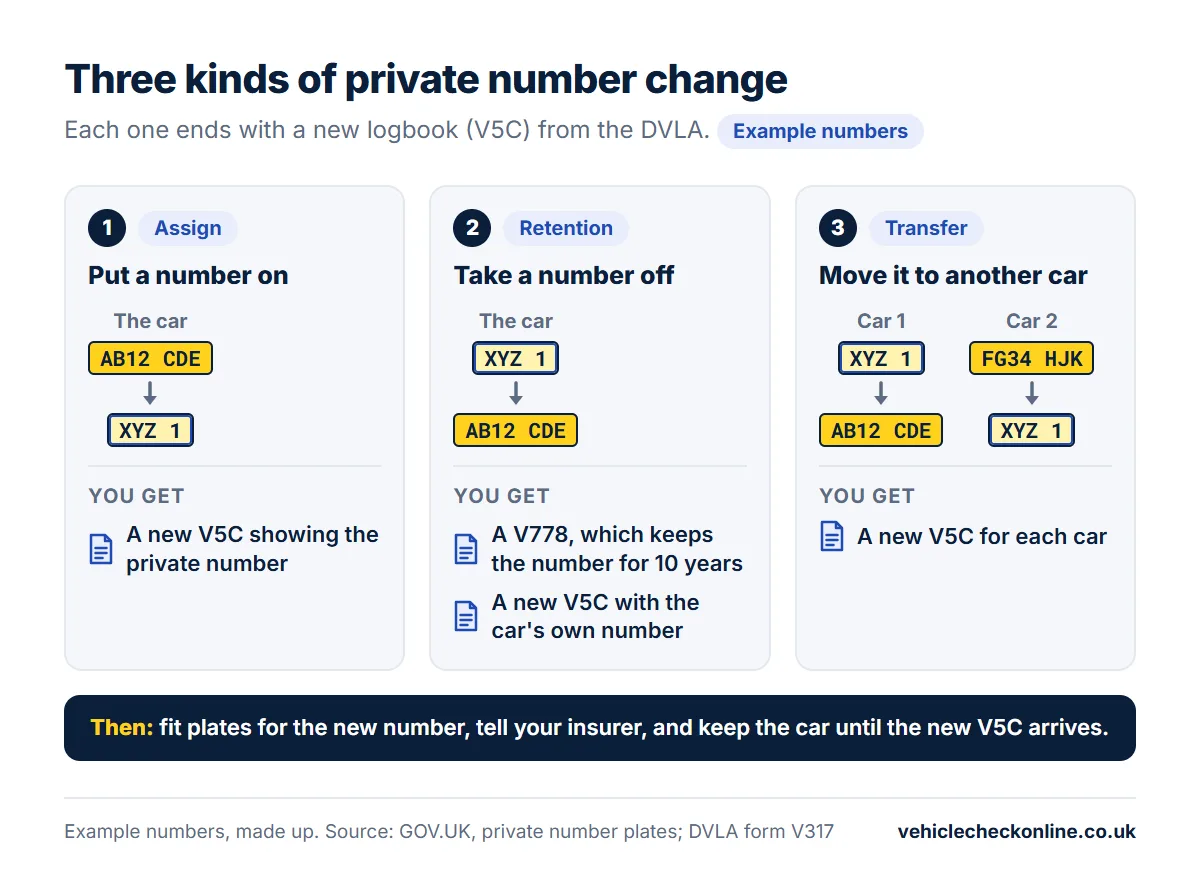
Every private number change is one of three things. GOV.UK calls them assigning, taking off (or retention) and transferring:
| Change | What you need | DVLA fee | What you get |
|---|---|---|---|
| Put a number on (assign) | The V750 or V778 for the number, or the online reference number, and the vehicle's V5C | Free | A new V5C showing the private number |
| Take a number off (retention) | The vehicle's V5C | £80 | A V778 retention document, and a new V5C showing the number the car now carries |
| Move it to another vehicle (transfer) | Both of the above, one after the other | £80 | A new V5C for each vehicle |
Which cars and numbers qualify?
Both the vehicle giving up the number and the one receiving it must meet the DVLA's conditions. Each one must:
- be registered with the DVLA in the UK and able to move under its own power
- be a type that needs an MOT or HGV test certificate, and be available if the DVLA asks to inspect it
- have been taxed or declared off the road (SORN) without a break for the past five years, and be taxed or SORN now; after more than five years of SORN it must be taxed and have an MOT
- have a current MOT if it is a historic vehicle, even though it would normally be exempt
The number has rules too. It must not make the vehicle look newer than it is, which our guide to the number plate age identifier explains. A number starting with Q or QNI cannot be moved, and no private number can go on a Q-registered vehicle.
Check the V5C before you apply: if it says the number is non-transferable, it cannot be transferred or retained. And only the registered keeper, or the person becoming the keeper, can apply to take a number off a vehicle.
How do you put a private number on a car?
Assigning a number is free online or by post. You need the V750 certificate of entitlement if you bought the number, or the V778 retention document if it came off another vehicle. After taking a number off online, the reference number you are given works in place of the V778.
- Check whose name the car is in. It can be registered to you or to the person you are giving the number to. If you have just bought the car, wait until the DVLA sends you a V5C in your name. For a brand new car, give the V750 or V778 to the dealer and ask it to apply.
- Take any private number already on the car off first, or you could lose the right to it.
- Apply. Online, the number is assigned immediately unless the DVLA needs to inspect the car; the service runs from 7am to 9pm on weekdays and to 8pm at weekends. By post, send the completed V750 or V778 with the V5C, naming the other person as the nominee if the number is going on their car.
- Fit the new plates before the car is driven, and keep the old ones: the original number goes back on the car if the private number comes off later.
- Wait for the new V5C before you sell the car or get rid of it.
How do you take a private number off and keep it?
Taking a number off costs £80, online or by post, and you need the vehicle's V5C. If the vehicle is not in your name, you have to apply by post on form V317.
Online, the number comes off immediately unless the vehicle needs an inspection, and the car usually gets its original number back at the same moment. Fit plates showing that number before it is driven, and tell your insurer. The DVLA then posts a new V5C showing the number the car now carries. The change stays on the car's record: a buyer's number plate history check will show the private number and the date it came off.
The V778 retention document goes to you, or to the person the number is held for. It keeps the right to put the number on a vehicle for 10 years. Renewing it is free and you can apply from 28 days before it expires. Miss the expiry date and the right to the number is lost permanently.
How do you transfer a private number plate to another car?
A transfer is the two changes above, one after the other. Online, you can do both in one go:
- Check both cars meet the conditions, and that the number is not marked non-transferable. Our car tax and MOT check shows each car's MOT status and links to its tax record on GOV.UK.
- Deal with the second car's own number. If it already carries a private number, take that off first. Otherwise it is withdrawn when your number goes on, and you lose it.
- Take your number off the first car online, pay the £80 fee and note the reference number you are given.
- Assign it to the second car straight away, using that reference number.
- Fit plates to both cars before they are driven, and tell both insurers.
By post, use option A of form V317, which takes the number off one vehicle and puts it straight onto another. Send it with the V5C for each vehicle and the £80 fee, paid by cheque, banker's draft or postal order.
How long does a private plate transfer take?
Online, the change itself is quick. The paperwork that follows takes longer:
| Step | How long it takes |
|---|---|
| Taking a number off or putting one on, online | Immediately, unless the DVLA needs to inspect the vehicle |
| New V5C after putting a number on | Usually about 4 weeks |
| New V5C after taking a number off | It can take 4 to 6 weeks |
| A postal application on form V317 | The form's notes say the new V5C, and any V778, are sent within 2 weeks of the DVLA receiving it, or up to 4 weeks if you sent a V62 or the vehicle needs an inspection |
If a new V5C has not arrived 4 weeks after you applied, contact the DVLA. If 6 weeks pass and you have not told the DVLA, a replacement V5C costs £25.
What else do you need to update: plates, insurer and other accounts?
A number plate change is not finished when the DVLA approves it:
- Plates. Have them made up by a registered number plate supplier. It will ask for proof of your name and address and a document showing you can use the number, such as the V5C, V750 or V778. GOV.UK warns that plates displayed incorrectly can bring a fine of up to £1,000 and an MOT failure.
- Insurance. You must tell your insurer the new registration. The notes on form V317 warn that your insurance may be invalid if you do not.
- Charging accounts. Update the number on any automatic payment account, such as the Congestion Charge, the Low Emission Zone, the Ultra Low Emission Zone, the Dart Charge or a Clean Air Zone. GOV.UK says you may get a penalty charge if you do not.
How do you sell a car with a private plate?
Decide what happens to the number before you advertise the car. To keep it, GOV.UK says you must apply to take it off before you sell, and you need both the V778 and the new V5C before the car changes hands. Sell earlier and the number passes to the new keeper. Our guide on telling the DVLA you sold your car covers the rest of the sale.
If the number is part of the deal, it simply stays on the car, and the right to it passes to the buyer as the new registered keeper. Say so in the advert and on the receipt.
If you sell the number on its own, through a dealer or privately, never post a photo or scan of the V750 or V778. GOV.UK warns that someone other than your buyer could use it to put the number on another vehicle.
What should you check when buying a car after a plate change?
Wait until the seller holds the new V5C showing the number the car carries now. Our car history check lists each earlier number with the date it changed, and the Premium report (£7.99) adds the outstanding finance, write-off and stolen checks.
A plate change on its own is normal, but the dates should fit the seller's story. Our guide to private plate history explains which patterns are worth asking about.
Can you transfer a plate from a leased, written-off, stolen or exported car?
The DVLA's leaflet INF46 covers the awkward cases:
| Situation | What the DVLA says |
|---|---|
| The car is leased | Only the registered keeper can transfer or retain the number. If that is the leasing company, check it agrees before you put your number on the car. |
| The car is written off | You can still transfer or retain the number if the car is available to inspect. Tell your insurer: if it sells the car as salvage first, the number goes with it. |
| The car is stolen and not recovered | You can apply to keep the number straight away, but no V778 is issued until 6 months after the theft or until the car is recovered. |
| The car is being exported | Transfer or retain the number before the car leaves the UK. You cannot apply once it has gone. |
| The car has been scrapped | Too late: once a vehicle no longer exists, its number is withdrawn. |
Questions and answers
How much does it cost to transfer a private number plate?
The DVLA charges £80 to take a number off a vehicle and nothing to assign it, so moving a number from one car to another costs £80 in DVLA fees. The new number plates are extra.
Can I put my private plate on someone else's car?
Yes. You can assign it to another person's vehicle online or by post, naming them as the nominee on the V750 or V778 if you apply by post. Once the number is on their car, the right to it belongs to that car's registered keeper.
Do I need new number plates after a transfer?
Yes, for both cars. The car receiving the private number needs new plates before it is driven, and the car it came off needs plates showing its original or replacement number.
What happens if I sell my car without taking the private plate off?
The number goes with the car to the new keeper, and you lose the right to it. To keep it, apply to take it off and wait for the V778 and the new V5C before you sell.
How long does a V778 retention document last?
Ten years. Renewing it is free, you can apply from 28 days before it expires, and the right to the number is lost if it has not been renewed by the expiry date.
Can I transfer a private plate to a car I have just bought?
Yes, once the car is registered to you. GOV.UK says to wait until the DVLA has sent you a new V5C in your name before you apply.
Sources
- GOV.UK: Private (personalised) number plates
- GOV.UK: Take a private number off a vehicle
- GOV.UK: Assign a private number to a vehicle
- DVLA: Form V317, keep a registration number and put it on another vehicle
- DVLA: INF46, registration numbers and you
- GOV.UK: Selling a vehicle
Related guides
- Private plate history: how to see a car's old number platesHow to check if a car has had a private plate: read the age identifier, compare the paperwork, and see the full number plate change history in a report.
- Number plate year check: how to read UK age identifiersHow to read the number plate age identifier, with every UK number plate year since 2001, the older styles and the plates that do not show a car's age.
- What is a Q plate car? The Q registration explainedQ plate meaning: why the DVLA gives a car a Q registration, and should you buy one? Insurance, finance, resale and the checks to make before you pay.
- Sold your car? How to tell the DVLA and what else to doUse GOV.UK's "Tell DVLA you've sold, transferred or bought a vehicle" service: what you need, the steps, selling to the trade, posting the V5C, and your refund.
This guide is general information for people buying, owning or selling a car in the UK, not legal or financial advice. Vehicle Check Online is an independent service, not affiliated with the DVLA, the DVSA or GOV.UK.