
Car finance
Car finance claims: who qualifies and how to claim
A car finance claim is a complaint to your lender that you were not told about commission, or a tie, between the lender and the dealer or broker who arranged your finance. The FCA's compensation scheme covers car, van and motorbike finance taken out between 6 April 2007 and 1 November 2024, including PCP. Claiming is free, but lenders do not have to pay under the scheme until a legal challenge to it is decided.
This guide explains who the scheme covers, how to claim without a claims company, what the Supreme Court decided, how compensation is worked out and where things stand after the FCA's update of 3 November 2026. It is general information, not legal or financial advice, and we do not handle claims.
Who can make a car finance claim?
The scheme looks at motor finance where the lender paid commission to the broker, usually the dealer, who arranged the loan. You may be owed compensation if you took the finance out between 6 April 2007 and 1 November 2024 and were not properly told about at least one of three arrangements:
- Discretionary commission: the broker could raise the interest rate you paid to earn more commission. The Financial Ombudsman notes that the FCA banned them in January 2021.
- High commission: commission of at least 39% of the total cost of credit (the interest and charges) and 10% of the loan.
- A contractual tie: the broker used only one lender, or gave one lender first refusal on your loan. A tie does not count where there were visible links between the lender, the manufacturer and a franchised dealer, such as a shared or similar name.
The FCA estimates that around 12.1 million agreements, 37% of those made in the period, are eligible. Even inside the dates, an agreement is treated as fair if the commission was £120 or less (agreements before 1 April 2014) or £150 or less (from that date), or if you were charged no interest.
| Not covered by the scheme | Why, or what to do instead |
|---|---|
| Leasing on personal contract hire (PCH) | Complain to the finance company in the usual way |
| A complaint already decided by the Ombudsman or a court, or already compensated | It cannot be considered again under the scheme |
| A high-value loan, larger than 99.5% of that year's loans | Complain to the lender in the usual way, then to the Ombudsman |
| Over £25,000, if made before 6 April 2008 or for business purposes | Before April 2008, loans over £25,000 were unregulated |
Are PCP car finance claims covered?
Yes. The FCA says the scheme includes hire purchase agreements such as personal contract purchase, so PCP car finance claims are assessed like any other: what matters is the commission arrangement and what you were told, not the type of finance.
A finished agreement still counts: under the Consumer Credit Act 1974, a relationship can be found unfair after it has ended, so a car returned or paid off years ago is not ruled out.
What did the Supreme Court decide in August 2025?
On 1 August 2025, the Supreme Court ruled on three linked hire purchase cases about commission that lenders paid to car dealers. It held that a dealer arranging finance does not owe the customer the "single-minded loyalty" of a fiduciary, so the claims against the lenders for bribery and secret profits failed, reversing the Court of Appeal's ruling of 25 October 2024 on those points.
In one of the cases, though, the court found the relationship between the customer and the lender unfair under section 140A of the Consumer Credit Act 1974. The undisclosed commission was 25% of the loan and 55% of the total charge for credit, the paperwork did not reveal a tie that gave the lender first refusal, and the customer was commercially unsophisticated. The lender had to pay the commission back with interest.
The court added that not disclosing commission does not make a relationship unfair by itself: it is one factor in a test that depends on the facts. On 3 August 2025 the FCA said it would consult on an industry-wide scheme, and on 30 March 2026 it confirmed the final rules. The unfair relationship test has applied since 6 April 2007, and the FCA says lenders owe liabilities from that date, which is why the scheme starts there.
How do you make a car finance claim?
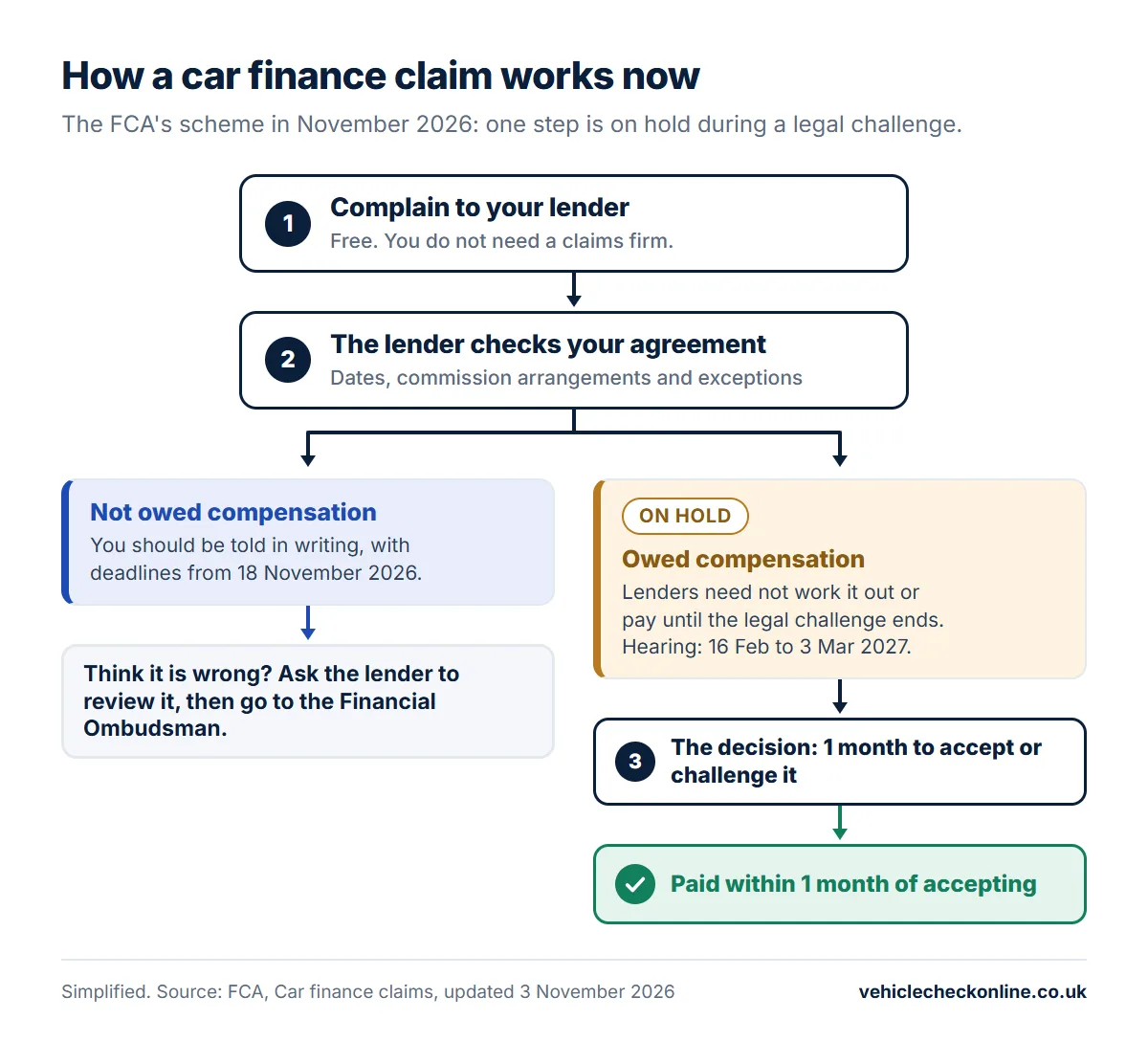
The FCA says the best step, if you are concerned, is to complain directly to your lender. It costs nothing:
- Find your lender. Look at old bank statements, ask the dealer that sold you the car, or check your credit file, which you can get free from the credit reference agencies.
- Complain to the lender. The FCA's list of lenders gives contact details for each, with a template letter or a link to the lender's complaint form.
- Wait for the lender's answer. It must tell you whether you are owed compensation and how much; if you are owed money, the timing depends on the legal challenge below.
- Reply within one month. You can accept the lender's decision or challenge it. If you are still unhappy with its final decision, called a redress determination, you can go to the Financial Ombudsman Service, free, by the date given in that letter.
- Get paid. Once you accept, the lender has one month to pay you.
The Ombudsman asks people to wait for their lender's answer before contacting it. For a case under the scheme, it can only check whether the lender followed the scheme rules, so explain why you think it did not. Complaints it received before 30 March 2026 are not affected by the scheme.
You should never be asked for a fee to receive compensation. Genuine messages from your lender under the scheme carry a unique reference number and the correct details of your agreement; the FCA warns of scammers posing as lenders or as the FCA.
Where does the compensation scheme stand now?
The FCA announced on 1 May 2026 that the scheme faced four legal challenges, three of them from lenders. On 2 July 2026 the Upper Tribunal suspended parts of it, and the hearing is listed for 16 February to 3 March 2027, with a judgment expected in the following months.
Until the legal process ends, lenders do not have to calculate or pay compensation under the scheme. If it is upheld and the judgment is not appealed, the FCA expects payments to begin in 2027. If it is overturned in whole or in part, the FCA will decide what to do next; it has warned that a revised scheme could delay compensation to 2028 or beyond, and that it may instead tell lenders to resolve complaints individually within eight weeks.
If you are not owed compensation, your lender should still tell you by these dates, unless it thinks your complaint is out of time, or your complaint is about a tie it says was visible. Not hearing by then does not necessarily mean you are owed money.
| Your agreement began | You complained by | A "not owed" letter is due by |
|---|---|---|
| On or after 1 April 2014 | 30 June 2026 | 18 November 2026 |
| Before 1 April 2014 | 31 August 2026 | 18 January 2027 |
| Either | A later date | Within 5 months of your complaint |
Some lenders may make settlement offers before the challenge is decided. The FCA says an offer should not be less than you would get through the scheme. If you accept, you keep the money whatever happens next, but you cannot claim more later or ask the Ombudsman to review the offer. If you turn it down, the lender must still tell you later whether you are owed compensation.
How much compensation could you get?
The FCA estimates that people who receive compensation will get around £830 per agreement on average. In the most serious cases, those closest to the case the Supreme Court decided (an undisclosed tie or discretionary commission, with commission of at least 50% of the total cost of credit and 22.5% of the loan), people get back all the commission paid, plus interest.
For most people, compensation is the average of two figures, plus interest: the commission paid, and an estimate of what they overpaid. That estimate is a discount on the interest rate: 17% for agreements from April 2014 and 21% for earlier ones. Interest is added at the annual average Bank of England base rate plus 1%, and at least 3% in any year.
In about 1 in 3 cases the amount is capped, for example at 90% of the commission plus interest. If your interest rate was among the lowest 5% on offer at the time, excluding 0% deals, you will not receive compensation. Car finance is not covered by the Financial Services Compensation Scheme, so if a lender goes out of business you may get nothing.
Do you need a claims company or a solicitor?
No. The FCA says you do not need a claims management company (CMC) or a law firm to take part in the scheme or to find out whether you are eligible. If you sign up with one, you may pay up to 36% of any compensation in fees, including VAT.
For financial services claims started on or after 1 March 2022, the FCA caps what an authorised CMC can charge:
| Compensation awarded | Most a CMC can take (before VAT) | Largest fee, with VAT |
|---|---|---|
| £1 to £1,499 | 30% | £504 |
| £1,500 to £9,999 | 28% | £3,000 |
| £10,000 to £24,999 | 25% | £6,000 |
| £25,000 to £49,999 | 20% | £9,000 |
| £50,000 or more | 15% | £12,000 |
The cap does not apply if you go to court with a CMC. An authorised CMC must offer a 14-day cooling-off period; if you leave after that, any fee must be reasonable and reflect the work done, and the FCA notes that most car finance claims are still at an early stage.
Do not sign up with more than one firm: you may pay several fees, and it can delay your compensation. To complain about a firm, go to it first; after eight weeks, or if you are unhappy with its answer, a law firm complaint goes to the Legal Ombudsman and a CMC complaint to the Claims Management Ombudsman.
You can also take your claim to court; the FCA suggests thinking about independent legal advice first. It says the scheme is likely to be simpler and more certain, and that after legal fees you could end up with less.
Is a mis sold car finance claim the same thing?
Not always. Many car finance complaints get called mis-selling, but the FCA scheme deals only with commission and ties that were not properly disclosed. The Financial Ombudsman also handles complaints that the car or the finance was mis-sold or mis-described, that the car was faulty, that the agreement was unaffordable, or about charges at the end of an agreement.
A mis sold car finance claim of that kind follows the usual route: complain to the lender first and, if it has not sent a final response within eight weeks or you disagree with it, take it to the Ombudsman for free. Our guide to no deposit car finance explains the affordability checks lenders must make before they lend.
Does a claim change anything about your car?
A claim is about how the finance was sold, not about the car. If you are still paying and your lender makes a settlement offer, the FCA says it may pay only what is left after taking off the payments you still owe, which it calls set-off.
On hire purchase or PCP, the finance company owns the car until everything is paid, including any final payment, so the finance has to be settled before you sell. Our guide on how to sell a car with outstanding finance explains how.
If you are buying another used car, it may still carry the previous owner's finance. Our outstanding finance check shows whether a finance agreement is recorded against it, with the finance company and agreement type the lender registered. It is part of the Premium report, £7.99, with the write-off and stolen checks.
Questions and answers
Is there a deadline for a car finance claim?
The FCA's advice is to complain now if you are concerned. Claims are generally limited to six years from the end of the agreement, but that may be extended where information about commission or a tie was deliberately concealed, and the FCA does not expect lenders to routinely find cases out of time.
Do I need my old paperwork to make a claim?
Not to start. You can find your lender from old bank statements, the dealer or your credit file, and lenders must gather the details of commission arrangements themselves, including from brokers.
Will my lender contact me if I have not complained?
Under the scheme rules, lenders contact people who have not complained only if they may be owed money, and those invitations are on hold during the legal challenge. If you are concerned, the FCA's advice is to complain to your lender now.
Can I claim on someone else's car finance?
Only the people who were party to the agreement can claim, though a relative, friend or professional can act for them with their authority. If a borrower has died, their beneficiaries may be able to claim.
What if I signed up with more than one claims company?
Decide which one, if any, you want to act for you and tell your lender; you can also tell it you do not want anyone to represent you. The FCA warns that several representatives can mean several fees and a longer wait.
Sources
- FCA: Car finance claims (updated 3 November 2026)
- FCA: PS26/3, Motor finance consumer redress scheme (March 2026)
- UK Supreme Court: judgment of 1 August 2025 on motor finance commission, [2025] UKSC 33
- legislation.gov.uk: Consumer Credit Act 1974, section 140A (unfair relationships)
- Financial Ombudsman Service: Complaints about car finance commission
- FCA: Using claims management companies (fee caps)
Related guides
- How does no deposit car finance work?No deposit car finance explained: HP, PCP and loans with nothing upfront, what a deposit changes, your rights and what to check before you sign for a used car.
- Can I sell my car with finance on it?How to sell a car with outstanding finance: why the lender is paid first, how to get a settlement figure, selling to a dealer or privately, and handing it back.
- What is a finance marker on a car?A finance marker shows a lender still has an interest in a car. What it means when you buy, and how removal works after the finance is paid off.
- Buying a car with outstanding finance: what the law saysBuying a car with outstanding finance? What the Hire Purchase Act 1964 says about private buyers, who it does not protect, and what to do if the lender calls.
This guide is general information for people buying, owning or selling a car in the UK, not legal or financial advice. Vehicle Check Online is an independent service, not affiliated with the DVLA, the DVSA or GOV.UK.