
The V5C and other documents
Where is the document reference number on a V5C?
The V5C document reference number is the 11-digit number printed on the front of your logbook, near the top. You use it to tax the car, make a SORN, tell the DVLA you have sold the car or change your address online. Always use the number on your latest V5C, and keep it to yourself.
This guide explains what a V5C is, and why it does not prove who owns a car, then exactly where the number is, what it is used for, how it differs from the 12-digit number on the new keeper slip, and what to do if you have lost the logbook.
What is a V5C?
The V5C, or vehicle registration certificate, is the document that registers a vehicle with the DVLA. Most people call it the logbook. It records the car's details, such as the date it was first registered, the make, the colour and the engine size, and it names the registered keeper: the person responsible for the car, including taxing it.
GOV.UK refers to two designs: a newer one with multi-coloured numbered blocks on its front cover, and an older style without them. It tells you to fill in different sections depending on which one you hold, but both carry a document reference number.
Is the V5C proof of ownership?
No. When the government announced a redesigned V5C in 2010, it said that buyers often mistakenly believe the V5C to be proof of ownership of a vehicle, and that this is not the case. The new certificate was made to say so on its front.
The keeper and the owner can be different people. DVSA puts it simply: the registered keeper is the person responsible for taxing the vehicle, not necessarily the person with a legal claim to ownership.
At the same time, the DVLA advised buyers to ask for proof of ownership, such as a bill of sale, and to check whether the car has outstanding finance, because that could affect their rights to it. An outstanding finance check shows whether a finance agreement is recorded against the car.
What is the V5C document reference number?
It is an 11-digit number printed on the logbook itself. It is not the registration number and not the VIN: GOV.UK's services ask for the number from the latest V5C, so it points to the current logbook rather than to the car.
With it, the keeper can deal with the car's record online. That is also why GOV.UK warns that the number, like photos or copies of the logbook, could be used by someone else to get a fraudulent copy of your logbook. Treat it like a password.
Where is the document reference number on the V5C?
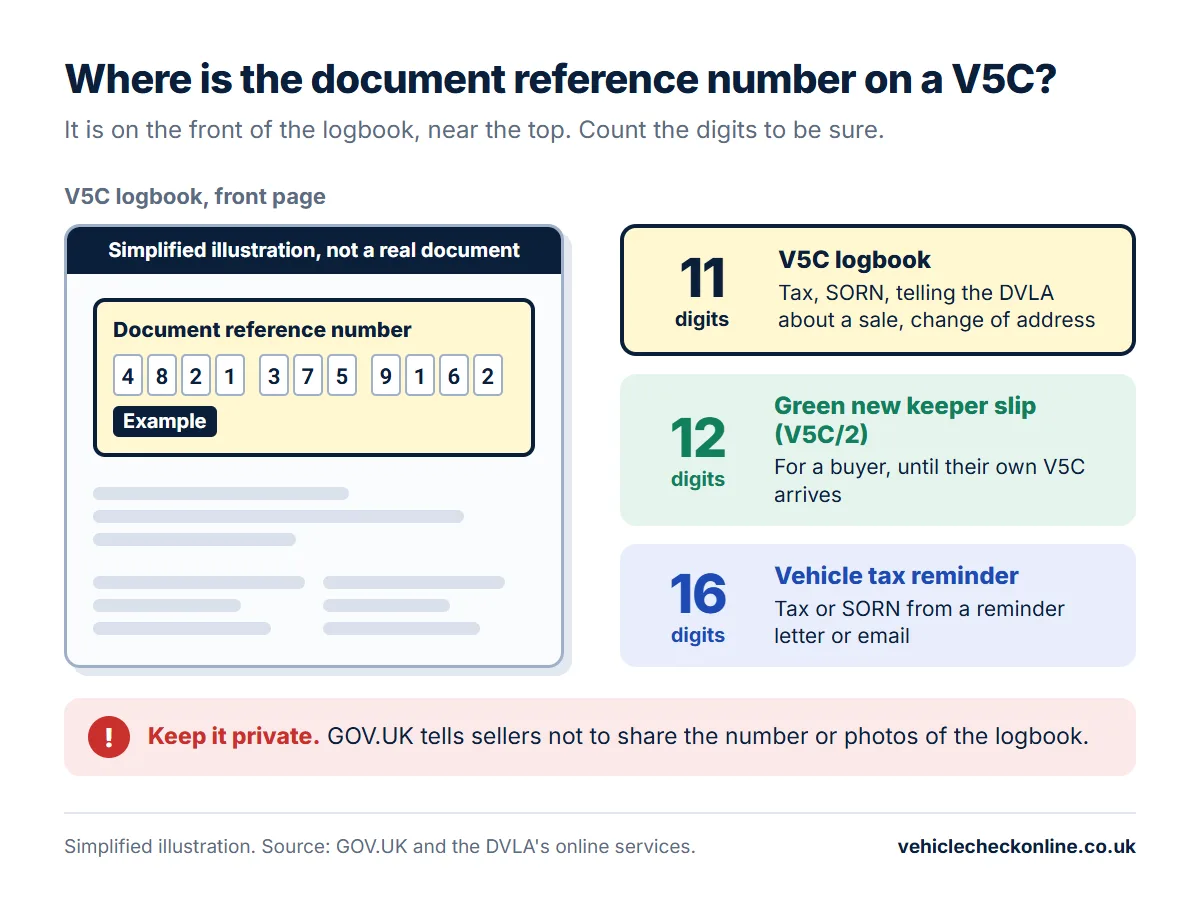
It is on the front of the V5C, near the top, labelled as the document reference number. The DVLA's own online services point you there: the SORN service, for example, says the V5C document reference number can be found on the front of your V5C.
Count the digits before you type it in. The logbook's number has 11. If the number in front of you has 12 digits, you are probably holding the green new keeper slip (V5C/2), which has its own reference on its front. A 16-digit number comes from a vehicle tax reminder.
You may also find an 11-digit reference in the yellow section of the logbook used when selling to the motor trade. GOV.UK asks for that one when you tell the DVLA that an insurer has written off and scrapped your car.
The serial number is something else again. It is printed in letters and digits, and it is the number GOV.UK tells buyers to compare with the ranges of stolen blank logbooks. Our guide on checking a V5C is genuine covers that check.
What is the document reference number used for?
These are the everyday jobs where GOV.UK asks for a reference number, and which one it wants:
| What you want to do | The number GOV.UK asks for |
|---|---|
| Tax the car online as its current keeper | 11 digits, from your V5C |
| Tax a car you have just bought | 12 digits, from the green new keeper slip |
| Make a SORN online | 11 digits from the V5C, or 16 from a tax reminder |
| Tell the DVLA you have sold the car | 11 digits, from the latest V5C |
| Change your address on the V5C online | The reference from the latest V5C |
| See where each MOT test was done (England, Scotland and Wales) | 11 digits, from the V5C |
| See the car's current tax rate on the vehicle enquiry service | 11 digits, from the V5C |
You do not need the number just to look a car up. GOV.UK's free tax and MOT checks work from the registration alone; the reference unlocks the extra details, such as the tax rate and where each test was done.
Why does the number change with each new V5C?
The DVLA issues a new logbook after a change of keeper, a change of name or address, a change to the car's details, a private number going on or coming off, and to replace a lost one. Its services ask for the number from the latest V5C, so once a new logbook reaches you, the number printed on it is the one to use.
That matters in two situations. A seller needs the number from the latest logbook to tell the DVLA about a sale online. And if your tax is due within the next 4 weeks, GOV.UK says to tax the car using your current V5C before you change your address online.
Is it the same as the 12-digit number on the new keeper slip?
The green new keeper slip (V5C/2) is the part of the logbook the seller hands to the buyer. It carries its own 12-digit reference on the front, and that is the number a new keeper uses to tax the car, or make a SORN, before a V5C in their name arrives.
So as a buyer you do not need the seller's 11-digit number at all. If a seller offers to read it out instead of giving you the slip, ask for the slip. Once your own V5C arrives, the slip has done its job, and you use the 11-digit number on your new logbook from then on.
If the slip has gone missing, our guide to a lost new keeper slip explains how to tax and register the car without it.
Should you keep the document reference number private?
GOV.UK's advice to sellers is that a buyer may look at the logbook to make sure its details match the car, but the document reference number should not be shared, and neither should photos or copies of the logbook. In the wrong hands they could be used to get a fraudulent copy of your logbook, which puts the car at risk of being stolen or cloned.
- Show the logbook in person at the viewing, rather than sending pictures of it.
- Keep the logbook out of the photos when you advertise the car.
- When you sell, hand over the green slip only, and tell the DVLA yourself.
What if you have lost your V5C?
Without the logbook you have no document reference number, but you can still deal with the DVLA. If you are the registered keeper and nothing has changed, you can get a replacement V5C online or by phone with the registration number, the VIN and the name and postcode on the logbook. It usually costs £25 and arrives within 5 to 7 working days, and you can tax the car online at the same time.
To tax the car without the logbook, a recent vehicle tax reminder works too: GOV.UK's tax service accepts the reference on it, and its SORN service takes the 16-digit number from it.
For how long each kind of new logbook takes, see how long a V5C takes.
Can you check a car without the reference number?
You do not need anyone's document reference number to check a car's basic status. GOV.UK's free vehicle enquiry shows from the registration alone whether the car is taxed and when the tax runs out. Our car tax and MOT check shows its MOT status and MOT history, with the make, model and colour on record to compare with the logbook you are shown.
Our Premium report adds the full VIN on record, so you can compare it with the logbook and the car, together with the finance, write-off and stolen checks. A sample report shows what you get.
Questions and answers
How many digits is the V5C document reference number?
Eleven. The green new keeper slip has a 12-digit reference and a vehicle tax reminder a 16-digit one, so counting the digits tells you which document a number came from.
Is the document reference number the same as the V5C serial number?
No. The serial number is a mix of letters and digits, and it is the one to compare with the ranges of stolen blank logbooks that GOV.UK lists. The document reference number is made of 11 digits and is the one GOV.UK services ask for.
How do I find my V5C number?
Look on the front of your logbook, near the top: the document reference number has 11 digits. Do not confuse it with the serial number, which mixes letters and digits, or with the 12-digit number on the green new keeper slip.
Can I find my V5C document reference number online?
The number is printed on the logbook, and GOV.UK services ask you to enter it from there. If the logbook is lost, the registered keeper can apply for a replacement online with the registration number, the VIN and the name and postcode on the logbook.
Should I give a buyer my V5C document reference number?
No. GOV.UK tells sellers not to share it, or photos or copies of the logbook, because they could be used to get a fraudulent copy. Show the logbook in person, and give the buyer the green new keeper slip when you sell.
Which number do I use after moving house?
Changing your address gets you a new logbook, and from then on GOV.UK services want the number printed on that latest V5C. If your tax is due within 4 weeks, tax the car before you change the address online.
Sources
- DVLA SORN service: where to find the V5C and V5C/2 reference numbers
- GOV.UK: Tax your vehicle without a vehicle tax reminder (11 and 12-digit numbers)
- GOV.UK: Selling a vehicle (protect your log book)
- GOV.UK: The re-designed vehicle registration certificate, 2010 (not proof of ownership)
- DVSA Safe Driving for Life: The V5C, what it is and why it is important
Related guides
- How to check a V5C logbook is genuineHow to check a V5C is genuine: the DVL watermark, the serial number and the stolen V5C serial numbers, and the VIN and keeper details to match.
- How to tax a car you have just boughtHow to tax a car you just bought: the tax does not transfer with the car. What you need, the V5C/2 green slip, the steps, and what to do without a slip.
- How long does a new V5C take to arrive?How long does a V5C take? The DVLA's timescale for each change, the date to chase it before a £25 fee applies, and how to tax and drive while you wait.
- Lost the new keeper slip? What to do nextLost the new keeper slip (V5C/2)? You cannot tax the car until a V5C in your name arrives. What to do, the form V62 route, and what the seller should do.
This guide is general information for people buying, owning or selling a car in the UK, not legal or financial advice. Vehicle Check Online is an independent service, not affiliated with the DVLA, the DVSA or GOV.UK.