
MOT, servicing and condition
When should a cambelt be changed?
There is no single cambelt change interval. The manufacturer sets one for each engine, as a mileage and an age, and the belt should be changed at whichever comes first. You will find it in the handbook or service schedule, and a garage can check whether the maker has revised it since. Some engines have a timing chain instead, which is meant to last the life of the engine.
This guide explains what the cambelt does and how it differs from a timing chain, why a broken belt is so expensive, how to work out when a particular car is due, what makes the job cost more or less, and what proof to ask for when you buy a used car.
What does a cambelt do?
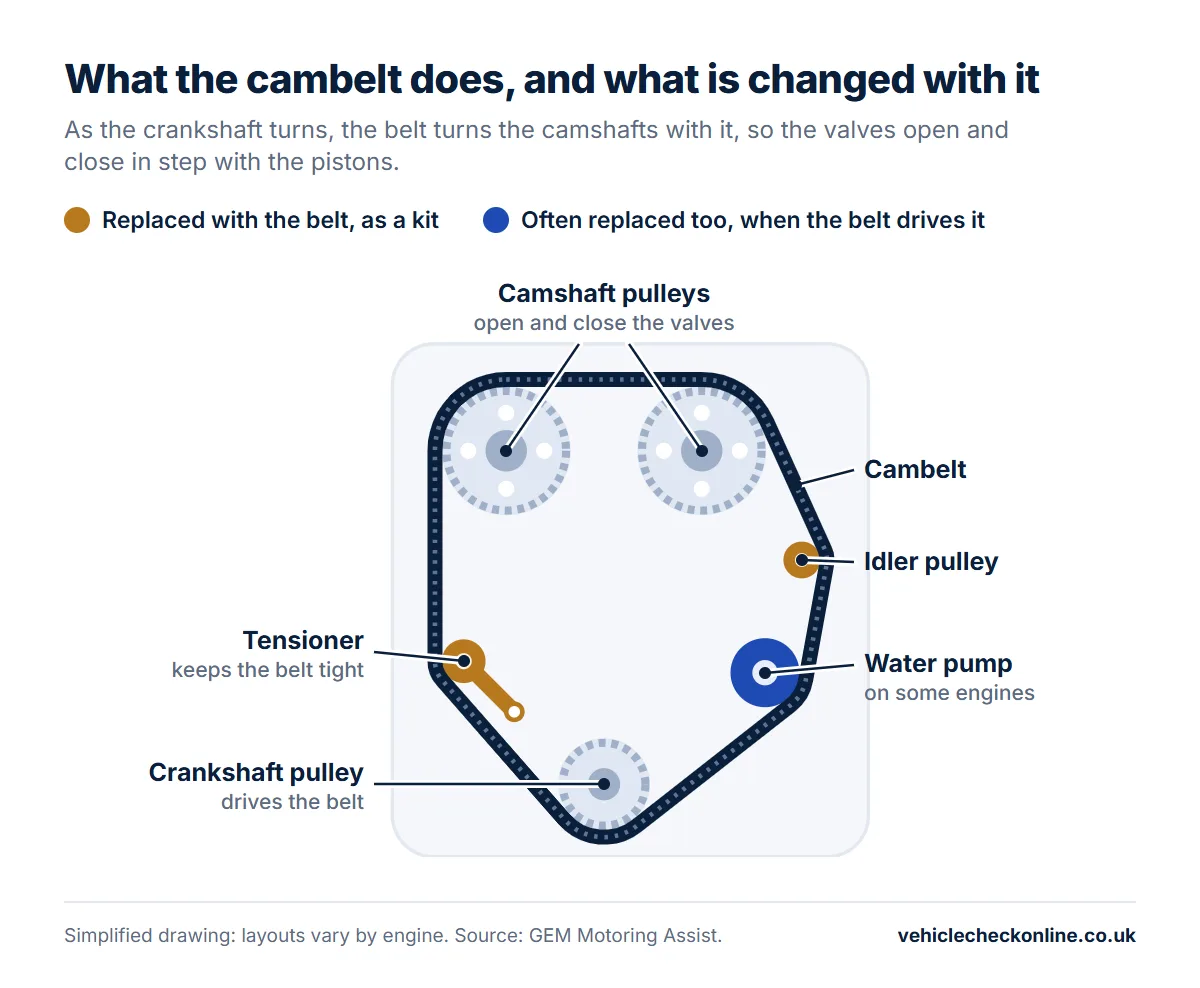
The cambelt, also called the timing belt, is a toothed rubber belt that links the crankshaft at the bottom of the engine to the camshaft or camshafts at the top. As the crankshaft turns, the belt turns the camshafts, which open and close the valves, so every valve moves in step with the pistons.
The belt runs around toothed pulleys, kept tight by a tensioner and guided by one or more idler pulleys, behind a cover on the outside of the engine. On some engines it also drives the water pump, which matters when the time comes to change it.
Cambelt or timing chain: which does your car have?
Not every engine has a cambelt. Some have a timing chain, which does the same job from inside the engine. The two need different care:
| What differs | Cambelt (timing belt) | Timing chain |
|---|---|---|
| Made of | Toothed rubber, reinforced with fibres | Steel links, like a bicycle chain |
| Where it runs | Outside the engine, behind a cover | Inside the engine, relying on clean oil |
| How long it lasts | Until the maker's limit in miles or years | Meant to last the life of the engine, but not always |
| Warning before it fails | Very little | Often a rattle at idle, worst just after a cold start |
| What shortens its life | Age as well as miles, and stop-start driving | Missed or neglected oil changes |
A third design, used on certain Ford and Stellantis group engines among others, is the "wet" belt: it runs inside the engine and is lubricated by the engine oil, which is why it is also called belt-in-oil. It must be replaced with the right type of belt, never a conventional one, and neglected oil changes shorten its life.
To find out which your car has, look in the handbook or service schedule, or ask a garage or a franchised dealer for the make.
What happens if a cambelt snaps?
When a cambelt breaks, the engine usually stops at once. What happens inside depends on its design. In an interference engine, the valves and the pistons can strike each other once the belt no longer holds them in step. In a non-interference engine they should not collide, but the car still has to be recovered and the belt replaced.
GEM Motoring Assist, a road safety organisation, says the usual result of a broken belt or chain is a ruined engine and a very large repair bill. Set against that, a planned change on time is the cheaper option.
A cambelt tends to give very little notice before it fails. Treat the maker's interval as a deadline, not a rough guide, and do not put a change off to save money.
When should you change a timing belt?
The manufacturer gives two limits for each engine, a number of miles and a number of years, and the belt is due when the first of them is reached. Age counts as well as distance, because a belt degrades over time and wears faster in stop-start driving.
The figures vary widely between engines. GEM puts the range at anything from four years or 60,000 miles to ten years or 150,000 miles, so a figure that suits one car can be badly wrong for another. Always use the one for the exact engine.
A belt can also be due sooner than the handbook suggests:
- Mostly short or urban journeys. Some makers set a shorter interval for cars used mainly in town, and GEM advises an earlier change for cars driven mostly at low speed.
- A revised interval. Some makers have shortened their original intervals after belts failed early, so ask a garage whether the figure in an older handbook still stands.
- Worn parts around it. A failing tensioner, idler pulley, water pump or auxiliary belt can break the cambelt, which is one reason they are replaced together.
GEM adds that many garages recommend changing a belt before the official interval, because some belts have failed before reaching it. If your car is close to its limit, there is little to gain by waiting.
How do you find the cambelt interval for your car?
- Find out whether the engine has a cambelt, a timing chain or a wet belt.
- Look up the interval in the handbook or the service schedule. It is given as a mileage and an age.
- Ask a garage or a franchised dealer whether the maker has changed it since, and whether a shorter interval applies to the way the car is used.
- Find the date and the mileage of the last change on its invoice.
- Add the interval to both, and plan the next change for whichever date or mileage comes first.
With no record of a change at all, the safe assumption is that the belt is as old as the car. The month of first registration, which our free car tax check shows for any car, tells you how old that is.
What affects the cost of a timing belt change in the UK?
There is no price that holds for every car. What you pay depends on:
- The engine and how easy the belt is to reach. The time the job takes depends on how much has to come off to get at the belt, and labour is charged at the garage's rate.
- The parts in the kit. The belt should be changed as a kit with its tensioner and idler pulleys. If the belt drives the water pump, a garage will usually recommend a new pump at the same time, and not every kit includes one. Auxiliary belts are often renewed too.
- The type of parts. Parts from the car maker and parts from other suppliers are priced differently.
- The garage and the area. Labour rates differ from one garage to another and from one part of the country to another.
- Belt or chain. GEM says replacing a timing chain usually costs more than a belt change, especially if the engine has to come out to reach it.
Get written quotes from two or three garages for the exact engine, listing the same parts, so you compare like with like. Ask for a quote rather than an estimate: Citizens Advice explains that a quote is a promise to do the work at an agreed price and should say what will be done, while an estimate is only the garage's best guess.
What proves the cambelt was changed on a used car?
On a car with a cambelt, ask when it was last changed before you talk about price. If a change is due soon, its cost comes with the car.
The proof that counts is the invoice. It should show the date, the mileage, the registration, the garage and what was fitted: the belt kit, and the water pump if it was replaced. A service-book stamp that only says "cambelt" tells you much less. Our guide on how to check service history explains how to confirm an entry with the garage that made it.
Some belt kits come with a sticker for the garage to fill in with the date and mileage and fix inside the engine bay. It is a useful clue, but treat it as a pointer to the invoice rather than proof on its own.
Then check the invoice against the car's own records. The mileage it gives should fit between the readings taken at the MOT tests before and after the work, which you can see on our free MOT history.
Be most careful with an older car that has covered few miles: its mileage may be nowhere near the limit while its age is well past it. If there is no proof of a change, price the work into your offer or ask the seller to have it done first. Our guide to buying a car with no service history explains how to weigh missing records.
What can you do if a new cambelt fails?
Keep the invoice for as long as you own the car, and pass it on when you sell. If the belt or one of the parts fitted with it fails soon after the work, contact the garage in writing straight away.
Citizens Advice says that if a garage's work was not done with reasonable skill and care, you have the right to have it done again or to get a price reduction, and suggests a second opinion from another garage. If the garage belongs to a trade body such as The Motor Ombudsman, that body may help settle the dispute free. This is general information, not legal advice: Citizens Advice, or Consumerline in Northern Ireland, can explain your options.
Questions and answers
Does the MOT check the cambelt?
No. The condition of the engine is outside the scope of the MOT, and the belt sits behind a cover, so a pass tells you nothing about when it was last changed.
Should the water pump be changed with the cambelt?
If the belt drives the water pump, garages usually recommend replacing the pump at the same time, as it sits in the same area. Not every belt kit includes one, so check what the quote covers.
How long does a cambelt last on a car that is rarely driven?
Only until the maker's age limit. A belt degrades over time whether or not the car is used, so a low-mileage car still needs a new one when the years run out.
Do timing chains ever need replacing?
They are meant to last the life of the engine, but they can wear, especially if oil changes were missed. A rattle at idle just after a cold start is the usual sign, so have it checked by a garage.
Can you drive a car with a broken cambelt?
No. The engine stops when the belt breaks and cannot run until it is repaired, so the car has to be recovered to a garage.
What is a wet cambelt?
A belt that runs inside the engine and is lubricated by the engine oil, used on some Ford and Stellantis engines among others. It must be replaced with the correct type of belt, and regular oil changes matter for its life.
Sources
- GEM Motoring Assist: What is my timing belt interval? (2024)
- GEM Motoring Assist: Timing belts vs timing chains (2025)
- Carbuyer: What is a cambelt change and does your car need one?
- GOV.UK: Getting an MOT, how the MOT test works
- Citizens Advice: Problem with a car repair
Related guides
- How to check a car's service historyHow to check the service history of a car: there is no free government lookup, so here is how to verify the service book, digital records and invoices.
- Buying a car with no service history: what to check firstBuying a car with no service history? How to judge the risk from the MOT and mileage records, what to assume is due, the price, and what to do after.
- Used car checklist: what to check before you buyWhat to check when buying a used car, in order: the records, V5C and VIN, bodywork, tyres, engine, interior, test drive and seller, and what each sign means.
This guide is general information for people buying, owning or selling a car in the UK, not legal or financial advice. Vehicle Check Online is an independent service, not affiliated with the DVLA, the DVSA or GOV.UK.